
Chef Juliette
John Dory (St. Pierre)
John Dory has the delicacy of sole and the firmness of turbot. A light flouring, a quick butter sauté, and nut-brown beurre noisette show exactly why looks never mattered.
A cooking platform built around craft, culture, and the stories behind what we eat.
Created by Chef Juliette
Based on No. 890, Filets de Soles New-burg, from Le Guide Culinaire (1907) by Auguste Escoffier
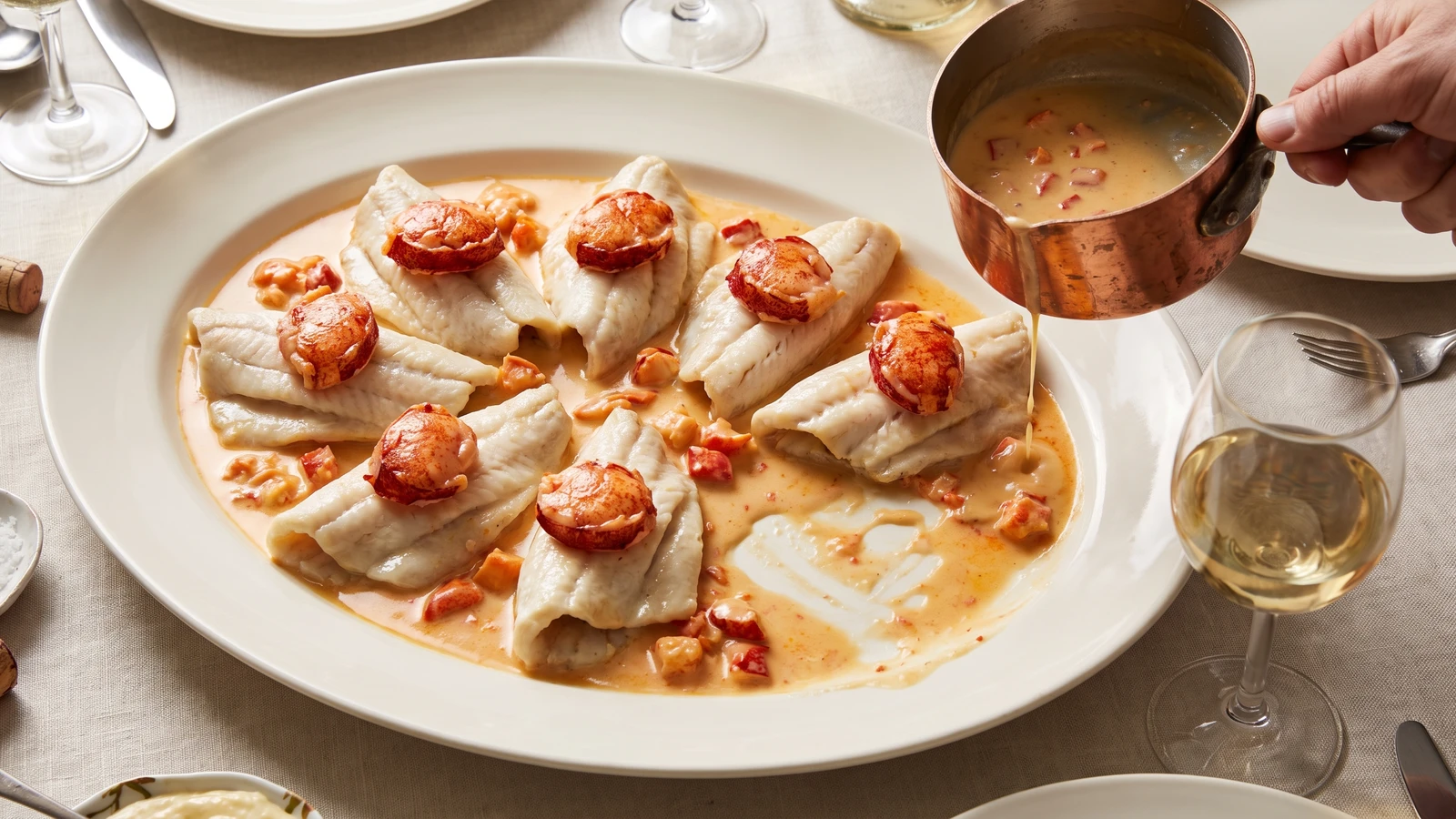
Filets de Soles New-burg teaches orchestration: tender sole, hot lobster, and a coral-rich Marsala cream sauce must meet at once, each properly cooked, none sacrificed to the waiting.
Filets de Soles New-burg (sole fillets with lobster New-burg sauce) teaches orchestration. The sole, the tail medallions, and the sauce must arrive hot together, but the one true thing to know before touching a pan is this: gentle heat protects both the fish and the sauce. Boiling toughens one and breaks the other.
The original sent a full lobster preparation through a saucier's hands, reached for fumet, a concentrated fish essence, from a stockpot that never went cold, and held each element separately for service. At home, use one shallow pan, one small saucepan, a low oven, and a warmed oval platter. A salamander isn't needed; direct fierce heat would only punish the cream and coral. For the Marsala, cream, and coral profile called for here, use Homard à la New-burg (with raw lobster) (No. 948). The book's second path, Homard à la New-burg (with the lobster cooked) (No. 949), remains an honest option when the lobster is already cooked, though its Madeira and liaison (egg-yolk thickening) make a different sauce.
The hot cupboard and separate station are brigade scaffolding, so they go. Folding the sole, poaching it in fumet, cutting one tail slice for every fillet, and stirring the remaining lobster dice into the sauce are the dish, so they stay. One cook, one stove, one evening. The moment that decides everything comes when the diced lobster meets the sauce: warm it only until coated and supple, never until it boils.
Filets de Soles New-burg belongs to the cosmopolitan classical dining room rather than to a French province: the folded, fumet-poached sole follows French fish service, while New-burg sauce entered the repertoire from New York City's grand dining tables. The name never settled into one immutable sauce, and the source records the debate in two working branches, Marsala with raw lobster and coral, or Madeira with cooked lobster and a liaison. Draping either preparation over sole turned a lobster dish into a composed fish course, formal in appearance but built from the same poaching and sauce control used at home.
Quantity
1 home-scale preparation (No. 948), about 2 cups sauce plus lobster meat (480 ml sauce / about 680 g total)
Quantity
1 home-scale preparation (No. 949), about 2 cups sauce plus lobster meat (480 ml sauce / about 680 g total)
Quantity
8, about 3 oz / 85 g each (1½ lb / 680 g total)
Quantity
2 tablespoons (30 ml / 28 g)
softened
Quantity
2 cups plus 2 tablespoons (510 ml / 510 g)
divided
Quantity
1 teaspoon (5 ml / 6 g)
Quantity
¼ teaspoon (1 ml / 0.5 g)
| Ingredient | Quantity |
|---|---|
| Homard à la New-burg (with raw lobster) | 1 home-scale preparation (No. 948), about 2 cups sauce plus lobster meat (480 ml sauce / about 680 g total) |
| Homard à la New-burg (with the lobster cooked) (optional) | 1 home-scale preparation (No. 949), about 2 cups sauce plus lobster meat (480 ml sauce / about 680 g total) |
| skinless sole fillets | 8, about 3 oz / 85 g each (1½ lb / 680 g total) |
| unsalted buttersoftened | 2 tablespoons (30 ml / 28 g) |
| fish fumetdivided | 2 cups plus 2 tablespoons (510 ml / 510 g) |
| fine sea salt | 1 teaspoon (5 ml / 6 g) |
| ground white pepper | ¼ teaspoon (1 ml / 0.5 g) |
For the coral-rich Marsala version described here, set the finished Homard à la New-burg (with raw lobster) (No. 948) beside the stove. The source also permits Homard à la New-burg (with the lobster cooked) (No. 949); use that finished component when starting with cooked lobster, but respect its Madeira and yolk liaison by keeping it below a simmer. Choose one preparation and keep its method whole. Combining the two would blur the sauce rather than improve it.
Heat the oven to 170°F (75°C), place the empty oval platter inside for 10 minutes, then switch the oven off. Butter the platter and the shallow sauté pan with half the softened butter each. Reserve 2 tablespoons of the cool fumet for adjusting the sauce; the remaining 2 cups are for poaching. This warm, quiet arrangement replaces the brigade's hot cupboard. It holds the elements briefly without cooking them twice.
Lift the lobster meat from its finished New-burg sauce with a slotted spoon. Cut the tail crosswise into 8 neat medallions, one for every sole fillet, and hold them covered with a spoonful of sauce in the warm oven for no more than 10 minutes. Cut the claw, knuckle, and remaining body meat into ½-inch (1.25 cm) dice. Keep the dice separate until the sauce is stable and ready for them.
Dry the sole fillets carefully, then season both sides with the salt and white pepper. Fold each fillet in half, or into thirds if it is especially long, with the skinned side enclosed and the presentation side outward. Aim for 8 parcels of equal thickness so they finish together. Arrange them seam-side down in one snug layer in the buttered sauté pan.
Bring the 2 cups of fumet just to a simmer, then pour it around the folded fillets; it should reach roughly halfway up their sides. Cover the surface with parchment and set the lid slightly ajar. Hold the liquid at the faintest tremble for 5 to 8 minutes, depending on thickness, until the fish is opaque, gives under gentle pressure, and reaches 140 to 145°F (60 to 63°C) at its centre. Lift each fillet out with a fish spatula, let it drain for a moment, and arrange it on the warm platter.
Warm the chosen New-burg sauce alone in the small saucepan over low heat, stirring gently, until it coats the back of a spoon and feels hot but never boils. If it is too thick, loosen it teaspoon by teaspoon with the reserved fumet. If oily beads appear at the edge, remove the pan from the heat and whisk in 1 tablespoon of cool fumet until the sauce gathers again. Ça se rattrape. Once smooth, fold in the diced lobster and warm it for 1 to 2 minutes, turning gently so the pieces remain distinct. A sauce made from Homard à la New-burg (with the lobster cooked) (No. 949) needs particular care because its liaison will grain if overheated; Homard à la New-burg (with raw lobster) (No. 948) also wants restraint so its coral and butter remain bound.
Arrange the folded sole in an oval, with the pieces slightly overlapping but not piled. Lay one warm lobster-tail medallion on every fillet. Spoon the lobster sauce and its dice over the fish, coating each parcel generously while leaving the red tail slices visible. Carry the platter straight to the table. This dish waits for nobody. À table!
1 serving (about 320g)
Culinary guides, cultural storytelling, and the editorial depth that makes cooking meaningful.
Discover Culinary ExplorerChef Juliette
John Dory has the delicacy of sole and the firmness of turbot. A light flouring, a quick butter sauté, and nut-brown beurre noisette show exactly why looks never mattered.

Chef Juliette
Fresh haddock proves its delicacy in the meunière pan: a fine flour crust, moist pearly flakes, and beurre noisette sharpened with lemon and parsley, ready from one skillet in half an hour.

Chef Juliette
Éperlans à l’Anglaise turns small fish into a lesson in disciplined coating: boned smelts under a close, crisp crumb, pan-fried in clarified butter and finished with bright, half-melted maître d’hôtel butter.

Chef Juliette
Tiny smelts, shallot, mushrooms, white wine, gratin sauce, and fine bread raspings meet a fierce oven, where the fish must turn tender in the same breath the buttered crust bronzes.