
Chef Juliette
John Dory (St. Pierre)
John Dory has the delicacy of sole and the firmness of turbot. A light flouring, a quick butter sauté, and nut-brown beurre noisette show exactly why looks never mattered.
A cooking platform built around craft, culture, and the stories behind what we eat.
Created by Chef Juliette
Based on No. 949, Homard à la New-burg (with the lobster cooked), from Le Guide Culinaire (1907) by Auguste Escoffier
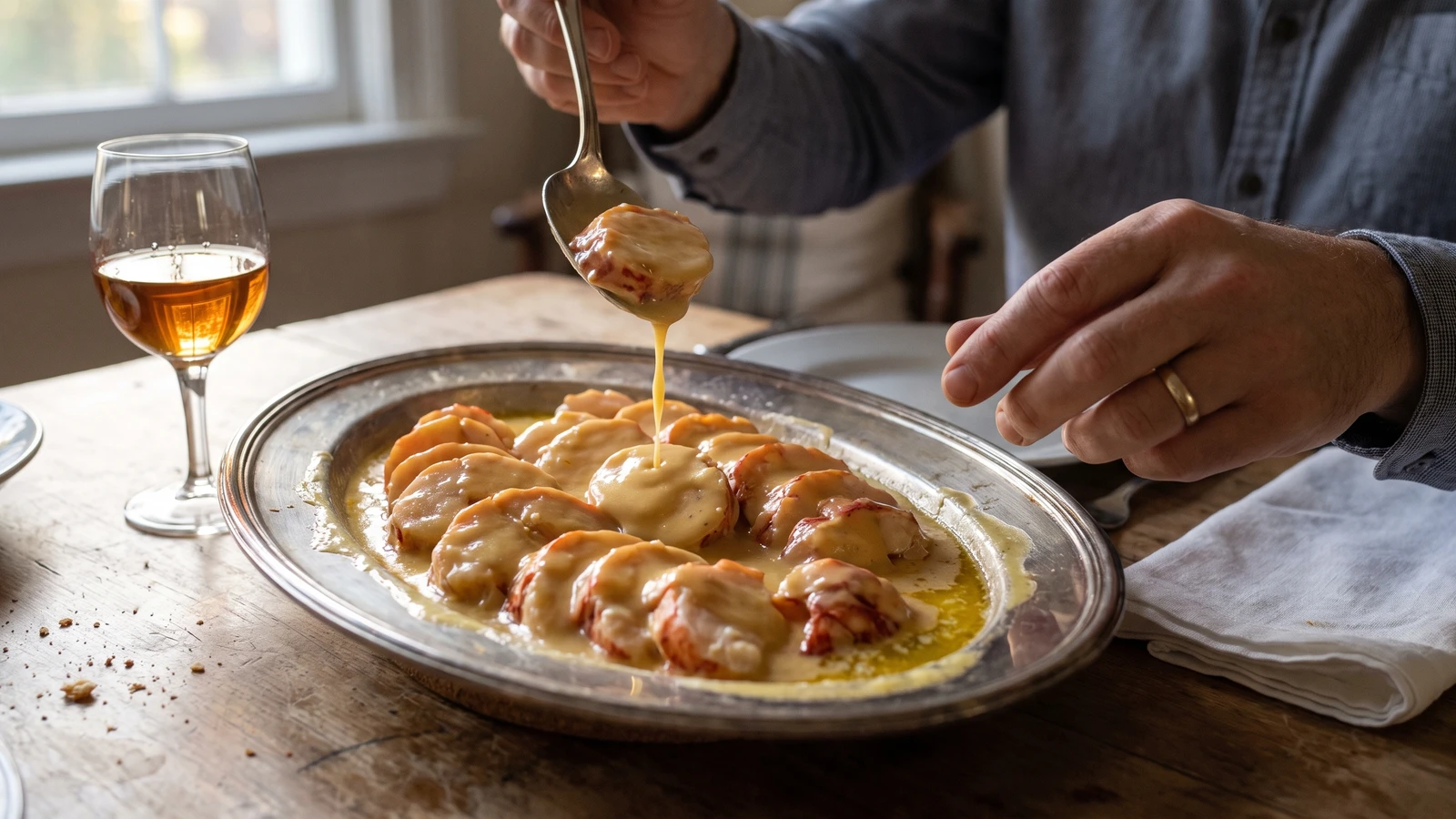
Homard à la New-burg turns cooked lobster into a lesson in liaison: redden each slice in butter, reduce Madeira nearly dry, then thicken cream and yolk without a single boil.
Homard à la New-burg (lobster with Madeira and cream) teaches control at the edge of heat. Cooked tail meat is reddened briefly in generous butter, nearly drinks up its Madeira, then receives a liaison, a yolk-thickened cream binding, that turns glossy and silken without ever boiling. That last condition is the one true thing to know before you touch the pan: a simmer curdles the yolk.
The source assumes a saucier stationed at the side of the fire and a lukewarm timbale waiting for service. It needs neither the brigade's perpetual stockpot nor its salamander. Your honest equivalents are a straight-sided sauté pan, the lowest heat on your stove, and a shallow serving bowl warmed with hot water. The liaison keeps the book's proportion, one yolk for 355 ml cream, while two substantial lobsters give four generous home portions. One cook, one stove, one evening.
The large batch and the dedicated sauce station were brigade scaffolding, so they go. The court-bouillon poach, butter reddening, near-dry Madeira reduction, and gentle liaison are the dish itself, so they stay. Watch the pan most closely when the liaison enters; that final binding decides everything, and if it begins to grain, ça se rattrape.
Despite its French title, Homard à la New-burg belongs first to the formal dining rooms of New York, where lobster was enriched with Madeira, cream, and egg yolks before entering the French classical repertoire. Its familiar origin story says the dish was first called Wenberg and renamed Newberg after a quarrel, though the exact telling remains debated. French codifiers rendered the name New-burg and treated the preparation as a lesson in reduction and liaison rather than as a regional French dish.
Quantity
2, about 2 pounds (900 g) each
Quantity
5 quarts (4.7 liters / 4.7 kg)
Quantity
2 cups (475 ml / 475 g)
Quantity
1, about 10 ounces (285 g)
thickly sliced
Quantity
2, about 8 ounces (225 g)
thickly sliced
Quantity
2, about 4 ounces (115 g)
thickly sliced
Quantity
6
Quantity
4
Quantity
2
Quantity
1 teaspoon (5 ml / 2.5 g)
Quantity
2 tablespoons (30 ml / 36 g)
Quantity
6 tablespoons (90 ml / 85 g)
Quantity
¾ teaspoon (3.75 ml / 4.5 g)
Quantity
½ teaspoon (2.5 ml / 1 g)
Quantity
⅛ teaspoon (0.6 ml / 0.25 g)
Quantity
1½ cups (355 ml / 355 g)
Quantity
1½ cups (355 ml / 355 g)
Quantity
1
Quantity
2 tablespoons (30 ml / 30 g)
| Ingredient | Quantity |
|---|---|
| whole live lobsters | 2, about 2 pounds (900 g) each |
| water | 5 quarts (4.7 liters / 4.7 kg) |
| dry white wine | 2 cups (475 ml / 475 g) |
| large yellow onionthickly sliced | 1, about 10 ounces (285 g) |
| medium carrotsthickly sliced | 2, about 8 ounces (225 g) |
| celery stalksthickly sliced | 2, about 4 ounces (115 g) |
| parsley stems | 6 |
| fresh thyme sprigs | 4 |
| bay leaves | 2 |
| black peppercorns | 1 teaspoon (5 ml / 2.5 g) |
| fine sea salt for the court-bouillon | 2 tablespoons (30 ml / 36 g) |
| unsalted butter | 6 tablespoons (90 ml / 85 g) |
| fine sea salt for seasoning | ¾ teaspoon (3.75 ml / 4.5 g) |
| ground white pepper | ½ teaspoon (2.5 ml / 1 g) |
| cayenne pepper | ⅛ teaspoon (0.6 ml / 0.25 g) |
| medium-dry Madeira | 1½ cups (355 ml / 355 g) |
| heavy cream, 36 to 40 percent fat | 1½ cups (355 ml / 355 g) |
| large egg yolk | 1 |
| cold heavy cream for rescue (optional) | 2 tablespoons (30 ml / 30 g) |
Combine the water, white wine, onion, carrots, celery, parsley stems, thyme, bay leaves, peppercorns, and court-bouillon salt in a large stockpot. This court-bouillon, the brief aromatic poaching liquor, should taste distinctly seasoned and fresh rather than like a finished soup. Bring it to a boil, lower to a lively simmer, and cook for 20 minutes so the vegetables and herbs give up their aroma.
Chill the lobsters for 20 minutes while the court-bouillon simmers. Return the liquid to a full boil, lower the lobsters in headfirst, and cover until the liquid returns to the boil. Uncover, reduce to a steady simmer, and cook for about 12 minutes, until the shells are vivid red and the tail meat is opaque and springy. Lift them onto a rimmed tray and leave them just until cool enough to handle.
Twist the tails from the bodies. Cut through the soft underside of each shell with kitchen shears, open the shell carefully, and remove each tail in one piece, preserving the thin red exterior membrane. Cut the meat crosswise into regular slices about ½ inch (1.25 cm) thick. Pick the claw and knuckle meat and refrigerate it for another meal; this entry calls specifically for the tail.
Fill a shallow heatproof serving bowl or timbale with hot water and set it aside. Whisk the egg yolk smooth in a separate bowl, then gradually whisk in the 1½ cups of heavy cream until completely homogeneous. This is the liaison. Keep it near the stove, but do not warm it directly.
Melt the butter in an 11 to 12-inch straight-sided sauté pan over medium heat. Season the lobster slices strongly and evenly with the fine salt, white pepper, and cayenne. When the butter foams but has not browned, lay in the slices in one layer. Heat them for 30 to 45 seconds on each side, just until the outer membrane deepens to a fine coral-red. They are already cooked, so colour them without frying them hard.
Pour in the Madeira, which should almost cover the lobster in a snug pan. Bring it to a brisk simmer and reduce for 4 to 6 minutes, turning the slices once, until the wine has nearly disappeared and only a glossy spoonful or two clings around the buttered lobster. Do not stop while a loose pool remains. This near-dry reduction cooks away the wine's raw edge and concentrates its nutty sweetness before the cream arrives.
Move the pan completely off the heat and wait 45 seconds for the fiercest bubbling to stop. Pour the liaison over the lobster and stir gently with a flexible spatula, then return the pan to the lowest heat you own. Keep the slices moving carefully until the sauce nappes the spatula, coating it in a smooth layer that holds a finger-drawn line, about 3 to 5 minutes. Keep the sauce below a simmer, ideally between 165 and 170°F (74 and 77°C); one boil can curdle the yolk. If the first grains appear, remove the lobster, set the pan on a folded cold towel, and whisk in the reserved cold cream. Ça se rattrape: strain the sauce into a clean pan, blending it briefly before straining if necessary, then warm it with great restraint and return the lobster.
Empty and dry the warmed timbale; it should be lukewarm, not hot enough to keep cooking the yolk. Transfer the lobster and every drop of sauce at once, arranging the regular slices so the coral edges remain visible beneath the glossy cream. Serve immediately. À table!
1 serving (about 225g)
Culinary guides, cultural storytelling, and the editorial depth that makes cooking meaningful.
Discover Culinary ExplorerChef Juliette
John Dory has the delicacy of sole and the firmness of turbot. A light flouring, a quick butter sauté, and nut-brown beurre noisette show exactly why looks never mattered.

Chef Juliette
Fresh haddock proves its delicacy in the meunière pan: a fine flour crust, moist pearly flakes, and beurre noisette sharpened with lemon and parsley, ready from one skillet in half an hour.

Chef Juliette
Éperlans à l’Anglaise turns small fish into a lesson in disciplined coating: boned smelts under a close, crisp crumb, pan-fried in clarified butter and finished with bright, half-melted maître d’hôtel butter.

Chef Juliette
Tiny smelts, shallot, mushrooms, white wine, gratin sauce, and fine bread raspings meet a fierce oven, where the fish must turn tender in the same breath the buttered crust bronzes.