
Chef Juliette
John Dory (St. Pierre)
John Dory has the delicacy of sole and the firmness of turbot. A light flouring, a quick butter sauté, and nut-brown beurre noisette show exactly why looks never mattered.
A cooking platform built around craft, culture, and the stories behind what we eat.
Created by Chef Juliette
Based on No. 882, Filets de Soles Marie Stuart, from Le Guide Culinaire (1907) by Auguste Escoffier
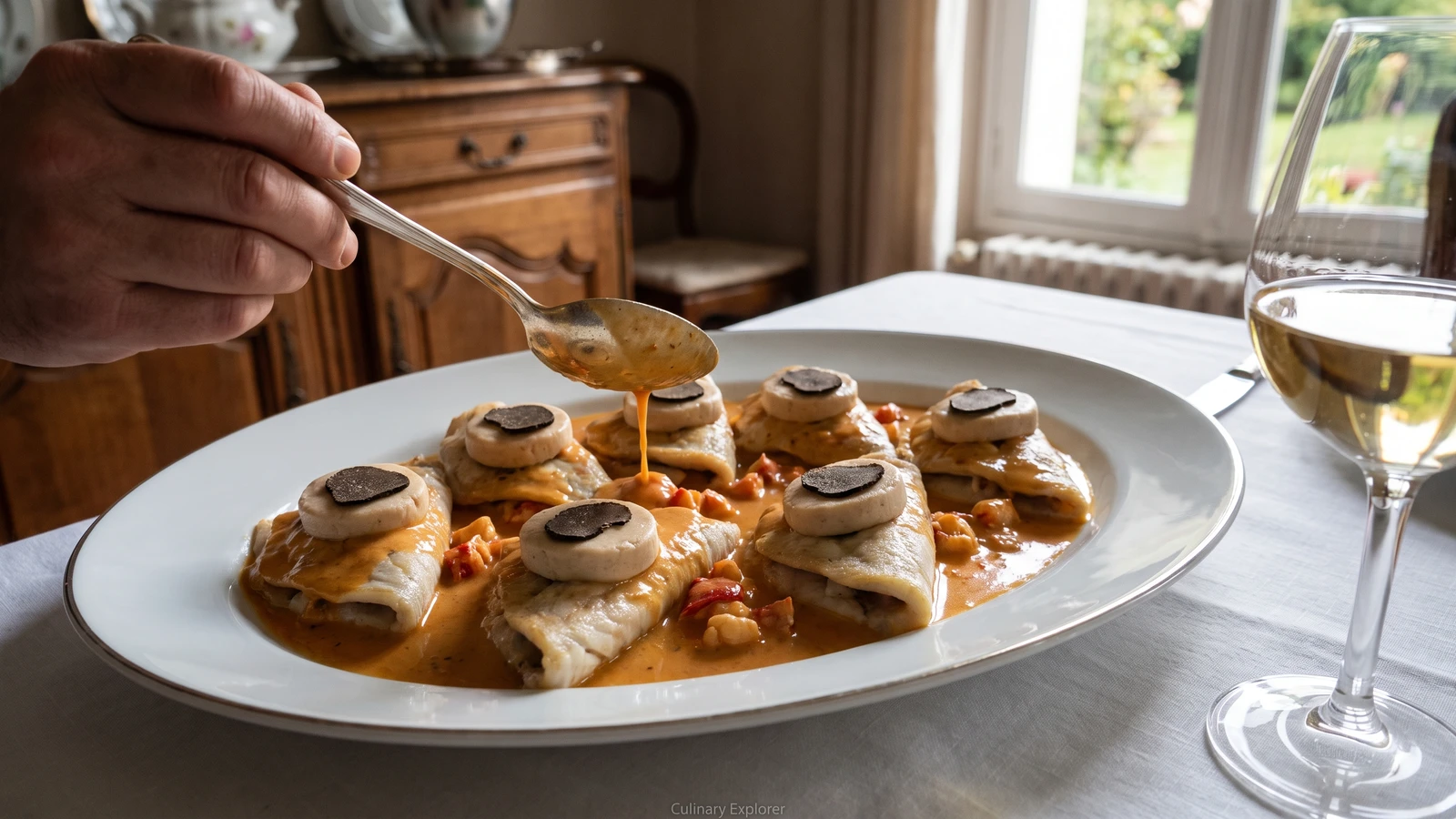
Fumet-poached sole, glossy lobster New-burg sauce, and silken fish quenelles crowned with black truffle: a grand composed dish translated faithfully for one cook, with every element arriving hot and properly drained.
Filets de Soles Marie Stuart (sole poached in fumet, a concentrated fish stock, with lobster New-burg sauce and truffled fish quenelles) teaches the discipline of service. Each delicate element is cooked separately, then brought together hot, glossy, and dry. The one true thing to know before touching a pan is that poaching liquid cannot follow the fish onto the platter. Drain the sole and quenelles with almost comic thoroughness, or one wet underside will thin the carefully built sauce.
The old entry gives no home quantities because it assumed a saucier tending the lobster sauce, fish fumet never off the fire, and another pair of hands shaping quenelles while the sole was poached. It calls for no salamander because nothing here is gratinéed. For one cook, one stove, one evening, the honest equivalents are a finished cross-referenced sauce, a food processor instead of mortar and sieve, and one shallow pan used in sequence. Eight fillets, eight forcemeat rings, and one truffle slice on each preserve the composition for four. The extra hands were brigade scaffolding; fumet poaching, New-burg sauce, the quoit-shaped quenelles, and truffle are the dish and must stay.
On the platter, the ivory sole sits beneath a coral-cream gloss, each fillet crowned with a pale ring and a dark coin of truffle. Keep the forcemeat cold and the sauce below a simmer, but make draining the final gate: each quenelle should leave no wet mark before it touches the fish.
Filets de Soles Marie Stuart belongs to the Parisian grand-kitchen repertory of named sole garnishes, not to a Scottish regional table. Marie Stuart is the French name for Mary, Queen of Scots, whose close connection to the French court suited the courtly naming of composed dishes. The preparation traveled through formal dining rooms as a fixed combination of fumet-poached sole, lobster New-burg sauce, quoit-shaped fish forcemeat, and truffle.
Quantity
8 fillets (about 24 ounces / 680 g total)
pin bones removed
Quantity
¾ packed cup (180 ml / 200 g)
very cold and cut into 1-inch pieces
Quantity
1
thoroughly chilled
Quantity
½ cup (120 ml / 120 g)
ice-cold
Quantity
2 tablespoons (30 ml / 30 g)
chilled
Quantity
1 teaspoon (5 ml / 6 g)
divided
Quantity
⅛ teaspoon (0.6 ml / 0.3 g)
Quantity
4 cups (960 ml / 960 g)
Quantity
1½ cups (360 ml / 370 g) from Filets de soles à la New-burg (No. 890)
Quantity
1 small truffle
cut into 8 thin slices
| Ingredient | Quantity |
|---|---|
| skinless sole filletspin bones removed | 8 fillets (about 24 ounces / 680 g total) |
| skinless whiting, hake, or sole trimmingsvery cold and cut into 1-inch pieces | ¾ packed cup (180 ml / 200 g) |
| large egg whitethoroughly chilled | 1 |
| heavy creamice-cold | ½ cup (120 ml / 120 g) |
| heavy cream for correction (optional)chilled | 2 tablespoons (30 ml / 30 g) |
| fine sea saltdivided | 1 teaspoon (5 ml / 6 g) |
| ground white pepper | ⅛ teaspoon (0.6 ml / 0.3 g) |
| fish fumet | 4 cups (960 ml / 960 g) |
| prepared lobster sauce | 1½ cups (360 ml / 370 g) from Filets de soles à la New-burg (No. 890) |
| fresh or preserved black trufflecut into 8 thin slices | 1 small truffle |
Chill the food-processor bowl and blade for 15 minutes. Add the cold whiting, hake, or sole trimmings with two-thirds of the salt and process in short pulses until the fish becomes fine and tacky. Scrape the bowl, add the chilled egg white, and pulse until absorbed. With the machine running briefly, add the ½ cup of ice-cold cream in three additions, stopping as soon as the forcemeat is smooth and satiny. Cold protects the emulsion. If it turns loose and unusually glossy, the mixture has warmed; stop, set the bowl over ice for 10 minutes, and pulse only once or twice after it firms.
Warm 1 cup of the fish fumet to a bare tremble and poach a teaspoon of forcemeat for 2 minutes. It should hold together and feel tender, not rubbery. If it feathers apart, chill the mixture again and process for 5 seconds to strengthen the bind. If it is too firm, fold in the reserved cold cream 1 teaspoon at a time, testing again after each addition. Transfer the forcemeat to a piping bag fitted with a ¾-inch tip. Pipe eight thick rings, each about 2¼ inches wide with a ¾-inch opening, onto individual 3-inch parchment squares. Chill them for 15 to 20 minutes.
Warm the lobster sauce prepared as directed in Filets de soles à la New-burg (No. 890) in a small saucepan over the lowest heat, stirring gently until it coats the back of a spoon. Never let it simmer. If the sauce begins to grain or shed a line of fat, remove it from the heat. Ça se rattrape: whisk 1 tablespoon of the reserved cold cream in a clean bowl, then whisk the troubled sauce into it one spoonful at a time. Hold the smooth sauce in a bain-marie, a warm-water bath, for no longer than 15 minutes.
Pour the remaining fumet into a wide shallow pan and bring it to 175°F to 180°F (80°C to 82°C), where the surface barely moves. Season the sole with the remaining salt and white pepper. Fold each fillet into thirds with the thin tail tucked inside, then lower the parcels into the fumet in one layer. Cover and poach gently for 4 to 6 minutes, until the flesh is opaque, springs lightly under a finger, and reaches 145°F (63°C) at its thickest point. If the fumet begins boiling and the fillets curl, take the pan off the heat at once and let its stored warmth finish them.
Lift the sole onto a rack set over a tray and blot each underside carefully with a clean lint-free towel. Arrange the fillets in an oval on a platter warmed with hot water and dried completely. Return the fumet to its bare tremble. Using a wet offset spatula, slide the chilled forcemeat rings from their parchment into the liquid and poach them for 4 to 6 minutes, turning once, until just firm and 145°F (63°C) at the centre. If a ring opens while its surface is setting, nudge the ends together with two spoons. Drain the quenelles on the rack and blot beneath each one; this last-minute poaching and thorough draining are essential to the original preparation.
Stir the lobster sauce from Filets de soles à la New-burg (No. 890) and spoon it generously over the oval of sole, letting a little pool around the fish. Set one well-drained quenelle ring on every fillet and deck each ring with a slice of black truffle. If a ring has torn, place its ends together before adding the truffle; sauce and garnish will cover the seam without changing a bite. Carry the platter straight to the table. À table!
1 serving (about 330g)
Culinary guides, cultural storytelling, and the editorial depth that makes cooking meaningful.
Discover Culinary ExplorerChef Juliette
John Dory has the delicacy of sole and the firmness of turbot. A light flouring, a quick butter sauté, and nut-brown beurre noisette show exactly why looks never mattered.

Chef Juliette
Fresh haddock proves its delicacy in the meunière pan: a fine flour crust, moist pearly flakes, and beurre noisette sharpened with lemon and parsley, ready from one skillet in half an hour.

Chef Juliette
Éperlans à l’Anglaise turns small fish into a lesson in disciplined coating: boned smelts under a close, crisp crumb, pan-fried in clarified butter and finished with bright, half-melted maître d’hôtel butter.

Chef Juliette
Tiny smelts, shallot, mushrooms, white wine, gratin sauce, and fine bread raspings meet a fierce oven, where the fish must turn tender in the same breath the buttered crust bronzes.