
Chef Juliette
John Dory (St. Pierre)
John Dory has the delicacy of sole and the firmness of turbot. A light flouring, a quick butter sauté, and nut-brown beurre noisette show exactly why looks never mattered.
A cooking platform built around craft, culture, and the stories behind what we eat.
Created by Chef Juliette
Based on No. 881, Filets de Soles Marinette, from Le Guide Culinaire (1907) by Auguste Escoffier
Poached sole, firm cheese paste, Villeroy, anglaise, hot fat: Filets de Soles Marinette teaches the classical art of building a sealed crust around a tender, lavish center.
Filets de Soles Marinette (sole fillets stuffed with cheese, coated in thick sauce, breaded, and fried) teaches the architecture of a croquette. A crisp exterior can hold tender fish, a rich filling, and sauce only if every layer is cold and firm before the next is added. That is the one true thing to know before touching a pan.
The brigade entry assumed a saucier at your elbow, fish fumet and mushroom cooking liquor already waiting, cold-room shelves, and a fryer ready for service. At home, one small saucepan makes the spoonful of Béchamel and then the Villeroy, the refrigerator supplies the cold room, and a deep heavy pot with a thermometer replaces the fryer. The staffed sauce station and production quantities are scaffolding; the cold cheese set, the Villeroy coat, paner à l’anglaise, and very hot fat are the dish, so they stay. One cook, one stove, one evening.
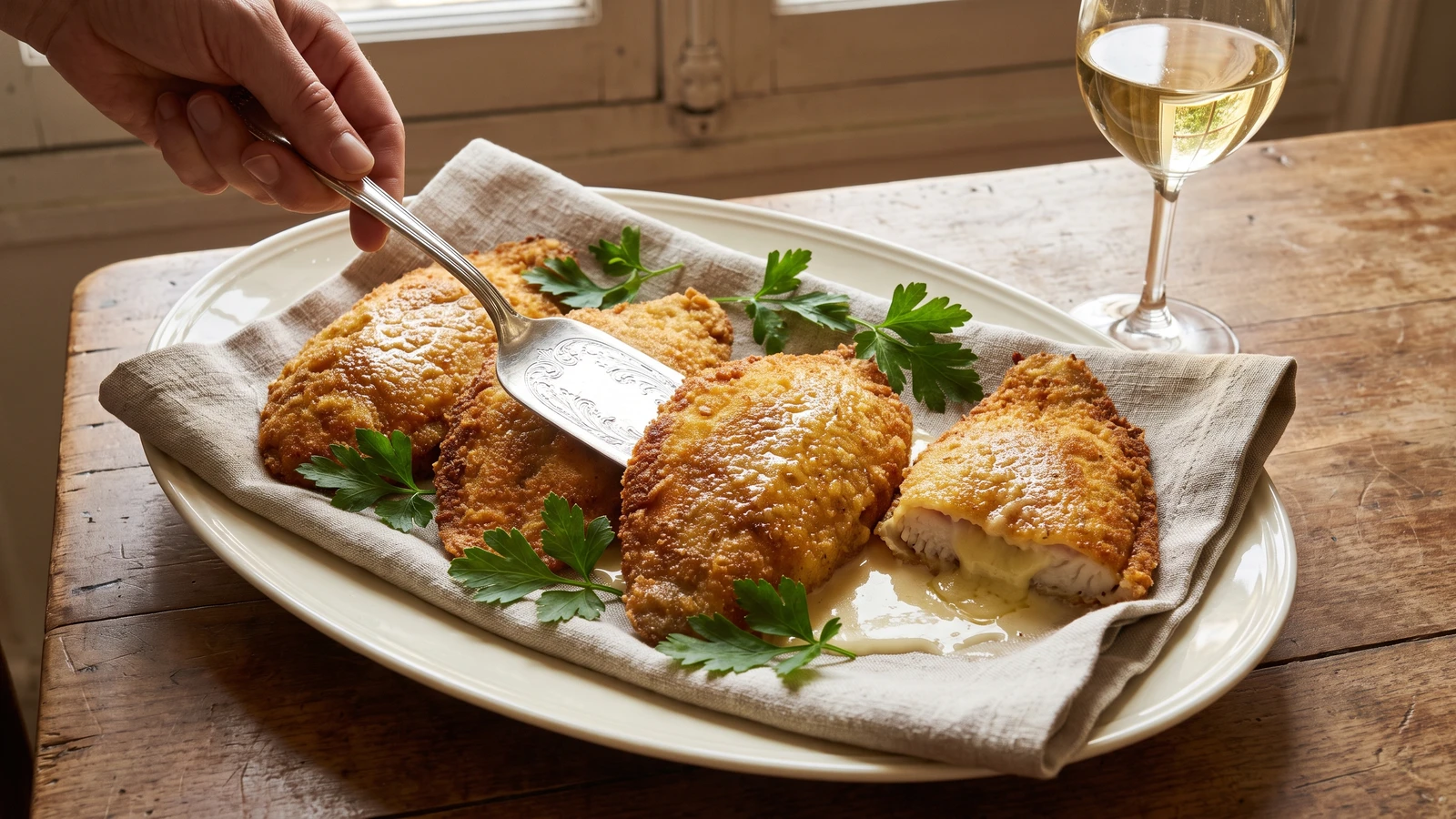
Done properly, the butter-gold crust gives under the knife to an ivory band of Villeroy, delicate sole, and a savory Gruyère-Parmesan center sharpened with cayenne. The decisive moment comes before the coating: chill the filled fillets until the cheese paste cannot shift beneath a fingertip. Do not ask breadcrumbs to restrain a loose center.
Filets de Soles Marinette belongs to the Parisian cuisine classique of named sole preparations, not to the larder of a particular French province. Its title is an appellation, while its method shows the grand-kitchen practice of rebuilding delicate fish into a composed dining-room dish: poach, lift the fillets, fill, coat, crumb, and fry. Villeroy is not served as a loose sauce here; reduced until it sets around the fish, it becomes part of the protective shell that carried the preparation from brigade menus to bourgeois special-occasion tables.
Quantity
1 teaspoon (5 ml / 5 g)
Quantity
1 teaspoon (5 ml / 3 g)
Quantity
2 tablespoons (30 ml / 30 g)
Quantity
3 cups sliced (720 ml / 225 g)
thinly sliced
Quantity
1½ cups (360 ml / 360 g)
Quantity
1 teaspoon (5 ml / 5 g)
Quantity
1 tablespoon (15 ml / 14 g)
Quantity
¼ teaspoon (1.25 ml / 1.5 g)
Quantity
2, about 1¼ pounds (570 g) each
cleaned and skinned, with bones intact
Quantity
2½ cups (600 ml / 600 g)
divided
Quantity
2
Quantity
1¼ to 1½ cups (300 to 360 ml / 120 to 150 g)
finely grated
Quantity
1½ to 1¾ cups (360 to 420 ml / 120 to 150 g)
finely grated
Quantity
1 tablespoon plus 1 teaspoon (20 ml / 20 g)
Quantity
¼ teaspoon (1.25 ml / 1.5 g)
Quantity
⅛ teaspoon (0.6 ml / 0.25 g)
Quantity
3 tablespoons (45 ml / 42 g)
Quantity
⅓ cup (80 ml / 40 g)
Quantity
1½ cups (360 ml / 360 g)
Quantity
⅔ cup (160 ml / 160 g)
divided
Quantity
2
Quantity
Up to ¼ teaspoon (1.25 ml / 1.5 g)
Quantity
1 cup (240 ml / 125 g)
Quantity
1 cup (240 ml / 240 g) Anglaise (for Egg-and-bread-crumbing) (No. 174)
chilled
Quantity
3 cups (720 ml / 300 g)
Quantity
2 quarts (1.9 liters / 1.75 kg)
for deep-frying
Quantity
1 large bunch
washed and dried thoroughly
| Ingredient | Quantity |
|---|---|
| unsalted butter for the Béchamel | 1 teaspoon (5 ml / 5 g) |
| all-purpose flour for the Béchamel | 1 teaspoon (5 ml / 3 g) |
| whole milk | 2 tablespoons (30 ml / 30 g) |
| white button mushroomsthinly sliced | 3 cups sliced (720 ml / 225 g) |
| water | 1½ cups (360 ml / 360 g) |
| fresh lemon juice | 1 teaspoon (5 ml / 5 g) |
| unsalted butter for the mushroom cooking liquor | 1 tablespoon (15 ml / 14 g) |
| fine sea salt for the mushroom cooking liquor | ¼ teaspoon (1.25 ml / 1.5 g) |
| whole Dover solescleaned and skinned, with bones intact | 2, about 1¼ pounds (570 g) each |
| fish fumetdivided | 2½ cups (600 ml / 600 g) |
| large eggs | 2 |
| Gruyèrefinely grated | 1¼ to 1½ cups (300 to 360 ml / 120 to 150 g) |
| Parmesanfinely grated | 1½ to 1¾ cups (360 to 420 ml / 120 to 150 g) |
| cold Béchamel sauce | 1 tablespoon plus 1 teaspoon (20 ml / 20 g) |
| fine sea salt for the cheese paste | ¼ teaspoon (1.25 ml / 1.5 g) |
| cayenne pepper | ⅛ teaspoon (0.6 ml / 0.25 g) |
| unsalted butter for the Villeroy sauce | 3 tablespoons (45 ml / 42 g) |
| all-purpose flour for the Villeroy sauce | ⅓ cup (80 ml / 40 g) |
| strained sole poaching liquor | 1½ cups (360 ml / 360 g) |
| heavy creamdivided | ⅔ cup (160 ml / 160 g) |
| large egg yolks | 2 |
| fine sea salt for the Villeroy sauce | Up to ¼ teaspoon (1.25 ml / 1.5 g) |
| all-purpose flour for coating | 1 cup (240 ml / 125 g) |
| Anglaise (for Egg-and-bread-crumbing)chilled | 1 cup (240 ml / 240 g) Anglaise (for Egg-and-bread-crumbing) (No. 174) |
| fine dry white breadcrumbs | 3 cups (720 ml / 300 g) |
| refined peanut oil or rendered beef fatfor deep-frying | 2 quarts (1.9 liters / 1.75 kg) |
| flat-leaf parsleywashed and dried thoroughly | 1 large bunch |
Melt the butter for the Béchamel in a small saucepan over gentle heat. Stir in its flour and cook for one minute without coloring, then whisk in the milk. Simmer, whisking, until the Béchamel is very thick and leaves the pan clean behind the whisk, about two minutes. Scrape it onto a small plate, press parchment directly against its surface, and refrigerate until completely cold. You need only 1 tablespoon plus 1 teaspoon (20 ml / 20 g); this compact batch replaces the spoonful a saucier would have waiting.
Combine the mushrooms, water, lemon juice, butter, and salt in a covered saucepan. Bring them to a gentle boil and cook for six minutes, just until the mushrooms surrender their clear, savory liquor. Strain without pressing, measure 1 cup (240 ml / 240 g) of the cooking liquor, and reserve it. Keep the mushrooms for an omelet or another sauce; they have done their work here.
Pour 2 cups (480 ml / 480 g) of the fish fumet and the measured mushroom cooking liquor into a wide sauté pan. Lay in one sole, cover it with a parchment cartouche, and bring the liquid only to a tremble. Poach for 6 to 9 minutes, depending on thickness, until the flesh has turned opaque and releases cleanly from the backbone. Transfer it to a towel-lined rack and repeat with the second sole in the same liquor. Reserve the liquor. While each fish is still lukewarm, run a flexible knife along the backbone, lift the two upper fillets, remove the frame, and lift the two lower fillets. Trim the eight fillets into four matching pairs. If one tears, fit the pieces together in their original shape; the cold filling and Villeroy will bind them.
Beat the eggs thoroughly. Stir in 120 g each of Gruyère and Parmesan, the cold Béchamel, salt, and cayenne. The paste must be dense enough to hold a spatula upright, not merely thick enough to spoon. Egg sizes and grated cheese vary, so add the remaining cheeses in equal weights, a spoonful at a time, until the paste stands firmly. If it spreads into a puddle, stop and add more of both cheeses equally. Ça se rattrape.
Lay four fillets on a parchment-lined tray. Spread the cheese paste over them in an even 1-inch (2.5 cm) layer, leaving a narrow margin so the filling does not squeeze through the seams. Cover with the matching fillets and straighten the sides with a small palette knife. If the layers slide now, lift off the upper fillet and thicken the paste with equal quantities of both cheeses before rebuilding. Refrigerate for at least one hour, until the sandwiches feel rigid and the filling does not shift beneath a light fingertip. This cold set is the dish's governing principle.
Strain 1½ cups (360 ml / 360 g) of the reserved sole poaching liquor. If needed, complete the measure with some of the remaining fish fumet. Melt the butter for the Villeroy sauce, stir in its flour, and cook the roux for two minutes without coloring. Whisk in the hot liquor gradually, then simmer for 6 to 8 minutes until the sauce falls from the whisk in a heavy ribbon. Whisk ½ cup (120 ml / 120 g) of the cream with the egg yolks, temper this liaison with several spoonfuls of hot sauce, and return everything to the pan. Cook over low heat without boiling until the Villeroy heavily coats a spoon, then season carefully. If it turns grainy, remove it from the heat, whisk in a tablespoon of the reserved cold cream, and strain it. Ça se rattrape. Let the sauce cool until warm and thick but still fluid.
Using two broad fish slices, lower each cold sole sandwich into the warm Villeroy and turn it carefully, coating the top, bottom, and seams in an even layer about ⅛ inch (3 mm) thick. Set the coated fillets on a clean parchment-lined rack. The sauce should begin setting within a minute; if it slides off, it is too warm, so wait five minutes and try again. Chill the coated fillets for at least one hour, until the Villeroy is cold, matte, and firm enough to touch without marking.
Arrange the coating station in order: flour, the prepared Anglaise (for Egg-and-bread-crumbing) (No. 174), then fine breadcrumbs. Dust each cold fillet sandwich lightly but completely with flour, dip it in the Anglaise (for Egg-and-bread-crumbing) (No. 174), and press breadcrumbs over every surface, paying close attention to the seams. This is paner à l’anglaise, coating with flour, seasoned egg preparation, and crumbs so hot fat seals the parcel instantly. Inspect each crust before chilling it for 20 to 30 minutes. Patch any crack with flour, Anglaise, and crumbs in that order.
Heat the frying fat in a deep, heavy pot to 355°F (180°C), allowing enough empty space above it for safe bubbling. Fry the fillets two at a time for 5 to 7 minutes, turning once if they float, until the crust is evenly butter-gold and the center reaches 160°F (71°C) when tested carefully from the side. Keep the fat near 345°F (175°C); if the crust colors before the center is hot, lower the heat to 330°F (165°C) and continue gently. Drain on a rack, never in a heap, while the fat returns to temperature. Arrange the four fillets on a warm oval platter lined with a clean folded napkin, with very green parsley all around. Serve at once. À table!
1 serving (about 460g)
Culinary guides, cultural storytelling, and the editorial depth that makes cooking meaningful.
Discover Culinary ExplorerChef Juliette
John Dory has the delicacy of sole and the firmness of turbot. A light flouring, a quick butter sauté, and nut-brown beurre noisette show exactly why looks never mattered.

Chef Juliette
Fresh haddock proves its delicacy in the meunière pan: a fine flour crust, moist pearly flakes, and beurre noisette sharpened with lemon and parsley, ready from one skillet in half an hour.

Chef Juliette
Éperlans à l’Anglaise turns small fish into a lesson in disciplined coating: boned smelts under a close, crisp crumb, pan-fried in clarified butter and finished with bright, half-melted maître d’hôtel butter.

Chef Juliette
Tiny smelts, shallot, mushrooms, white wine, gratin sauce, and fine bread raspings meet a fierce oven, where the fish must turn tender in the same breath the buttered crust bronzes.