Culinary Explorer

A cooking platform built around craft, culture, and the stories behind what we eat.
Discover Culinary Explorer
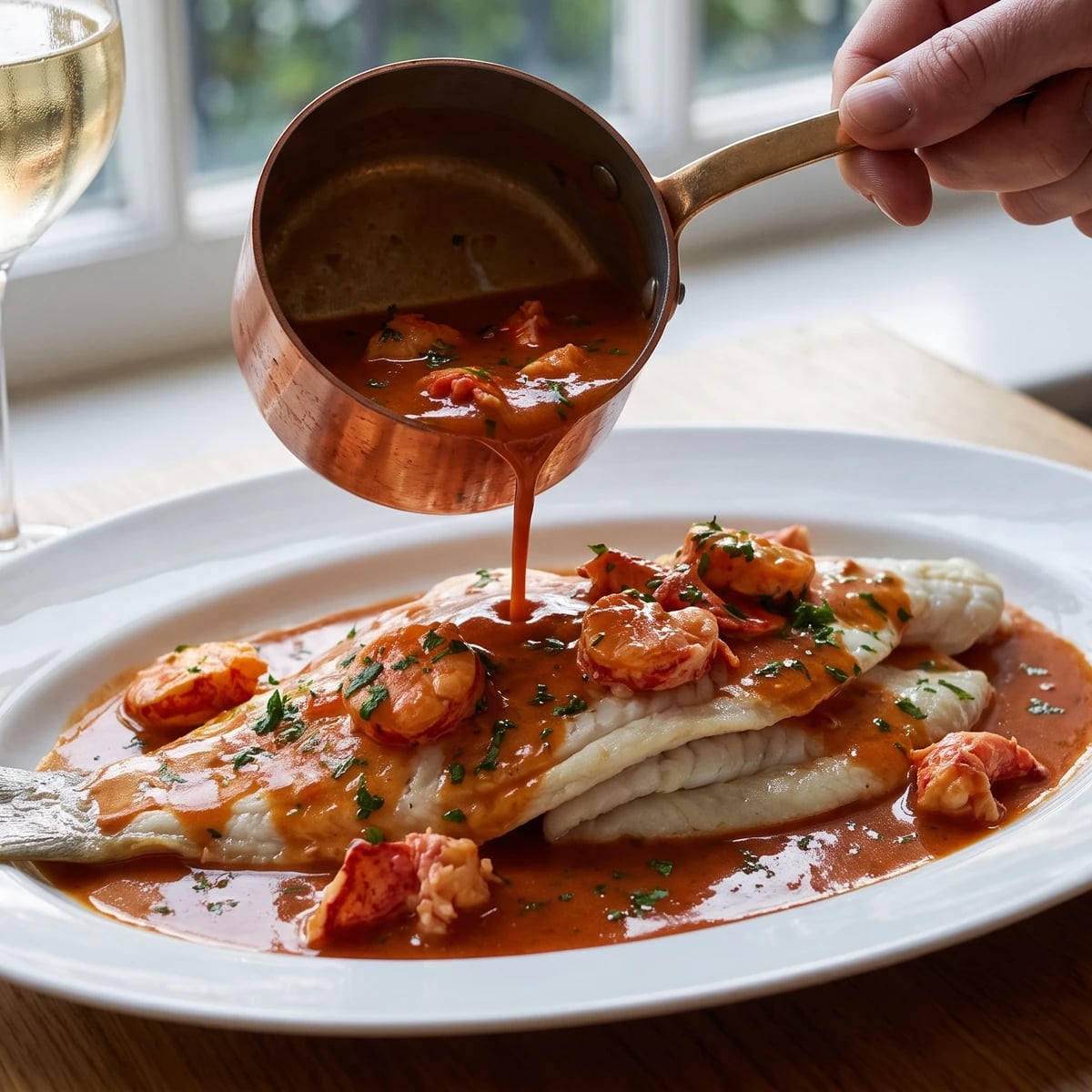
Filets de Soles Américaine

Filets de Soles Américaine

Created by Chef Juliette

Based on No. 865, Filets de Soles Américaine, from Le Guide Culinaire (1907) by Auguste Escoffier

Folded sole, barely poached in fumet, circles lobster beneath a gleaming brandy-and-tomato shellfish sauce. The sauce is the whole dish, and gentle heat is the lesson.

Main Dishes
French
Dinner Party
Special Occasion
Celebration
20 min
Active Time
15 min cook35 min total
Yield4 servings

Filets de Soles Américaine (folded sole fillets with lobster à l’américaine) teaches hierarchy. The sole is delicate, the lobster is generous, but the shellfish sauce carries the dish. Know that before you touch a pan: if the sauce is glossy, concentrated, and warm without boiling, everything beneath it makes sense.

The original service assumed a saucier, fish fumet never off the fire, another pair of hands managing the lobster, and a salamander standing ready, though this dish never needs its fierce heat. At home, prepare one finished Homard à l’Américaine (No. 939), keep its meat and sauce warm, then poach the sole at the last moment. The brigade handoffs and the lobster’s upright carapace presentation are scaffolding and can go. The fumet poach, overlapping oval, sliced lobster centre, and complete coating of sauce must stay. Those are the dish, scaled for four people and one cook.

The step that matters most is controlling the sauce after its butter has gone in. Let it boil and its gloss can turn oily; keep it below a simmer and it falls over the sole like satin. If it begins to separate, don’t pour it out. Ça se rattrape, and the rescue is waiting in the method.

Filets de Soles Américaine belongs to the Parisian grand-kitchen repertoire, where poached sole often served as a quiet foundation for a more forceful shellfish garnish and sauce. Its name comes through Homard à l’Américaine, a preparation of lobster, tomato, white wine, brandy, and fish fumet whose concentrated cooking liquor becomes the coating sauce. The familiar argument between américaine and armoricaine concerns the name more than the method; this formula preserves américaine, as the classical entry gives it.

The technique, the tradition, and the story behind every dish.

Discover Culinary Explorer

Ingredients

skinless sole fillets

Quantity

8 fillets, about 3 oz (85 g) each; 1½ lb (680 g) total

finished lobster preparation

Quantity

1 home-scale recipe Homard à l’Américaine (No. 939)

prepared completely and kept warm

fish fumet

Quantity

1½ cups (355 ml / 360 g)

heated

unsalted butter

Quantity

2 tbsp (30 ml / 28 g)

softened

Equipment Needed

  • Deep 12-inch sauté pan with a close-fitting lid
  • Small heavy saucepan
  • 14-inch oval serving platter
  • Slotted fish spatula
  • Fine whisk
  • Instant-read thermometer

Instructions

  1. 1

    Ready the lobster component

    Have the Homard à l’Américaine (No. 939) completely prepared before the sole enters its pan. Lift the cooked tail and claw meat gently from its sauce, slice the tail crosswise into generous medallions, and keep all the meat covered with a spoonful of sauce. Put the remaining lobster sauce in a small saucepan and keep it merely warm. Do not boil it.

  2. 2

    Prepare pan and platter

    Fill a large oval serving platter with hot water and set it aside to warm. Coat the base and sides of a deep 12-inch sauté pan with the softened butter. The pan should hold the folded fillets in one snug layer; too much empty space demands more fumet and weakens the poach.

  3. 3

    Fold the sole

    Feel each sole fillet for stray bones and remove any you find. Fold the thin tail end underneath the thicker half, keeping the former skin side inside, to make eight tidy packets of even thickness. Arrange them in the buttered pan without stacking. Even folds cook together; loose tails turn dry before the thick ends are ready.

    If the fillets vary greatly in size, pair the smallest folds near the cooler edge of the pan and the largest near the centre.
  4. 4

    Poach at a tremble

    Pour the hot fish fumet around the sole, not directly over it, so the liquid comes roughly one-third to halfway up the folds. Cover closely and set the pan over medium-low heat until the fumet shows only the faintest movement, then lower the heat. Poach for 5 to 7 minutes, until the fillets are pearly and just opaque at the thickest fold, reaching 145°F (63°C). If the fumet begins to boil, pull the pan off the heat and uncover it for half a minute; caught quickly, ça se rattrape. A hard boil contracts the fish and pushes out its moisture.

  5. 5

    Build the oval

    Empty and dry the warmed platter. Lift the sole from the fumet with a slotted fish spatula, allowing each fillet to drain well so the poaching liquor cannot dilute the lobster sauce. Arrange the folds in an oval, overlapping them slightly and turning every narrow tail end underneath and toward the centre, exactly as the entry directs. Cover loosely while you finish the sauce.

  6. 6

    Correct the sauce

    Warm the sauce from the Homard à l’Américaine (No. 939) over the lowest heat, stirring gently, until it is fluid enough to coat a spoon. Never let it boil. If it is too thick, whisk in hot fish fumet one teaspoon at a time. If butter gathers in oily beads at the edge, take the pan off the heat, put 1 tablespoon of cold water in a clean saucepan, and whisk the sauce into it gradually until the gloss returns. Ça se rattrape.

  7. 7

    Crown and coat

    Arrange the warm lobster medallions and claw meat in the centre of the sole oval. Spoon the lobster sauce over the lobster and every folded fillet, coating the whole dish generously while leaving its shape visible. Bring it straight to the table, with any remaining sauce alongside. À table!

Chef Tips

  • Ask the fishmonger for eight evenly sized fillets cut from four whole soles. Dover sole has the firmness to fold and poach cleanly; a very delicate flounder can work, but it needs gentler handling and may cook a minute sooner.
  • Fumet means a concentrated fish essence, not a heavy or oily stock. Use a clean homemade fumet when you have it; otherwise reduce a good unsalted fish stock by about one-third and taste before using, since the lobster sauce already carries seasoning.
  • Homard à l’Américaine (No. 939) is not an optional garnish here. Its lobster meat fills the centre and its sauce coats the sole, so replacing it with plain cooked lobster leaves the dish without its foundation.
  • Serve with plain rice or small boiled potatoes to catch the sauce, not another rich preparation competing for attention. A firm, dry white Burgundy or a dry Champagne has enough breadth for the lobster and enough freshness for the tomato.

Advance Preparation

  • Prepare the Homard à l’Américaine (No. 939) immediately before the sole, or hold its meat and sauce separately for no longer than 30 minutes. Keep both warm and never allow the finished sauce to boil.
  • The sole fillets may be checked for bones, folded, covered, and refrigerated up to 4 hours ahead. Take them from the cold while the fumet heats.
  • Fish fumet may be prepared up to 3 days ahead and refrigerated, or frozen in measured portions. Heat only the amount needed for the shallow poach.

Frequently Asked Questions

Nutrition Information

1 serving (about 400g)

Calories
545 calories
Total Fat
32 g
Saturated Fat
14 g
Trans Fat
1 g
Unsaturated Fat
17 g
Cholesterol
210 mg
Sodium
1100 mg
Total Carbohydrates
14 g
Dietary Fiber
2 g
Sugars
6 g
Protein
45 g

Note: Chef personas and recipes are created with AI assistance. Cook with care: follow safe food-handling practices, check doneness with a thermometer when needed, and adapt for allergies and your kitchen.

Where cooking meets culture.

Culinary guides, cultural storytelling, and the editorial depth that makes cooking meaningful.

Discover Culinary Explorer

More from Fish - Fillets of Sole

Browse the full collection