
Chef Juliette
John Dory (St. Pierre)
John Dory has the delicacy of sole and the firmness of turbot. A light flouring, a quick butter sauté, and nut-brown beurre noisette show exactly why looks never mattered.
A cooking platform built around craft, culture, and the stories behind what we eat.
Created by Chef Juliette
Based on No. 855, Sole Richelieu, from Le Guide Culinaire (1907) by Auguste Escoffier
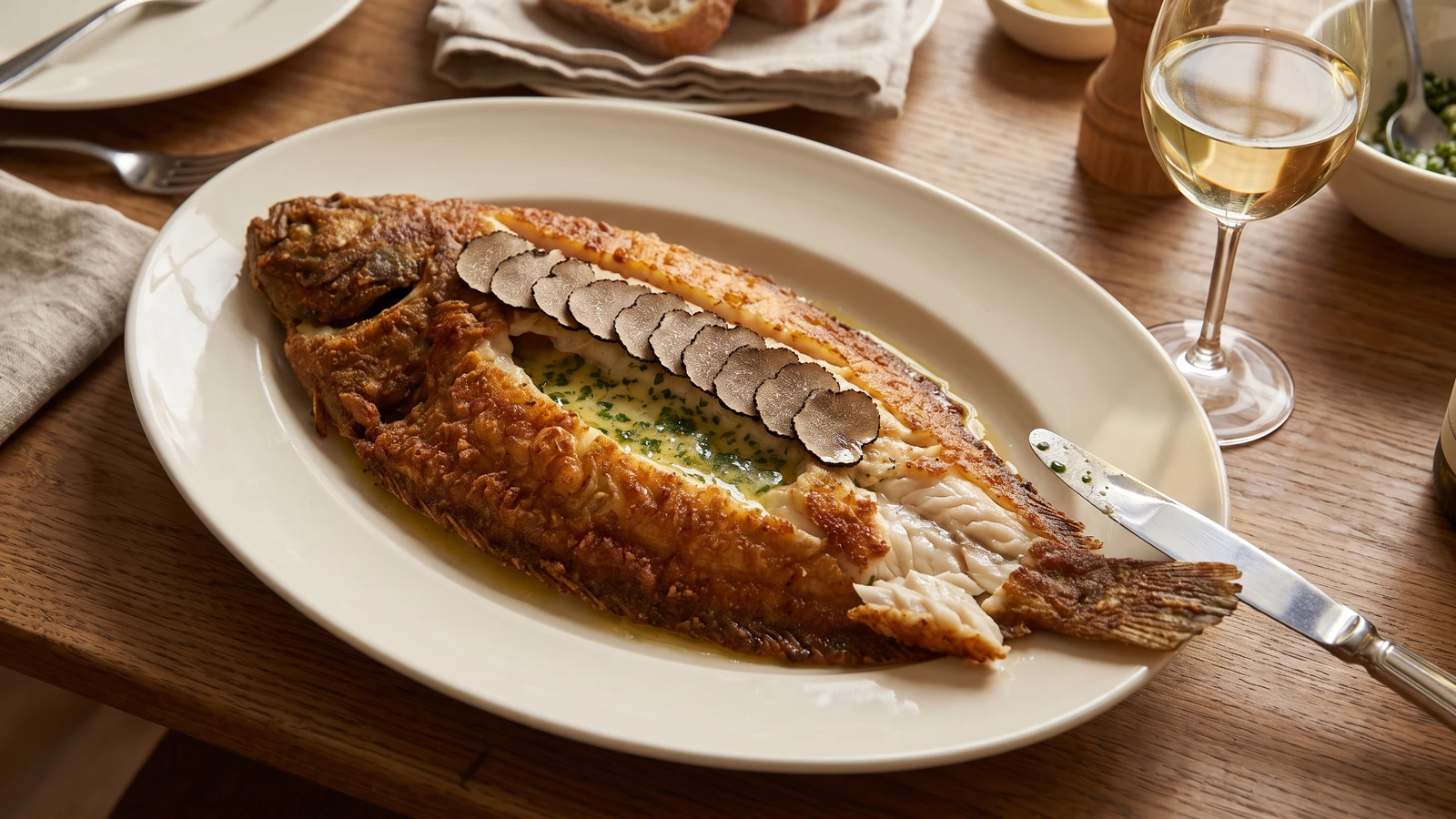
Sole Richelieu keeps its luxury disciplined: crisp-fried Sole Colbert, lifted from the bones while hot, filled with lemon-parsley maître d'hôtel butter, then crowned with one precise row of black truffle.
Sole Richelieu (crisp-fried sole, boned and filled with herb butter and truffle) teaches one uncompromising principle: luxury begins with correct frying. The crust must arrive dry, crisp, and deep gold before the bones are lifted away, then beurre à la maître d'hôtel (soft butter worked with parsley, lemon, salt, and pepper) melts into the hollow beneath a neat row of truffle.
The original assumes Sole Colbert (No. 822) coming directly from a fry station, service linen waiting to drain it, spare hands to remove the bones, and a hot platter ready at the pass. This entry needs neither a saucier nor a stockpot; its complication is timing. At home, mix the butter and slice the truffle first, replace the draining linen with a wire rack, fry in two batches, and warm one platter. That separate service choreography is brigade scaffolding and can go. The Colbert preparation, hot boning, maître d'hôtel butter, and truffle row are the dish and must stay. One cook, one stove, one evening.
When it lands correctly, the sole wears a crisp butter-gold shell while the opened centre gleams with melting parsley butter and near-black truffle. Before you touch the pan, settle the step that decides everything: the frying fat for the Sole Colbert must be truly hot, because a pale, oil-heavy crust cannot be repaired beneath expensive truffle.
Sole Richelieu belongs to the Parisian grand-kitchen repertory, where named treatments allowed cooks to make distinct dishes from the same prized flatfish. It is an elaboration of Sole Colbert (No. 822), not a regional fisherman's preparation: the Colbert frying and hot boning form the base, while maître d'hôtel butter and a strict row of truffle supply the Richelieu identity. The noble title reflects the formal naming habits of the canon, but the dish's logic remains visible and practical, crisp fish carrying melting butter and the perfume of truffle.
Quantity
4 Sole Colbert (No. 822), each made from 1 whole cleaned Dover sole weighing about 12 ounces (340 g)
freshly fried and drained according to its own entry
Quantity
8 tablespoons (120 ml / 113 g)
softened but still cool
Quantity
2 tablespoons (30 ml / 8 g)
very finely chopped
Quantity
1 tablespoon (15 ml / 15 g)
Quantity
1/4 teaspoon (1.25 ml / 1.5 g)
Quantity
1/8 teaspoon (0.6 ml / 0.25 g)
Quantity
1 small truffle, about 1 ounce (28 g)
drained if preserved and sliced paper-thin
| Ingredient | Quantity |
|---|---|
| hot Sole Colbertfreshly fried and drained according to its own entry | 4 Sole Colbert (No. 822), each made from 1 whole cleaned Dover sole weighing about 12 ounces (340 g) |
| unsalted buttersoftened but still cool | 8 tablespoons (120 ml / 113 g) |
| flat-leaf parsleyvery finely chopped | 2 tablespoons (30 ml / 8 g) |
| fresh lemon juice | 1 tablespoon (15 ml / 15 g) |
| fine sea salt | 1/4 teaspoon (1.25 ml / 1.5 g) |
| ground white pepper | 1/8 teaspoon (0.6 ml / 0.25 g) |
| fresh black truffle or preserved whole black truffledrained if preserved and sliced paper-thin | 1 small truffle, about 1 ounce (28 g) |
Work the softened butter with the parsley, lemon juice, salt, and white pepper until the beurre à la maître d'hôtel is evenly green-flecked and the lemon has disappeared into it. The butter should yield to a spoon but retain its shape. If it turns shiny or greasy, chill it for 5 minutes, then work it again; warm butter runs out of the fish before it can form the filling.
Divide the maître d'hôtel butter into four equal portions, about 2 tablespoons (30 ml / 28 g) each. Slice the truffle as thinly as your knife permits, blotting preserved truffle dry first, then keep the slices covered so their perfume stays where it belongs. Warm a large heatproof platter or four oval plates in a 200°F (95°C) oven.
Prepare the four Sole Colbert (No. 822) exactly according to its own entry, working in two uncrowded batches if your frying vessel holds two soles without touching. Keep the fat truly hot, about 350 to 355°F (175 to 180°C), and let it recover fully between batches. Hold the first pair on a wire rack in the warm oven for no more than 8 minutes while the second pair cooks; the rack replaces the book's draining linen and prevents the underside from sweating. If the fat cools, stop and restore the heat before another sole enters. A cooler bath gives a pale, oil-heavy crust, and no garnish can correct it afterward.
Set each hot sole upper side facing you. Gently lift the already freed upper fillets just enough to expose the central frame, then use a fork and the blunt side of a small fish knife to draw the pre-broken backbone away in sections from head end to tail. Sweep the hollow carefully for fragments without crushing the crisp coating. If a fillet tears, ça se rattrape: return the torn edge to its original line and let the butter hold it there, but never leave a bone beneath it.
Place one portion of maître d'hôtel butter inside each hollow and settle the freed fillets lightly around it, leaving the centre visible. Lay the truffle slices over the butter in one tidy, slightly overlapping row from head end to tail. Do not scatter them; that dark line is the Richelieu finish named by the source. Move the soles to the hot platter and serve while the crust remains crisp and the butter has just begun to pool beneath the truffle. À table!
1 serving (about 240g)
Culinary guides, cultural storytelling, and the editorial depth that makes cooking meaningful.
Discover Culinary ExplorerChef Juliette
John Dory has the delicacy of sole and the firmness of turbot. A light flouring, a quick butter sauté, and nut-brown beurre noisette show exactly why looks never mattered.

Chef Juliette
Fresh haddock proves its delicacy in the meunière pan: a fine flour crust, moist pearly flakes, and beurre noisette sharpened with lemon and parsley, ready from one skillet in half an hour.

Chef Juliette
Éperlans à l’Anglaise turns small fish into a lesson in disciplined coating: boned smelts under a close, crisp crumb, pan-fried in clarified butter and finished with bright, half-melted maître d’hôtel butter.

Chef Juliette
Tiny smelts, shallot, mushrooms, white wine, gratin sauce, and fine bread raspings meet a fierce oven, where the fish must turn tender in the same breath the buttered crust bronzes.