
Chef Juliette
John Dory (St. Pierre)
John Dory has the delicacy of sole and the firmness of turbot. A light flouring, a quick butter sauté, and nut-brown beurre noisette show exactly why looks never mattered.
A cooking platform built around craft, culture, and the stories behind what we eat.
Created by Chef Juliette
Based on No. 822, Sole Colbert, from Le Guide Culinaire (1907) by Auguste Escoffier
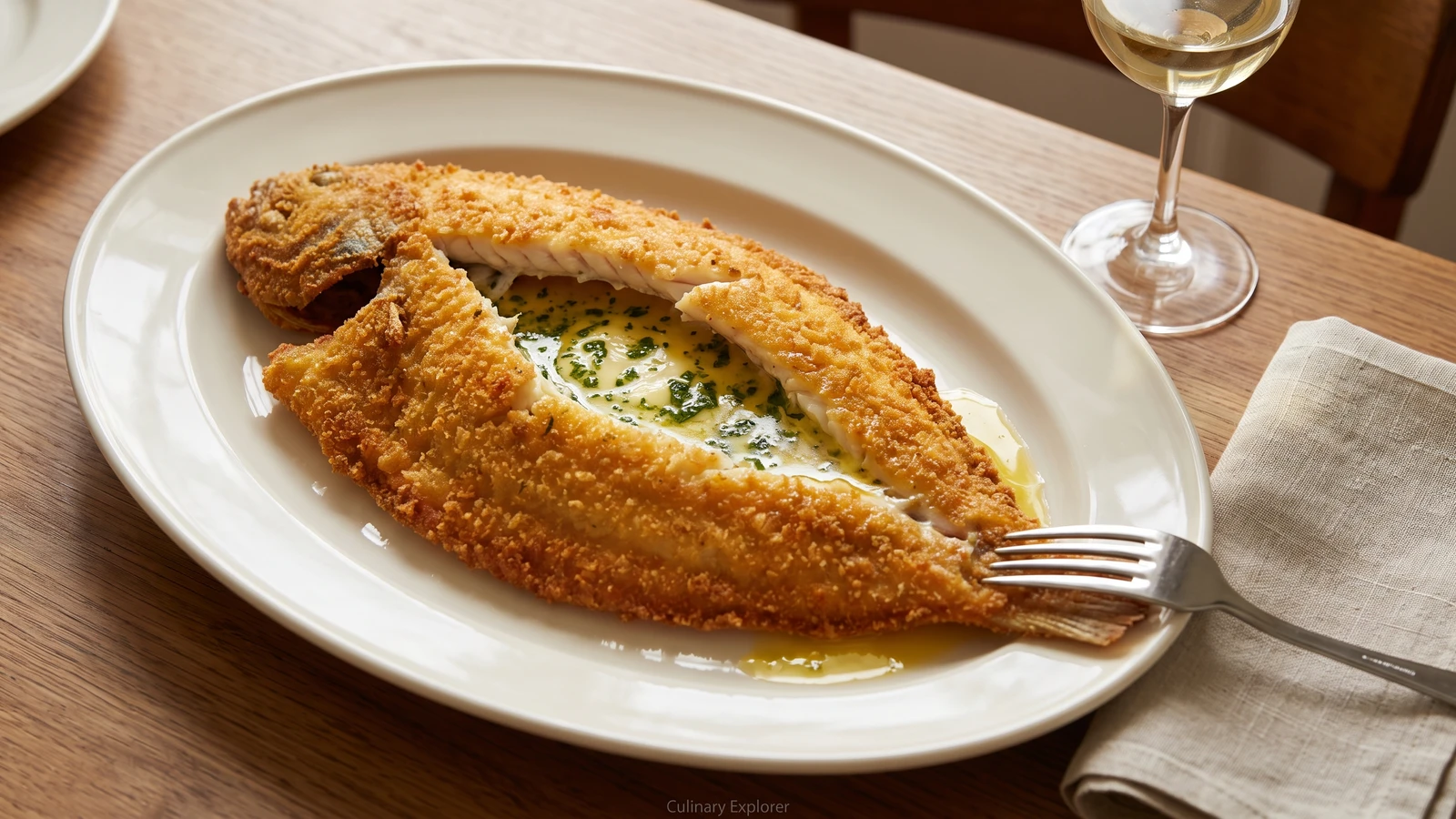
Sole Colbert turns exact knife work and truly hot fat into a generous dinner-party dish: a crisp golden fish whose bones lift away to make room for melting maître d'hôtel butter.
Sole Colbert (whole sole opened along the spine, crumbed and fried, then boned and filled with parsley-lemon butter) teaches one decisive truth: the fat must be truly hot before the fish enters. The panure à l'anglaise, its flour, egg, and crumb coat, becomes a protective crust only when the egg sets on contact. In lukewarm oil it drinks fat, loosens, and leaves the sole pale.
A brigade kept its soles trimmed, its coating ready, its fryer steady, its linen laid for draining, and its plates hot at the pass. There is no saucier, simmering stockpot, or salamander here because the entry needs none. Your honest equivalents are a fishmonger for the routine trimming, a flexible knife for the Colbert opening, a wide heavy pot with a thermometer, a wire rack, and a platter warmed in a low oven. The ready coating and draining station are scaffolding. Opening the upper fillets, breaking the backbone, frying in hot fat, and removing the skeleton while the fish is warm are the dish itself, and all of them stay. Four small soles make four generous servings, fried one at a time by one cook, on one stove, in one evening.
When it is right, the sole leaves the fat deep gold, its crumb dry and crisp beneath the fork. The skeleton draws away to reveal a clean hollow, and beurre maître d'hôtel, parsley-lemon butter, softens into that space and glosses the flesh. Before the first fish meets the pan, bring the oil fully to 375°F (190°C). No other step decides the dish so completely.
Sole Colbert belongs to the Parisian classical table, where whole flatfish preparations were distinguished as much by their cutting and service as by their sauces. Colbert is not a sauce: its identity lies in loosening the upper fillets, frying the fish pané à l'anglaise, drawing out the skeleton, and filling the resulting hollow with maître d'hôtel butter. The preparation passed readily into cuisine bourgeoise because its drama comes from disciplined knife work and timing, not from a stockpot or a brigade.
Quantity
4 fish, 8 to 10 oz (225 to 285 g) each
heads removed, both sides skinned and fins trimmed
Quantity
1 cup (240 ml / 245 g)
Quantity
1 cup (240 ml / 125 g)
Quantity
3/4 cup (180 ml / 180 g) prepared Anglaise (for Egg-and-bread-crumbing) (No. 174)
Quantity
2 cups (480 ml / 200 g)
Quantity
About 2 quarts (1.9 L / 1.75 kg), enough for a 2-inch (5 cm) depth
Quantity
8 tablespoons (120 ml / 113 g)
softened
Quantity
1/4 cup (60 ml / 15 g)
very finely chopped
Quantity
2 tablespoons (30 ml / 30 g)
Quantity
1/2 teaspoon (2.5 ml / 3 g)
Quantity
1/4 teaspoon (1.25 ml / 0.5 g)
| Ingredient | Quantity |
|---|---|
| whole Dover solesheads removed, both sides skinned and fins trimmed | 4 fish, 8 to 10 oz (225 to 285 g) each |
| whole milk | 1 cup (240 ml / 245 g) |
| plain flour | 1 cup (240 ml / 125 g) |
| Anglaise (for Egg-and-bread-crumbing) | 3/4 cup (180 ml / 180 g) prepared Anglaise (for Egg-and-bread-crumbing) (No. 174) |
| fine dry breadcrumbs | 2 cups (480 ml / 200 g) |
| neutral high-heat oil | About 2 quarts (1.9 L / 1.75 kg), enough for a 2-inch (5 cm) depth |
| unsalted buttersoftened | 8 tablespoons (120 ml / 113 g) |
| flat-leaf parsleyvery finely chopped | 1/4 cup (60 ml / 15 g) |
| fresh lemon juice | 2 tablespoons (30 ml / 30 g) |
| fine sea salt | 1/2 teaspoon (2.5 ml / 3 g) |
| finely ground white pepper | 1/4 teaspoon (1.25 ml / 0.5 g) |
Work the softened butter with the parsley, lemon juice, salt, and white pepper until evenly green-flecked and supple. Divide it into four equal batons, each about 1 oz (28 g), and chill them for 15 minutes so they hold their shape. Bring them out again as the oil heats; the butter should be cool but pliable when it enters the fish, not hard from the refrigerator.
Pat each sole thoroughly dry and set it pale side down, with the upper side facing you. Cut along the centre line from the shoulder end toward the tail until the knife reaches the backbone. Keeping the blade nearly flat, slide it outward over the bones to loosen each of the two upper fillets from the spine, stopping before the outer edge so the fillets remain attached around their margins. Through the central opening, snip or crack the exposed backbone in three evenly spaced places without cutting the lower skin. Ease the loosened fillets back a finger's width so they are clearly free of the bones.
Set a wire rack over a rimmed tray and warm the oven to 200°F (95°C), placing four heatproof dinner plates or one large platter inside. Pour the oil into a wide, deep, heavy pot, never filling it more than one-third, and heat it to 375°F (190°C). Very hot means measured, not smoking. Keep the pot steady, leave room around it, and have its lid nearby.
Arrange four wide dishes in order: milk, flour, the prepared Anglaise (for Egg-and-bread-crumbing) (No. 174), and fine breadcrumbs. Dip one sole completely in the milk and let the excess run away. Coat it lightly but thoroughly with flour, shake off every loose patch, pass it through the Anglaise (for Egg-and-bread-crumbing) (No. 174), then press it into the crumbs on both sides and inside the opened channels. Ease the upper fillets back slightly once more so the breading does not seal them onto the bones. Repeat with the remaining soles and leave them on a dry rack while the oil reaches its full temperature.
Lower one sole into the oil, upper side facing up and moving it away from you. The temperature will fall; adjust the heat to hold it between 350°F and 365°F (175°C and 185°C). Fry for 4 to 5 minutes, turning carefully once after the crust has set, until the coating is an even deep gold and the flesh beside the backbone is opaque, moist, and at least 145°F (63°C). If a piece of coating begins to loosen, stop moving the fish and hold that section beneath the oil with a spider for 20 seconds so the egg can set again. Ça se rattrape. Lift the fish with two wide turners or spiders, supporting its whole length.
Set the fried sole upper side up on the wire rack, never flat on paper, which traps moisture beneath the crust. Place the rack in the low oven while the oil returns to 375°F (190°C), then fry the remaining soles one at a time. Keep the holding time under 12 minutes; the oven is there to protect the first fish from the cold, not to cook it a second time.
Working with the first fried sole first, lift the two loosened upper fillets gently with the tip of a knife. Grip the exposed backbone at the shoulder end with small tongs and draw out the broken sections one by one; the attached rib bones should come with them. If a section resists, snip it free instead of tearing the flesh. Run a fingertip carefully through the hollow to find any remaining bone fragments, then settle the fillets back into their natural shape. If an edge tears, lay it back in place without fuss. The butter will hold the fish together on the plate.
Transfer each sole to its very hot plate and place one baton of maître d'hôtel butter along the clean central hollow. Let the butter soften into the fish until its edges shine and the parsley and lemon begin to perfume the crust. Serve at once, while the underside is still crisp and the butter is pooling through the flesh. À table!
1 serving (about 220g)
Culinary guides, cultural storytelling, and the editorial depth that makes cooking meaningful.
Discover Culinary ExplorerChef Juliette
John Dory has the delicacy of sole and the firmness of turbot. A light flouring, a quick butter sauté, and nut-brown beurre noisette show exactly why looks never mattered.

Chef Juliette
Fresh haddock proves its delicacy in the meunière pan: a fine flour crust, moist pearly flakes, and beurre noisette sharpened with lemon and parsley, ready from one skillet in half an hour.

Chef Juliette
Éperlans à l’Anglaise turns small fish into a lesson in disciplined coating: boned smelts under a close, crisp crumb, pan-fried in clarified butter and finished with bright, half-melted maître d’hôtel butter.

Chef Juliette
Tiny smelts, shallot, mushrooms, white wine, gratin sauce, and fine bread raspings meet a fierce oven, where the fish must turn tender in the same breath the buttered crust bronzes.