
Chef Juliette
John Dory (St. Pierre)
John Dory has the delicacy of sole and the firmness of turbot. A light flouring, a quick butter sauté, and nut-brown beurre noisette show exactly why looks never mattered.
A cooking platform built around craft, culture, and the stories behind what we eat.
Created by Chef Juliette
Based on No. 834, Sole au Chambertin, from Le Guide Culinaire (1907) by Auguste Escoffier
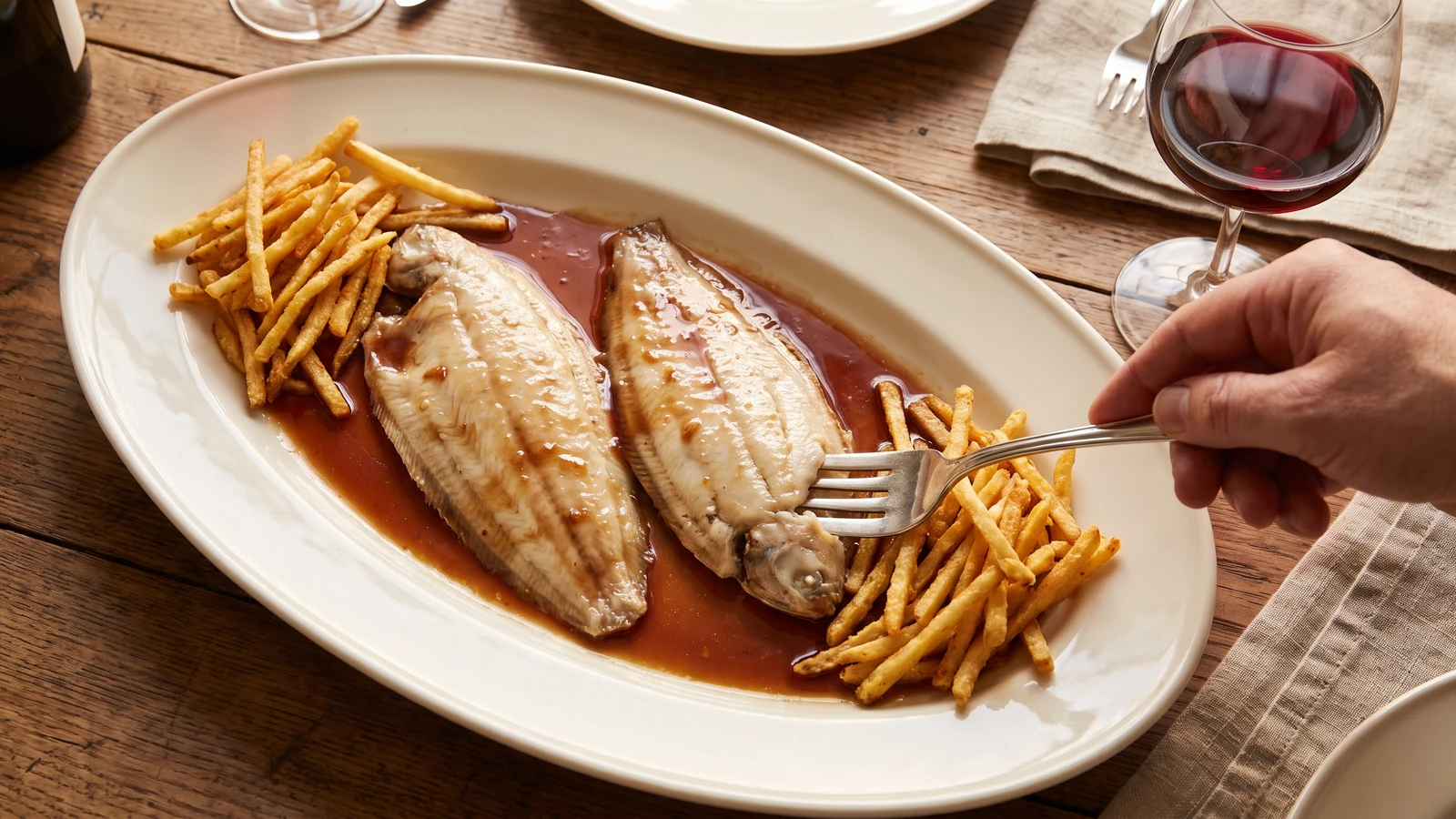
Sole poached in Chambertin, glazed with its wine-dark reduction, and bordered with crisp fried julienne: the classical lesson in cooking fish and sauce on separate clocks.
Sole au Chambertin (sole poached in Chambertin) teaches that a red wine sauce can meet delicate fish without bullying it, provided the fish and the reduction stop cooking on different clocks. The one true thing to know before touching a pan is this: once the sole is just cooked, it leaves the wine. The liquor must reduce alone, or the sauce stays thin while the fish turns dry.
The book's kitchen assumed a saucier to watch that reduction, a hot cupboard to hold the sole, a salamander ready for the glaze, and another pair of hands frying the julienne at the last moment. At home, a small saucepan, a warmed ovenproof platter, and a household broiler do those jobs in sequence. The hot cupboard and extra hands are brigade scaffolding, so they go; the Chambertin poach, the half reduction, the beurre manié (kneaded butter) supplied as Manied Butter (No. 151), the cold butter finish, the quick glaze, and the crisp sole julienne are the dish, so every one stays. Two large soles serve four. One cook, one stove, one evening.
The sauce should arrive wine-dark but not harsh, glossy with butter, with the fried matchsticks cracking lightly under the fork. Measure the liquor before and after reduction rather than trusting the clock. Reducing it to half, no less and no more, is the step that decides Sole au Chambertin.
Sole au Chambertin belongs to the Parisian grand-kitchen repertory, borrowing Chambertin from Burgundy's Côte de Nuits while its Dover sole comes from Channel fisheries. It passed from grand dining rooms to home recipe books because its logic scales cleanly: the poaching liquor itself becomes the sauce. The dish is neither a Burgundian fisherman's preparation nor meunière in red; its identity lies in poaching the fish, halving the wine liquor, building a butter-bound sauce, and glazing it quickly.
Quantity
2, each 1¼ to 1½ pounds (570 to 680 g)
gutted, skinned on both sides, with heads and fins trimmed
Quantity
2 fillets, 7 ounces (200 g) total
cut julienne-fashion into match-shaped strips
Quantity
1½ teaspoons (7.5 ml / 9 g)
divided
Quantity
½ teaspoon (2.5 ml / 1 g)
divided
Quantity
1 tablespoon (15 ml / 14 g)
softened
Quantity
1½ cups plus 2 tablespoons (385 ml / 380 g)
Quantity
6 drops (0.3 ml / 0.3 g)
Quantity
6 tablespoons (90 ml / 85 g)
cut into small cubes
Quantity
¼ cup (60 ml / 30 g)
for dredging
Quantity
¼ cup (60 ml / 55 g)
Quantity
Up to ¼ cup (60 ml / 60 g)
for sauce rescue
| Ingredient | Quantity |
|---|---|
| whole Dover solesgutted, skinned on both sides, with heads and fins trimmed | 2, each 1¼ to 1½ pounds (570 to 680 g) |
| skinless sole filletscut julienne-fashion into match-shaped strips | 2 fillets, 7 ounces (200 g) total |
| fine sea saltdivided | 1½ teaspoons (7.5 ml / 9 g) |
| freshly ground black pepperdivided | ½ teaspoon (2.5 ml / 1 g) |
| unsalted butter for the poaching dishsoftened | 1 tablespoon (15 ml / 14 g) |
| Chambertin wine | 1½ cups plus 2 tablespoons (385 ml / 380 g) |
| Manied Butterfreshly made | 2 tablespoons (30 ml / 30 g) Manied Butter (No. 151) |
| fresh lemon juice | 6 drops (0.3 ml / 0.3 g) |
| cold unsalted buttercut into small cubes | 6 tablespoons (90 ml / 85 g) |
| all-purpose flourfor dredging | ¼ cup (60 ml / 30 g) |
| clarified butter | ¼ cup (60 ml / 55 g) |
| water (optional)for sauce rescue | Up to ¼ cup (60 ml / 60 g) |
Heat the oven to 350°F (180°C). Fill a broiler-safe oval platter with hot water so it warms while you work. Pat the whole soles dry and season them on both sides with 1 teaspoon of the salt and ¼ teaspoon of the pepper. Cut the extra fillets julienne-fashion into match-shaped strips about ⅛ inch (3 mm) wide and 2 inches (5 cm) long; keep them cold and uncovered so their surfaces stay dry. Do not season or dredge the strips yet, because salt draws out moisture and flour left waiting turns pasty.
Coat a large shallow ovenproof dish with the softened butter and lay in the soles without overlap. Pour the Chambertin around them, cover closely with a sheet of parchment, and poach in the oven for 12 to 16 minutes. The wine should barely tremble at the edges; the fish is ready when its flesh is opaque, lifts cleanly beside the backbone, and reaches 145°F (63°C) at the thickest point. Drain and dry the warmed platter, lift the soles onto it with two wide spatulas, and cover loosely with buttered parchment. Pour every drop of the cooking liquor through a fine sieve into a small saucepan.
Bring the cooking liquor to a brisk simmer in the smallest saucepan that holds it comfortably. Reduce it from about 1½ cups plus 2 tablespoons (385 ml) to a measured ¾ cup plus 1 tablespoon (190 ml), skimming away any grey protein that gathers at the surface. Add the remaining ¼ teaspoon pepper and the 6 drops of lemon juice. Judge this by volume, not minutes. If you go below the mark, add enough hot water to return the liquor to 190 ml; ça se rattrape. Pressing on with overreduced wine gives a harsh, salty sauce.
Lower the heat until the reduction stops bubbling. Whisk in the Manied Butter (No. 151), a small piece at a time, waiting for each piece to disappear before adding the next. Hold the sauce just below a simmer for 2 minutes, whisking steadily; it should thicken without boiling. The finish is monter au beurre (mounting with butter): take the pan completely off the heat and whisk in the cold butter one cube at a time until the sauce nappes, or coats, the back of a spoon with a smooth gloss. If it turns greasy or grainy, stop adding butter. Ça se rattrape: put 1 teaspoon of cold water in a clean warm saucepan, whisk in a spoonful of the broken sauce until smooth, then rebuild the rest spoonful by spoonful. Taste and adjust the salt only after the butter is in.
Heat the broiler to high. Set the finished sauce off the heat and cover it. Season the sole strips with the remaining ½ teaspoon salt and ¼ teaspoon pepper, dredge them lightly in the flour, and toss them in a sieve to shed every loose speck. Heat the clarified butter in a wide skillet to about 350°F (175°C), then fry the strips in one uncrowded layer, working in two batches if necessary. Turn them once and lift them out after 60 to 90 seconds, when butter-gold at the edges and crisp enough to hold their shape. Drain on a wire rack, not a heap of paper where they would soften.
Whisk the sauce once more. If it has tightened while the julienne fried, loosen it with a teaspoon of warm water until it pours in a thick ribbon. Spoon it evenly over the soles and place the platter about 6 inches (15 cm) beneath the hot broiler for 20 to 40 seconds, only until the glaze shines and a few tiny bubbles appear around the edges. Do not chase browning; a long glaze breaks the butter and dries the fish. Arrange the crisp julienne in small generous heaps along both long sides of the platter and serve immediately. À table!
1 serving (about 220g)
Culinary guides, cultural storytelling, and the editorial depth that makes cooking meaningful.
Discover Culinary ExplorerChef Juliette
John Dory has the delicacy of sole and the firmness of turbot. A light flouring, a quick butter sauté, and nut-brown beurre noisette show exactly why looks never mattered.

Chef Juliette
Fresh haddock proves its delicacy in the meunière pan: a fine flour crust, moist pearly flakes, and beurre noisette sharpened with lemon and parsley, ready from one skillet in half an hour.

Chef Juliette
Éperlans à l’Anglaise turns small fish into a lesson in disciplined coating: boned smelts under a close, crisp crumb, pan-fried in clarified butter and finished with bright, half-melted maître d’hôtel butter.

Chef Juliette
Tiny smelts, shallot, mushrooms, white wine, gratin sauce, and fine bread raspings meet a fierce oven, where the fish must turn tender in the same breath the buttered crust bronzes.