
Chef Juliette
John Dory (St. Pierre)
John Dory has the delicacy of sole and the firmness of turbot. A light flouring, a quick butter sauté, and nut-brown beurre noisette show exactly why looks never mattered.
A cooking platform built around craft, culture, and the stories behind what we eat.
Created by Chef Juliette
Based on No. 803, Saumon Froid ou Darne de Saumon Froid à la Riga, from Le Guide Culinaire (1907) by Auguste Escoffier
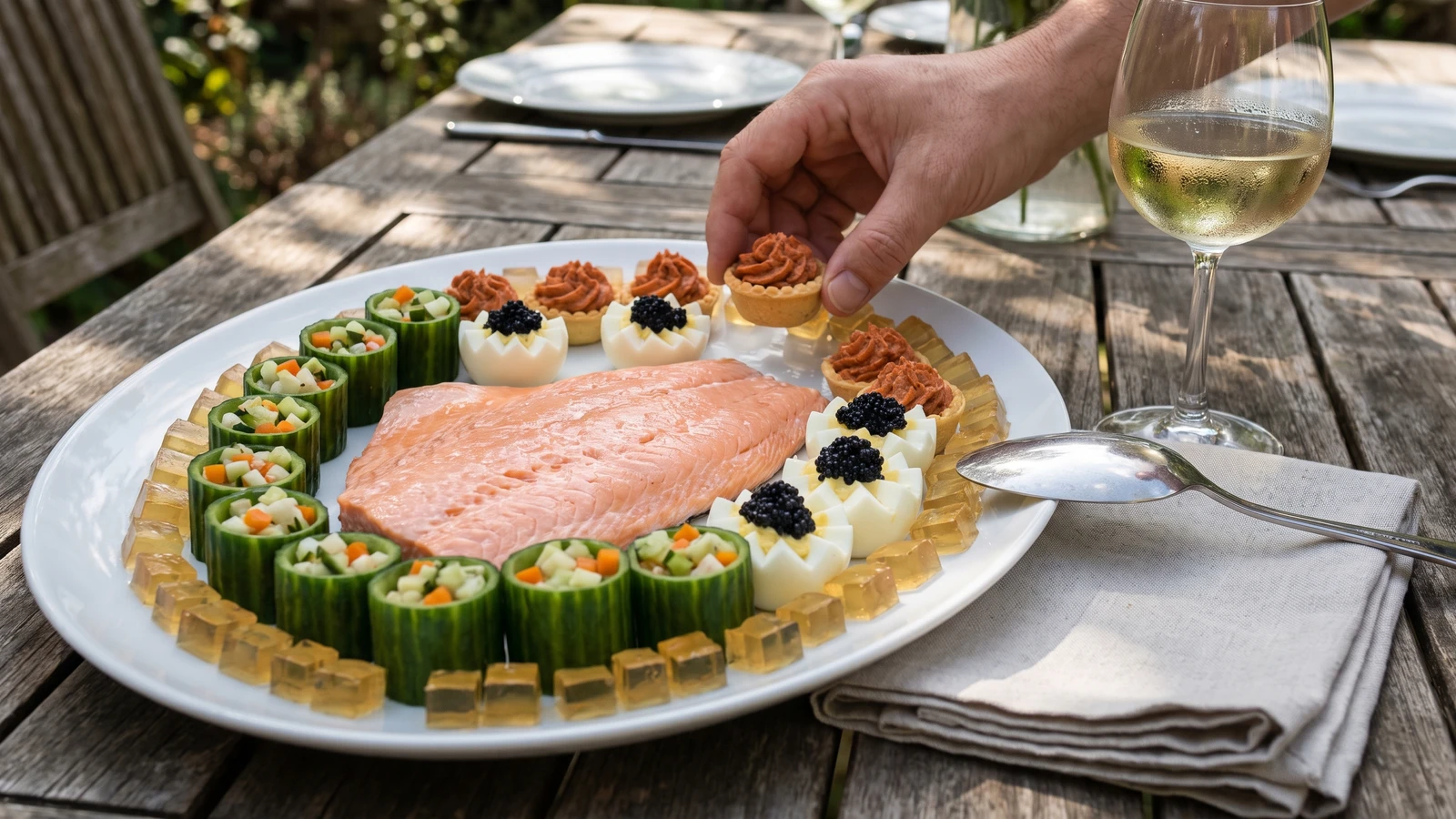
Saumon Froid à la Riga turns cold poached salmon into a generous summer centerpiece, surrounded by crisp cucumber timbales, caviar eggs, crayfish-mousse tartlets, and a bright border of jelly.
Saumon Froid ou Darne de Saumon Froid à la Riga (cold salmon with the Riga garnish) teaches the architecture of the classical cold table. The salmon sits calm at the center; cucumber timbales, macédoine bound with mayonnaise, caviar-filled eggs, crayfish mousse tartlets, and jelly dice make the ring around it. Each mouthful stays distinct, and together they read as abundance.
The book's formula assumed a fish poacher, a garde-manger shaping decorations while the cold larder held mayonnaise and aspic ready, and enough hands to cool, mould, fill, and arrange in parallel. At home, a snug roasting pan, a single center-cut darne for four, a small batch of real mayonnaise, and jelly made from the strained poaching liquor do the same work. The monumental whole fish and elaborate display cushion were brigade scaffolding, so the cushion becomes a low bed of cucumber trimmings; the alternating ring is the dish, and it stays. One cook, one stove, one evening.
Before touching a pan, know the one true thing: the poaching liquor must barely move. A boil squeezes the salmon dry and covers it with white albumen; hold the liquid below a simmer, then chill the fish completely before lifting and dressing it. That gentle poach decides everything that follows.
Saumon Froid à la Riga belongs to the French grand cold-buffet repertoire, especially the Parisian banquet and hotel table, rather than to Latvian home cooking. In French menu language, à la Riga points toward the Baltic through caviar and an ornamental shellfish garnish, turning simply poached salmon into a composed summer display. The dish traveled naturally to bourgeois garden tables because every part could be prepared cold, yet its alternating garnishes preserve the discipline of the grand kitchen.
Quantity
1, about 2 lb (900 g) and 3 in (7.5 cm) thick
scaled and wiped clean
Quantity
6 cups (1.4 L / about 1.45 kg) Cooked Marinade for Venison (No. 168)
chilled
Quantity
1 tbsp plus 1 tsp (20 ml / 12 g)
divided
Quantity
1/3 cup (80 ml / 80 g)
divided
Quantity
3/4 cup (180 ml / 95 g)
Quantity
3 1/2 tbsp (52 ml / 50 g)
diced
Quantity
1 1/2 to 2 tbsp (22 to 30 ml / 22 to 30 g)
Quantity
2 tsp (10 ml / 12 g)
divided
Quantity
1 large, about 14 oz (400 g)
Quantity
1 small, about 3 1/2 oz (100 g)
peeled and cut into 1/4 in (6 mm) dice
Quantity
1 medium, about 2 1/2 oz (70 g)
peeled and cut into 1/4 in (6 mm) dice
Quantity
1 small, about 2 1/2 oz (70 g)
peeled and cut into 1/4 in (6 mm) dice
Quantity
1/2 cup (120 ml / 60 g)
cut into 1/4 in (6 mm) pieces
Quantity
1/2 cup (120 ml / 70 g)
Quantity
1
Quantity
1 tsp (5 ml / 5 g)
Quantity
1 tbsp (15 ml / 15 g)
divided
Quantity
3/4 cup (180 ml / 165 g)
divided
Quantity
1 tbsp (15 ml / 15 g)
Quantity
1/2 tsp (2.5 ml / 1 g)
divided
Quantity
2
Quantity
2 tbsp (30 ml / 30 g)
Quantity
12, about 1 lb (450 g)
meat picked and 4 intact shells reserved
Quantity
1/3 cup (80 ml / 80 g)
very cold
| Ingredient | Quantity |
|---|---|
| center-cut salmon darnescaled and wiped clean | 1, about 2 lb (900 g) and 3 in (7.5 cm) thick |
| Cooked Marinade for Venisonchilled | 6 cups (1.4 L / about 1.45 kg) Cooked Marinade for Venison (No. 168) |
| powdered gelatindivided | 1 tbsp plus 1 tsp (20 ml / 12 g) |
| cold water for gelatindivided | 1/3 cup (80 ml / 80 g) |
| all-purpose flour | 3/4 cup (180 ml / 95 g) |
| cold unsalted butterdiced | 3 1/2 tbsp (52 ml / 50 g) |
| ice water | 1 1/2 to 2 tbsp (22 to 30 ml / 22 to 30 g) |
| fine sea saltdivided | 2 tsp (10 ml / 12 g) |
| English cucumber | 1 large, about 14 oz (400 g) |
| waxy potatopeeled and cut into 1/4 in (6 mm) dice | 1 small, about 3 1/2 oz (100 g) |
| carrotpeeled and cut into 1/4 in (6 mm) dice | 1 medium, about 2 1/2 oz (70 g) |
| turnippeeled and cut into 1/4 in (6 mm) dice | 1 small, about 2 1/2 oz (70 g) |
| fine green beanscut into 1/4 in (6 mm) pieces | 1/2 cup (120 ml / 60 g) |
| frozen peas | 1/2 cup (120 ml / 70 g) |
| pasteurized large egg yolk | 1 |
| Dijon mustard | 1 tsp (5 ml / 5 g) |
| fresh lemon juicedivided | 1 tbsp (15 ml / 15 g) |
| neutral oildivided | 3/4 cup (180 ml / 165 g) |
| cold water for mayonnaise | 1 tbsp (15 ml / 15 g) |
| finely ground white pepperdivided | 1/2 tsp (2.5 ml / 1 g) |
| large eggs | 2 |
| black or golden caviar | 2 tbsp (30 ml / 30 g) |
| cooked whole crayfishmeat picked and 4 intact shells reserved | 12, about 1 lb (450 g) |
| heavy creamvery cold | 1/3 cup (80 ml / 80 g) |
Make the pâte brisée, the short pastry for the tartlets. Mix the flour with 1/4 tsp of the salt, then rub in the cold butter until the mixture resembles coarse crumbs with a few small flakes remaining. Add 1 1/2 tbsp of ice water and press the dough together; add the final 1/2 tbsp only if dry flour remains. Flatten into a disc, wrap, and chill for 30 minutes. Work lightly, because overmixed pastry shrinks and hardens.
Lay the salmon on a wide strip of parchment long enough to serve as a lifting sling, then lower it into a snug oval pan. Pour the chilled Cooked Marinade for Venison (No. 168) around it and warm everything slowly over medium-low heat. Hold the liquor between 170 and 180°F (77 and 82°C), with only a faint movement at the edge, until the thickest flesh reaches 140°F (60°C), about 20 to 25 minutes. Remove the pan from the heat and rest the fish for 5 minutes so it carries to 145°F (63°C). If the liquor boils and white albumen beads on the salmon, pull the pan off the heat immediately; once the fish is cold, wipe the albumen away gently with a damp cloth. Ça se rattrape. Lift the darne onto a rack, cool for no longer than 30 minutes, then refrigerate until completely cold, at least 3 hours.
Strain 2 cups (475 ml) of the used Cooked Marinade for Venison (No. 168) into a clean saucepan, boil it for 2 minutes, then pass it through a damp cloth-lined sieve. Bloom 3 tsp of the gelatin in 1/4 cup (60 ml) of the cold water for 5 minutes. Remove the liquor from the heat, whisk in the bloomed gelatin until dissolved, and chill a teaspoonful on a saucer for 5 minutes. It should cut cleanly rather than slump. If it remains soft, bloom the reserved 1 tsp gelatin in the remaining cold water, rewarm the liquor without boiling, and whisk it in. Reserve 2 tbsp of liquid jelly for the mousse, then pour the rest into a shallow dish and chill until firm.
Heat the oven to 375°F (190°C). Roll the chilled pastry 1/8 in (3 mm) thick and line four 2 1/2 in (6 cm) tartlet tins. Prick the bases, chill them for 10 minutes, then line with parchment and baking weights. Bake for 12 minutes, remove the weights, and bake for another 5 to 7 minutes, until dry and evenly golden. Cool completely before filling. A warm shell softens the mayonnaise and loses its crisp bite.
Whisk the pasteurized yolk with the Dijon, 2 tsp of lemon juice, a pinch of salt, and a pinch of white pepper. Add the neutral oil first in drops, then in a thin thread once the emulsion thickens, reserving a few drops of oil for the cucumber. If the mayonnaise becomes too stiff, loosen it with a teaspoon of cold water. If it separates, stop pouring: whisk a teaspoon of cold water in a clean bowl, then feed the broken mayonnaise into it one teaspoon at a time. Ça se rattrape. Cover and keep cold.
Macédoine is the precise dice of vegetables that fills both the timbales and tartlets. Bring a saucepan of well-salted water to a lively boil and cook the vegetables separately: potato and turnip until tender but square, carrot until just tender, beans until bright and yielding, and peas for 1 minute. Chill each batch in iced water, drain thoroughly, and spread it on a clean towel until dry. Moist vegetables loosen mayonnaise. Fold the cold dice with about 2/3 cup (160 ml) of mayonnaise, adding only enough to bind the pieces into a salad that holds the shape of a spoonful. If it weeps, drain it briefly, pat it dry, and bind again with another spoonful of mayonnaise.
Run a channel knife down the cucumber at even intervals to make lengthwise grooves, then cut four sections about 1 1/2 in (4 cm) tall. Hollow each section with a small spoon, leaving a 1/4 in (6 mm) base and sturdy walls. Reserve the cucumber ends and grooved trimmings for the cushion. Parboil the timbales in salted water for 90 seconds, just until they bend slightly without collapsing, then chill them in iced water and drain upside down. Marinate them with the reserved drops of oil and a few drops of lemon juice. If one wall cracks, wrap it in a thin cucumber collar cut from a reserved end and stand the join toward the salmon.
Cook the eggs for 9 minutes, chill them thoroughly, and peel. Cut a shallow zigzag around each equator with a paring knife, separate the indented halves, and remove the yolks for another use. For the mousse, purée the crayfish meat with 2 tbsp of mayonnaise, the reserved 2 tbsp of barely liquid jelly, a pinch of salt, and white pepper. Whip the cold cream to soft folds and fold it into the crayfish mixture. Spoon the mousse into the four cleaned crayfish shells and chill for 20 minutes. If it slumps, chill the bowl for 10 minutes before filling; if it sets too firmly, fold in a teaspoon of cold cream.
Cut the firm jelly into neat 1/4 in (6 mm) dice. Fill the cucumber timbales generously with macédoine. Fill the tartlet shells with the same salad and crown each with a crayfish shell stuffed with mousse. Spoon the caviar into the four egg cavities only now, so its surface stays glossy and its salt does not stain the egg.
Pat the reserved cucumber trimmings dry and pack them into a low oval cushion on a chilled platter. Remove the salmon skin carefully and scrape away any dark surface bloodline without disturbing the shape, then lift the darne onto the cushion so it sits slightly raised. If it cracks at the central bone, fit the pieces back together on the cushion; the intact outline matters more than an invisible join. Alternate the four cucumber timbales, four caviar-filled egg halves, and four crayfish-mousse tartlets around the salmon. Encircle everything with a generous border of jelly dice. Keep the platter cold until serving, and set it over a shallow tray of ice for outdoor dining. À table!
1 serving (about 510g)
Culinary guides, cultural storytelling, and the editorial depth that makes cooking meaningful.
Discover Culinary ExplorerChef Juliette
John Dory has the delicacy of sole and the firmness of turbot. A light flouring, a quick butter sauté, and nut-brown beurre noisette show exactly why looks never mattered.

Chef Juliette
Fresh haddock proves its delicacy in the meunière pan: a fine flour crust, moist pearly flakes, and beurre noisette sharpened with lemon and parsley, ready from one skillet in half an hour.

Chef Juliette
Éperlans à l’Anglaise turns small fish into a lesson in disciplined coating: boned smelts under a close, crisp crumb, pan-fried in clarified butter and finished with bright, half-melted maître d’hôtel butter.

Chef Juliette
Tiny smelts, shallot, mushrooms, white wine, gratin sauce, and fine bread raspings meet a fierce oven, where the fish must turn tender in the same breath the buttered crust bronzes.