
Chef Juliette
John Dory (St. Pierre)
John Dory has the delicacy of sole and the firmness of turbot. A light flouring, a quick butter sauté, and nut-brown beurre noisette show exactly why looks never mattered.
A cooking platform built around craft, culture, and the stories behind what we eat.
Created by Chef Juliette
Based on No. 794, Darne de Saumon Régence, from Le Guide Culinaire (1907) by Auguste Escoffier
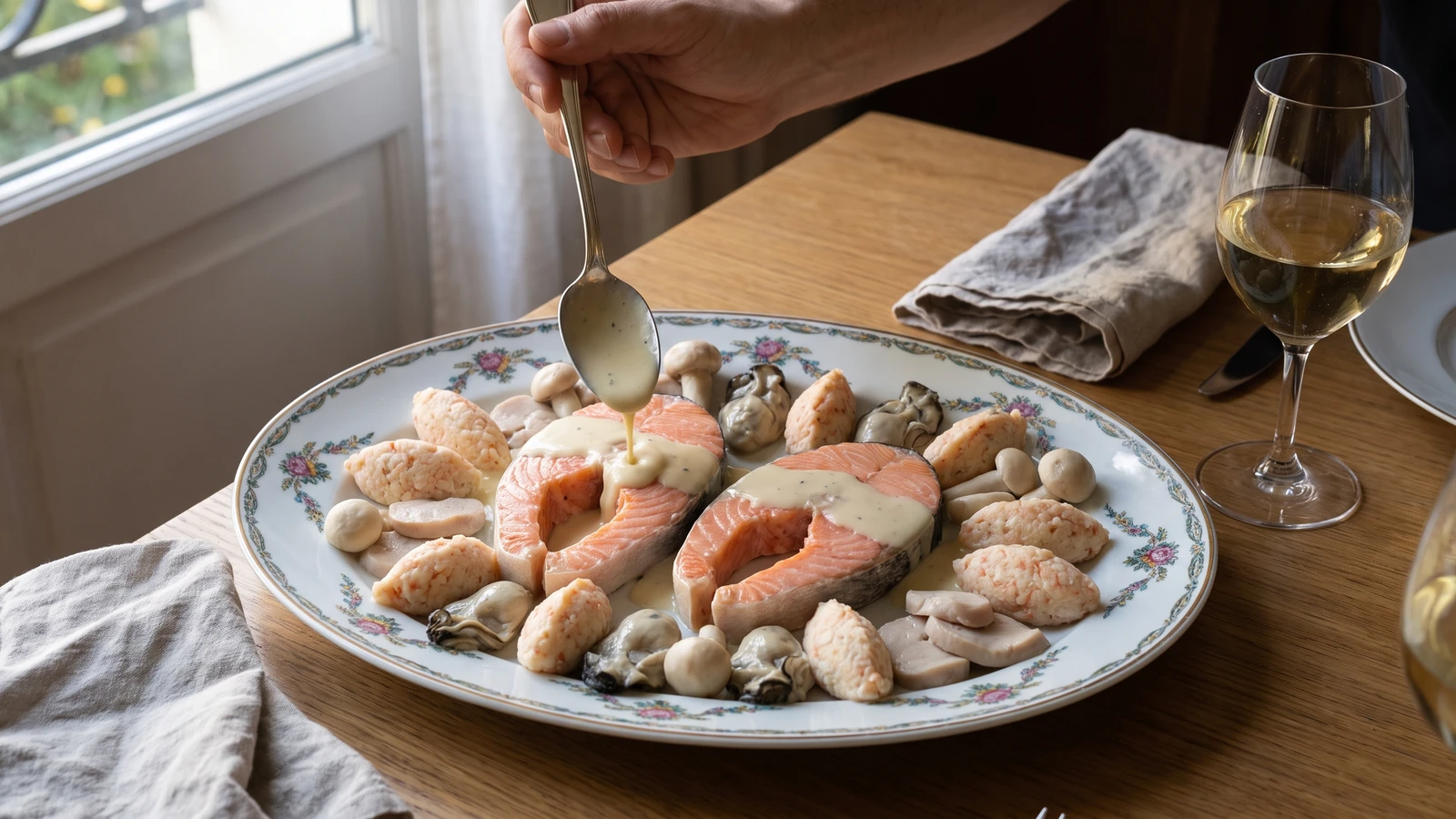
Salmon darnes braised in white wine, ringed with crayfish-whiting quenelles, oysters, mushrooms, and milt, then covered with truffle-scented Normande sauce: a grand garnish made workable for one careful home cook.
Darne de Saumon Régence (salmon steak dressed in the Régence manner) teaches orchestration. Its one true rule is simple: every garnish must be ready before the salmon enters the pan, because the fish won't wait while you shape a quenelle or beard an oyster. When the timing lands, the darne is moist, the quenelles are tender, the oysters barely set, and the ivory Normande sauce carries crayfish and truffle without smothering any of them.
The original kitchen assumed a poissonnier at the fish kettle, a saucier on staff, light fish stock never off the fire, and a salamander waiting for dishes that required its heat. This preparation needs no salamander; its glaze comes from the uncovered braise. At home, a snug sauté pan and wide spatula replace the fish kettle and drainer, while properly prepared crayfish butter and truffle essence replace two separate background productions. The equipment and brigade scheduling were scaffolding, so they go. The white-wine braise, all four garnishes, and the Normande liaison are the dish, so they stay. One cook, one stove, one evening.
Prepare and poach every element of the Régence garnish before beginning the salmon. That order, more than speed, is the step that brings the whole composition to the table hot, generous, and intact.
Darne de Saumon Régence belongs to the Parisian grand-kitchen repertoire, where a named garnish told the dining room exactly which family of accompaniments would surround the fish. Régence here means the composed ring of whiting quenelles enriched with crayfish butter, bearded oysters, white mushrooms, poached milt, and Normande sauce scented with truffle. The sauce draws on the cream, mushrooms, oysters, and fish liquors associated with Normandy and the Channel coast, but the complete preparation is a formal dish of the national canon, not a Norman household salmon recipe.
Quantity
4, about 7 ounces (200 g) each
cut 1½ inches (4 cm) thick
Quantity
1¼ cups (300 ml / 300 g)
Quantity
1¼ cups (300 ml / 300 g)
Quantity
1 fillet, about 8 ounces (225 g)
pin bones removed and thoroughly chilled
Quantity
1
Quantity
2 tablespoons (30 ml / 28 g)
cold
Quantity
1 cup (240 ml / 240 g)
thoroughly chilled and divided
Quantity
12
scrubbed, shucked, beards removed, liquor reserved
Quantity
16, about 2 cups (475 ml / 200 g)
trimmed
Quantity
2 sacs, about 4 ounces (120 g)
membranes cleaned
Quantity
7 tablespoons (105 ml / 100 g)
divided
Quantity
2 tablespoons (30 ml / 16 g)
Quantity
2
Quantity
2 teaspoons (10 ml / 10 g)
Quantity
2 teaspoons (10 ml / 10 g)
not flavored oil
Quantity
8 cups (1.9 L / 1.9 kg)
divided for poaching
Quantity
2 teaspoons (10 ml / 12 g)
divided
Quantity
¼ teaspoon (1.25 ml / 0.5 g)
divided
| Ingredient | Quantity |
|---|---|
| center-cut salmon darnescut 1½ inches (4 cm) thick | 4, about 7 ounces (200 g) each |
| The Braising of Fishscaled for four salmon darnes | 1 home-scale preparation (No. 780) |
| dry white wine | 1¼ cups (300 ml / 300 g) |
| light fish fumet | 1¼ cups (300 ml / 300 g) |
| skinless whiting filletpin bones removed and thoroughly chilled | 1 fillet, about 8 ounces (225 g) |
| large egg white | 1 |
| crayfish buttercold | 2 tablespoons (30 ml / 28 g) |
| heavy creamthoroughly chilled and divided | 1 cup (240 ml / 240 g) |
| medium oystersscrubbed, shucked, beards removed, liquor reserved | 12 |
| small white button mushroomstrimmed | 16, about 2 cups (475 ml / 200 g) |
| fresh cod or whiting milt sacsmembranes cleaned | 2 sacs, about 4 ounces (120 g) |
| unsalted butterdivided | 7 tablespoons (105 ml / 100 g) |
| plain flour | 2 tablespoons (30 ml / 16 g) |
| large egg yolks | 2 |
| fresh lemon juice | 2 teaspoons (10 ml / 10 g) |
| true truffle essence or concentrated truffle jusnot flavored oil | 2 teaspoons (10 ml / 10 g) |
| waterdivided for poaching | 8 cups (1.9 L / 1.9 kg) |
| fine sea saltdivided | 2 teaspoons (10 ml / 12 g) |
| ground white pepperdivided | ¼ teaspoon (1.25 ml / 0.5 g) |
Chill the food-processor bowl and blade for 10 minutes. Cut the whiting into small pieces, then process it with ½ teaspoon of the salt until the flesh becomes smooth and tacky. Add the egg white, then the cold crayfish butter. With the machine pulsing, add ½ cup (120 ml) of the chilled cream a spoonful at a time, stopping as soon as the forcemeat looks smooth, thick, and faintly coral. Scrape it into a cold bowl, cover, and chill for 30 minutes. If it turns greasy or loose, stop processing and chill it until firm, then work in one spoonful of cold cream. Ça se rattrape.
Strain the oyster liquor through a fine sieve into a small pan. Add the oysters and warm them over gentle heat just until they plump and their rims turn opaque, about 60 seconds; lift them out and reserve the liquor. Put the mushrooms in another small pan with 1 tablespoon (14 g) butter, the lemon juice, ¼ teaspoon salt, and enough water barely to cover. Simmer gently until tender but still very white, 6 to 8 minutes, then reserve them and their liquor. Poach the cleaned milt sacs in lightly salted water held below a boil until opaque and firm, about 8 minutes or 145°F (63°C) at the center. Drain, cool briefly, and cut them crosswise into neat slices. Browning has no business here; this garnish depends on pale, distinct forms against the sauce.
Bring a wide pan of salted water to the gentlest tremble. Poach a teaspoon of forcemeat first, taste it, and correct the salt or white pepper while you still can. Using two wet teaspoons, shape the remaining forcemeat into 12 small oval quenelles and lower them into the water in batches. Poach without boiling for 6 to 8 minutes, turning once, until they swell slightly, feel springy, and reach 145°F (63°C) at the center. If the test quenelle feathers apart, the water is too hot or the mixture too warm; chill the forcemeat again and lower the heat before continuing.
Season the salmon darnes lightly with salt and white pepper. Apply The Braising of Fish (No. 780) using the white wine and light fish fumet in the quantities given here, with a snug lidded sauté pan and wide fish spatula replacing the fish kettle and its drainer. Begin checking the thickest part after 8 minutes and lift the salmon when it reaches about 140°F (60°C); it will carry toward 145°F (63°C) while the sauce is finished. Transfer the darnes carefully to a warm platter and cover loosely. Strain the braising liquor, reserve ½ cup (120 ml) for warming the garnish, then reduce the remainder to 2 cups (475 ml).
Melt 2 tablespoons (28 g) butter in a saucepan. Stir in the flour and cook this roux over low heat for 2 minutes without letting it color. Gradually whisk in the reduced braising liquor, followed by the reserved oyster and mushroom liquors. Simmer gently for 8 to 10 minutes, whisking occasionally, until the sauce lightly coats a spoon and tastes integrated rather than floury. If lumps form, don't fight them in the pan; pass the sauce through a fine sieve and continue.
Whisk the egg yolks with the remaining ½ cup (120 ml) cream, reserving one tablespoon of cream for a possible rescue. Whisk in a ladleful of hot sauce, then return the liaison to the saucepan over the lowest heat. Stir until the sauce thickens to a silken nappant consistency, coating the spoon without running clear, but never let it boil. Take it off the heat and whisk in the remaining 4 tablespoons (58 g) butter piece by piece, followed by the truffle essence. Taste for salt and white pepper. If the sauce turns grainy, pull it from the heat, whisk in the reserved cold cream, and strain it into a clean warm pan. Ça se rattrape.
Put the quenelles, mushrooms, and milt slices into a shallow pan with the reserved braising liquor. Cover and warm over very low heat for 2 minutes, adding the oysters for only the final 30 seconds. Arrange the salmon darnes down the center of a warm oval platter, then surround them with alternating quenelles, oysters, white mushrooms, and milt slices. Spoon the Normande sauce generously over the fish and around the garnish, leaving each element recognizable. Serve at once. À table!
1 serving (about 490g)
Culinary guides, cultural storytelling, and the editorial depth that makes cooking meaningful.
Discover Culinary ExplorerChef Juliette
John Dory has the delicacy of sole and the firmness of turbot. A light flouring, a quick butter sauté, and nut-brown beurre noisette show exactly why looks never mattered.

Chef Juliette
Fresh haddock proves its delicacy in the meunière pan: a fine flour crust, moist pearly flakes, and beurre noisette sharpened with lemon and parsley, ready from one skillet in half an hour.

Chef Juliette
Éperlans à l’Anglaise turns small fish into a lesson in disciplined coating: boned smelts under a close, crisp crumb, pan-fried in clarified butter and finished with bright, half-melted maître d’hôtel butter.

Chef Juliette
Tiny smelts, shallot, mushrooms, white wine, gratin sauce, and fine bread raspings meet a fierce oven, where the fish must turn tender in the same breath the buttered crust bronzes.