
Chef Juliette
John Dory (St. Pierre)
John Dory has the delicacy of sole and the firmness of turbot. A light flouring, a quick butter sauté, and nut-brown beurre noisette show exactly why looks never mattered.
A cooking platform built around craft, culture, and the stories behind what we eat.
Created by Chef Juliette
Based on No. 780, The Braising of Fish, from Le Guide Culinaire (1907) by Auguste Escoffier
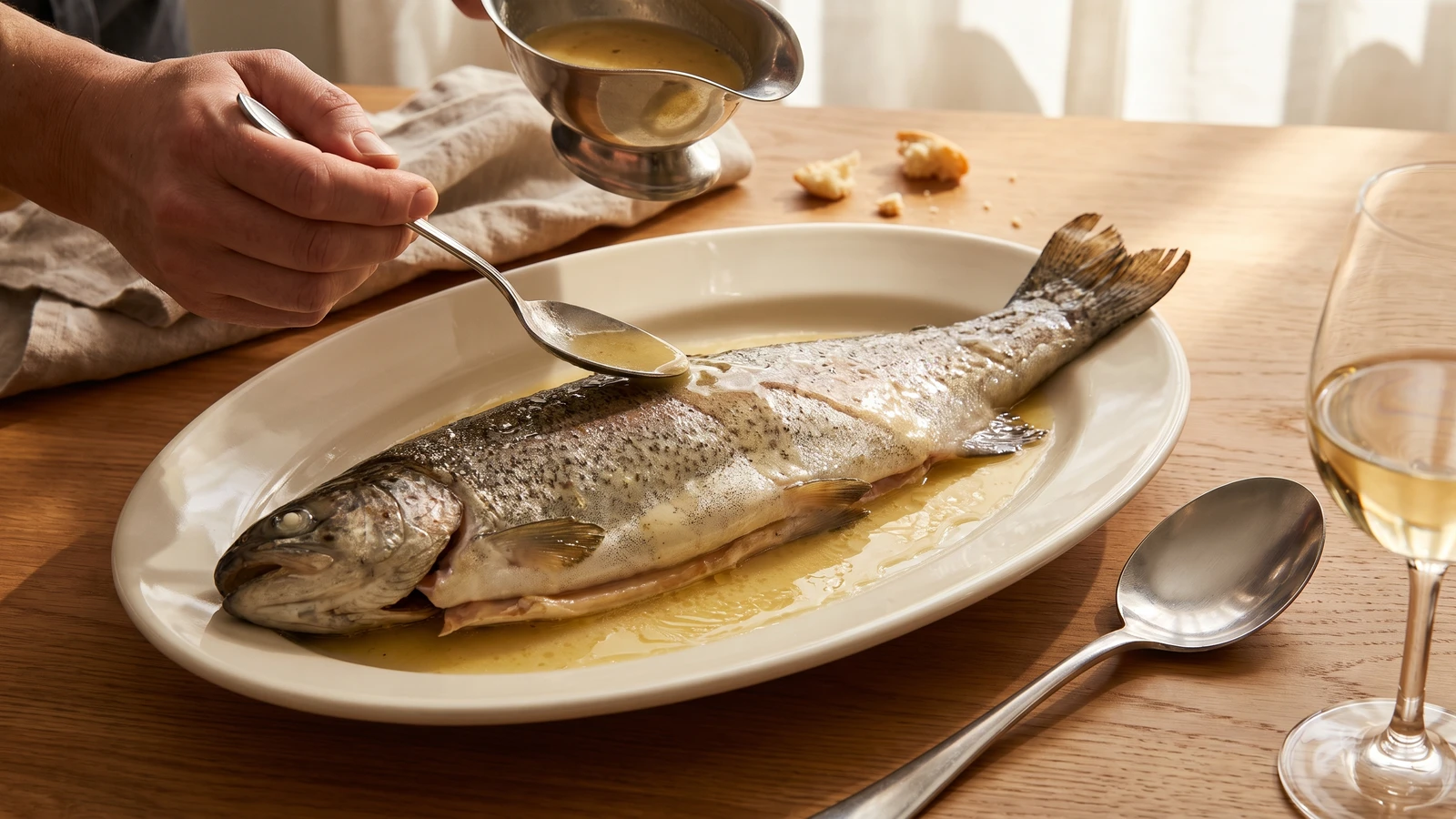
Poisson braisé turns equal parts white wine and fish fumet into both cooking liquor and sauce, with frequent basting and a final uncovered glaze. The lesson is timing: fish and reduction must finish together.
Poisson braisé au vin blanc (white-wine-braised fish) teaches one true thing: the liquor and the fish must finish together. The trout should be barely cooked just as equal parts wine and fumet have concentrated enough to glaze it. If one arrives early, either the flesh waits and dries or the sauce remains thin. C'est la même grammaire as every white braise, only the clock is less forgiving.
The original procedure assumed a large fish-kettle with its own drainer, light fish fumet always at hand, and a saucier free to skim and reduce while the whole fish waited for service. For one cook, one stove, one evening, a snug roasting dish, a parchment sling, and a small saucepan do the same work. Needle-larding with bacon fat, truffle, gherkin, or carrot was showpiece scaffolding and goes; an optional blanket of bacon protects the exposed back without puncturing the flesh. No salamander is needed. Frequent basting and the final uncovered minutes build the glaze honestly.
The equal measure of wine and fumet, the three-quarter depth, the loose cover, and the basting are the dish, so they stay. Choose the pan carefully before the fish meets it: too wide and the liquor disappears before the trout cooks, too deep and the fish merely poaches.
Poisson braisé belongs to the national classical repertoire centered in the grand kitchens of Paris and carried into bourgeois dining rooms, rather than to one regional larder. Whole salmon, trout, and turbot were cooked on the removable drainer of a fitted fish-kettle so they could be raised intact while their liquor was strained and finished as sauce. Despite the name, this is not a long pot braise: for delicate fish, braiser means shallow moist cooking, frequent basting, and glazing as the liquor reduces.
Quantity
1 fish, 2½ lb (1.1 kg)
scaled and gutted with fins trimmed
Quantity
4 tablespoons (60 ml / 57 g)
divided, with 3 tablespoons chilled for finishing
Quantity
2 (about 4 oz / 110 g)
thinly sliced
Quantity
1 (about 2½ oz / 70 g)
thinly sliced
Quantity
1 (about 1¾ oz / 50 g)
thinly sliced
Quantity
1
Quantity
4 slices (about 3 oz / 85 g)
Quantity
1½ cups (360 ml / 355 g)
Quantity
1½ cups (360 ml / 360 g)
Quantity
1½ teaspoons (7.5 ml / 9 g)
Quantity
¼ teaspoon (1.25 ml / 0.6 g)
Quantity
Braising of White Meats (No. 248)
applied here to fish; no separate batch is required
| Ingredient | Quantity |
|---|---|
| whole troutscaled and gutted with fins trimmed | 1 fish, 2½ lb (1.1 kg) |
| unsalted butterdivided, with 3 tablespoons chilled for finishing | 4 tablespoons (60 ml / 57 g) |
| medium shallotsthinly sliced | 2 (about 4 oz / 110 g) |
| medium carrotthinly sliced | 1 (about 2½ oz / 70 g) |
| celery stalkthinly sliced | 1 (about 1¾ oz / 50 g) |
| bouquet garni of parsley stems, thyme, and bay leaf | 1 |
| thinly sliced unsmoked streaky bacon (optional) | 4 slices (about 3 oz / 85 g) |
| dry white wine | 1½ cups (360 ml / 355 g) |
| light fish fumet | 1½ cups (360 ml / 360 g) |
| fine salt | 1½ teaspoons (7.5 ml / 9 g) |
| freshly ground white pepper | ¼ teaspoon (1.25 ml / 0.6 g) |
| classical method referenceapplied here to fish; no separate batch is required | Braising of White Meats (No. 248) |
Heat the oven to 375°F (190°C). Dry the trout thoroughly inside and out, then season the cavity and skin with the salt and white pepper. Wet skin dilutes the basting liquor and takes a poor glaze, so give this small step its full attention.
Butter a snug 14-inch (36 cm) oval roasting dish with 1 tablespoon of the butter. Lay two broad strips of parchment crosswise in the dish, leaving enough overhang to serve as a lifting sling. Scatter in the shallots, carrot, celery, and bouquet garni, then settle the trout over them. This is the fish application of Braising of White Meats (No. 248): aromatics below, controlled moist heat, frequent basting, and a final glaze. If using bacon, lay the slices across the exposed back of the fish without wrapping them underneath.
Combine the white wine and light fish fumet in a saucepan and bring them just to a bare simmer. Fumet is the concentrated but delicate essence drawn from fish bones and trimmings, and it must be light enough to reduce without becoming harsh. Pour the hot mixture around the trout, not over it, stopping when the liquor reaches no more than three-quarters of the fish's depth. Reserve any remainder. Cover the dish loosely with buttered parchment or an offset lid, leaving a narrow escape for evaporation; a tight seal prevents the reduction that makes the sauce.
Set the dish in the oven and braise for 18 to 22 minutes, basting the exposed fish every 6 minutes with liquor from the pan. The liquid should tremble gently around the edges, never boil hard. If it begins boiling, lower the oven to 340°F (170°C); if the level falls too quickly, add some reserved wine and fumet mixture. Ça se rattrape. Protect the fish first, then let the sauce catch up later.
Remove the parchment cover and lift off the bacon, reserving it for another use. Continue cooking uncovered for 8 to 12 minutes, basting every 2 to 3 minutes so the reducing liquor leaves a glossy coat over the fish. Begin checking at the thickest part beside the backbone. The flesh is ready when it separates cleanly from the bone and reaches about 140°F (60°C), carrying toward 145°F (63°C) as it rests. If the trout finishes before the liquor looks concentrated, remove the fish immediately and reduce the sauce separately. Never make cooked fish wait for a saucepan.
Use the parchment sling and two broad spatulas to lift the trout onto a wire rack set over a rimmed tray. Let it drain for 2 minutes, then slide it onto a warmed oval platter and cover it lightly. Strain the braising liquor into a clean saucepan, let it stand for 10 minutes, and skim away the bacon fat from the surface. Boil steadily until reduced to about 1 cup (240 ml) and glossy enough to lightly coat a spoon. Taste as it reduces. If it becomes too salty, add a little unsalted fumet or water before taking it any further.
Take the sauce off the heat. Whisk in the remaining 3 tablespoons of cold butter a few pieces at a time until the sauce becomes smooth, lightly thickened, and lustrous. Do not boil it after the butter goes in. If it turns oily, stop. Ça se rattrape: whisk 1 tablespoon of cold water in a clean saucepan, then add the split sauce gradually while whisking. Spoon enough sauce over the trout to renew its glaze and send the rest to the table in a warm sauceboat. À table!
1 serving (about 235g)
Culinary guides, cultural storytelling, and the editorial depth that makes cooking meaningful.
Discover Culinary ExplorerChef Juliette
John Dory has the delicacy of sole and the firmness of turbot. A light flouring, a quick butter sauté, and nut-brown beurre noisette show exactly why looks never mattered.

Chef Juliette
Fresh haddock proves its delicacy in the meunière pan: a fine flour crust, moist pearly flakes, and beurre noisette sharpened with lemon and parsley, ready from one skillet in half an hour.

Chef Juliette
Éperlans à l’Anglaise turns small fish into a lesson in disciplined coating: boned smelts under a close, crisp crumb, pan-fried in clarified butter and finished with bright, half-melted maître d’hôtel butter.

Chef Juliette
Tiny smelts, shallot, mushrooms, white wine, gratin sauce, and fine bread raspings meet a fierce oven, where the fish must turn tender in the same breath the buttered crust bronzes.