Culinary Explorer

A cooking platform built around craft, culture, and the stories behind what we eat.
Discover Culinary Explorer
Darne de Saumon Daumont

Darne de Saumon Daumont

Created by Chef Juliette

Based on No. 791, Darne de Saumon Daumont, from Le Guide Culinaire (1907) by Auguste Escoffier

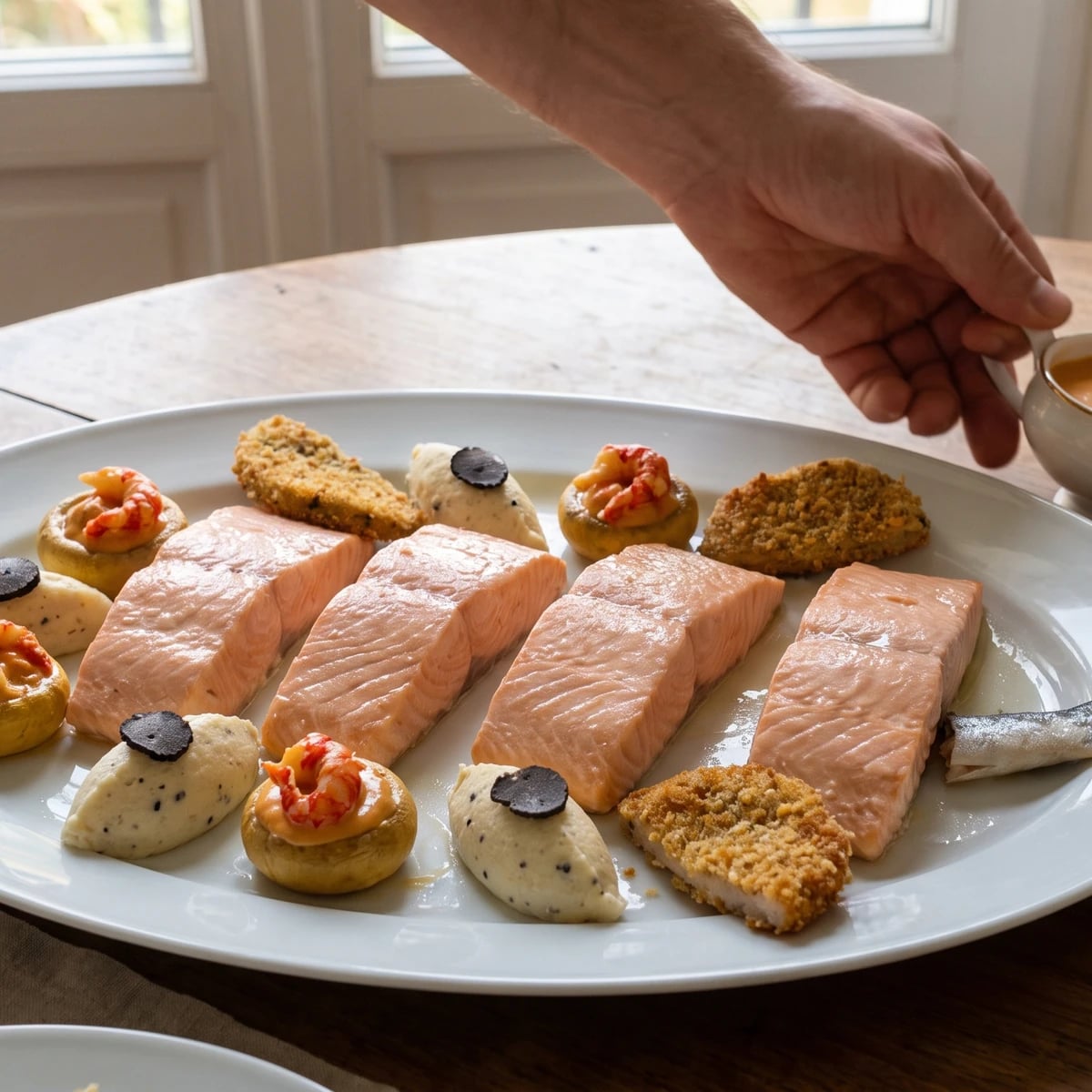
Darne de Saumon Daumont gathers a quiet court-bouillon poach, crayfish-crowned mushrooms, truffled fish mousseline quenelles, and crisp milt around salmon, with Nantua sauce passed separately.

Main Dishes
French
Special Occasion
Dinner Party
50 min
Active Time
40 min cook1 hr 30 min total
Yield4 servings

Darne de Saumon Daumont (salmon steak Daumont style) teaches orchestration. The one true thing to know before touching a pan is this: every garnish must be ready before the salmon begins poaching. The darne waits for nobody, and a perfect piece of fish can go dry while its cook searches for breadcrumbs.

The original entry assumed a saucier tending Nantua sauce, court-bouillon from a stockpot never off the fire, separate hands shaping mousseline quenelles and frying milt, and a salamander nearby even though this garnish requires the frying pan, not gratinating heat. At home, prepared court-bouillon, prepared Nantua sauce, chilled fish mousseline, and prepared Anglaise (for Egg-and-bread-crumbing) (No. 174) turn those stations into a careful sequence. Four individually assembled portions become one generous platter for four so one cook can serve everything at its best. The brigade stations are scaffolding and can go. The quiet poach, buttered mushrooms crowned with crayfish, truffled quenelles, crisp milt, and separately served Nantua sauce are the dish, and they stay.

When it comes together, pale coral salmon sits among butter-glazed mushrooms, scarlet crayfish tails, ivory quenelles marked with black truffle, and golden crumbed milt. Have that whole company ready, then keep the court-bouillon below a simmer. That calm poach is the step that decides the dish.

Darne de Saumon Daumont belongs to the formal French grand-kitchen repertoire rather than to a single province; Daumont names a composed garnish whose elements are prepared separately and arranged around the fish. Its geographical anchor is sauce Nantua, from Nantua in Bugey, east of Lyon, where freshwater crayfish gave a cream sauce its coral colour and deep shellfish savor. The composition carried that regional sauce into a codified salmon service, while the darne remained a transverse, bone-in cut prized for even poaching.

The technique, the tradition, and the story behind every dish.

Discover Culinary Explorer

Ingredients

center-cut salmon darnes

Quantity

4, each 1½ inches (4 cm) thick and about 7 ounces (200 g)

skin on and scaled

prepared court-bouillon

Quantity

10 cups (2.4 L / 2.4 kg)

chilled and divided

medium button mushrooms

Quantity

12 (about 2½ cups / 225 g)

stems removed and caps cleaned

unsalted butter

Quantity

3 tablespoons (45 ml / 42 g)

divided

cooked small crayfish tails

Quantity

24 (about ¾ cup / 170 g)

shelled and patted dry

prepared Nantua sauce

Quantity

1½ cups (355 ml / 365 g)

divided

mousseline forcemeat for fish

Quantity

1 cup (240 ml / 250 g)

well chilled

black truffle

Quantity

1 small truffle (about ½ ounce / 14 g)

cut into 12 small discs

fish milt, preferably cod or salmon

Quantity

2 whole lobes (about 8 ounces / 225 g)

membrane removed, chilled, and cut into 8 thick slices

all-purpose flour

Quantity

½ cup (120 ml / 60 g)

Anglaise (for Egg-and-bread-crumbing)

Quantity

½ cup (120 ml / 120 g) Anglaise (for Egg-and-bread-crumbing) (No. 174)

prepared and chilled

fine dry breadcrumbs

Quantity

1 cup (240 ml / 100 g)

clarified butter

Quantity

1 cup (240 ml / 215 g)

for shallow-frying

fine sea salt

Quantity

1 teaspoon (5 ml / 6 g)

divided

ground white pepper

Quantity

¼ teaspoon (1.25 ml / 0.6 g)

Equipment Needed

  • Wide 5-quart shallow poaching pan or covered sauté pan
  • Small saucepan for the quenelles
  • 10-inch skillet for the mushrooms
  • 8-inch skillet for shallow-frying
  • Instant-read thermometer
  • Two teaspoons and a slotted spoon
  • Kitchen twine
  • Warm oval serving platter and sauceboat

Instructions

  1. 1

    Stage the whole service

    Reserve 1 cup of the court-bouillon in the refrigerator as insurance against an overenthusiastic poach. Set aside another 2 cups for the quenelles and pour the remainder into a wide pan that will hold the four salmon darnes in one layer. Divide the Nantua sauce, reserving 3 tablespoons for the crayfish and keeping the rest ready for the sauceboat. Arrange the flour, prepared coating, and breadcrumbs in separate shallow dishes. Keep the salmon, milt, and mousseline cold until their turn. This mise en place replaces several brigade stations, and it is what lets one cook send the platter out whole.

  2. 2

    Poach the quenelles

    Bring the reserved 2 cups of court-bouillon to the barest tremble in a small saucepan. With two damp teaspoons, shape the cold mousseline into 12 small round quenelles, pressing one truffle disc neatly onto each. Lower them into the liquid without crowding and poach gently for 5 to 7 minutes, turning once, until they feel resilient but still tender. The liquid must never boil. If the first quenelle frays, lower the heat and chill the remaining mousseline for 10 minutes before shaping again. Ça se rattrape. Lift the cooked quenelles onto a buttered plate and cover loosely.

  3. 3

    Stew mushrooms and crayfish

    Melt 2 tablespoons of the butter in a skillet over medium-low heat. Add the mushroom caps, season with half the salt and a little white pepper, and turn them until buttered all over. Cover and let them stew gently for 7 to 9 minutes, without browning, until tender. Uncover and let any watery juices reduce until the butter clings to the caps. Warm the crayfish tails with the reserved 3 tablespoons of Nantua sauce over very low heat, only long enough for the sauce to bind them. If wet crayfish loosens the sauce, lift out the tails, reduce the sauce briefly, then fold them back in. Crown each mushroom cap with two tails and keep them covered.

  4. 4

    Bread the milt

    Pat the chilled milt slices thoroughly dry and season them with the remaining salt and white pepper. Coat each slice lightly in flour, then in the prepared Anglaise (for Egg-and-bread-crumbing) (No. 174), and finally in the fine breadcrumbs, pressing just enough to make an even coat. Set the slices on a rack in the refrigerator until the last moment. If the coating slides, the milt was damp: blot it again, dust the bare place with flour, and repeat the coating there. Do not discard it. Ça se rattrape.

  5. 5

    Poach the darnes

    Tie each salmon darne once around its circumference with kitchen twine so it holds its round shape. Lay the darnes in the cold court-bouillon in one layer, adding a little more liquid if they are not covered. Bring the pan up slowly over medium heat. As soon as the liquid begins to tremble, lower the heat and keep it between 175 and 185°F (80 and 85°C), with no rolling bubbles. Poach for 12 to 16 minutes, depending on thickness, until the flesh yields in broad moist flakes and reaches 145°F (63°C) beside the bone. If the liquid breaks into a boil, lift the pan off the burner and add some of the reserved cold court-bouillon before returning it to lower heat. A few white beads of albumin can be blotted away after draining; the fish is still yours.

  6. 6

    Fry the milt

    When the salmon is nearly ready, heat the clarified butter in a small skillet to 350°F (175°C). Fry the breaded milt in two batches, about 1½ to 2 minutes per side, until the crust is evenly golden and the centre reaches 145°F (63°C). Drain on a rack, not flat on paper, so the underside stays crisp. If the crumbs darken in seconds, pull the skillet from the heat before adding the next batch and let the butter cool slightly.

  7. 7

    Finish and arrange

    Warm the remaining Nantua sauce gently, never letting it boil. If it has tightened, whisk in cold reserved court-bouillon a teaspoon at a time; if an oily rim appears, take the sauce off the heat and whisk until smooth. Lift the salmon from its poaching liquid, drain for 30 seconds, remove the twine, and arrange the darnes down the centre of a warm oval platter. Ring them with the crayfish-crowned mushrooms, truffled quenelles, and crisp milt slices, keeping each garnish distinct. Pour the Nantua sauce into a warm sauceboat and pass it separately, exactly as the dish requires. À table!

Chef Tips

  • A darne is a thick transverse steak cut through the bone of a round fish. Ask for evenly sized centre cuts from the thick part of the salmon; thin tail steaks will finish before the garnishes reach the platter.
  • The court-bouillon, Nantua sauce, mousseline forcemeat, and Anglaise (for Egg-and-bread-crumbing) (No. 174) are finished components in this entry, just as they were in the classical kitchen. Prepare them before beginning the final dish. Their separate preparation is not fuss but structure.
  • Milt is the soft roe of a male fish and must be ordered from a fishmonger, often frozen. Cod or salmon milt both work. It is not an invisible ingredient, so omitting it makes a less complete Daumont garnish, though the remaining composition will still serve generously.
  • Dry cooked crayfish tails carefully. Water thins Nantua sauce and prevents it from holding the tails neatly against the mushrooms; warm them briefly, because prolonged cooking turns them firm and cottony.
  • Pour a full-bodied dry white Burgundy, such as Saint-Véran. It has enough breadth for the crayfish cream sauce without overwhelming the gently poached salmon.

Advance Preparation

  • Prepare the court-bouillon and Nantua sauce up to one day ahead and refrigerate them separately. Reheat the sauce with very gentle heat so its cream and crayfish butter remain joined.
  • The fish mousseline and Anglaise (for Egg-and-bread-crumbing) (No. 174) can be prepared earlier the same day and kept covered in the refrigerator.
  • Shape and poach the truffled quenelles up to 2 hours ahead. Cover and refrigerate them, then warm them for 1 minute in barely trembling court-bouillon before arranging the platter.
  • Bread the milt up to 2 hours ahead and keep it uncovered on a rack in the refrigerator. Fry it only as the salmon finishes; that last-minute crust is one of the steps that cannot be shortened.

Frequently Asked Questions

Nutrition Information

1 serving (about 530g)

Calories
1080 calories
Total Fat
76 g
Saturated Fat
35 g
Trans Fat
2 g
Unsaturated Fat
33 g
Cholesterol
515 mg
Sodium
1550 mg
Total Carbohydrates
27 g
Dietary Fiber
2 g
Sugars
5 g
Protein
72 g

Note: Chef personas and recipes are created with AI assistance. Cook with care: follow safe food-handling practices, check doneness with a thermometer when needed, and adapt for allergies and your kitchen.

Where cooking meets culture.

Culinary guides, cultural storytelling, and the editorial depth that makes cooking meaningful.

Discover Culinary Explorer

More from Fish - Salmon (Saumon)

Browse the full collection