
Chef Juliette
John Dory (St. Pierre)
John Dory has the delicacy of sole and the firmness of turbot. A light flouring, a quick butter sauté, and nut-brown beurre noisette show exactly why looks never mattered.
A cooking platform built around craft, culture, and the stories behind what we eat.
Created by Chef Juliette
Based on No. 789, Coulibiac de Saumon, from Le Guide Culinaire (1907) by Auguste Escoffier
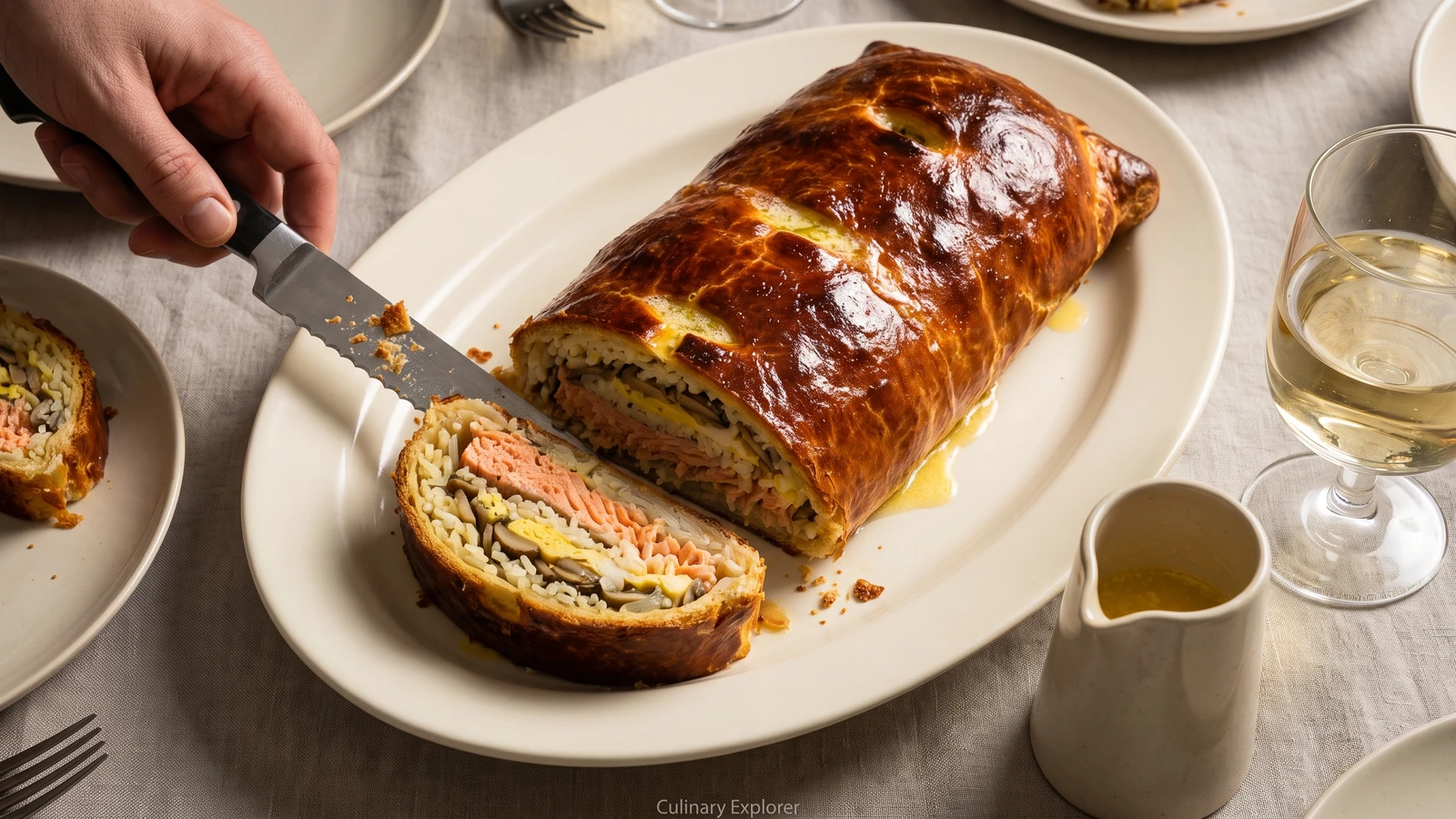
Coulibiac de saumon brings a burnished brioche loaf to the table, with distinct layers of salmon, stock-cooked grain, egg, mushrooms, onion, and tender vermicelli drinking in melted butter.
Coulibiac de saumon (salmon layered in brioche) teaches architecture: several modest fillings become splendid when each remains distinct inside one burnished loaf. The one true thing to know before touching a pan is this: every filling must be cold and dry before it meets the dough. Warm salmon melts the brioche's butter, wet grain turns the lower crust to paste, and neither mistake improves in the oven.
The source assumes Ordinary Brioche Paste (No. 2368) already fermented, consommé never off the fire, and vesiga that someone has soaked and simmered for hours. It needs neither a saucier nor a salamander, so we won't invent work for them. For one cook, one stove, one evening, the brioche and grain are prepared ahead, the loaf is scaled to four, and rare vesiga may be replaced by the same cooked weight of fine vermicelli. The vermicelli preserves its tender chew without pretending to be identical. That is the one unavoidable change.
Preparing specialty dough and drying semolina separately was brigade scaffolding, and the book itself permits stock-cooked rice in place of the kache. What must stay is the dish: successive layers, a proper seal, the short proof, the vent, and melted butter poured into the baked loaf. Cool the filling completely. Everything after that is assembly and nerve.
Coulibiac de saumon has its real home at the Russian table, particularly in Moscow and St Petersburg, where kulebyaka is a yeast-dough pie constructed in separated layers rather than stirred into one filling. French grand kitchens took it into the canon as coulibiac, clothing salmon, grain, eggs, mushrooms, onion, and vesiga in savory brioche. It is often mistaken for salmon en croûte, but its layered starch, egg, vesiga, and butter poured through the vent make it an entirely different construction.
Quantity
1 lb (454 g) Ordinary Brioche Paste (No. 2368)
prepared without sugar and chilled
Quantity
12 oz (340 g)
cut into small collops
Quantity
⅔ cup (160 ml / 115 g) Kache de Semoule pour Coulibiac (No. 2292)
fully cooked and cooled
Quantity
8 oz (225 g) cooked vesiga, or 3 oz (85 g) dried vermicelli cooked to yield the same weight
drained, cooled, and roughly chopped
Quantity
1
hard-boiled and chopped
Quantity
½ cup (120 ml / 40 g)
finely chopped
Quantity
½ medium, about ½ cup (120 ml / 75 g)
finely chopped
Quantity
8 tablespoons (120 ml / 113 g)
divided
Quantity
2 tablespoons (30 ml / 12 g)
Quantity
2 tablespoons (30 ml / 16 g)
for rolling
Quantity
1 tablespoon (15 ml / 15 g)
for sealing
Quantity
¾ teaspoon (3.75 ml / 4.5 g)
Quantity
¼ teaspoon (1.25 ml / 0.5 g)
| Ingredient | Quantity |
|---|---|
| Ordinary Brioche Pasteprepared without sugar and chilled | 1 lb (454 g) Ordinary Brioche Paste (No. 2368) |
| skinless salmon filletcut into small collops | 12 oz (340 g) |
| Kache de Semoule pour Coulibiac, or stock-cooked long-grain ricefully cooked and cooled | ⅔ cup (160 ml / 115 g) Kache de Semoule pour Coulibiac (No. 2292) |
| vesiga, or fine vermicellidrained, cooled, and roughly chopped | 8 oz (225 g) cooked vesiga, or 3 oz (85 g) dried vermicelli cooked to yield the same weight |
| large egghard-boiled and chopped | 1 |
| button or cremini mushroomsfinely chopped | ½ cup (120 ml / 40 g) |
| onionfinely chopped | ½ medium, about ½ cup (120 ml / 75 g) |
| unsalted butterdivided | 8 tablespoons (120 ml / 113 g) |
| very fine dry breadcrumbs | 2 tablespoons (30 ml / 12 g) |
| all-purpose flourfor rolling | 2 tablespoons (30 ml / 16 g) |
| cold waterfor sealing | 1 tablespoon (15 ml / 15 g) |
| fine salt | ¾ teaspoon (3.75 ml / 4.5 g) |
| ground white pepper | ¼ teaspoon (1.25 ml / 0.5 g) |
Have the Ordinary Brioche Paste (No. 2368) chilled and ready to roll. Measure the cold Kache de Semoule pour Coulibiac (No. 2292), or spread the stock-cooked rice on a tray until no warmth remains. Drain the cooked vesiga or vermicelli thoroughly and chop it into short, loose lengths. Keep every component separate and cold.
Season the salmon collops with half the salt and white pepper. Melt 2 tablespoons of the butter in a wide skillet over medium-high heat. Raidir the salmon, meaning firm its surface without cooking it through, for about 45 seconds on each side. The outside should turn opaque while the centre remains nearly raw. Transfer it to a cold plate in one layer and refrigerate until completely cool.
Return the skillet to medium-high heat with 1 tablespoon of butter. Fry the mushrooms until they release their water, the pan dries, and their edges take a little colour. Scrape them onto a separate plate. Add another tablespoon of butter and fry the onion until tender and pale gold. Season both with the remaining salt and pepper, then cool them separately. If either mixture remains warm, wait. Brioche rewards patience and punishes bravado.
Line a baking sheet with parchment. On a lightly floured surface, roll the cold Ordinary Brioche Paste (No. 2368) into a rectangle 12 by 8 inches (30 by 20 cm), keeping the thickness even and the corners reasonably square. Brush away loose flour. If the dough softens and begins to shine, slide it onto the baking sheet and chill it for 10 minutes before continuing.
Arrange half the Kache de Semoule pour Coulibiac (No. 2292), or half the stock-cooked rice, in a compact strip about 8 inches (20 cm) long down the centre of the dough, leaving clear borders on every side. Add the salmon, then the vesiga or vermicelli, chopped egg, mushrooms, and onion in that exact succession. Finish with the remaining kache or rice. Press only enough to make a stable loaf. Do not stir the layers together, because the clean succession in each slice is the coulibiac's grammar.
Moisten the long edges of the dough lightly with cold water, bring them together over the filling, and pinch firmly closed. Fold the short ends toward the centre and seal them in the same way. Turn the loaf seam-side down on the prepared sheet and straighten it gently. If the dough tears, don't pull it wider. Ça se rattrape: flatten a scrap of dough, moisten its edge, and patch the opening. Cover loosely and proof in a mild place for 25 minutes, until the brioche looks slightly puffy but has not doubled. Heat the oven to 350°F (180°C).
Melt the remaining 4 tablespoons of butter. Brush 1 tablespoon over the proofed loaf and scatter the fine breadcrumbs evenly across the surface. Cut a neat vent about ¾ inch (2 cm) long through the top centre. Bake for 45 to 50 minutes, until the brioche is deeply burnished, the underside feels firm, and the filling reaches 145°F (63°C) at the centre. If the crust darkens too quickly, cover it loosely with foil. If a seam splits, leave it alone until the loaf is baked, then return any escaped butter through the top vent. It will still slice generously.
As soon as the coulibiac leaves the oven, pour the remaining 3 tablespoons of freshly melted butter slowly through the vent, pausing between additions so the layers can drink it in. Rest the loaf for 15 minutes before cutting with a serrated knife. Serve thick slices while the brioche is crisp at the edges and the butter gleams between the layers. À table!
1 serving (about 330g)
Culinary guides, cultural storytelling, and the editorial depth that makes cooking meaningful.
Discover Culinary ExplorerChef Juliette
John Dory has the delicacy of sole and the firmness of turbot. A light flouring, a quick butter sauté, and nut-brown beurre noisette show exactly why looks never mattered.

Chef Juliette
Fresh haddock proves its delicacy in the meunière pan: a fine flour crust, moist pearly flakes, and beurre noisette sharpened with lemon and parsley, ready from one skillet in half an hour.

Chef Juliette
Éperlans à l’Anglaise turns small fish into a lesson in disciplined coating: boned smelts under a close, crisp crumb, pan-fried in clarified butter and finished with bright, half-melted maître d’hôtel butter.

Chef Juliette
Tiny smelts, shallot, mushrooms, white wine, gratin sauce, and fine bread raspings meet a fierce oven, where the fish must turn tender in the same breath the buttered crust bronzes.