
Chef Juliette
John Dory (St. Pierre)
John Dory has the delicacy of sole and the firmness of turbot. A light flouring, a quick butter sauté, and nut-brown beurre noisette show exactly why looks never mattered.
A cooking platform built around craft, culture, and the stories behind what we eat.
Created by Chef Juliette
Based on No. 788, Côtelettes de Saumon, from Le Guide Culinaire (1907) by Auguste Escoffier
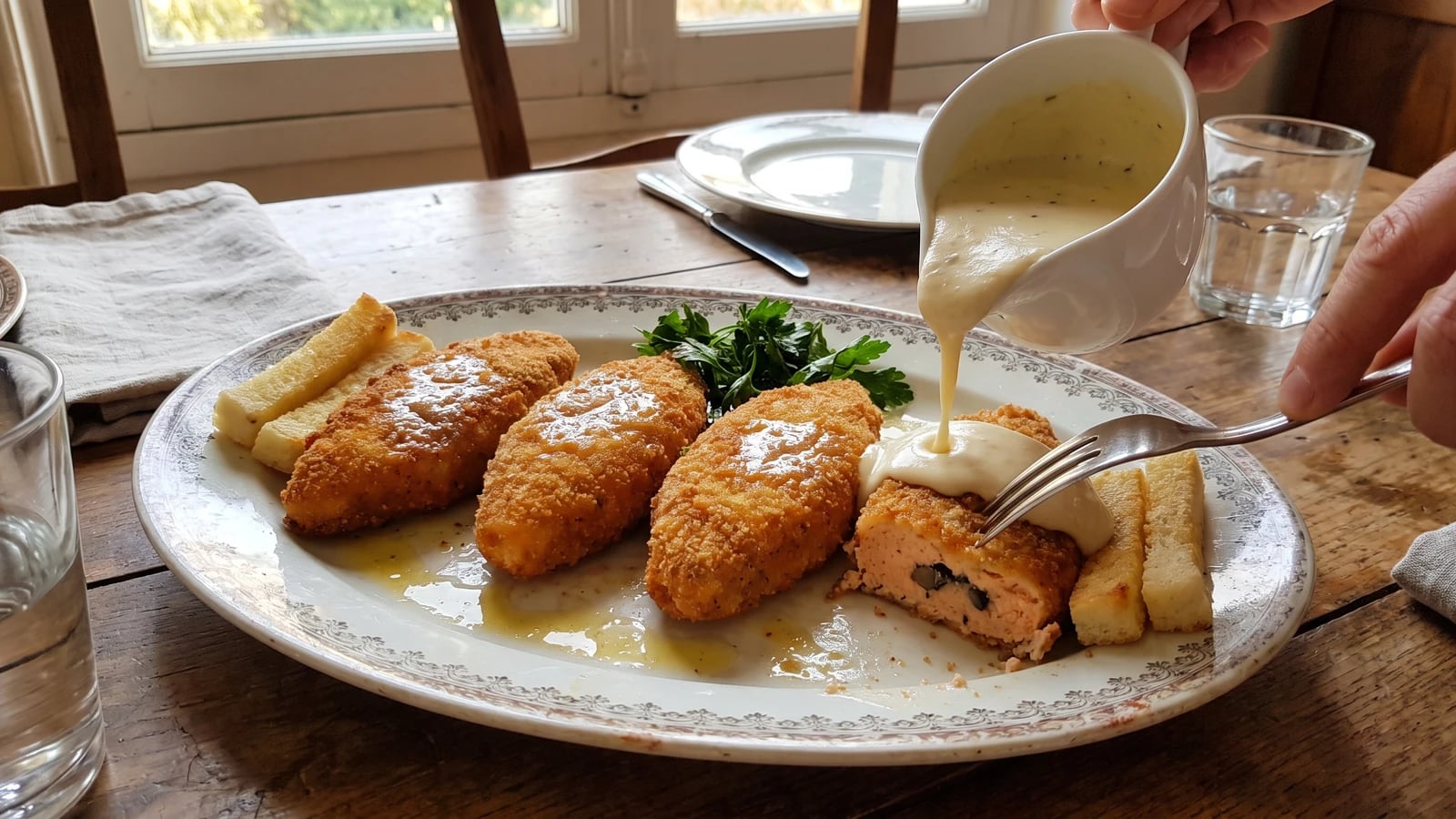
Cold salmon mousseline wrapped around a truffled mushroom salpicon, poached until tender, then breaded à l'anglaise and fried in clarified butter: the grand cutlet translated for one careful home stove.
Côtelettes de Saumon (salmon mousseline cutlets) teach the discipline behind every delicate forcemeat: softness comes from control, not fragility. The salmon is worked with egg white and cream until it holds like satin, molded around a salpicon (a fine dice bound with sauce), gently poached, then protected by an à l'anglaise crust. Keep the mousseline cold and the finished cutlet will be light, moist, and strong enough to meet hot butter without surrendering its filling.
The original kitchen assumed a saucier with reduced Allemande ready, stock never off the fire, ranks of cutlet molds, and enough hands to poach, crumb, fry, and garnish at once. At home, good prepared fish stock and one saucepan build the small quantity of Allemande you need; a food processor replaces the mortar, and four shallow oval ramekins replace the specialized tins. One cook, one stove, one evening. The paper frill was brigade scaffolding and can go, but the cutlet shape, truffled filling, gentle poach, bread baton, and à l'anglaise coating are the dish and must stay.
A food processor saves labor, not judgment, and the coarse sieve remains because it catches sinew while refining the mousseline without turning it gummy. Before you touch the pan, chill the salmon, cream, processor bowl, and blade thoroughly. That cold is the step that decides everything.
Côtelettes de Saumon belong to the Parisian grand-kitchen canon, where fish forcemeats were molded into the familiar silhouette of a butcher's cutlet and served as individual entrées. The name describes the shape rather than a steak cut from the fish, while the bread baton counterfeits the little bone and completes the illusion. The French à l'anglaise coating gave the delicate poached mousseline a sealed, butter-gold crust sturdy enough for formal service.
Quantity
2 1/2 cups (400 g)
cut into 1-inch (2.5 cm) cubes and thoroughly chilled
Quantity
3/4 cup (180 ml / 178 g)
Quantity
2 large egg whites (1/4 cup / 60 g)
Quantity
1 1/4 teaspoons (6.25 ml / 7.5 g)
Quantity
1/4 teaspoon (1.25 ml / 0.6 g)
Quantity
1 tablespoon (15 ml / 14 g)
Quantity
1 1/3 cups (320 ml / 125 g)
cut into fine salpicon dice
Quantity
3 tablespoons (45 ml / 25 g)
cut into fine salpicon dice
Quantity
1 tablespoon (15 ml / 14 g)
Quantity
1 cup (240 ml / 240 g)
Quantity
1 1/2 tablespoons (22.5 ml / 21 g)
Quantity
1 1/2 tablespoons (22.5 ml / 12 g)
Quantity
1/4 cup (60 ml / 60 g)
reserve 1 tablespoon for rescue if needed
Quantity
1 large egg yolk (1 tablespoon / 18 g)
Quantity
1 teaspoon (5 ml / 5 g)
Quantity
3/4 cup (180 ml / 95 g)
Quantity
3/4 cup (180 ml / 180 g) Anglaise (for Egg-and-bread-crumbing) (No. 174)
chilled
Quantity
2 cups (480 ml / 180 g)
Quantity
1 1/4 cups (300 ml / 275 g)
for frying
Quantity
4
cut about 4 by 1/2 inch (10 by 1.25 cm)
Quantity
1 loosely packed cup (240 ml / 30 g)
washed and dried completely
Quantity
1 1/4 cups (300 ml / 300 g)
prepared and kept warm for serving
| Ingredient | Quantity |
|---|---|
| skinless, boneless salmon filletcut into 1-inch (2.5 cm) cubes and thoroughly chilled | 2 1/2 cups (400 g) |
| cold heavy cream for the salmon mousseline | 3/4 cup (180 ml / 178 g) |
| cold large egg whites | 2 large egg whites (1/4 cup / 60 g) |
| fine salt for the salmon mousseline | 1 1/4 teaspoons (6.25 ml / 7.5 g) |
| ground white pepper for the salmon mousseline | 1/4 teaspoon (1.25 ml / 0.6 g) |
| softened unsalted butter for the molds | 1 tablespoon (15 ml / 14 g) |
| button or cremini mushroomscut into fine salpicon dice | 1 1/3 cups (320 ml / 125 g) |
| fresh or preserved whole black trufflecut into fine salpicon dice | 3 tablespoons (45 ml / 25 g) |
| unsalted butter for sautéing the salpicon | 1 tablespoon (15 ml / 14 g) |
| unsalted fish stock | 1 cup (240 ml / 240 g) |
| unsalted butter for the Allemande roux | 1 1/2 tablespoons (22.5 ml / 21 g) |
| plain flour for the Allemande roux | 1 1/2 tablespoons (22.5 ml / 12 g) |
| heavy cream for the Allemande liaisonreserve 1 tablespoon for rescue if needed | 1/4 cup (60 ml / 60 g) |
| large egg yolk | 1 large egg yolk (1 tablespoon / 18 g) |
| fresh lemon juice | 1 teaspoon (5 ml / 5 g) |
| plain flour for coating | 3/4 cup (180 ml / 95 g) |
| Anglaise (for Egg-and-bread-crumbing)chilled | 3/4 cup (180 ml / 180 g) Anglaise (for Egg-and-bread-crumbing) (No. 174) |
| fine fresh white breadcrumbs | 2 cups (480 ml / 180 g) |
| clarified butterfor frying | 1 1/4 cups (300 ml / 275 g) |
| firm white-bread batonscut about 4 by 1/2 inch (10 by 1.25 cm) | 4 |
| small parsley sprigswashed and dried completely | 1 loosely packed cup (240 ml / 30 g) |
| Sauce Dieppoiseprepared and kept warm for serving | 1 1/4 cups (300 ml / 300 g) |
Put the processor bowl, blade, salmon, egg whites, and cream in the cold for 20 minutes. Butter four shallow 8-ounce (240 ml) oval molds or ramekins generously. Heat the oven to 325°F (165°C) and set a folded kitchen towel in the bottom of a roasting pan; the towel steadies the molds and softens the direct heat beneath them.
Melt the roux butter in a small saucepan over medium-low heat, stir in the roux flour, and cook for 2 minutes without coloring it. Whisk in the fish stock gradually, scraping into every corner, then simmer gently until reduced to about 1/2 cup (120 ml) and thick enough to leave a clear trail across the pan. Whisk the egg yolk with all but the reserved tablespoon of cream, temper it with a little hot sauce, then whisk it back into the pan off the heat. Return the pan to its lowest heat and stir until the Allemande coats the spoon, but never let it boil. Add the lemon juice. If the liaison turns grainy, remove it from the heat and whisk in the reserved cold cream, then strain it. Ça se rattrape.
Melt the salpicon butter in a skillet over medium-high heat. Add the diced mushrooms and cook until their liquid has escaped and evaporated, leaving the dice tender and lightly browned rather than wet. Add the truffle for the final 30 seconds, then fold the mixture into the reduced Allemande. The salpicon must hold together in a spoon with no sauce running around it; if it is loose, return it to low heat briefly and stir until tighter. Spread it in a shallow dish, cover its surface, and chill until completely cold.
Put the cold salmon and salt in the chilled processor and pulse until the fish becomes smooth and tacky. Add the egg whites and process only until absorbed. With the machine running, pour in the cold cream in a thin, steady stream, stopping as soon as the mousseline is glossy and holds a soft peak; add the white pepper. Press it once through a medium-mesh sieve with a flexible scraper to remove sinew and refine the texture. If it turns oily or grainy, stop processing, nest the bowl over ice, and fold in a spoonful of cold cream. Do not force a warm mousseline forward.
Using a spoon dipped in cold water, line the bottom and sides of each buttered mold with a 1/2-inch (1.25 cm) coating of mousseline. Divide the cold salpicon among the cavities, stopping about 1/3 inch (8 mm) below the rims. Cover completely with the remaining mousseline and smooth the tops. Seal every gap, especially around the edges, because exposed filling will escape during poaching.
Set the molds in the prepared roasting pan. Pour hot water around them to reach halfway up their sides, cover loosely with buttered parchment, and poach in the oven for 20 to 25 minutes. The mousseline is ready when it feels resilient under a fingertip and reaches 145°F (63°C) at the center. The water should quiver, never boil; if bubbles become vigorous or beads of fat rise on the mousseline, add a little cold water to the bath and lower the oven heat.
Rest the molds for 10 minutes, then loosen each edge with a thin knife and invert the cutlets onto a rack. If one clings, dip the bottom of its mold in hot water for 3 seconds and try again. Refine the ovals gently with a damp knife, then refrigerate uncovered for 20 minutes, just until their surfaces are cool, firm, and dry enough to accept the coating.
Heat a shallow layer of clarified butter to 340°F (170°C). Fry the bread batons until evenly butter-gold, then drain them on a rack. Fry the thoroughly dried parsley sprigs for only a few seconds, shielding the pan with a splatter screen, and lift them out while still green. Strain the butter if any crumbs remain and return it to the skillet.
Arrange the coating station in order: flour, Anglaise (for Egg-and-bread-crumbing) (No. 174), and fine breadcrumbs. Roll each cutlet lightly in flour and brush away the excess, coat it completely in the Anglaise, then press it gently into the crumbs. The layer must be even and closed, not heavy. If you find a bare patch, dab it with a little Anglaise and press on fresh crumbs. Rest the coated cutlets for 10 minutes so the crust adheres.
Bring the clarified butter back to 340°F (170°C) and fry the cutlets two at a time, about 3 minutes per side, spooning hot butter over their curved edges until the crust is an even deep gold and the centers are hot. Handle them with a wide spatula rather than tongs. If a seam begins to leak, stop turning that cutlet and spoon butter over its top until the crust seals; ça se rattrape. Arrange the four côtelettes in a circle on a warm platter, tuck a fried bread baton into the narrow end of each to suggest the bone, and place the fried parsley in the center. Send the Sauce Dieppoise separately, hot and glossy. À table!
1 serving (about 390g)
Culinary guides, cultural storytelling, and the editorial depth that makes cooking meaningful.
Discover Culinary ExplorerChef Juliette
John Dory has the delicacy of sole and the firmness of turbot. A light flouring, a quick butter sauté, and nut-brown beurre noisette show exactly why looks never mattered.

Chef Juliette
Fresh haddock proves its delicacy in the meunière pan: a fine flour crust, moist pearly flakes, and beurre noisette sharpened with lemon and parsley, ready from one skillet in half an hour.

Chef Juliette
Éperlans à l’Anglaise turns small fish into a lesson in disciplined coating: boned smelts under a close, crisp crumb, pan-fried in clarified butter and finished with bright, half-melted maître d’hôtel butter.

Chef Juliette
Tiny smelts, shallot, mushrooms, white wine, gratin sauce, and fine bread raspings meet a fierce oven, where the fish must turn tender in the same breath the buttered crust bronzes.