
Chef Juliette
John Dory (St. Pierre)
John Dory has the delicacy of sole and the firmness of turbot. A light flouring, a quick butter sauté, and nut-brown beurre noisette show exactly why looks never mattered.
A cooking platform built around craft, culture, and the stories behind what we eat.
Created by Chef Juliette
Based on No. 782, The Cooking of Fish au Gratin, from Le Guide Culinaire (1907) by Auguste Escoffier
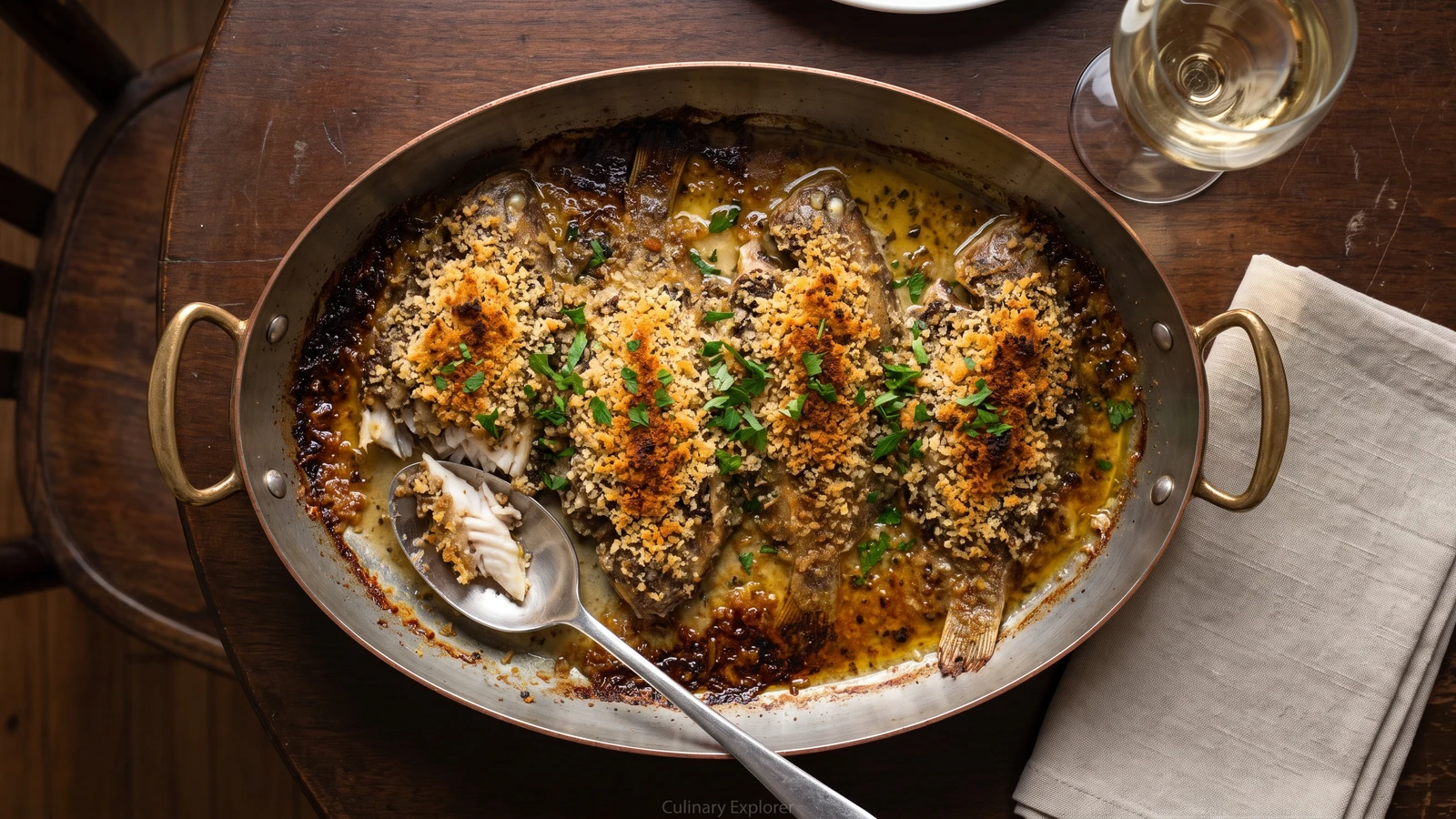
Small sole, mushroom-shallot duxelles, buttered raspings, and fierce heat meet in one gratin, teaching the essential balance: the fish cooks exactly as the sauce reduces and the crust bronzes.
Poissons au Gratin Complet (small fish cooked under a duxelles crust) teaches one exacting lesson: the fish, the reduction of its sauce, and the formation of the gratin must finish together. That coincidence is the dish. Too much sauce leaves a watery bed beneath cooked fish; too little disappears before the flesh is ready, and adding more later makes a patchwork crust.
The original method assumed a saucier tending the reduction, stock never off the fire, and a salamander applying fierce direct heat at the finish. At home, prepare one four-serving quantity of Complete Gratin (No. 269), use a shallow dish over a heated baking sheet, and let the upper oven and a brief pass beneath the broiler do the salamander's work. The brigade's separate hands were scaffolding and can go. The proportions of fish, sauce, raspings, and real butter must stay, because they are the gratin itself. One cook, one stove, one evening.
Small fish want fierce heat and a measured coating. When it works, the sole remains pearly and moist against its bones, the sauce clings rather than floods, and the surface wears a crisp, butter-gold crust freckled with mushrooms and parsley. The one step that matters most is matching the amount of Complete Gratin (No. 269), and the force of the oven, to four fish of equal size.
Poissons au gratin complet belongs to the classical Paris kitchen's family of gratins, a method that moved readily into cuisine bourgeoise because small fish, mushrooms, shallots, bread raspings, and butter all meet in one shallow serving dish. The term au gratin does not promise cheese: here the gratin is the crimped crust formed when reduced sauce, raspings, and butter take direct heat together. Its discipline is mathematical rather than regional, with the size of the fish governing both the sauce quantity and the force of the oven.
Quantity
4 fish, about 8 ounces (225 g) each
cleaned, dark skin removed, white skin scraped, and fins trimmed
Quantity
1 home-scale preparation Complete Gratin (No. 269), scaled to coat 4 small fish
| Ingredient | Quantity |
|---|---|
| small whole solecleaned, dark skin removed, white skin scraped, and fins trimmed | 4 fish, about 8 ounces (225 g) each |
| Complete Gratin | 1 home-scale preparation Complete Gratin (No. 269), scaled to coat 4 small fish |
Set a rack in the upper third of the oven and heat it to 450°F (230°C). Place a heavy rimmed baking sheet on the rack as the oven heats; the hot metal gives the shallow gratin dish immediate bottom heat while the upper elements bronze its surface. Have the broiler ready, but do not use it yet.
Run clean fingers over each fish to check for stray scales, then dry the skin and cavities thoroughly. Keep the sole cold until the gratin is ready for assembly. A wet fish releases unnecessary liquid, and unnecessary liquid breaks the balance between cooking and reduction before the dish has properly begun.
Bring the home-scale preparation of Complete Gratin (No. 269) to its assembly point according to its own entry. Use the four sole as its principal item, arranging them head-to-tail in one snug layer so each fish receives the same depth of sauce and topping. Complete the assembly exactly as directed. Do not add extra sauce for generosity and do not heap the raspings over the thin tails; generosity here means balance, not excess.
Set the gratin dish on the heated baking sheet and bake for 10 to 14 minutes without opening the oven during the first 8. The dish is ready when the sauce bubbles thickly at the rim, the raspings have bronzed through their butter, and the fish reaches 145°F (63°C) beside the backbone without the thermometer touching bone. Test all three signs together. If the crust bronzes before the fish is cooked, lower the oven to 400°F (205°C), shield only the darkest patches with foil, and continue gently. If the fish is ready but the surface is pale, place it about 6 inches (15 cm) beneath the broiler for 20 to 60 seconds. Watch without looking away. Ça se rattrape.
At the moment the dish leaves the oven, apply the lemon-and-parsley finish prescribed in Complete Gratin (No. 269). Let the gratin settle for 2 minutes, no longer, then bring the whole dish to the table. The sauce should make a narrow glossy pool around the fish while the crust remains crisp above it. Serve each sole with a broad fish slice so its coating travels with it. À table!
1 serving (about 260g)
Culinary guides, cultural storytelling, and the editorial depth that makes cooking meaningful.
Discover Culinary ExplorerChef Juliette
John Dory has the delicacy of sole and the firmness of turbot. A light flouring, a quick butter sauté, and nut-brown beurre noisette show exactly why looks never mattered.

Chef Juliette
Fresh haddock proves its delicacy in the meunière pan: a fine flour crust, moist pearly flakes, and beurre noisette sharpened with lemon and parsley, ready from one skillet in half an hour.

Chef Juliette
Éperlans à l’Anglaise turns small fish into a lesson in disciplined coating: boned smelts under a close, crisp crumb, pan-fried in clarified butter and finished with bright, half-melted maître d’hôtel butter.

Chef Juliette
Tiny smelts, shallot, mushrooms, white wine, gratin sauce, and fine bread raspings meet a fierce oven, where the fish must turn tender in the same breath the buttered crust bronzes.