
Chef Juliette
John Dory (St. Pierre)
John Dory has the delicacy of sole and the firmness of turbot. A light flouring, a quick butter sauté, and nut-brown beurre noisette show exactly why looks never mattered.
A cooking platform built around craft, culture, and the stories behind what we eat.
Created by Chef Juliette
Based on No. 776, The Boiling of Fish in Salted Water, from Le Guide Culinaire (1907) by Auguste Escoffier
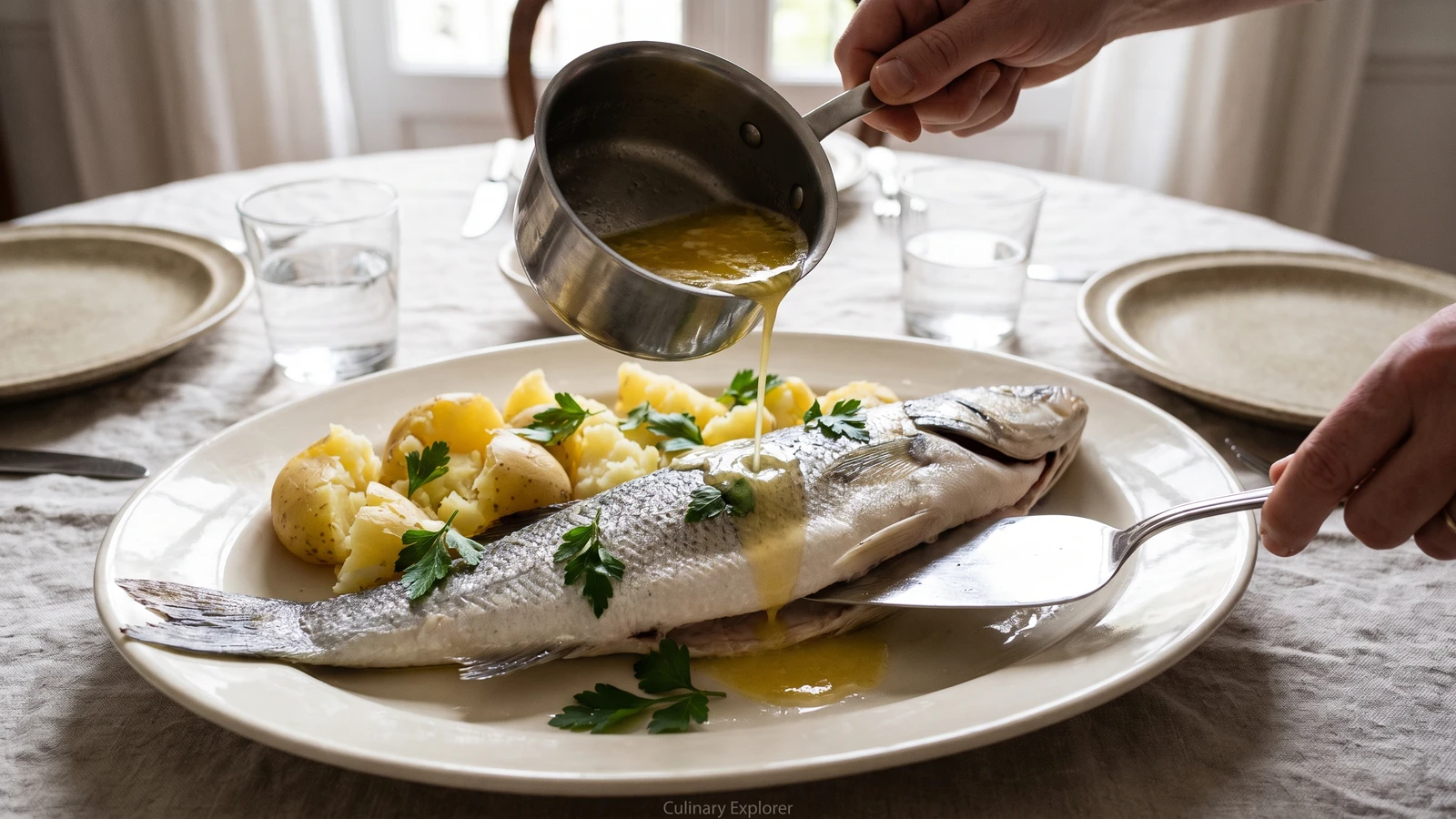
Poisson Poché à l’Eau Salée teaches the gentlest lesson in the canon: salt the water exactly, bring whole fish up slowly, and never let the liquid keep boiling once the flesh begins to set.
Poisson Poché à l’Eau Salée (fish poached in salted water) teaches restraint. The liquid may reach the boil, but it must never go on boiling around the fish. That single distinction keeps the flesh full, pearly, and intact; agitation and excess heat tighten it until it shrinks, splits, and gives its juices to the pot.
The brigade method assumed a fish-kettle with its fitted drainer, a cooler edge of the range, Court-bouillon with Vinegar (No. 163) ready for salmon or trout, and a saucier attending the sauce sent separately. At home, use a wide covered vessel with a rack or insert, move it onto an unlit burner, and finish with a small beurre monté. The fish-kettle and napkin presentation are service scaffolding and can go. Exact salting, controlled heat, careful draining, and the separate sauce are the dish, so they stay. One cook, one stove, one evening.
A whole fish begins in cold liquid so its outside doesn't seize before the centre warms. Thick slices enter boiling liquid so their cut surfaces set quickly, then the heat stops at once. Watch the first decisive bubble. That is the moment that governs everything afterward.
Poisson poché à l’eau salée has no single provincial claim; its home is the classical French service table, where whole fish was lifted from a fitted fish-kettle onto a napkin-covered drainer and accompanied by floury potatoes and sauce served apart. The fish-kettle moved between grand kitchens and bourgeois homes because it solved two practical problems, supporting the fish's shape and lifting it without breaking. Despite the English title's promise of boiling, generations of cooks understood that the boil marks a transition, never the temperature at which the fish should finish.
Quantity
1 whole fish, 2½ to 3 lb (1.1 to 1.4 kg), or 4 steaks, 6 to 7 oz (170 to 200 g) each
scaled, gutted, washed inside, trimmed, and patted dry
Quantity
2 qt (1.9 L / about 1.9 kg), or enough to cover
Quantity
2 qt (1.9 L / about 1.9 kg) cold Court-bouillon with Vinegar (No. 163)
Quantity
2½ tsp (12 ml / 14 g), exactly ¼ oz (7 g) per qt (950 ml / about 950 g) water
Quantity
1 cup (240 ml / 245 g), one-eighth of the water volume
Quantity
8 potatoes, about 1½ lb (680 g)
peeled
Quantity
1 tbsp (15 ml / 18 g)
Quantity
½ cup (120 ml / 113 g)
cut into small cubes
Quantity
1 small bunch, about 1 loosely packed cup (240 ml / 30 g)
washed and dried
| Ingredient | Quantity |
|---|---|
| whole round white fish or thick fish steaksscaled, gutted, washed inside, trimmed, and patted dry | 1 whole fish, 2½ to 3 lb (1.1 to 1.4 kg), or 4 steaks, 6 to 7 oz (170 to 200 g) each |
| cold water | 2 qt (1.9 L / about 1.9 kg), or enough to cover |
| Court-bouillon with Vinegar (optional) | 2 qt (1.9 L / about 1.9 kg) cold Court-bouillon with Vinegar (No. 163) |
| fine sea salt for the poaching water | 2½ tsp (12 ml / 14 g), exactly ¼ oz (7 g) per qt (950 ml / about 950 g) water |
| whole milk (optional) | 1 cup (240 ml / 245 g), one-eighth of the water volume |
| small floury potatoespeeled | 8 potatoes, about 1½ lb (680 g) |
| fine sea salt for the potato water | 1 tbsp (15 ml / 18 g) |
| cold unsalted buttercut into small cubes | ½ cup (120 ml / 113 g) |
| fresh flat-leaf parsleywashed and dried | 1 small bunch, about 1 loosely packed cup (240 ml / 30 g) |
Ask the fishmonger to scale, gut, and remove the gills from a whole fish, then trim away any sharp fins at home. Rinse the cavity under a thin stream of cold water, wipe away every trace of blood near the backbone, and pat the fish dry. If using steaks, keep them at least 1¼ in (3 cm) thick; thin slices overcook before you can settle the liquid.
Put the potatoes in a saucepan, cover them with cold water, and add the measured salt. Bring to a gentle boil and cook until a knife enters the centres without resistance, about 18 to 22 minutes. Drain well, return them to the dry pan off the heat, and cover loosely so their surfaces become floury rather than wet.
For white fish, measure enough cold water to cover the fish and add exactly ¼ oz (7 g) salt for every qt (950 ml) used. For turbot or brill, add whole milk equal to one-eighth of the water volume, which preserves the book's whitening treatment. For salmon or trout, replace both the water and its added salt with Court-bouillon with Vinegar (No. 163); it is a finished preparation here, so use it as it comes rather than rebuilding it in this pot.
Set the whole fish on the insert or rack in the wide vessel and pour in the chosen liquid cold, covering the fish by no more than 1 in (2.5 cm). Cover and warm it slowly over medium heat. At the first decisive boil, uncover, skim the pale froth, and move the vessel immediately to an unlit burner. Hold the liquid between 175 and 185°F (80 and 85°C), calm except for an occasional movement at the edge, until the thickest flesh reaches 145°F (63°C), usually another 8 to 15 minutes. If the liquid breaks into a rolling boil, pull the vessel off the heat and add ½ cup (120 ml) cold water around the fish. Ça se rattrape: the split flesh won't knit itself together, but the gentler finish will stop further damage.
For steaks or thick slices, bring the chosen liquid to a proper boil before the fish enters. Lower the pieces in one layer, then move the vessel off the heat as soon as the last piece is submerged; do not wait for the liquid to boil again. Hold it between 175 and 185°F (80 and 85°C), returning it to the lowest heat only if necessary, until the centres reach 145°F (63°C), about 7 to 12 minutes according to thickness. This hot beginning sets the cut surfaces and keeps more of the fish's juices inside.
Lift a whole fish on its insert, or raise steaks with a broad slotted spatula, and let them drain over the vessel for 2 minutes. The flesh should separate in moist flakes under gentle pressure but still hold its shape. Transfer it to a warmed oval platter using two broad spatulas. If a piece breaks, fit it back into place and leave it alone. Never apologize at your own table.
Bring 3 tbsp (45 ml) of the poaching liquid to a full boil in a small saucepan and reduce it to about 2 tbsp (30 ml). Lower the heat completely. Beurre monté, butter held in a warm water emulsion, begins by whisking in the cold butter one cube at a time until the sauce is ivory, glossy, and thick enough to cling softly to a spoon. Never let it boil. If it separates into yellow fat and watery droplets, put 1 tsp (5 ml) cold water in a clean pan and whisk the broken sauce into it gradually. Ça se rattrape.
Arrange the floury potatoes beside the fish and tuck generous parsley sprigs along the platter. Pour the beurre monté into a warm sauceboat and send it separately, as the classical service intends, so each person sauces their own portion. The fish needs no disguise, only careful cooking and enough butter. À table!
1 serving (about 360g)
Culinary guides, cultural storytelling, and the editorial depth that makes cooking meaningful.
Discover Culinary ExplorerChef Juliette
John Dory has the delicacy of sole and the firmness of turbot. A light flouring, a quick butter sauté, and nut-brown beurre noisette show exactly why looks never mattered.

Chef Juliette
Fresh haddock proves its delicacy in the meunière pan: a fine flour crust, moist pearly flakes, and beurre noisette sharpened with lemon and parsley, ready from one skillet in half an hour.

Chef Juliette
Éperlans à l’Anglaise turns small fish into a lesson in disciplined coating: boned smelts under a close, crisp crumb, pan-fried in clarified butter and finished with bright, half-melted maître d’hôtel butter.

Chef Juliette
Tiny smelts, shallot, mushrooms, white wine, gratin sauce, and fine bread raspings meet a fierce oven, where the fish must turn tender in the same breath the buttered crust bronzes.