Culinary Explorer

A cooking platform built around craft, culture, and the stories behind what we eat.
Discover Culinary Explorer
Velouté de Homard, otherwise Cardinal

Velouté de Homard, otherwise Cardinal

Created by Chef Juliette

Based on No. 684, Velouté de Homard, otherwise Cardinal, from Le Guide Culinaire (1907) by Auguste Escoffier

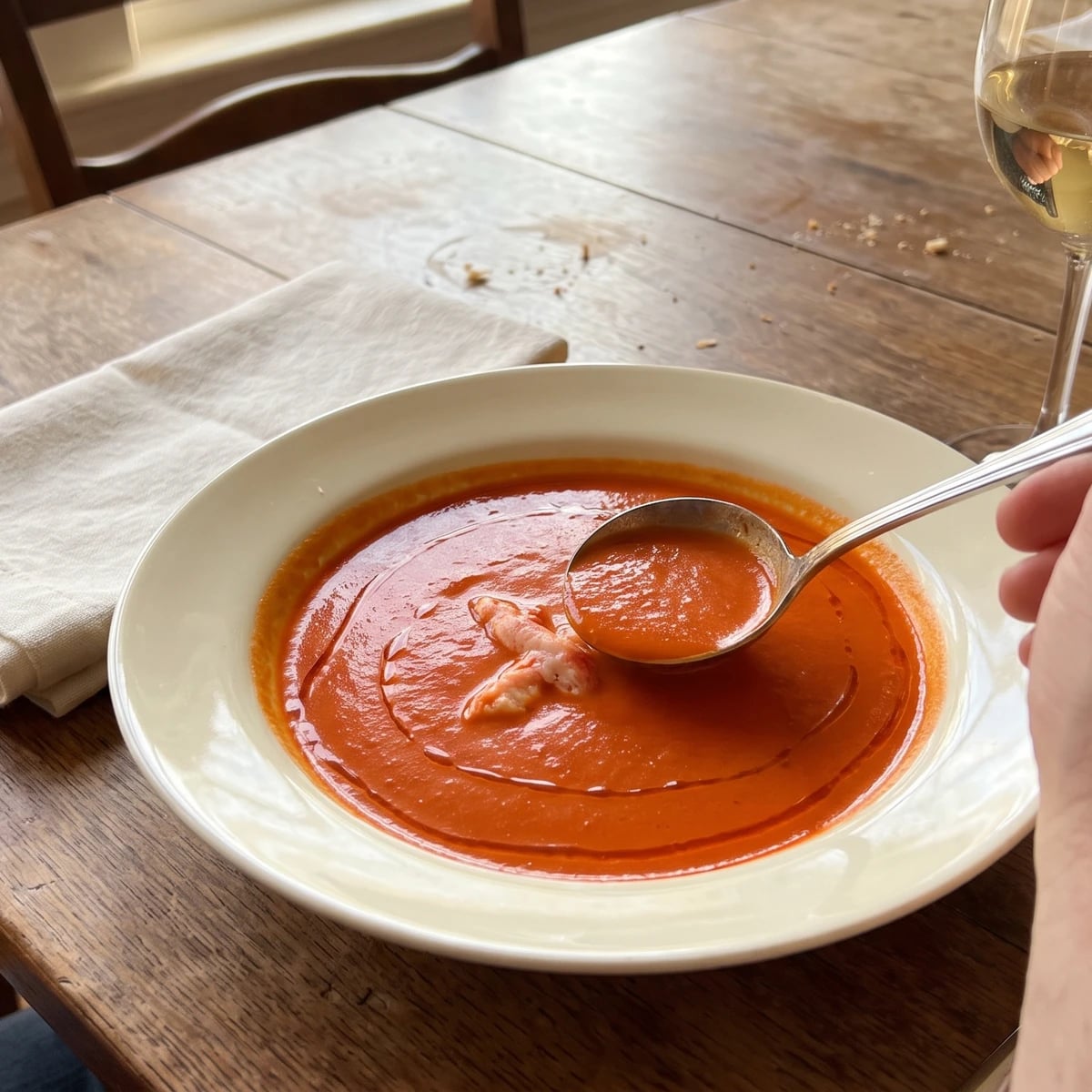
Velouté de Homard Cardinal teaches the quiet finish: a smooth lobster base bound with velouté, passed fine, then mounted with lobster butter and red butter, never finished with egg-yolk liaison.

Soups & Stews
French
Dinner Party
Special Occasion
30 min
Active Time
45 min cook1 hr 15 min total
YieldAbout 2 quarts (8 first-course servings)

Velouté de Homard, autrement dit Cardinal (lobster velouté in the Cardinal manner), teaches one true thing: a shellfish soup becomes velvet through controlled binding, not by piling on cream. Here the rice of an ordinary bisque gives way to velouté, and the soup receives no liaison (egg-yolk binding). Lobster butter and red butter, whisked in after the heat is gone, make the texture and vivid Cardinal color together.

The original kitchen assumed a saucier's hands, a stockpot never far from the fire, a cloth tammy, Baba-moulds (small deep cylinders slightly wider at the top), and a drawer containing a fancy cross cutter. At home, the cited lobster base can be prepared ahead, a fine-mesh chinois replaces the tammy, four small dariole moulds or ramekins replace the Baba-moulds, and a paper guide with a sharp paring knife cuts the crosses. The constant stockpot and specialty equipment are brigade scaffolding. The velouté substitution, fine straining, lobster royale, and two-butter finish are the dish and must stay. No salamander is needed, and no broiler should go near it. One cook, one stove, one evening.

The step that decides Cardinal is monter au beurre (mounting with butter). Bring the strained base only to a bare simmer, remove it completely from the heat, then whisk in the cold butters piece by piece. Keep that finish below a boil and the velouté will gleam rather than split.

Velouté de Homard Cardinal belongs to the Parisian classical table, where named garnishes told the cook both a color and a manner of finish. Cardinal signals the lobster-red hue, deepened by red butter and echoed by the cross-cut royale, rather than a province or a tomato-heavy soup. As the preparation passed from grand service to the bourgeois dining room, its identity remained technical: velouté replaces rice, the soup is strained fine, and butter, never egg-yolk liaison, supplies its final body.

The technique, the tradition, and the story behind every dish.

Discover Culinary Explorer

Ingredients

Bisque de Homard, velouté form

Quantity

8 cups (1.9 L / about 1.9 kg) Bisque de Homard (No. 663)

prepared with velouté replacing the rice thickening and held before its final butter

cooked lobster tail meat

Quantity

1 cup (240 ml / 150 g), reserved while making Bisque de Homard (No. 663)

chilled and diced

large eggs

Quantity

2

heavy cream

Quantity

1/2 cup (120 ml / 120 g)

fine sea salt

Quantity

1/4 teaspoon (1.25 ml / 1.5 g)

for the royale

unsalted butter

Quantity

1 teaspoon (5 ml / 5 g)

softened, for the moulds

prepared lobster butter

Quantity

9 1/2 tablespoons (140 ml / 135 g)

cold and cut into small pieces

prepared red butter

Quantity

2 tablespoons plus 2 teaspoons (40 ml / 40 g)

cold and cut into small pieces

fine sea salt (optional)

Quantity

Up to 1 teaspoon (5 ml / 6 g)

for final adjustment

Equipment Needed

  • 4-quart (3.8 L) heavy saucepan
  • Fine-mesh chinois or sturdy sieve
  • Blender or food processor
  • Four 3-fluid-ounce (90 ml) Baba-moulds, dariole moulds, or straight-sided ramekins
  • Small roasting pan for the bain-marie
  • Small cross-shaped aspic cutter, or paper template and sharp paring knife
  • Whisk and ladle

Instructions

  1. 1

    Set the lobster royale

    Heat the oven to 300°F (150°C). Blend the reserved lobster meat, eggs, cream, and 1/4 teaspoon salt just until completely smooth; prolonged blending beats in air, and air leaves holes in a royale. Pass the mixture through a fine sieve. Butter four 3-fluid-ounce (90 ml) Baba-moulds, dariole moulds, or straight-sided ramekins, divide the mixture among them, and set them in a small roasting pan. Add hot water to reach halfway up their sides and bake for 20 to 25 minutes, until the edges are set and each centre trembles as one soft mass. If the water begins bubbling or the custard edges puff, remove the pan for two minutes, replace some hot water with cool water, and lower the oven to 275°F (135°C). Ça se rattrape if you calm the heat before the royale turns grainy.

    The whole eggs belong only to this separate garnish. They never enter the velouté itself; shellfish veloutés take butter, not egg-yolk liaison.
  2. 2

    Cut the royale crosses

    Let the royales settle for 10 minutes, then loosen their edges and turn them out. Slice each cylinder crosswise into 1/4-inch (6 mm) rounds. Cut the rounds with a small cross-shaped aspic cutter, or lay a clean paper cross over each round and cut around it with the point of a sharp paring knife. Cover the crosses so their surfaces don't dry. The trimmings belong to the cook, not the soup; adding them would turn a precise garnish into rubble.

  3. 3

    Pass the lobster base

    Rub the Bisque de Homard (No. 663) through a fine-mesh chinois or sturdy sieve into a clean bowl, working with a flexible spatula until the liquid passes and any coarse residue remains behind. This is the home equivalent of the tammy, and it is not decorative labor: Cardinal must feel satin-smooth on the tongue. Reserve 1/2 cup (120 ml) of the strained base in the cold for the butter-emulsion rescue, should you need it.

  4. 4

    Heat to a tremble

    Pour the remaining strained base into a heavy saucepan and warm it gradually over medium-low heat, stirring along the bottom so the velouté cannot catch. Bring it only to a bare simmer, with a quiet movement at the edge rather than a rolling boil. Taste it now. Adjust with fine salt only if needed, remembering that both finishing butters will deepen the flavor.

  5. 5

    Monter au beurre

    Remove the saucepan completely from the heat. Whisk in the cold lobster butter a few pieces at a time, letting each addition disappear before adding the next, then whisk in the red butter by the same method. The velouté should turn vivid coral-red, glossy, and supple enough to pour in a broad ribbon. Do not return it to a boil, and do not add egg yolk. If orange beads of fat gather around the edge, stop. Whisk 2 tablespoons of the cold reserved base in a clean saucepan, then whisk the split velouté into it gradually, off the heat, until smooth again. Ça se rattrape. More heat is not the answer.

    The finishing butter looks generous because the original proportion has been preserved at the home scale. This abundance is structural: the butter carries flavor, color, and the final emulsion.
  6. 6

    Garnish and serve

    Warm eight shallow soup bowls. Arrange two or three lobster royale crosses in each, keeping their shape visible, then give the velouté one gentle stir and ladle it around them. If service pauses, hold the saucepan over barely warm water rather than direct heat, and never let the finished soup simmer again. Bring the bowls to the table while the surface still carries its butter gloss. À table!

Chef Tips

  • This is an assembly recipe by design. Prepare the Bisque de Homard (No. 663) in its velouté form before beginning this entry. The old kitchen kept that foundation ready; the honest home equivalent is advance preparation, not an improvised stock.
  • Lobster butter and red butter are distinct prepared foundations, not plain butter with casual flavoring stirred through it. Lobster butter carries the concentrated shell character; red butter supplies the precise Cardinal color. Tomato paste cannot replace either without changing the acidity, flavor, and identity of the soup.
  • Keep the lobster and red butters cold until the final minute. Cold butter enters the warm base gradually and forms a stable emulsion; soft or melted butter rushes in as fat and tends to remain that way.
  • A small cross-shaped aspic cutter is convenient, but the paper-template method preserves the source garnish perfectly well. Specialty cutting equipment is brigade scaffolding. The cross itself stays.
  • Serve with a dry Champagne or a mineral white Burgundy. Both have enough acidity to meet the butter and enough restraint to leave the lobster in command.

Advance Preparation

  • The Bisque de Homard (No. 663), lobster butter, and red butter may be prepared up to two days ahead and kept separately covered in the refrigerator. Bring the base toward room temperature before passing and reheating it.
  • The lobster royale may be baked, cooled, and cut one day ahead. Refrigerate the crosses in a single layer under a tight cover so their surfaces remain tender.
  • Once mounted with the finishing butters, the velouté is best served immediately. Leftovers may be refrigerated for one day and reheated over very gentle heat while whisking, but they must not boil and should not be frozen.

Frequently Asked Questions

Nutrition Information

1 serving (about 300g)

Calories
450 calories
Total Fat
36 g
Saturated Fat
21 g
Trans Fat
1 g
Unsaturated Fat
14 g
Cholesterol
230 mg
Sodium
1300 mg
Total Carbohydrates
14 g
Dietary Fiber
1 g
Sugars
3 g
Protein
17 g

Note: Chef personas and recipes are created with AI assistance. Cook with care: follow safe food-handling practices, check doneness with a thermometer when needed, and adapt for allergies and your kitchen.

Where cooking meets culture.

Culinary guides, cultural storytelling, and the editorial depth that makes cooking meaningful.

Discover Culinary Explorer

More from Soups - Thick Soups

Browse the full collection