
Chef Juliette
Purée de Carottes, otherwise Crécy
Purée de Carottes, otherwise Crécy, turns carrots, butter, rice, and white consommé into a silken soup. The lesson is simple and absolute: blend for smoothness, then sieve for finesse.
A cooking platform built around craft, culture, and the stories behind what we eat.
Created by Chef Juliette
Based on No. 650, Potage Ambassadeurs, from Le Guide Culinaire (1907) by Auguste Escoffier
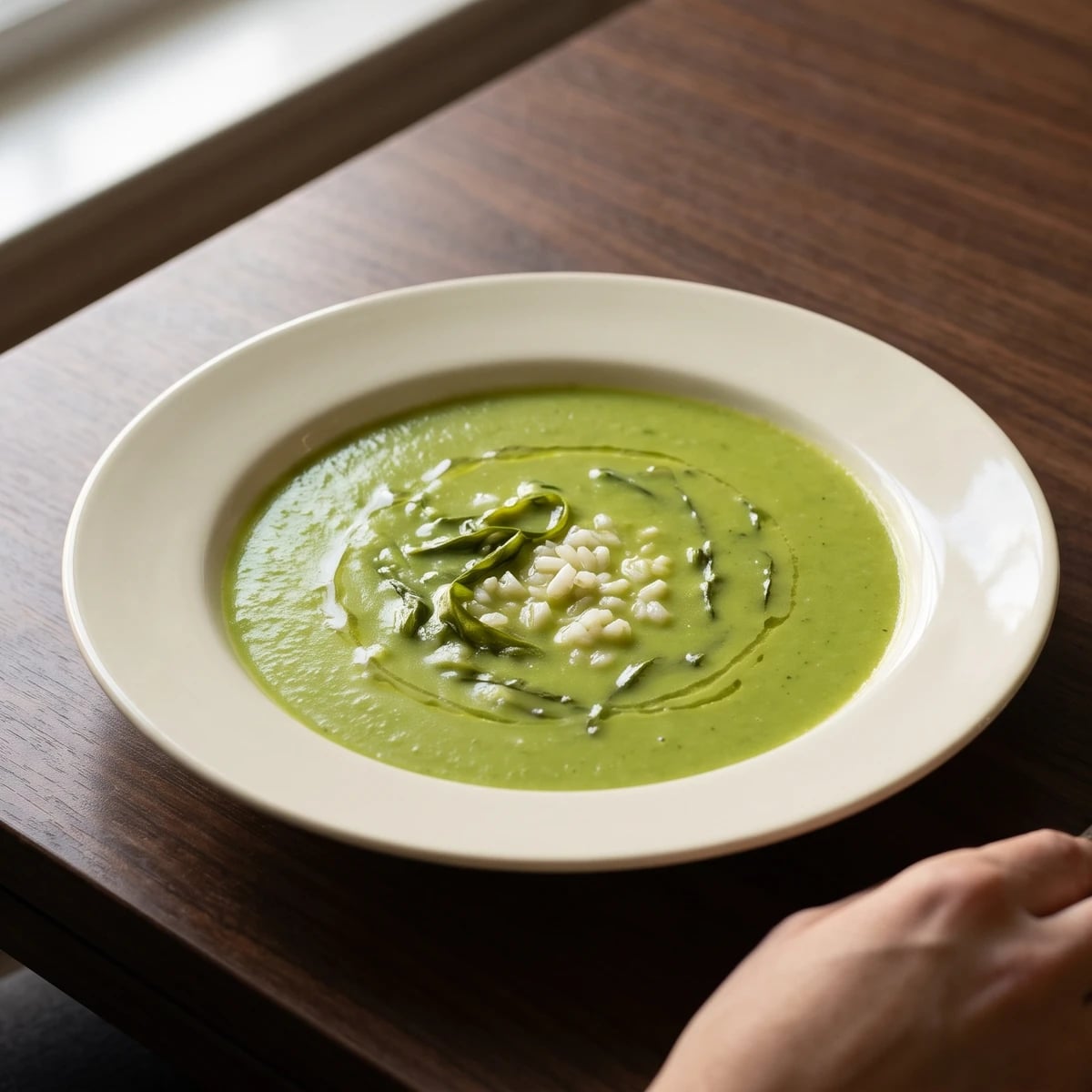
Potage Ambassadeurs turns a silky Saint-Germain pea purée into a composed soup with buttery sorrel-and-lettuce ribbons and tender poached rice, each garnish kept distinct against the sweet green base.
Potage Ambassadeurs (Ambassadors' pea soup) teaches a quiet classical truth: the purée is the foundation, but the garnish gives the soup its name and character. Know this before touching a pan: those garnishes are not decoration. The sweet green base must remain silky enough to carry sorrel's bright edge, tender lettuce, and distinct grains of rice without swallowing them.
The brigade formula assumed a soup cook with fresh-pea purée already at readiness, Chiffonade (No. 215), fine ribbons of sorrel and lettuce prepared at their own station, poached rice waiting, and stock never off the fire. At home, you make two quarts in one saucepan, poach a spoonful of rice beside it, and use a blender and fine sieve in place of repeated passing through a tamis. The separate stations and long holding were scaffolding, so they go. The independently prepared Chiffonade and the exact per-quart garnish ratio are the dish, so they stay. One cook, one stove, one evening.
The pea purée should taste fresh, rounded with cream, and glossy from a final butter emulsion. Fold in the Chiffonade and rice only at the end; prolonged simmering makes the rice swell, dulls the sorrel, and turns three clear textures into one. That last-minute finish is the step that decides the soup.
Potage Ambassadeurs belongs to the classical Paris dining-room repertoire, where a familiar purée received a distinct service name through its garnish rather than a different stock or cream finish. It is a dressed member of the fresh-pea Potage Saint-Germain family: Chiffonade (No. 215) contributes tenderness and the lively acidity of sorrel, while poached rice gives the spoon a separate, gentle texture. The grand title can mislead; its identity lies in those measured additions, not in rare ingredients or elaborate display.
Quantity
2 tablespoons (30 ml / 24 g), yielding ¼ cup (60 ml / 45 g) poached rice
rinsed
Quantity
3 cups (720 ml / 720 g)
for poaching the rice
Quantity
1¼ teaspoons (6 ml / 7 g), plus more to taste
divided
Quantity
4 tablespoons (60 ml / 57 g)
divided, with 2 tablespoons chilled for finishing
Quantity
1 cup (240 ml / 120 g)
thinly sliced and washed well
Quantity
6 cups (1.4 L / 870 g)
leave frozen peas frozen until cooking
Quantity
Up to 5 cups (1.2 L / 1.2 kg)
preferably unsalted and divided
Quantity
½ cup (120 ml / 120 g)
Quantity
¼ teaspoon (1 ml / 0.5 g)
Quantity
2 small tablespoons (30 ml / 22 g) Chiffonade (No. 215)
prepared as its own finished component and kept warm
| Ingredient | Quantity |
|---|---|
| long-grain white ricerinsed | 2 tablespoons (30 ml / 24 g), yielding ¼ cup (60 ml / 45 g) poached rice |
| waterfor poaching the rice | 3 cups (720 ml / 720 g) |
| fine sea saltdivided | 1¼ teaspoons (6 ml / 7 g), plus more to taste |
| unsalted butterdivided, with 2 tablespoons chilled for finishing | 4 tablespoons (60 ml / 57 g) |
| white and pale green leekthinly sliced and washed well | 1 cup (240 ml / 120 g) |
| shelled fresh peas, or frozen peas picked at their peakleave frozen peas frozen until cooking | 6 cups (1.4 L / 870 g) |
| light chicken stockpreferably unsalted and divided | Up to 5 cups (1.2 L / 1.2 kg) |
| heavy cream | ½ cup (120 ml / 120 g) |
| ground white pepper | ¼ teaspoon (1 ml / 0.5 g) |
| Chiffonadeprepared as its own finished component and kept warm | 2 small tablespoons (30 ml / 22 g) Chiffonade (No. 215) |
Bring the water to a boil with ¼ teaspoon of the salt. Add the rinsed rice, lower the heat, and poach at a bare simmer until the grains are tender but still distinct, 12 to 15 minutes. Drain immediately and rinse for only a few seconds under cool water to remove loose surface starch, then spread the rice on a plate. Measure exactly ¼ cup (60 ml / 45 g) for the soup; there may be a spoonful left, and it does not go into the pot because the garnish ratio matters. If the cooled grains cling together, rinse them briefly under warm water and drain well. Ça se rattrape.
Melt 2 tablespoons of the butter in a heavy 4 to 5-quart saucepan over medium-low heat. Add the leek and ¼ teaspoon of the salt, cover, and sweat gently for 7 to 8 minutes, stirring twice, until completely tender without browning. Colour would muddy both the fresh pea flavour and the green of the finished soup; softness, not caramelization, is the work here.
Add the peas and 3 cups of the stock. Bring the liquid just to a simmer, then cook uncovered until the peas crush readily between two fingers, about 5 to 7 minutes for fresh peas or 3 to 4 minutes for frozen. Stop while their colour and sweetness are still lively. A hard boil or a long simmer turns the peas dull and cabbage-like, and no quantity of cream can hide it.
Remove the pan from the heat and purée until perfectly smooth. If using a countertop blender, work in batches, fill the jar no more than halfway, and vent the lid beneath a folded towel. Pass the purée through a fine-mesh sieve, pressing firmly with a flexible scraper and discarding the dry skins left behind. The blender replaces the brigade's repeated pounding, while the sieve preserves the characteristic silk; this passing is part of the dish, not discarded scaffolding.
Pour the strained purée into an 8-cup measure and stir in the cream. Add enough of the remaining stock to make exactly 8 cups (1.9 L), then return the soup to the cleaned saucepan. Season with the white pepper and the remaining ¾ teaspoon salt, adjusting for the stock. Heat gently until the surface barely quivers. Remove the pan from the heat and monter au beurre, finish the soup by whisking in the 2 tablespoons of chilled butter a piece at a time. Do not boil it afterward. If beads of butter rise to the surface, take the pan off the heat and blend for a few seconds with 1 tablespoon of cold reserved stock. Ça se rattrape.
Loosen the measured poached rice with a small ladleful of soup, then fold it into the pot with the warm Chiffonade (No. 215). Keep the soup over the lowest heat for 60 to 90 seconds, stirring gently from the bottom, only until both garnishes are warmed through. Do not simmer. The rice must remain distinct, and the sorrel must keep its fresh edge against the sweet pea purée.
Warm the soup bowls, stir once so each ladle receives its share of rice and Chiffonade, and serve immediately. The potage should fall from the ladle in a smooth green ribbon, with small white grains and tender dark-green threads visible through its butter gloss. Add no last-minute herb shower or swirl of cream; the measured garnish has already finished the soup. À table!
1 serving (about 240g)
Culinary guides, cultural storytelling, and the editorial depth that makes cooking meaningful.
Discover Culinary Explorer
Chef Juliette
Purée de Carottes, otherwise Crécy, turns carrots, butter, rice, and white consommé into a silken soup. The lesson is simple and absolute: blend for smoothness, then sieve for finesse.

Chef Juliette
Purée Crécy meets tender tapioca poached in white consommé, then butter brings the two together. Velours earns its name from the spoon: glossy, softly pearled, and entirely itself.

Chef Juliette
Purée de Céleri-rave turns knobby celeriac into an ivory, butter-glossed soup, its bitterness blanched away, its body supplied by potato, and its sweetness clarified by a patient half-hour of skimming.

Chef Juliette
A pale-green Flamande purée built on fresh Brussels sprouts, butter, white consommé, and potato, passed smooth and milk-finished, with crisp bread dice for the necessary bite.