
Chef Juliette
Purée de Carottes, otherwise Crécy
Purée de Carottes, otherwise Crécy, turns carrots, butter, rice, and white consommé into a silken soup. The lesson is simple and absolute: blend for smoothness, then sieve for finesse.
A cooking platform built around craft, culture, and the stories behind what we eat.
Created by Chef Juliette
Based on No. 640, Purée de Lentilles, otherwise Conti, from Le Guide Culinaire (1907) by Auguste Escoffier
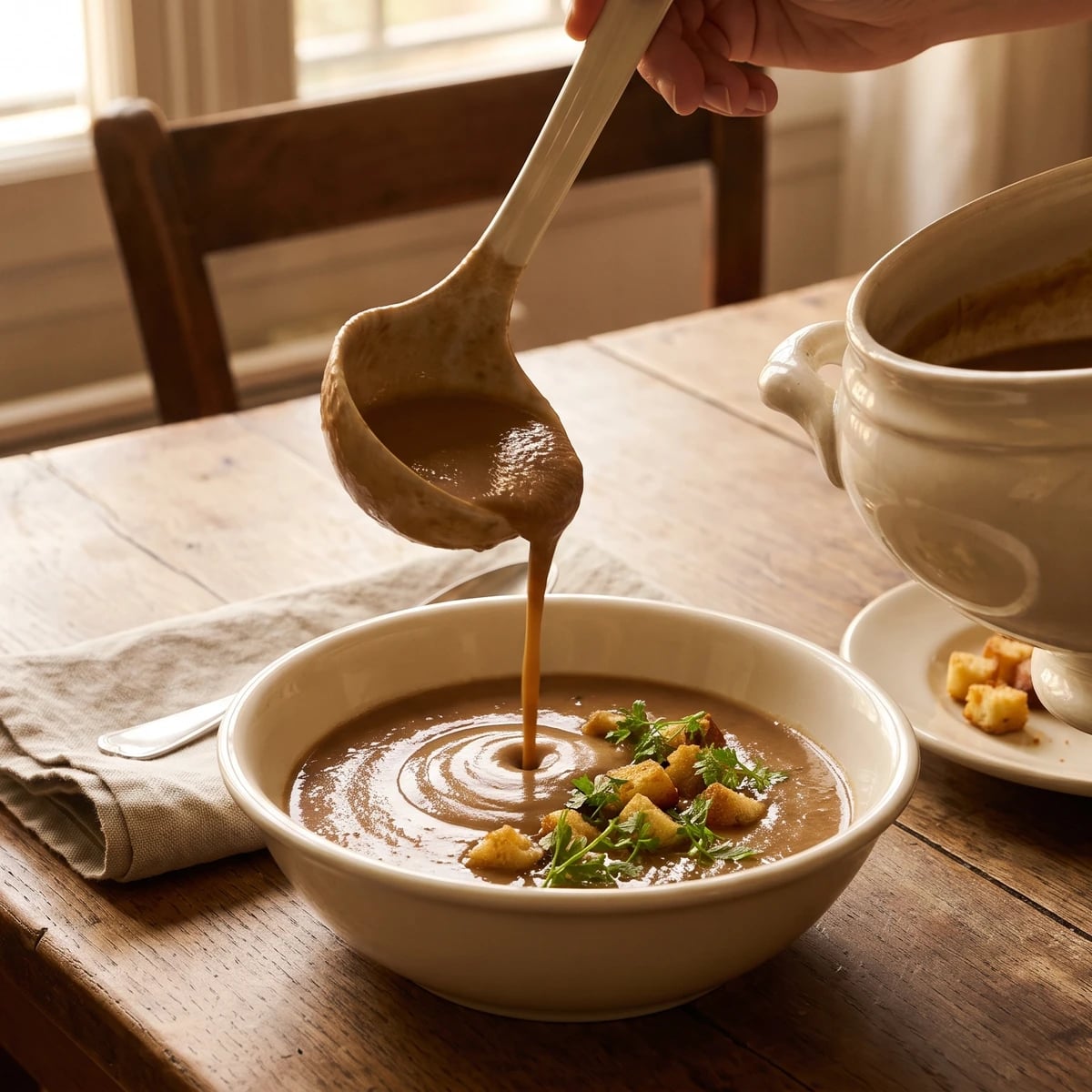
Purée de Lentilles Conti turns humble lentils, lean bacon, and white consommé into velvet, finished with real butter, crisp bread dice, and chervil. Remove the aromatics before sieving, because that small discipline decides the soup.
Purée de Lentilles, dite Conti (silken lentil soup), teaches the discipline of refinement. Flavour is built with the whole aromatic garnish in the pot, but texture depends on removing every piece before the lentils are worked. Carrot, onion, and bouquet garni have already given what they owe; blend them into the soup and their fibres coarsen what should pass over the tongue like velvet.
The original kitchen assumed a saucier on staff, white consommé never off the fire, a mortar for pounding, and a tammy for sieving. This quantity is already sensible for a home pot, about two quarts, so I have converted its measures without disturbing the ratio. A prepared consommé replaces the perpetual stockpot, a blender replaces the mortar, and a sturdy fine-mesh sieve does the tammy's work. Hand-pounding was brigade scaffolding and can go. Sieving is the dish and must stay. One cook, one stove, one evening.
Conti should be savoury and satin-smooth, with lean bacon giving depth rather than smoke, butter supplying the final gloss, and little croûtons cracking under the spoon. If the purée tightens or stays coarse, ça se rattrape, and the method shows you where. Before you touch the pan, remember the step that matters most: the cooking garnish comes out before the lentils meet the blender.
Purée Conti belongs to the Parisian classical table, where the name Conti, borrowed from the princely house of Conti, became attached to preparations founded on lentils. Beneath that courtly name sits the thrifty logic of dry pulses cooked with salt pork; the grand kitchen's contribution was to sieve the mixture and finish it with butter. Despite its satin finish and its place among potages liés (bound soups), classical Conti contains no cream: lentil starch supplies the body, and butter supplies the gloss.
Quantity
1 3/4 cups (420 ml / 340 g)
picked over
Quantity
8 cups (1.9 L / 1.9 kg)
for soaking
Quantity
1/3 cup (80 ml / 57 g), prepared by Blanchings (No. 273)
cooled and cut into small dice
Quantity
4 3/4 cups (1.14 L / 1.14 kg)
homemade or good-quality prepared
Quantity
2/3 cup (160 ml / 85 g)
cut into large pieces
Quantity
1
peeled and halved
Quantity
1
Quantity
4 tablespoons (60 ml / 57 g)
cubed for finishing
Quantity
2 tablespoons (30 ml / 5 g)
cut into small dice
Quantity
1 tablespoon (15 ml / 14 g)
for frying the bread
Quantity
1 tablespoon (15 ml / 1 g)
Quantity
as needed
| Ingredient | Quantity |
|---|---|
| small brown or green dried lentilspicked over | 1 3/4 cups (420 ml / 340 g) |
| lukewarm waterfor soaking | 8 cups (1.9 L / 1.9 kg) |
| very lean unsmoked slab baconcooled and cut into small dice | 1/3 cup (80 ml / 57 g), prepared by Blanchings (No. 273) |
| white consomméhomemade or good-quality prepared | 4 3/4 cups (1.14 L / 1.14 kg) |
| carrotscut into large pieces | 2/3 cup (160 ml / 85 g) |
| small onionpeeled and halved | 1 |
| bouquet garni of parsley stems, thyme, and bay leaf | 1 |
| cold unsalted buttercubed for finishing | 4 tablespoons (60 ml / 57 g) |
| stale white breadcut into small dice | 2 tablespoons (30 ml / 5 g) |
| unsalted butterfor frying the bread | 1 tablespoon (15 ml / 14 g) |
| chervil pluches (small picked leaves) | 1 tablespoon (15 ml / 1 g) |
| fine salt and ground white pepper | as needed |
Rinse and pick over the lentils, then cover them generously with the lukewarm water and leave them for 2 hours. This soaking belongs to the source method and helps the lentils soften evenly enough to pass through the sieve without leaving a sandy purée. Drain them thoroughly and discard the soaking water.
Use the very lean bacon already prepared according to Blanchings (No. 273), cooled, and cut into small dice. Keep the pieces modest and even so they cook through with the lentils and disappear into the finished purée rather than leaving chewy fragments.
Put the drained lentils and diced bacon in a heavy saucepan and add the white consommé. Bring it slowly to the boil, skim away the foam that gathers at the surface, then add the carrots, onion, and bouquet garni. Lower the heat, partially cover, and cook at the gentlest tremble for 50 to 70 minutes, until a lentil crushes between your fingers without a hard or chalky centre. A rolling boil breaks the lentils unevenly and muddies the cooking liquor; if the surface begins to heave, lower the heat at once.
Lift out the carrots, both onion halves, and the bouquet garni before you do anything else. Count them out if necessary. This is the one discipline that decides Conti: the aromatics have flavoured the lentils, but their fibres must not enter the purée. Set a fine sieve over a bowl, drain the lentils and bacon, and reserve every drop of cooking liquor. If a piece of carrot breaks apart, fish out the fragments now; if one escapes into the blender, ça se rattrape, but the purée will need a second passage through the sieve.
Blend the drained lentils and bacon with about 3/4 cup (180 ml) of the reserved cooking liquor, working in small batches and adding only enough liquid to keep the blades moving. If using a countertop blender, never fill it more than halfway and vent the lid beneath a folded towel. Press the blended mixture firmly through the fine-mesh sieve with a ladle or flexible spatula, scraping the smooth purée from underneath. If it feels coarse, blend it again with another spoonful of liquor and sieve once more. Don't flood it merely to hurry the work; texture comes from patient sieving, not excess liquid.
Return the sieved purée to a clean saucepan and stir in the reserved cooking liquor gradually until the soup pours in a broad ribbon and lightly coats a spoon without standing like mash. Warm it to a bare simmer for 3 to 5 minutes, then taste and correct with fine salt and white pepper. Remove the pan from the heat and monter au beurre (finish with butter), whisking in the cold cubes a few at a time until the surface is satin-glossed. Do not boil it after the butter goes in. If an oily film appears, take the pan off the heat and whisk in a tablespoon of warm reserved liquor; if necessary, give it a brief pulse with an immersion blender. Ça se rattrape.
Melt the tablespoon of butter in a small skillet over medium heat. Add the bread dice and toss until every face is crisp and evenly golden, then drain them briefly on a towel. Ladle the Conti into a warmed soupière or deep bowls, scatter over the butter-fried bread dice and chervil pluches, and serve at once. À table!
1 serving (about 245g)
Culinary guides, cultural storytelling, and the editorial depth that makes cooking meaningful.
Discover Culinary Explorer
Chef Juliette
Purée de Carottes, otherwise Crécy, turns carrots, butter, rice, and white consommé into a silken soup. The lesson is simple and absolute: blend for smoothness, then sieve for finesse.

Chef Juliette
Purée Crécy meets tender tapioca poached in white consommé, then butter brings the two together. Velours earns its name from the spoon: glossy, softly pearled, and entirely itself.

Chef Juliette
Purée de Céleri-rave turns knobby celeriac into an ivory, butter-glossed soup, its bitterness blanched away, its body supplied by potato, and its sweetness clarified by a patient half-hour of skimming.

Chef Juliette
A pale-green Flamande purée built on fresh Brussels sprouts, butter, white consommé, and potato, passed smooth and milk-finished, with crisp bread dice for the necessary bite.