Chef Juliette
Bouillabaisse à la Marseillaise
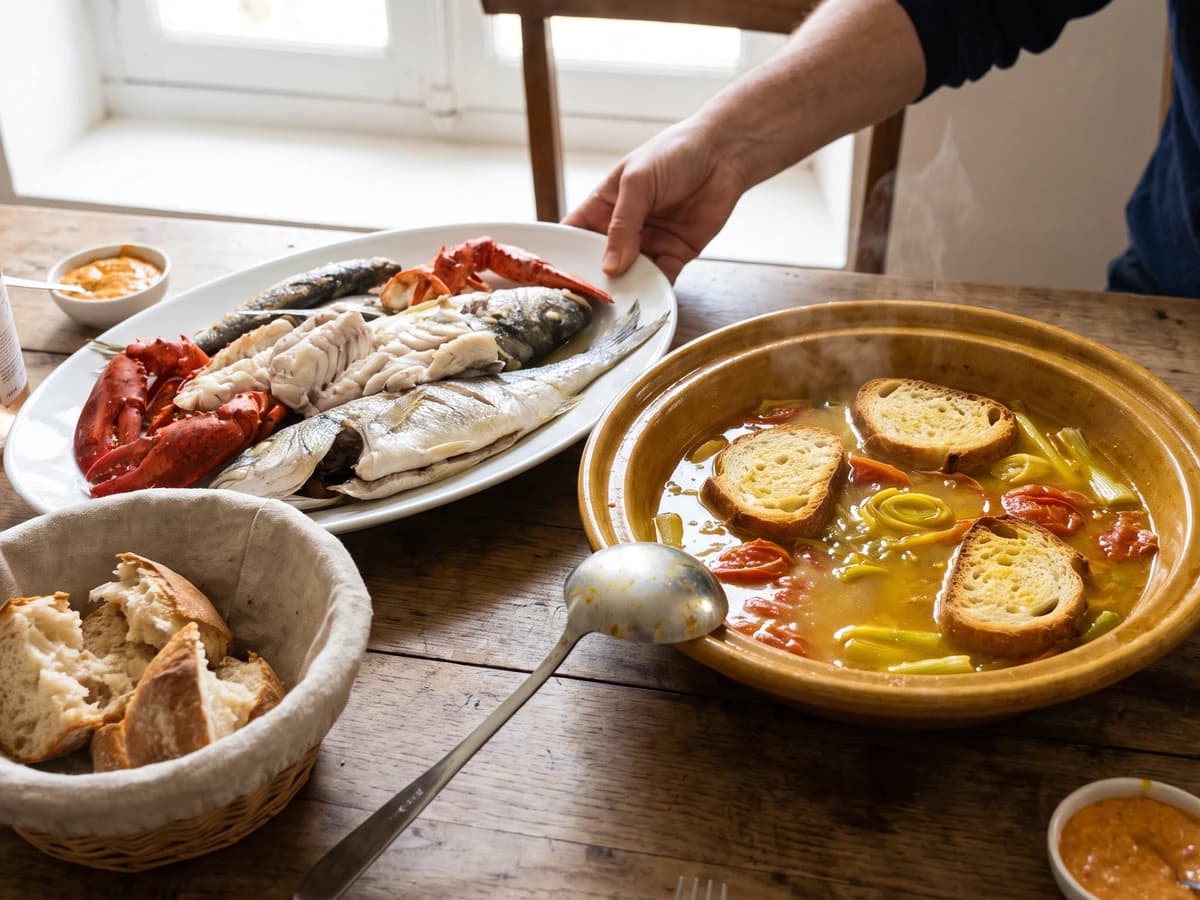
Marseille's great fish stew, saffron-gold and garlic-scented, proves that a hard boil can be the careful choice: it binds olive oil into broth before the whole pot meets bread.
A cooking platform built around craft, culture, and the stories behind what we eat.
Created by Chef Juliette
Based on No. 620, Consommé à l’Essence de Morilles, from Le Guide Culinaire (1907) by Auguste Escoffier
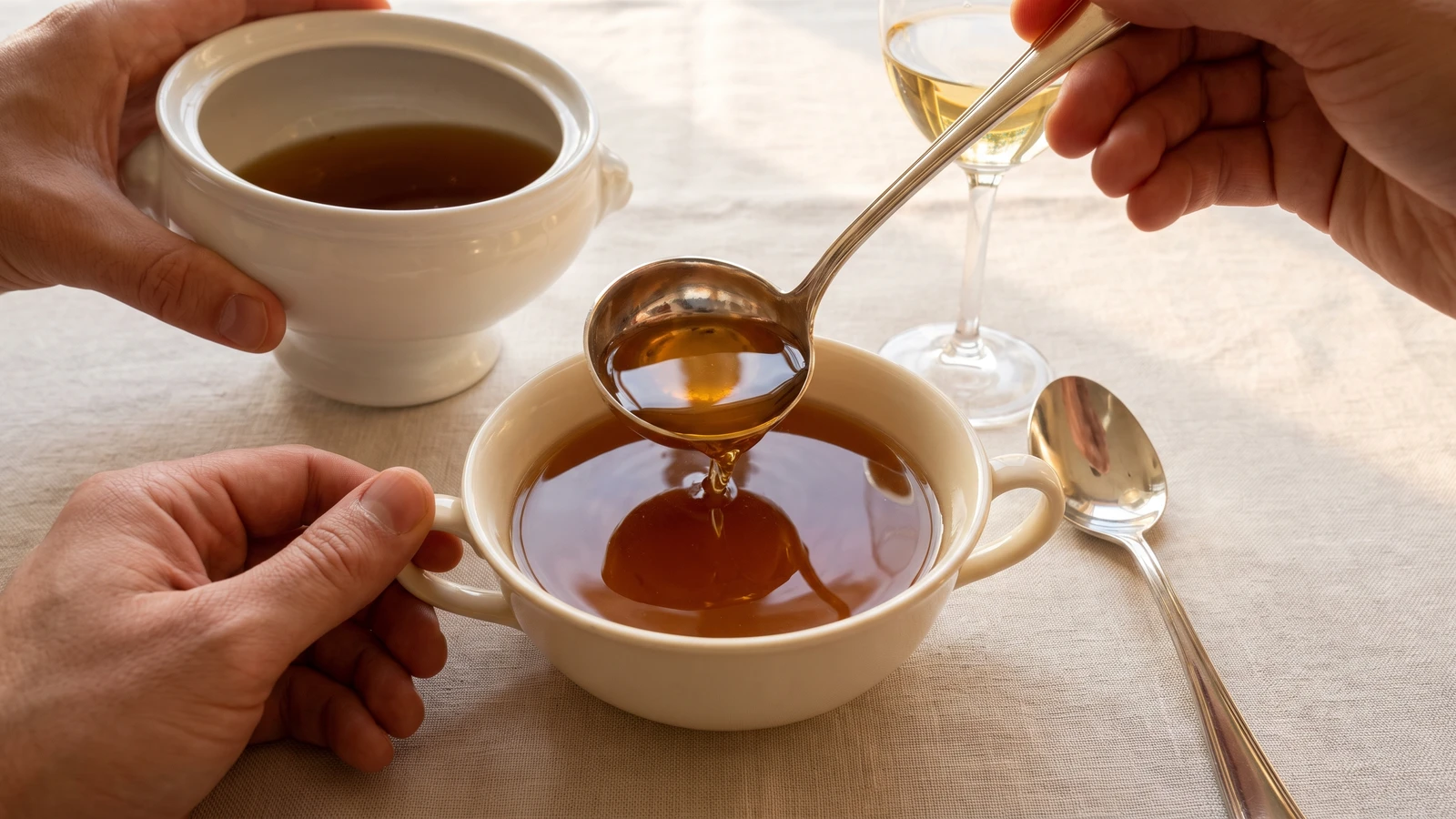
Pounded morels perfume the clarification itself, leaving a limpid amber consommé with woodland depth in every spoonful. The raft does the work, and one patient simmer makes the old canon practical at home.
Consommé à l’Essence de Morilles (clear consommé scented with morel essence) teaches the central discipline of clarification, the egg-white raft that traps impurities: intensity may deepen while the broth grows clearer. Before you touch a pan, know this: the pot begins cold, the liquid rises slowly, and once the raft seals the surface, you do not stir it.
The old formula assumed a saucier on staff, a basic consommé drawn from a stock never off the fire, and a mortar ready for pounding five ounces of fresh morels or three ounces of dried morels into each quart’s clarification. Your honest equivalents are chilled gelatin-rich beef stock, a food processor, and a tall pot. A salamander has no part in this dish. For about two quarts, the original ratio becomes ten ounces fresh or six ounces dried, and it stays exact.
The brigade’s separate batches and holding pots are scaffolding, so they go. The pounded mushrooms in the clarification are the dish, so they stay. What reaches the table is deep amber and limpid, with a woodland perfume that arrives before the spoon. One cook, one stove, one evening. Start cold, then protect the raft.
Consommé à l’Essence de Morilles belongs to the classical Parisian dining room rather than to one regional household pot, although its prized fungus connects it to the wooded larders of eastern France, especially the Jura in Franche-Comté. The preparation carried morels from spring baskets into grand-kitchen clarification, where they could perfume a formal first course without sacrificing the broth’s clarity. Here essence does not mean a bottled extract or a garnish added at the end: the mushrooms are pounded into the raft itself, then disappear so only their scent and depth remain.
Quantity
8 cups (1.9 L / 1.9 kg)
Quantity
10 ounces fresh (about 5 loosely packed cups / 1.2 L / 285 g), or 6 ounces dried (about 6 loosely packed cups / 1.4 L / 170 g)
cleaned and checked carefully for grit
Quantity
12 ounces (about 2 loosely packed cups / 475 ml / 340 g)
kept very cold
Quantity
6 (about 3/4 cup / 180 ml / 180 g)
kept very cold
Quantity
2 (about 1/4 cup / 60 ml / 60 g)
used only when reclarifying a broken raft
Quantity
1/3 cup (80 ml / 50 g)
very finely chopped
Quantity
1/3 cup (80 ml / 45 g)
very finely chopped
Quantity
1/3 cup (80 ml / 35 g)
very finely chopped
Quantity
1 teaspoon (5 ml / 2 g)
lightly crushed
Quantity
Up to 2 teaspoons (10 ml / 12 g)
added as needed after clarification
| Ingredient | Quantity |
|---|---|
| cold, gelatin-rich, unsalted brown beef stock | 8 cups (1.9 L / 1.9 kg) |
| fresh small morels, or dried morelscleaned and checked carefully for grit | 10 ounces fresh (about 5 loosely packed cups / 1.2 L / 285 g), or 6 ounces dried (about 6 loosely packed cups / 1.4 L / 170 g) |
| extra-lean ground beefkept very cold | 12 ounces (about 2 loosely packed cups / 475 ml / 340 g) |
| large egg whiteskept very cold | 6 (about 3/4 cup / 180 ml / 180 g) |
| additional large egg whites for rescue (optional)used only when reclarifying a broken raft | 2 (about 1/4 cup / 60 ml / 60 g) |
| onionvery finely chopped | 1/3 cup (80 ml / 50 g) |
| carrotvery finely chopped | 1/3 cup (80 ml / 45 g) |
| celeryvery finely chopped | 1/3 cup (80 ml / 35 g) |
| black peppercornslightly crushed | 1 teaspoon (5 ml / 2 g) |
| fine sea saltadded as needed after clarification | Up to 2 teaspoons (10 ml / 12 g) |
For fresh morels, split them lengthwise, inspect every hollow centre, and swish them briefly in cold water. Lift them out so the grit stays behind, drain well, and process them into a rough paste with a few spoonfuls of the measured stock. For dried morels, soak them for 30 minutes in enough of the measured cold stock to cover, lift them out without disturbing the sediment, and filter the soaking stock through a damp coffee filter before returning it to the remaining stock. Process the softened mushrooms into a paste. A food processor replaces the old mortar, but the pounding itself stays. Never taste the paste raw; morels must be thoroughly cooked.
Combine the pounded morels, cold ground beef, six egg whites, onion, carrot, celery, and crushed peppercorns in a large bowl. Work the mixture together until the mushrooms and vegetables are evenly caught through the meat. Stir in 1 cup (240 ml) of the measured cold stock to loosen it, then transfer everything to a tall, heavy pot and add the remaining cold stock. The mixture will look murky and alarming. It is exactly right.
Set the pot over medium-low heat and stir slowly from the bottom with a flat wooden spoon, scraping gently so the proteins cannot catch. As the liquid approaches 140°F (60°C), the meat and egg whites will gather into soft curds and begin rising. Stop stirring the moment they collect across the surface. Let them join into a solid raft, then make a 2-inch (5 cm) chimney through its centre with the handle of the spoon. Once the raft forms, movement is the enemy. If it tears slightly, lower the heat and leave it alone; it can knit itself back together.
Reduce the heat until only a few bubbles appear inside the chimney, holding the broth between 180°F and 190°F (82°C and 88°C). Simmer gently for 50 minutes without stirring or letting the raft boil. Every 15 minutes, dip a ladle through the chimney and pour a little clear broth gently over the raft. This washes the morel essence back through the clarification while the raft traps the particles that would cloud it. The broth beneath should deepen to clear amber and smell distinctly of woodland mushrooms.
Remove the pot from the heat and leave it undisturbed for 10 minutes. Line a fine sieve with damp muslin, a clean cotton napkin, or a damp coffee filter and set it over a clean pot. Ladle the consommé out through the chimney and into the sieve, working slowly so the raft remains intact. Do not pour the whole pot and never press the solids, because pressure drives the trapped sediment back into the broth. If a faint haze remains, pass the consommé once more through a fresh damp coffee filter. Draw a strip of clean paper towel lightly across the surface to lift any beads of fat.
Warm the strained consommé gently until it is just below a simmer. Taste only now, then add salt a pinch at a time; reduction and clarification concentrate seasoning, so an early hand with salt is difficult to undo. The finished consommé should be clear enough to see the bottom of a pale cup, with beef beneath and morel perfume above. Ladle it into warmed consommé cups with no garnish to interrupt its clarity. À table!
1 serving (about 240g)
Culinary guides, cultural storytelling, and the editorial depth that makes cooking meaningful.
Discover Culinary ExplorerChef Juliette
Marseille's great fish stew, saffron-gold and garlic-scented, proves that a hard boil can be the careful choice: it binds olive oil into broth before the whole pot meets bread.
Chef Juliette
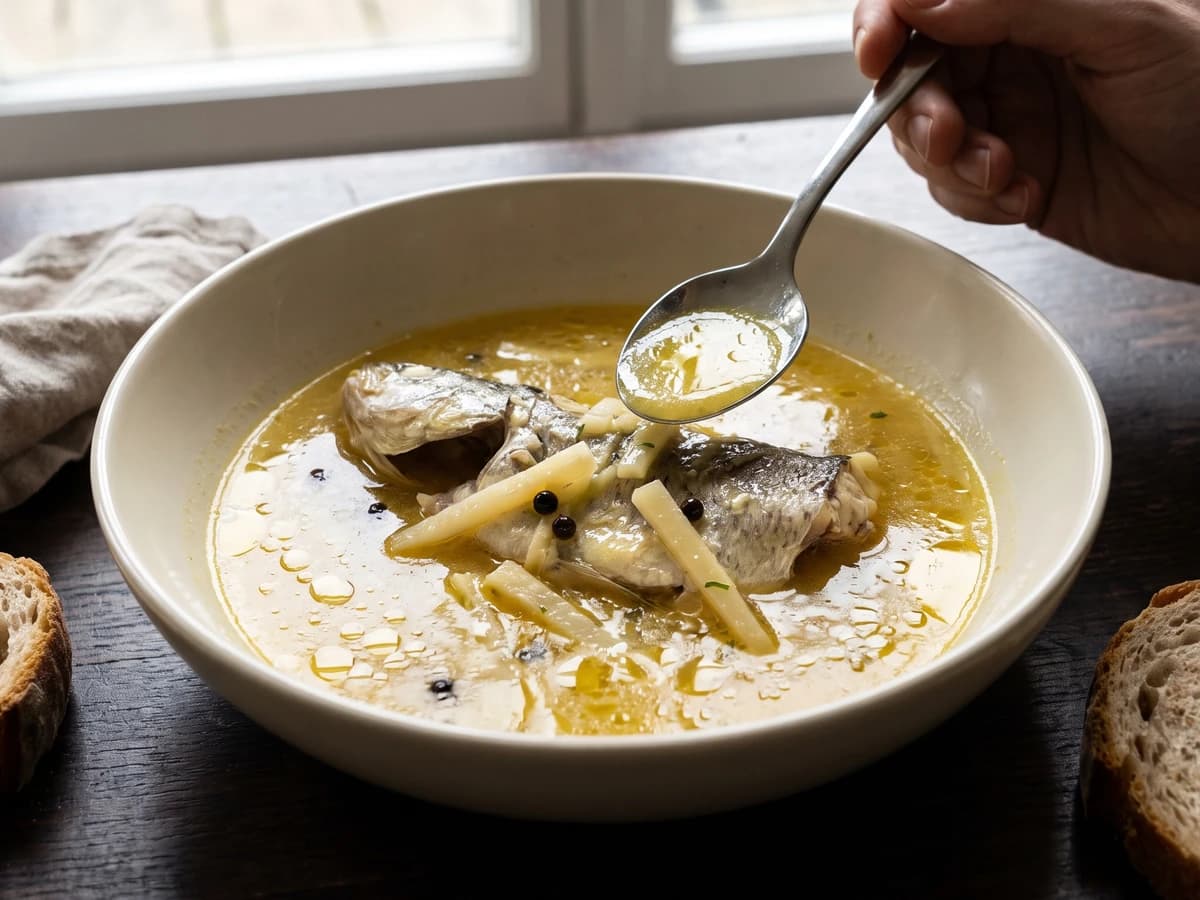
Waterzoi asks fresh, bone-in river fish to thicken its own buttery broth, with parsley root and pepper for company. No flour, no stockpot, just a brisk simmer watched closely.
Chef Juliette
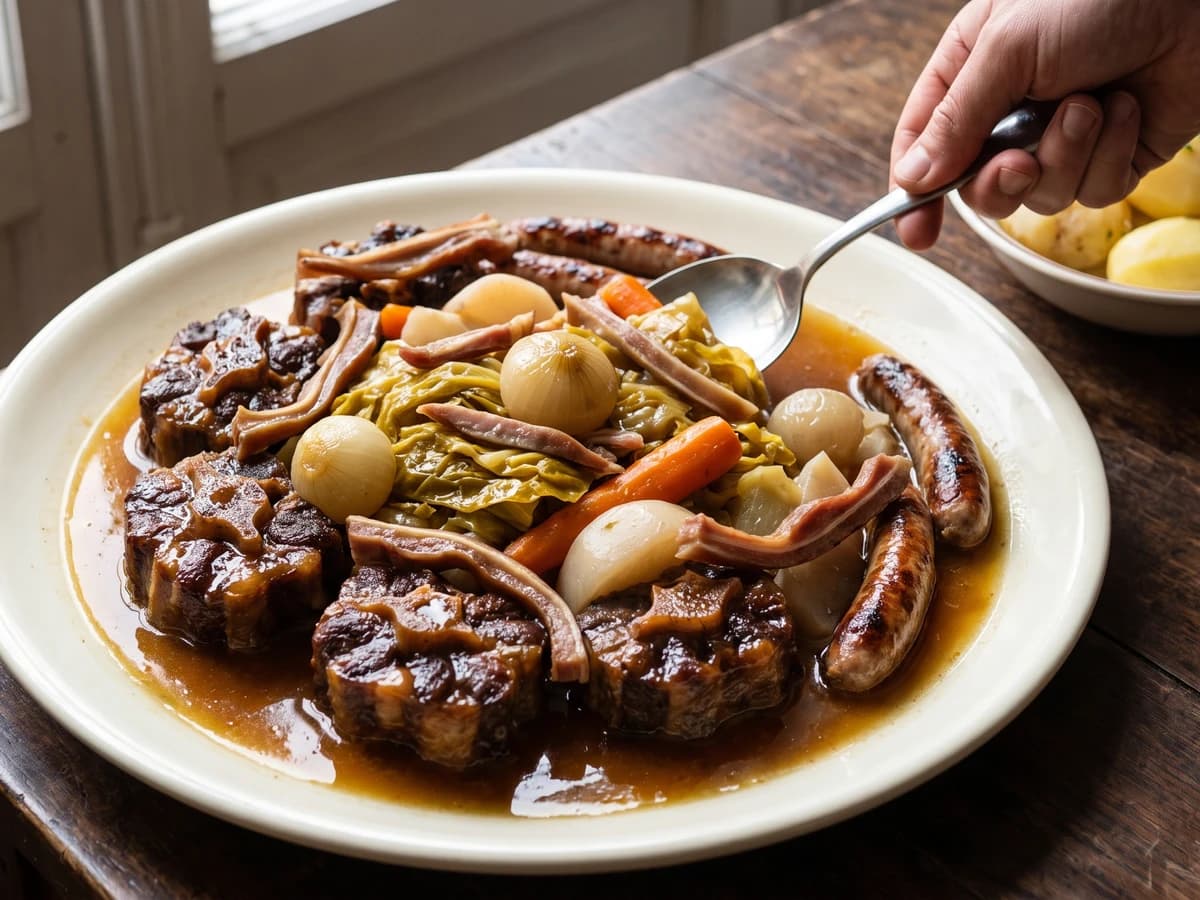
Queue de Bœuf en Hochepot gathers oxtail, pig's trotter and ear, cabbage, roots, and grilled chipolatas around a clear, gelatin-rich broth whose quiet simmer keeps every piece tender and distinct.
Chef Juliette
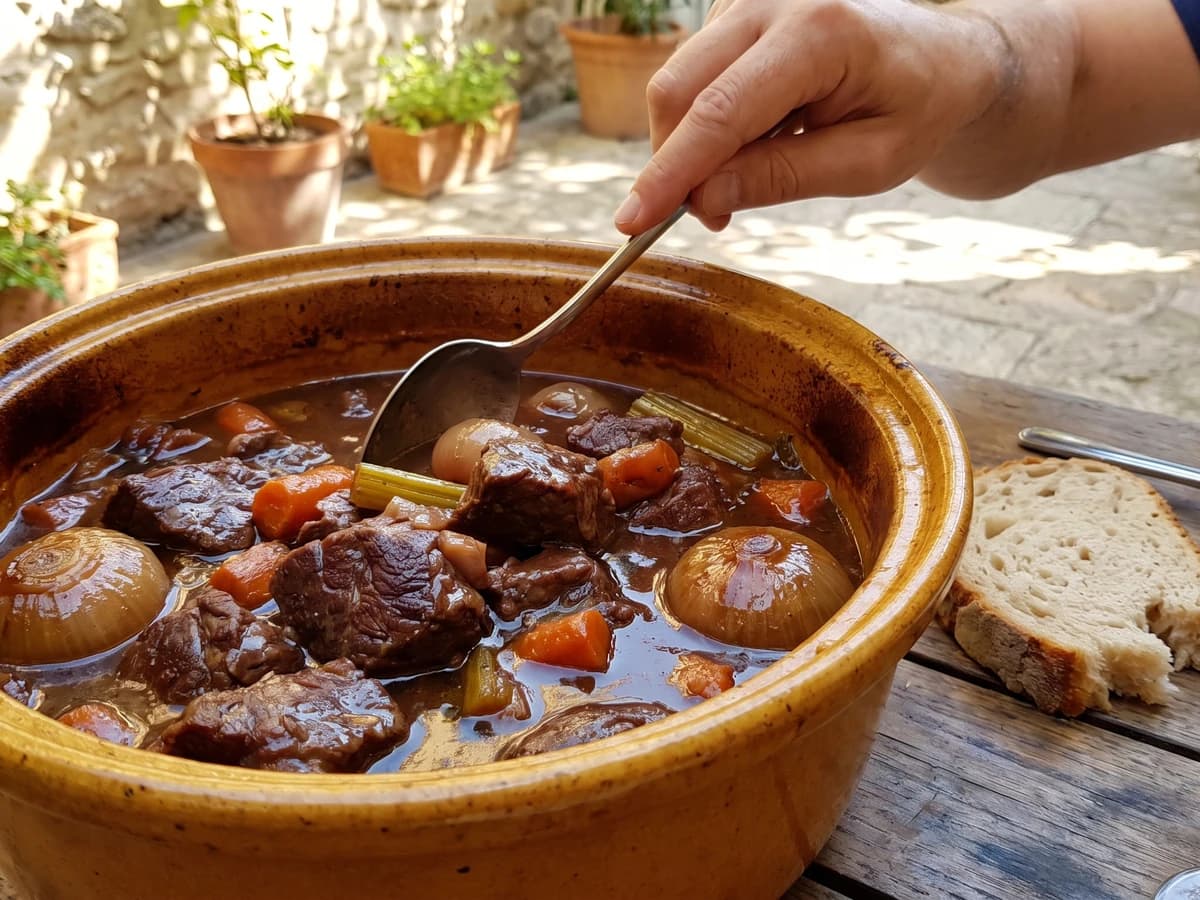
Beef shoulder larded with bacon, sharpened by red wine and vinegar, then sealed with garlic, vegetables, and dry lemon peel until the low oven turns it yielding and the gravy darkly glossy.