Chef Juliette
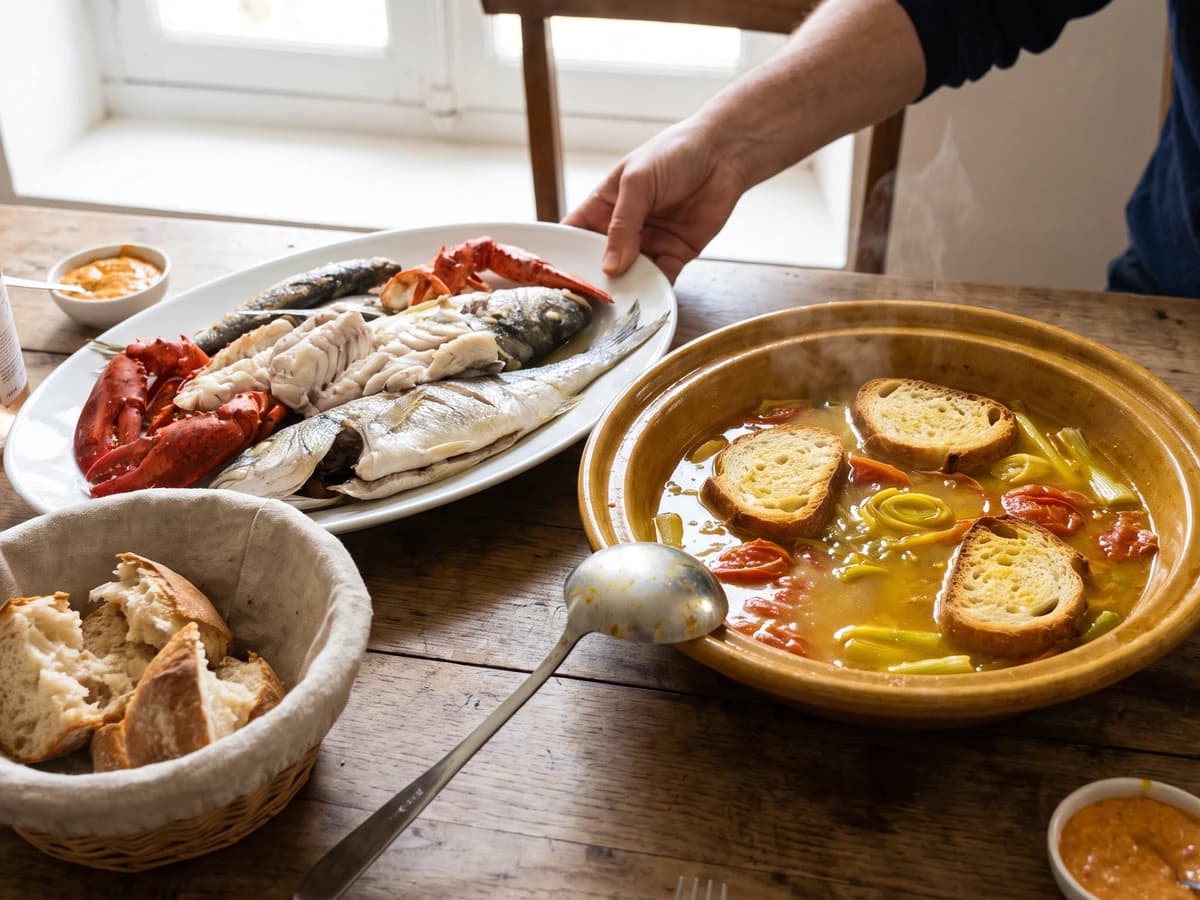
Bouillabaisse à la Marseillaise
Marseille's great fish stew, saffron-gold and garlic-scented, proves that a hard boil can be the careful choice: it binds olive oil into broth before the whole pot meets bread.
A cooking platform built around craft, culture, and the stories behind what we eat.
Created by Chef Juliette
Based on No. 617, Consommé Villeneuve, from Le Guide Culinaire (1907) by Auguste Escoffier
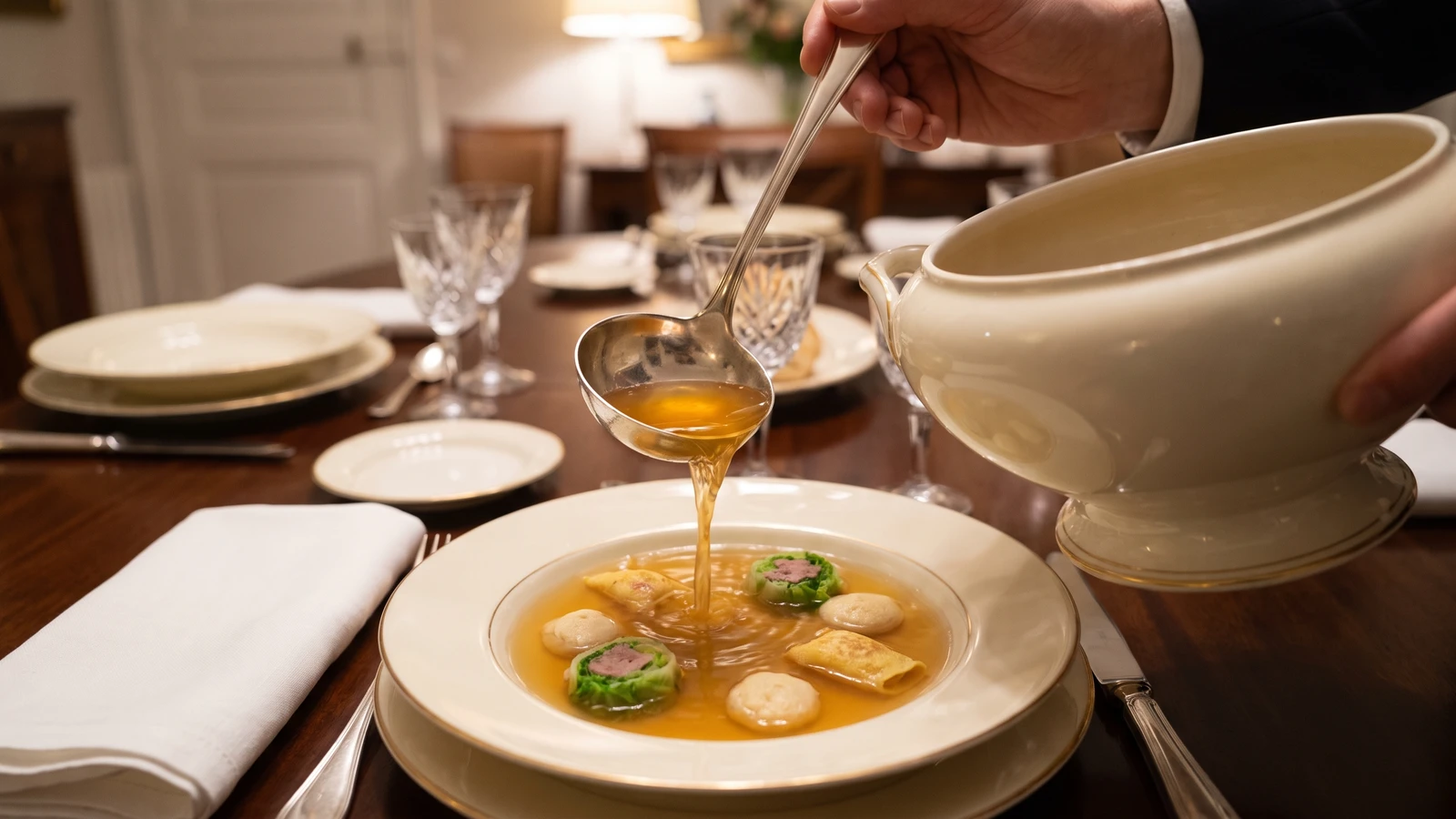
A clear chicken consommé carrying three precise garnishes: tongue-stuffed lettuce, plain royale pastilles, and tender lozenges of forcemeat-coated crêpe, each cooked separately so the broth reaches the table brilliant.
Consommé Villeneuve (clear chicken consommé with stuffed lettuce, royale, and forcemeat crêpe lozenges) teaches that clarity is not simply made in the stockpot. You protect it through every garnish. Before you touch a pan, know the one true thing: the lettuce, royale, and crêpes cook separately, and only the boiling consommé joins them at the table.
The brigade formula assumes a saucier on staff, chicken stock never off the fire, a bank of dariole moulds, and an oven with a cooler front beside a salamander used for browning. This forcemeat must not brown. Four small heatproof moulds and a low home oven give the honest equivalent. I repeat the book’s one-quart garnish ratio once to make a two-quart home batch for eight first courses. Repeated station work is scaffolding and goes; preparing the three garnishes separately is the dish and stays. One cook, one stove, one evening.
In the tureen, clear amber broth settles around pale royale pastilles, green rounds of stuffed lettuce flecked with rose-coloured tongue, and narrow crêpe diamonds capped with tender chicken. Keep the forcemeat truly cold and poach it gently. That one choice decides whether the garnish remains delicate and the consommé reaches the table brilliant.
Consommé Villeneuve belongs to the Parisian grand-kitchen repertory of named consommés, where a title identified a fixed garnish and told the dining room precisely what the tureen carried. Its stuffed lettuce, plain royale, and forcemeat-coated crêpes reflect the classical practice of cooking elaborate garnishes apart so the finished broth remains clear. The name is sometimes mistaken for proof of origin in one of France’s towns called Villeneuve, but the dish’s true home is the formal French menu, and its identity rests on its garnish formula rather than a regional larder.
Quantity
10 cups (2.4 L / 2.4 kg)
divided
Quantity
4 (about 14 oz / 400 g total), prepared by Blanchings (No. 273)
cooled and thoroughly drained
Quantity
4 tablespoons (60 ml / 56 g)
divided
Quantity
about 2½ cups (600 ml / 340 g)
diced and very cold
Quantity
2 (¼ cup / 60 ml / 60 g)
very cold
Quantity
¾ cup (180 ml / 180 g)
very cold
Quantity
1¼ teaspoons (6 ml / 7 g)
Quantity
⅛ teaspoon (0.6 ml / 0.3 g)
Quantity
1 small pinch (less than ⅛ teaspoon / 0.1 g)
Quantity
¾ cup (180 ml / 120 g)
finely chopped
Quantity
2
Quantity
2
Quantity
½ cup (120 ml / 60 g)
Quantity
½ cup (120 ml / 122 g)
Quantity
1
Quantity
⅛ teaspoon (0.6 ml / 0.8 g)
| Ingredient | Quantity |
|---|---|
| clear, fully seasoned chicken consommédivided | 10 cups (2.4 L / 2.4 kg) |
| small butter lettucescooled and thoroughly drained | 4 (about 14 oz / 400 g total), prepared by Blanchings (No. 273) |
| unsalted butterdivided | 4 tablespoons (60 ml / 56 g) |
| skinless chicken breastdiced and very cold | about 2½ cups (600 ml / 340 g) |
| large egg whitesvery cold | 2 (¼ cup / 60 ml / 60 g) |
| heavy creamvery cold | ¾ cup (180 ml / 180 g) |
| fine salt for the forcemeat | 1¼ teaspoons (6 ml / 7 g) |
| ground white pepper | ⅛ teaspoon (0.6 ml / 0.3 g) |
| freshly grated nutmeg | 1 small pinch (less than ⅛ teaspoon / 0.1 g) |
| cooked salted beef tonguefinely chopped | ¾ cup (180 ml / 120 g) |
| large eggs for the plain royale | 2 |
| large egg yolks for the plain royale | 2 |
| all-purpose flour | ½ cup (120 ml / 60 g) |
| whole milk | ½ cup (120 ml / 122 g) |
| large egg for the crêpes | 1 |
| fine salt for the crêpes | ⅛ teaspoon (0.6 ml / 0.8 g) |
Measure 8 cups (1.9 L / 1.9 kg) of consommé into the saucepan for final service. Set aside 1 cup (240 ml / 240 g) for braising the lettuces, ¾ cup (180 ml / 180 g) for the royale, and ¼ cup (60 ml / 60 g) as a reserve. Reach for the lettuces already prepared by Blanchings (No. 273). Press them gently between clean towels until no water remains between the leaves; trapped water weakens the stuffing and later clouds the soup.
Chill the food-processor bowl and blade. Process the cold chicken with the forcemeat salt, white pepper, and nutmeg until it forms a smooth, sticky paste. Add the egg whites and process just until absorbed, then add the cold cream in four additions, pulsing briefly after each. Stop as soon as the mixture is smooth and glossy. Warm forcemeat separates and turns grainy; if you see fat at the edge, stop immediately, set the bowl over ice for ten minutes, and pulse once or twice to bring it back together. Ça se rattrape, but do not add more cream.
Weigh or judge the forcemeat into two equal portions. Fold the chopped salted tongue into one half without overworking it. Open each drained lettuce gently, remove only the small core, and place one quarter of the tongue forcemeat in the centre. Fold the leaves back over the filling to reconstruct a compact head, then tie it loosely with kitchen string. The second half of the plain forcemeat belongs to the crêpes; keep it over ice.
Heat the oven to 325°F (165°C). Butter a small covered baking dish with 1 tablespoon (15 ml / 14 g) butter and arrange the lettuces snugly inside. Add the reserved 1 cup (240 ml / 240 g) consommé, dot with another 1 teaspoon (5 ml / 5 g) butter, cover with parchment and the lid, and braise for 25 to 30 minutes. The filling must reach 165°F (74°C), while the leaves remain intact. Cool the lettuces in their liquid, then lift them out and chill. Do not add the braising liquid to the service consommé; it has done its work and will no longer be perfectly clear.
Lower the oven to 300°F (150°C). Royale is a plain savory egg custard, and here it must remain pale and close-textured. Butter four dariole moulds, small baba-shaped moulds, or four ⅓-cup heatproof cups. Whisk the two eggs and two yolks just enough to combine, stir in the reserved ¾ cup (180 ml / 180 g) consommé, then pass the mixture through a fine sieve. Skim away every bubble and divide it among the moulds. Set them in a small bain-marie with hot water reaching halfway up their sides and bake for 20 to 25 minutes, until barely firm at the centre. If the water begins to boil, add a little cold water and lower the oven. Ça se rattrape before the custard curdles. If an edge becomes porous, trim it away later and cut the smooth centre into pastilles.
Whisk the flour and crêpe salt with the milk and egg until smooth, then whisk in 1 tablespoon (15 ml / 14 g) melted butter. Rest the batter for fifteen minutes. Brush a 6-inch (15 cm) skillet sparingly with butter and cook four thin crêpes, colouring them only lightly. Stack them beneath a clean towel as they come from the pan. If the first one tears, whisk a teaspoon of flour into the batter and let it stand five minutes; the first crêpe is often tuition.
Lay the crêpes smooth-side down on a buttered baking sheet. Spread the reserved plain chicken forcemeat over each in an even layer about ⅛ inch (3 mm) thick, taking it nearly to the edges. The book’s cooler oven front becomes a 300°F (150°C) home oven, gentle enough to poach without the browning a salamander would give. Bake for 8 to 10 minutes, until the forcemeat is matte, springy, and 165°F (74°C) at the centre. If the paste slides or smears before baking, it has warmed too far; chill the coated crêpes for ten minutes, then continue.
Unmould the cold royale and slice it crosswise into neat pastilles about ¼ inch (6 mm) thick. Remove the strings from the lettuces and cut each head crosswise into four compact rounds, wiping the knife between cuts. Trim the crêpes into rectangles, then cut them on opposing diagonals into small, narrow lozenges about 1¼ inches by ½ inch (3 cm by 1 cm). Keep the three garnishes separate and covered until service so their edges remain clean.
Warm a soup tureen with hot water, empty it, and dry it thoroughly. Arrange the lettuce rounds, crêpe lozenges, and royale pastilles across its base without packing them tightly. Bring the 8 cups (1.9 L / 1.9 kg) service consommé to a full, clean boil, taste it, and skim the surface if needed. If it has reduced too strongly, use the reserved ¼ cup (60 ml / 60 g) consommé to restore its balance.
Carry the tureen to the table and pour the boiling consommé gently over the garnishes. Do not return the assembled soup to the stove. Boiling the royale and forcemeat inside the broth roughens their surfaces, sends particles into the consommé, and undoes the clarity you have protected. Ladle two lettuce rounds with a share of pastilles and lozenges into each warm bowl. À table!
1 serving (about 410g)
Culinary guides, cultural storytelling, and the editorial depth that makes cooking meaningful.
Discover Culinary ExplorerChef Juliette
Marseille's great fish stew, saffron-gold and garlic-scented, proves that a hard boil can be the careful choice: it binds olive oil into broth before the whole pot meets bread.
Chef Juliette
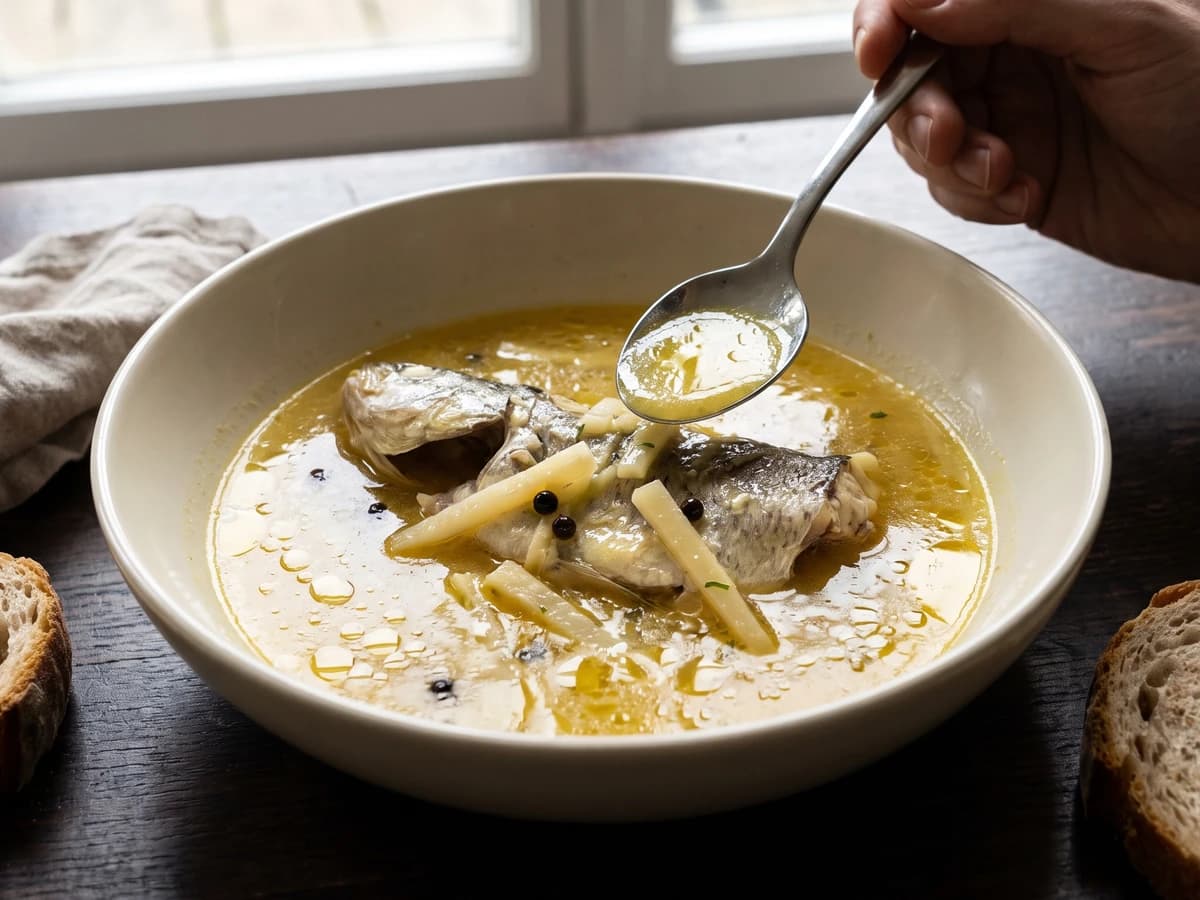
Waterzoi asks fresh, bone-in river fish to thicken its own buttery broth, with parsley root and pepper for company. No flour, no stockpot, just a brisk simmer watched closely.
Chef Juliette
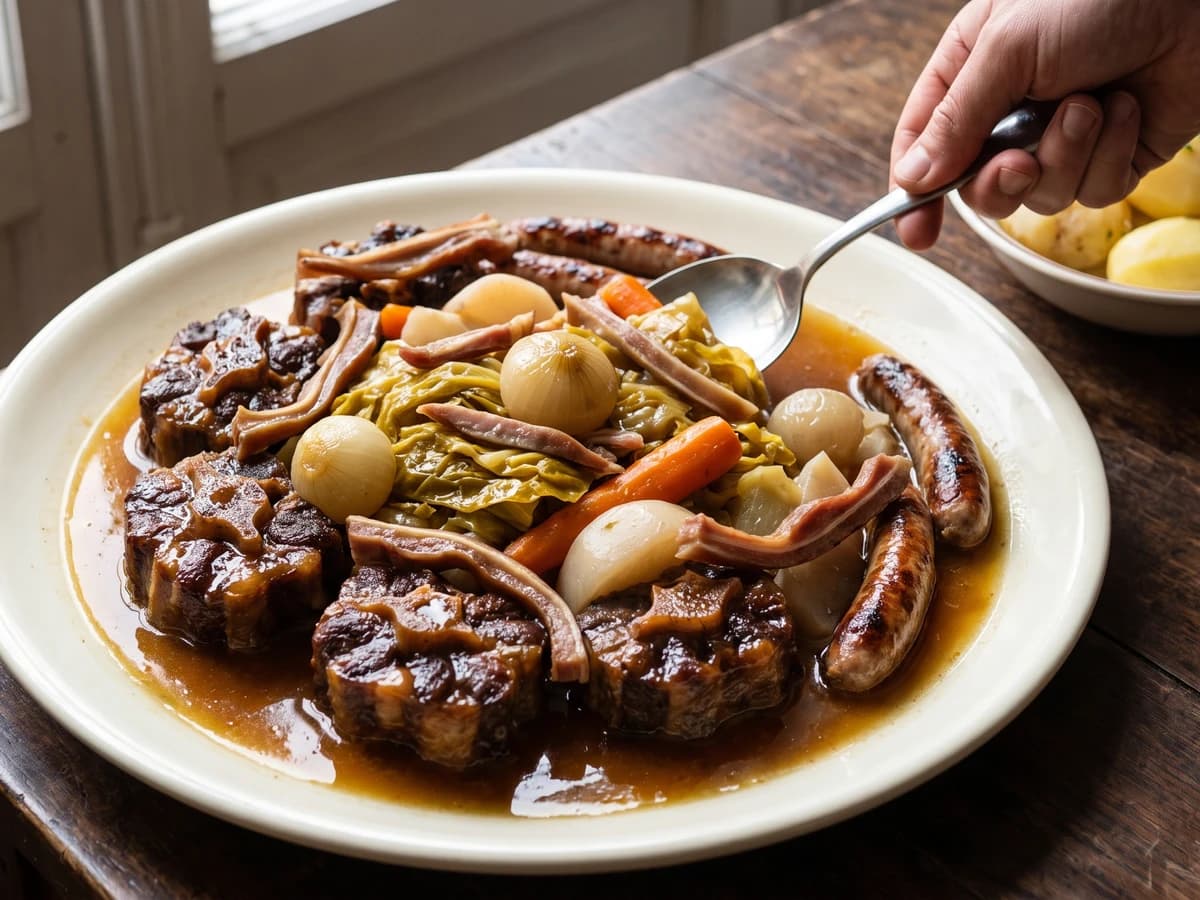
Queue de Bœuf en Hochepot gathers oxtail, pig's trotter and ear, cabbage, roots, and grilled chipolatas around a clear, gelatin-rich broth whose quiet simmer keeps every piece tender and distinct.
Chef Juliette
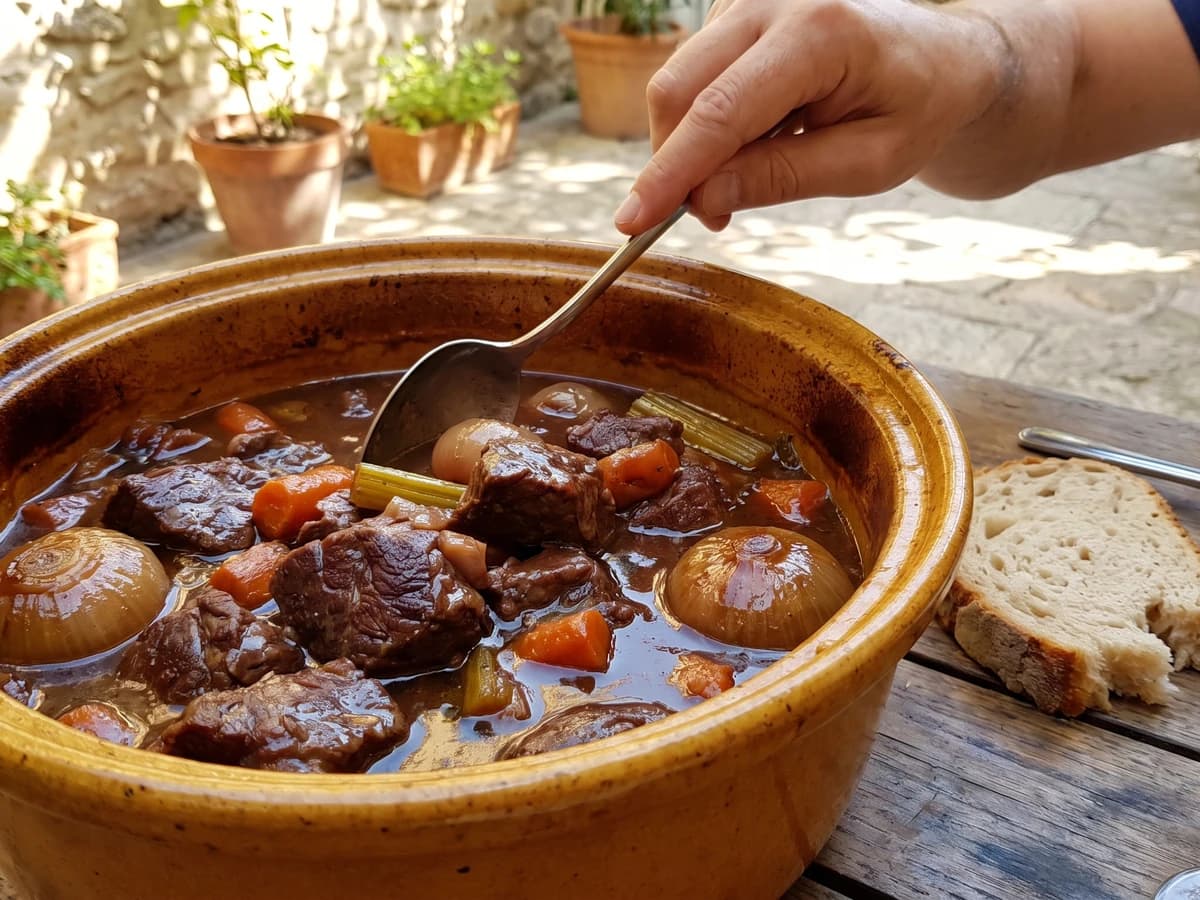
Beef shoulder larded with bacon, sharpened by red wine and vinegar, then sealed with garlic, vegetables, and dry lemon peel until the low oven turns it yielding and the gravy darkly glossy.