Culinary Explorer

A cooking platform built around craft, culture, and the stories behind what we eat.
Discover Culinary Explorer
Potage Sarah Bernhardt

Potage Sarah Bernhardt

Created by Chef Juliette

Based on No. 611, Potage Sarah Bernhardt, from Le Guide Culinaire (1907) by Auguste Escoffier

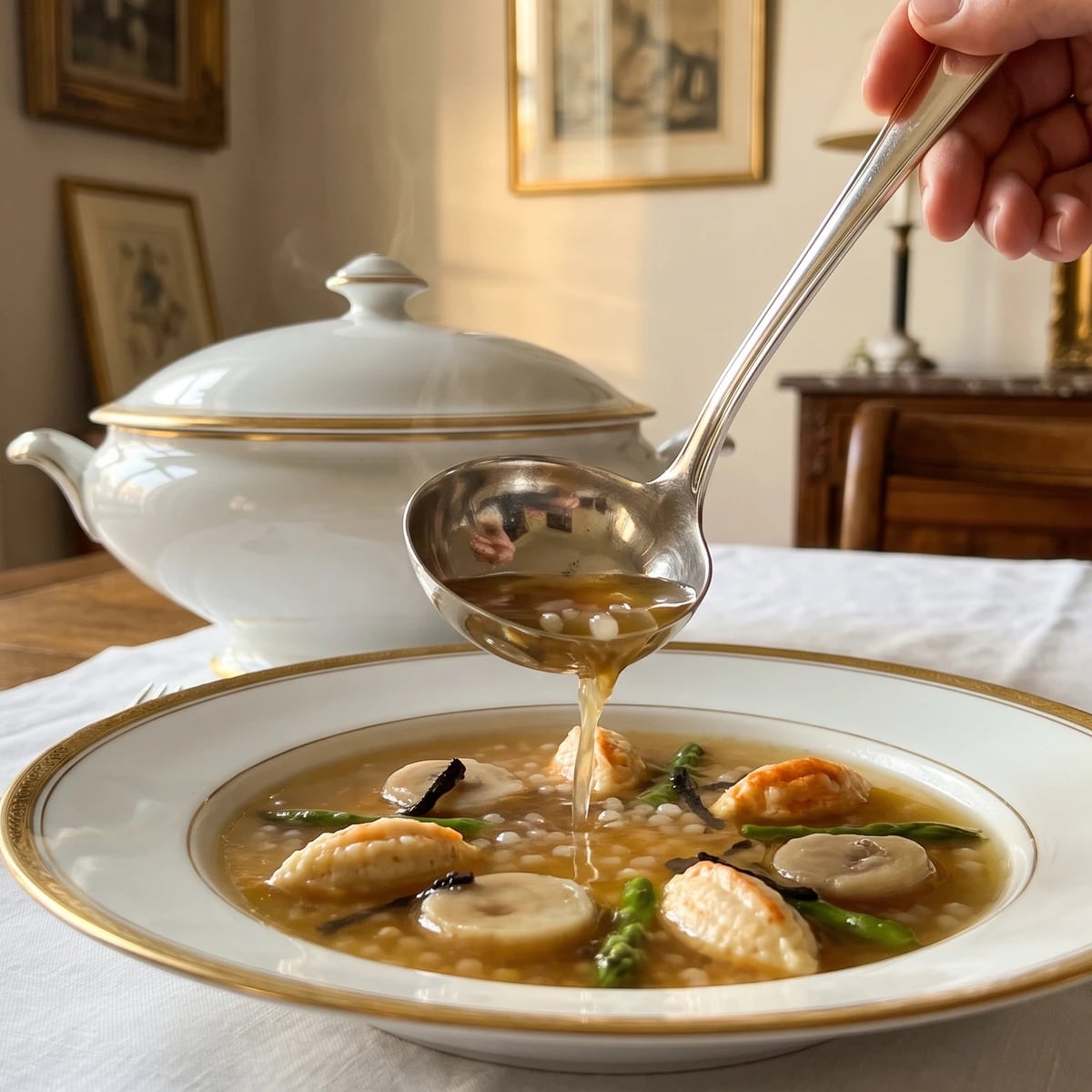
A clear tapioca consommé carrying coral-flecked chicken quenelles, tender marrow rounds, black truffle, and asparagus tips: a Parisian celebration soup whose luxury depends on gentle poaching, not display.

Soups & Stews
French
Dinner Party
Special Occasion
Celebration
1 hr 15 min
Active Time
45 min cook2 hr total
YieldAbout 2 quarts (8 first-course servings)

Potage Sarah Bernhardt (tapioca chicken consommé with crayfish-butter quenelles, marrow, truffle, and asparagus) teaches the discipline of a clear soup carrying a generous garnish. Every element must be fully cooked, fully drained, and gentle enough not to muddy the broth. The one true thing to know before touching a pan is this: clarity isn't decoration. It is the dish.

The original assumed a saucier, a stockpot never off the fire, chicken forcemeat and crayfish butter waiting at separate stations, little grooved molds, and enough hands to manage garnish and broth at once. It called for no salamander, so we invent no broiler business. Those stations were brigade scaffolding; at home, one prepared consommé, a food processor, and a fluted piping bag do the work. The book's quart is doubled to make the requested two-quart home batch for eight first courses, with every proportion held exactly. Ordinary Meringue (No. 2382) remains what the entry meant it to be, a model for the quenelles' little grooved silhouette, not sugar dropped into soup. One cook, one stove, one evening.

The clear consommé, the crayfish finish, the separately poached garnishes, and the fifteen-to-eighteen-minute tapioca cook are the dish itself, so they stay. Hold the poaching liquid at a bare tremble. A boil tears the quenelles and melts marrow into a greasy cloud; if the first quenelle frays, pull the pan from the heat, skim the broth, and chill the remaining forcemeat before continuing. Ça se rattrape. Gentle poaching is the step that decides everything.

Potage Sarah Bernhardt belongs to Parisian grande cuisine, whose dining rooms named elaborate preparations for celebrated figures of the stage and salon; the title honors the actress Sarah Bernhardt, not a regional soup or one she is known to have devised. From Paris service it entered the written classical canon as a study in separate garnish work: chicken quenelles scented with crayfish butter, marrow, black truffle, and asparagus, all brought together only in the tureen. Tapioca is not a cheap thickener here; its translucent pearls give the consommé body without the opacity of a roux.

The technique, the tradition, and the story behind every dish.

Discover Culinary Explorer

Ingredients

clear, full-flavored chicken consommé

Quantity

9 cups (2.13 L / 2.13 kg)

include 1 cup in reserve for restoring the final volume

small pearl tapioca

Quantity

6 tablespoons (90 ml / 60 g)

not instant

cooked whole crayfish

Quantity

8 ounces (225 g)

shells removed and crushed; tail meat reserved for another dish

unsalted butter

Quantity

6 tablespoons (90 ml / 85 g)

softened, for the crayfish butter

boneless, skinless chicken breast

Quantity

10 ounces (285 g)

diced and thoroughly chilled

fine sea salt

Quantity

1 teaspoon (5 ml / 6 g)

large egg white

Quantity

1 large egg white (2 tablespoons / 30 ml / 30 g)

thoroughly chilled

heavy cream

Quantity

½ cup (120 ml / 120 g)

thoroughly chilled and divided

intact beef marrow cylinders

Quantity

4 ounces (115 g)

very cold

very black truffle

Quantity

2 tablespoons (30 ml / 20 g)

cut julienne-fashion

small asparagus tips

Quantity

2 tablespoons (30 ml / 30 g)

optional shaping reference, not an ingredient in the finished soup (optional)

Quantity

1 small Ordinary Meringue (No. 2382)

used only as a visual model

Equipment Needed

  • Food processor with metal blade
  • Fine-mesh sieve and damp cheesecloth
  • Piping bag with ½-inch (13 mm) open-star tip
  • Wide 3-quart saucepan
  • Instant-read thermometer
  • 2-quart soupière

Instructions

  1. 1

    Make the crayfish butter

    Pulse the crushed crayfish shells in a food processor until they resemble coarse gravel. Add the softened butter and pulse again to make a brick-red paste. Scrape it into a small saucepan and cook over very gentle heat for 10 minutes, stirring often, until the butter turns coral-orange and smells sweetly of shellfish without browning. Pass it through a fine sieve lined with damp cheesecloth, pressing firmly, then strain once more without pressing so no shell grit remains. Let the butter cool until soft but no longer liquid, and measure 3 tablespoons (45 ml / 42 g) for the forcemeat. Chill any remainder for another sauce.

    Keep the heat low. Scorched shell tastes bitter and cannot be hidden by the consommé; coral color and a sweet marine aroma are your signals to strain.
  2. 2

    Build the chicken forcemeat

    Chill the food processor bowl and blade for 10 minutes. Pulse the cold chicken with the salt until it becomes a fine, tacky paste, then add the egg white and process just until smooth. With the motor running, pour in 6 tablespoons (90 ml / 90 g) of the cold cream in a thin stream, followed by the measured crayfish butter in small pieces. Stop as soon as the mixture is smooth and faintly coral. Press it through a fine-mesh sieve for the satin texture this garnish requires, cover directly against the surface, and chill for 30 minutes.

    The forcemeat must stay cold enough to hold its emulsion. If butter begins shining separately around the blade, stop, chill the bowl for 10 minutes, then pulse in 1 tablespoon of the reserved cream. Ça se rattrape.
    Poach a teaspoon of forcemeat before shaping the batch. If it is firm and springy rather than tender, fold in the remaining reserved cream a teaspoon at a time; if it spreads, chill it longer.
  3. 3

    Shape and poach quenelles

    Set the Ordinary Meringue (No. 2382) nearby if you have one; it is only a model for the small grooved silhouette and never enters the soup. Fit a piping bag with a ½-inch (13 mm) open-star tip and fill it with the cold forcemeat. Heat 3 cups (710 ml / 710 g) of the consommé in a wide saucepan until it barely trembles, about 180°F (82°C). Working in four batches, pipe 40 small fluted mounds directly into the liquid, cutting each free with a wet knife. Poach for 4 to 5 minutes, turning once, until gently puffed and 165°F (74°C) at the center. Lift them with a slotted spoon and drain on a clean lint-free towel.

    If the first quenelle feathers at its edges, the consommé is too hot or the forcemeat is too warm. Pull the pan from the heat, skim away the fragments, chill the piping bag for 10 minutes, and continue at a lower tremble.
  4. 4

    Poach the marrow rounds

    Cut the cold marrow cylinders crosswise into 24 penny-sized rounds, each about ¾ inch (2 cm) wide and ¼ inch (6 mm) thick. Lower the poaching consommé to about 170°F (77°C), add the marrow, and poach for 60 to 90 seconds, just until the rounds look glossy and supple while still holding their shape. Lift them immediately and drain beside the quenelles. Pass the poaching consommé through fresh damp cheesecloth. If it looks cloudy, let it stand for 5 minutes and filter it again without squeezing; sacrifice the last spoonful of sediment rather than carrying it into the tureen.

  5. 5

    Prepare the final garnish

    Blanch the asparagus tips in boiling water for 45 to 60 seconds, until bright green and barely tender, then cool them in ice water and dry them thoroughly. Cut the black truffle julienne-fashion, meaning into fine match-shaped rods, and measure exactly 2 tablespoons (30 ml / 20 g). Keep the quenelles, marrow, asparagus, and truffle separate and well drained. Water clinging to any garnish dilutes the consommé and dulls its clarity.

  6. 6

    Poach the tapioca

    Combine the untouched consommé with the strained poaching consommé, then add enough of the reserved cup to measure exactly 8 cups (1.9 L / 1.9 kg). Bring it to a full boil in a clean saucepan. Sprinkle in the tapioca in a thin rain while stirring, lower the heat immediately, and poach gently for 15 to 18 minutes, stirring from the bottom every few minutes. The pearls are ready when nearly translucent, with only a faint pinprick remaining at their centers, and the consommé should retain a light, flowing body. If a clump forms, lift the pan from the heat and tease it apart with a fork; hard whisking only clouds the broth. If the soup tightens too far, loosen it with a little remaining hot consommé, never water.

  7. 7

    Fill the soupière

    Warm a 2-quart soupière with hot water, empty it, and dry it well. Arrange the drained quenelles and marrow rounds across the bottom, then scatter over the truffle julienne and asparagus tips. Taste the tapioca consommé for seasoning, bring it back to a decisive boil for a few seconds, and pour it at once over the garnish. Stir once very gently from the bottom before ladling so each serving receives five quenelles, three marrow rounds, truffle, and asparagus. Bring the soupière straight to the table. À table!

Chef Tips

  • Begin with consommé clear enough to read a spoon through and flavorful enough to serve alone. The stockpot was brigade scaffolding, not a demand that you simmer bones on the day of the party; make and clarify the consommé ahead, or buy an excellent prepared chicken consommé and correct its strength by gentle reduction.
  • Frozen whole cooked crayfish are the classical pantry's honest answer when fresh ones aren't available. Thaw them in the refrigerator and dry the shells before making the butter. Shrimp or lobster butter will make a pleasant quenelle, but the flavor changes and the dish is no longer exact.
  • Ask the butcher for intact marrow cylinders rather than canoe-cut bones. Marrow softens quickly once sliced, so keep it very cold and use a thin sharp knife wiped clean between cuts.
  • A good preserved black truffle is preferable to a tired fresh one outside its season. Drain and dry it before cutting; very black means a ripe, dark truffle, never one dyed for effect.
  • Pour a dry Champagne or a taut white Burgundy. The wine needs enough freshness to meet the marrow and crayfish butter without shouting over the consommé.

Advance Preparation

  • The chicken consommé may be made and clarified up to 2 days ahead. Chill it promptly, covered, and remove any set surface fat before reheating.
  • The crayfish butter may be made up to 3 days ahead and kept chilled. Let the measured portion soften slightly before incorporating it into the cold forcemeat.
  • The forcemeat may be mixed up to 6 hours ahead. The quenelles may be poached up to 4 hours ahead, chilled promptly, and held covered; the boiling tapioca consommé reheats them in the tureen.
  • Blanch the asparagus and cut the truffle up to 2 hours ahead. Cut and poach the marrow no more than 1 hour before serving, then keep the rounds cold and covered.

Frequently Asked Questions

Nutrition Information

1 serving (about 250g)

Calories
355 calories
Total Fat
28 g
Saturated Fat
14 g
Trans Fat
1 g
Unsaturated Fat
13 g
Cholesterol
90 mg
Sodium
1180 mg
Total Carbohydrates
9 g
Dietary Fiber
0 g
Sugars
1 g
Protein
17 g

Note: Chef personas and recipes are created with AI assistance. Cook with care: follow safe food-handling practices, check doneness with a thermometer when needed, and adapt for allergies and your kitchen.

Where cooking meets culture.

Culinary guides, cultural storytelling, and the editorial depth that makes cooking meaningful.

Discover Culinary Explorer