Chef Juliette
Bouillabaisse à la Marseillaise
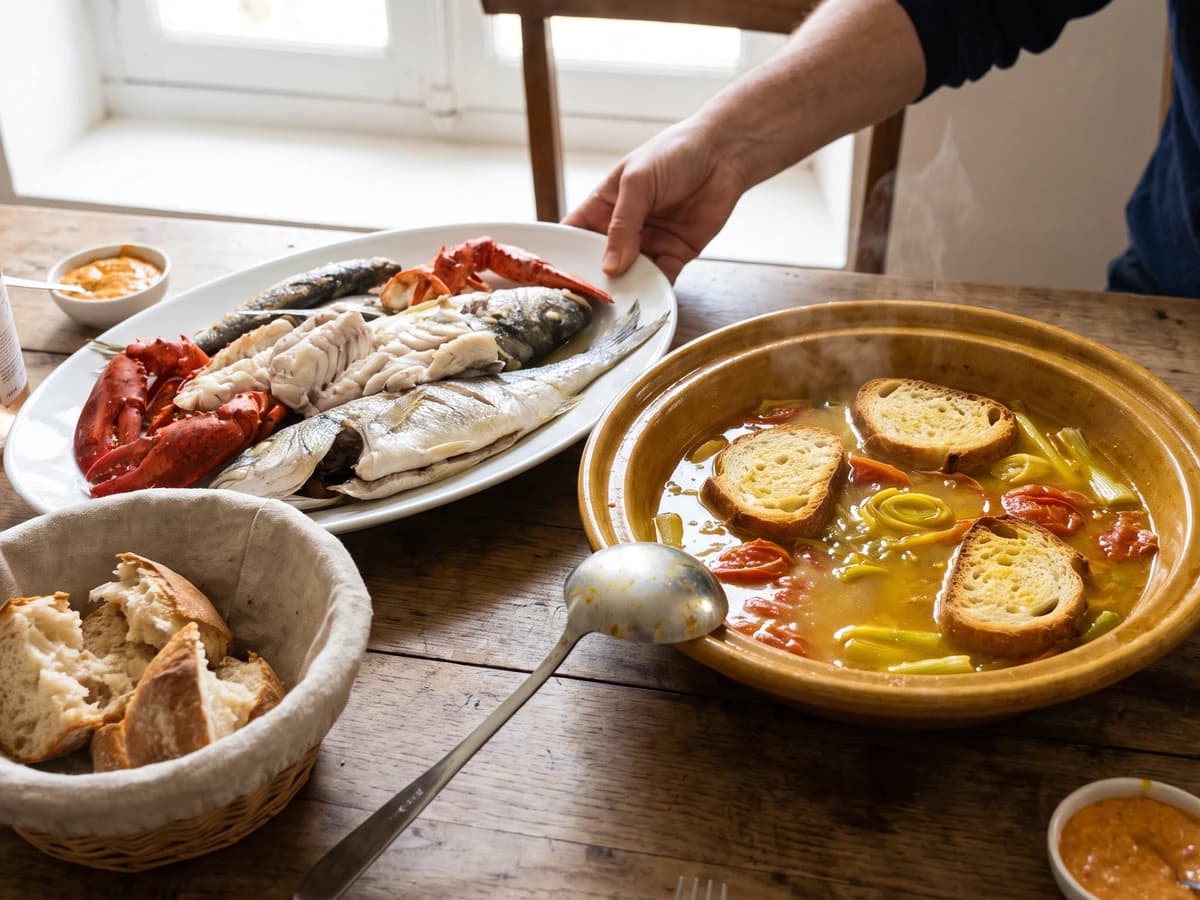
Marseille's great fish stew, saffron-gold and garlic-scented, proves that a hard boil can be the careful choice: it binds olive oil into broth before the whole pot meets bread.
A cooking platform built around craft, culture, and the stories behind what we eat.
Created by Chef Juliette
Based on No. 608, Consommé Rossini, from Le Guide Culinaire (1907) by Auguste Escoffier
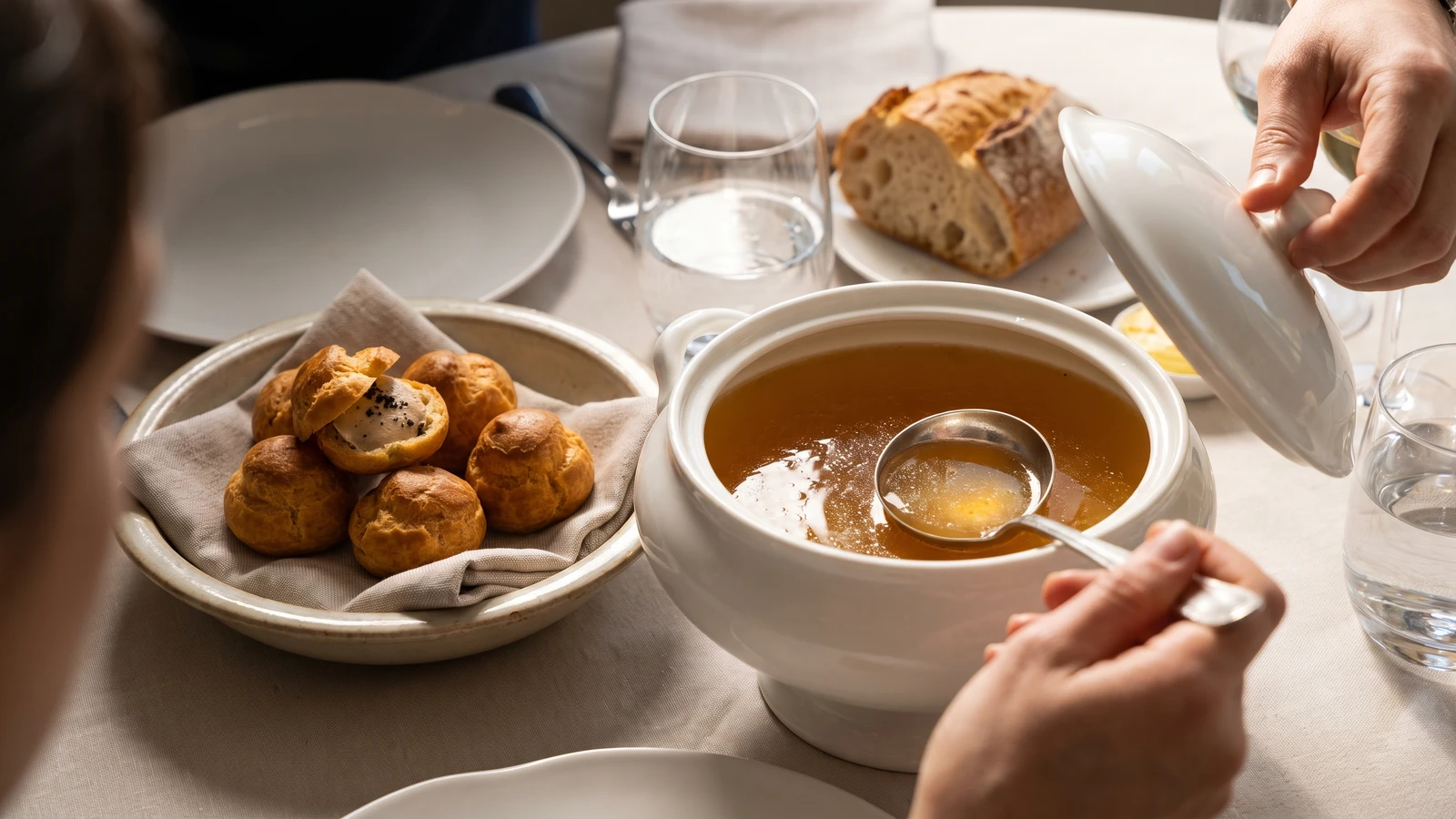
Consommé Rossini turns clarity into ceremony: luminous chicken broth, a whisper of tapioca, and crisp little profiterolles carrying foie gras and truffle, served apart until the last moment so each keeps its character.
Consommé Rossini (clarified chicken broth with savory choux puffs of foie gras and truffle) teaches the discipline of contrast. The one true thing to know before touching a pan is this: the broth and profiterolles must not meet until the bowl is served. One stays luminous and fluid, the others crisp outside and yielding within.
The old service assumed a saucier, chicken stock never off the fire, extra hands to fill tiny shells, and a warm shelf at the front of the range, with a salamander ready elsewhere. Your equivalents are a finished consommé, a muslin-lined sieve, one piping bag, and two gentle oven temperatures. The Profiterolles for Soups (No. 218) and their Common Pâte à Choux (for Souffléd Fritters, Gnochi, Potatoes à la Dauphine) (No. 2374) remain finished preparations from their own entries. Making those foundations ahead is brigade scaffolding; lightly binding the broth, filling the shells, and serving the two apart are the dish itself and must stay.
The source gives one quart and eighteen shells. This version doubles both to about two quarts and thirty-six, preserving the ratio and serving eight people four profiterolles each, with four held against cracks or generous hands. One cook, one stove, one evening. The step that decides everything is the last one: keep the broth at a bare tremble and the profiterolles dry until each bowl is ready.
Consommé Rossini belongs to the formal Paris table, where clear consommés were distinguished by their garnishes and often named for celebrated figures. Rossini, the Italian composer who made Paris his table, lent his name across French cookery to combinations of foie gras and black truffle; here that richness is enclosed in tiny soup profiterolles and kept apart from the clear broth. Rossini does not name a regional soup, as is sometimes assumed; it identifies the garnish and its generous register within the French classical system.
Quantity
8 cups (1.9 L / 1.9 kg)
perfectly clear
Quantity
Up to 1 cup (240 ml / 240 g)
kept hot for correcting the final body
Quantity
2 tablespoons (30 ml / 24 g)
Quantity
2 cups (475 ml / 475 g)
for poaching the tapioca
Quantity
36 Profiterolles for Soups (No. 218), prepared from Common Pâte à Choux (for Souffléd Fritters, Gnochi, Potatoes à la Dauphine) (No. 2374)
left unfilled and dried crisp
Quantity
1/3 cup (80 ml / 90 g)
softened but still cool
Quantity
1 small truffle (about 15 g)
drained if preserved and very finely chopped
Quantity
1 to 2 tablespoons (15 to 30 ml / 15 to 30 g)
| Ingredient | Quantity |
|---|---|
| finished chicken consomméperfectly clear | 8 cups (1.9 L / 1.9 kg) |
| additional finished chicken consommé (optional)kept hot for correcting the final body | Up to 1 cup (240 ml / 240 g) |
| small pearl tapioca | 2 tablespoons (30 ml / 24 g) |
| waterfor poaching the tapioca | 2 cups (475 ml / 475 g) |
| hazelnut-size soup profiterollesleft unfilled and dried crisp | 36 Profiterolles for Soups (No. 218), prepared from Common Pâte à Choux (for Souffléd Fritters, Gnochi, Potatoes à la Dauphine) (No. 2374) |
| cooked foie gras terrine or bloc de foie grassoftened but still cool | 1/3 cup (80 ml / 90 g) |
| fresh or preserved black truffledrained if preserved and very finely chopped | 1 small truffle (about 15 g) |
| cold heavy cream | 1 to 2 tablespoons (15 to 30 ml / 15 to 30 g) |
Have the finished chicken consommé cold enough to inspect. Lift away every trace of set fat, then check that you can see clearly through a ladleful. Set out 36 Profiterolles for Soups (No. 218), already prepared hazelnut-size and unfilled from Common Pâte à Choux (for Souffléd Fritters, Gnochi, Potatoes à la Dauphine) (No. 2374). Keep the shells dry while you prepare the filling and binder.
Bring the water to a gentle boil in a small saucepan, rain in the tapioca, and reduce the heat immediately. Poach for 15 to 20 minutes, stirring often, until the pearls are completely translucent and tender through the centre. If you can still see white pinpoints, they're underdone; return them to the water rather than forcing them through the cloth. Drain well and measure 1/4 cup (60 ml / about 60 g) of the cooked tapioca.
Line a fine-mesh sieve with damp, tightly woven muslin or lint-free linen. While the measured tapioca is warm, rub it through the cloth with the back of a spoon, moistening it with a tablespoon of consommé if it resists. What passes through should be a smooth, translucent gel without recognizable pearls. Scrape it from the underside of the cloth and discard anything coarse that remains.
Warm the 8 cups of consommé over medium-low heat until its surface barely trembles. Whisk in the strained tapioca a little at a time, allowing each addition to disperse before judging the next. The finished consommé should cling almost imperceptibly to a spoon while remaining unmistakably broth, not sauce. If it tightens too far, don't pour it out. Ça se rattrape: whisk in the additional hot consommé one ladle at a time. Pass the broth through fresh damp muslin if any tapioca flecks remain, then cover and hold it off the heat.
Press the softened foie gras through a clean fine-mesh sieve into a cool bowl. Fold in the chopped truffle and 1 tablespoon of cream, working only until the purée is smooth and pipeable. It should hold a soft peak rather than run. If it turns greasy from warmth, chill it for 10 minutes and beat it briefly; if it remains too firm, add the remaining cream drop by drop. Transfer the purée to a small piping bag fitted with a 1/4-inch (6 mm) plain tip.
Heat the oven to 325°F (165°C). Set the Profiterolles for Soups (No. 218) on a baking sheet and refresh them for 5 to 7 minutes, until dry and audibly crisp when tapped. Cool for 3 minutes, pierce the flat base of each shell with the piping tip, and fill it gently with the foie gras and truffle purée. Stop when the shell feels weighted; forcing in more will split it.
Lower the oven to 225°F (110°C), opening the door briefly to shed the excess heat. Return the filled Profiterolles for Soups (No. 218) for 5 minutes, just until the shells are hot and the filling has relaxed without becoming liquid. This low oven is the honest home equivalent of holding them near the warm front of the range. More heat melts the foie gras and softens the shells, so don't try to hurry them.
Warm the soup tureen with hot water, then empty and dry it. Bring the consommé back to a bare tremble without boiling and pour it into the tureen. Transfer the hot Profiterolles for Soups (No. 218) to a separate warm dish and take both to the table at once. Ladle the consommé first, then pass four profiterolles to each guest so they meet the broth only in the bowl. À table!
1 serving (about 275g)
Culinary guides, cultural storytelling, and the editorial depth that makes cooking meaningful.
Discover Culinary ExplorerChef Juliette
Marseille's great fish stew, saffron-gold and garlic-scented, proves that a hard boil can be the careful choice: it binds olive oil into broth before the whole pot meets bread.
Chef Juliette
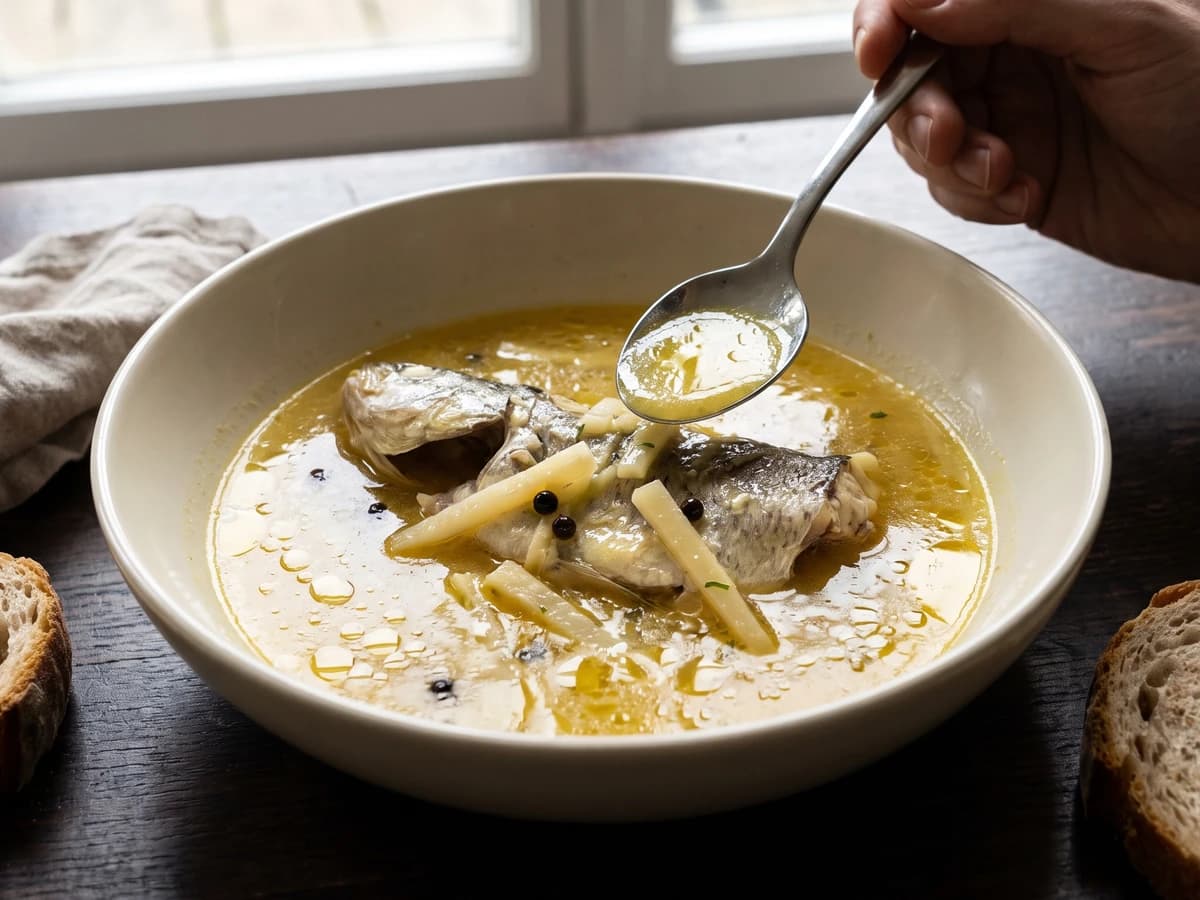
Waterzoi asks fresh, bone-in river fish to thicken its own buttery broth, with parsley root and pepper for company. No flour, no stockpot, just a brisk simmer watched closely.
Chef Juliette
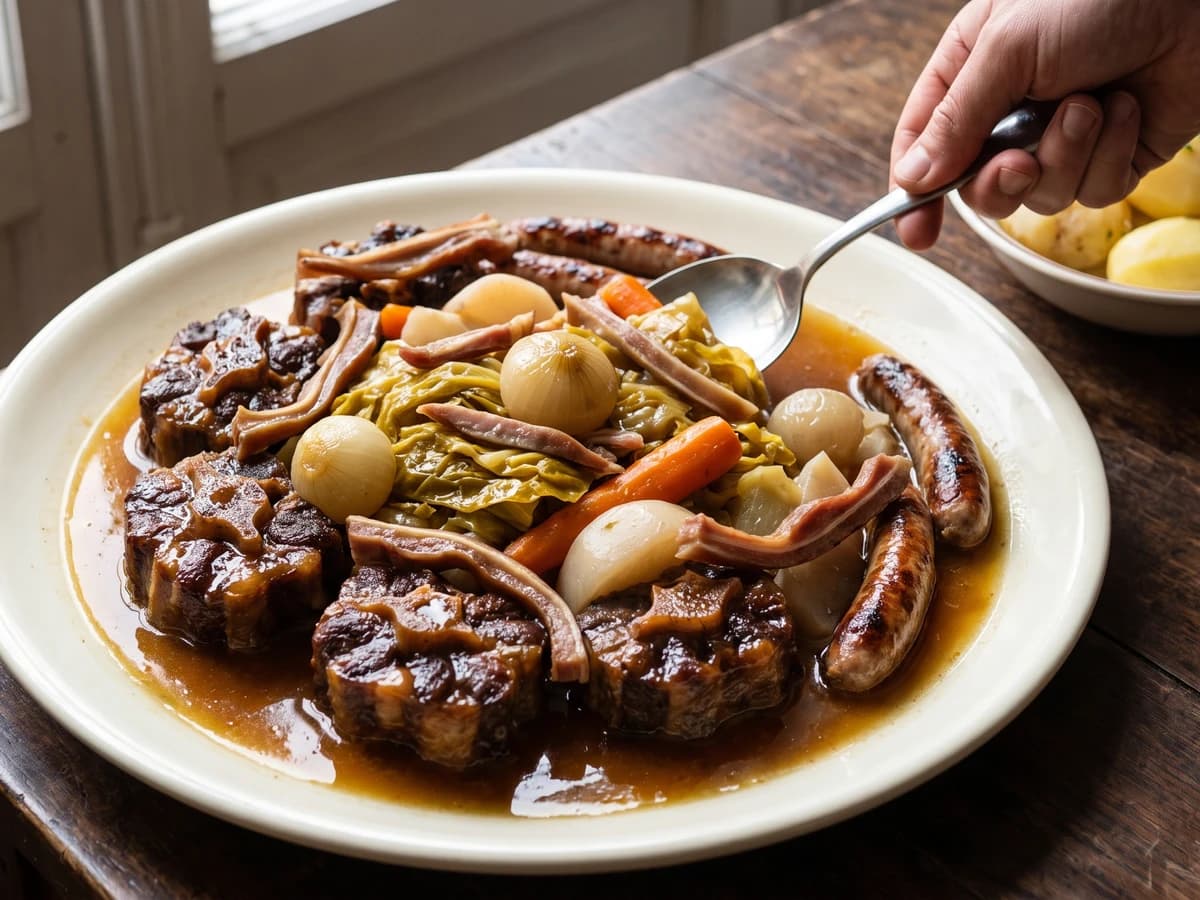
Queue de Bœuf en Hochepot gathers oxtail, pig's trotter and ear, cabbage, roots, and grilled chipolatas around a clear, gelatin-rich broth whose quiet simmer keeps every piece tender and distinct.
Chef Juliette
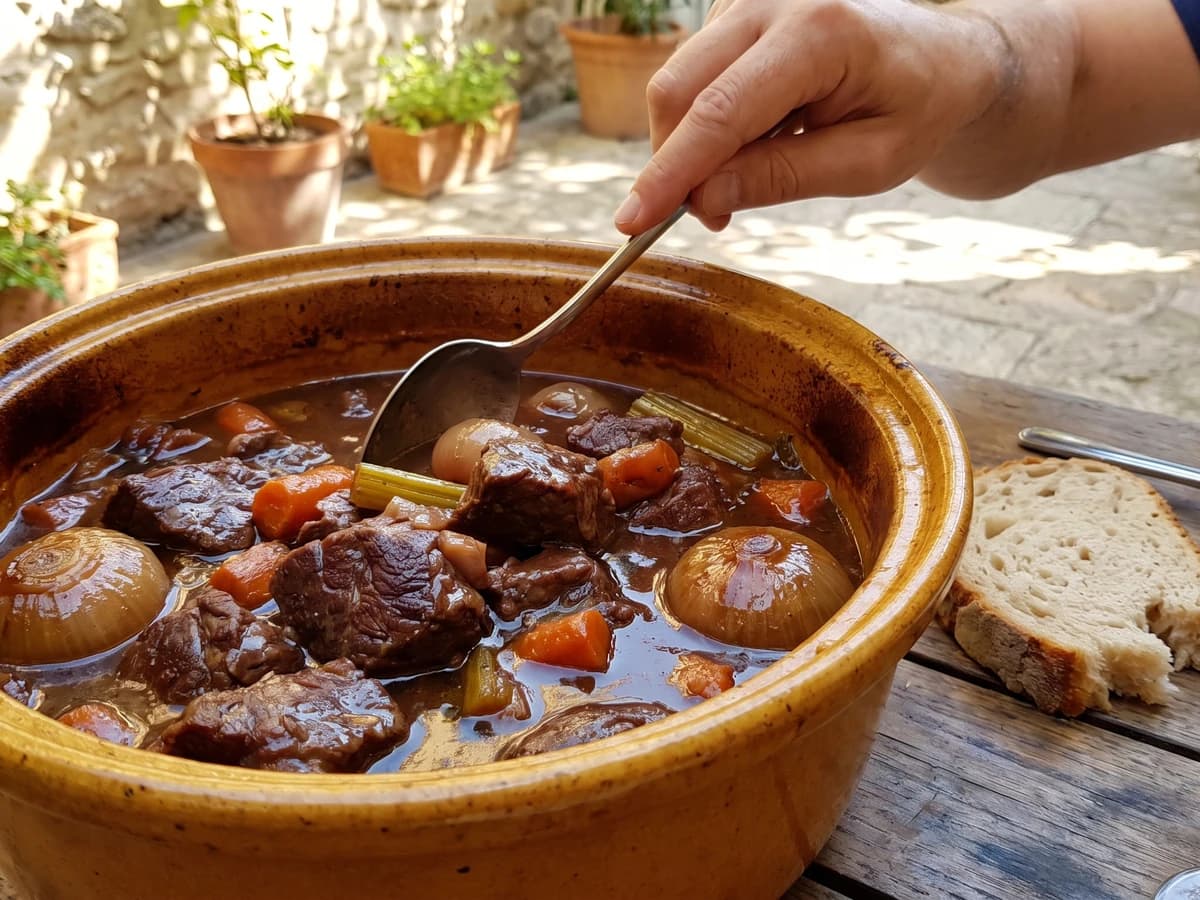
Beef shoulder larded with bacon, sharpened by red wine and vinegar, then sealed with garlic, vegetables, and dry lemon peel until the low oven turns it yielding and the gravy darkly glossy.