Chef Juliette
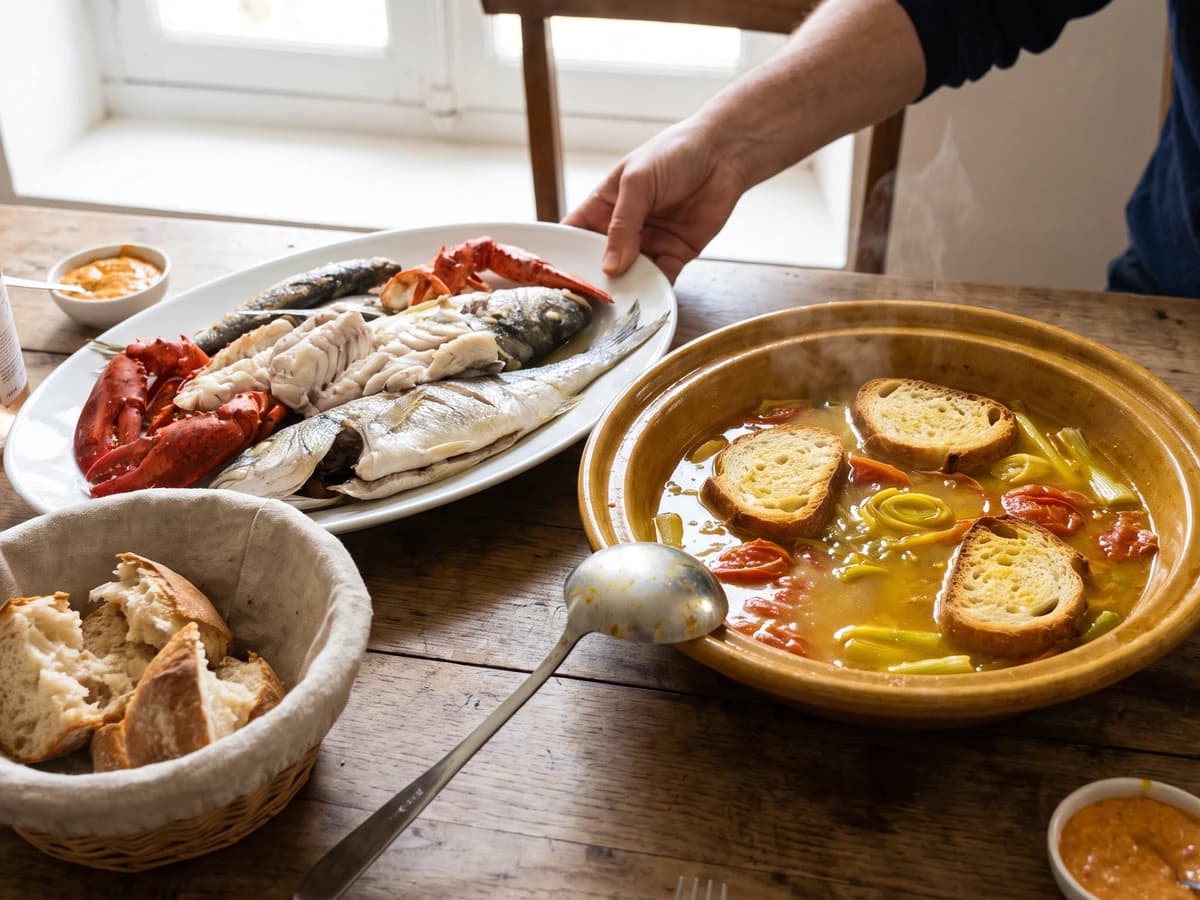
Bouillabaisse à la Marseillaise
Marseille's great fish stew, saffron-gold and garlic-scented, proves that a hard boil can be the careful choice: it binds olive oil into broth before the whole pot meets bread.
A cooking platform built around craft, culture, and the stories behind what we eat.
Created by Chef Juliette
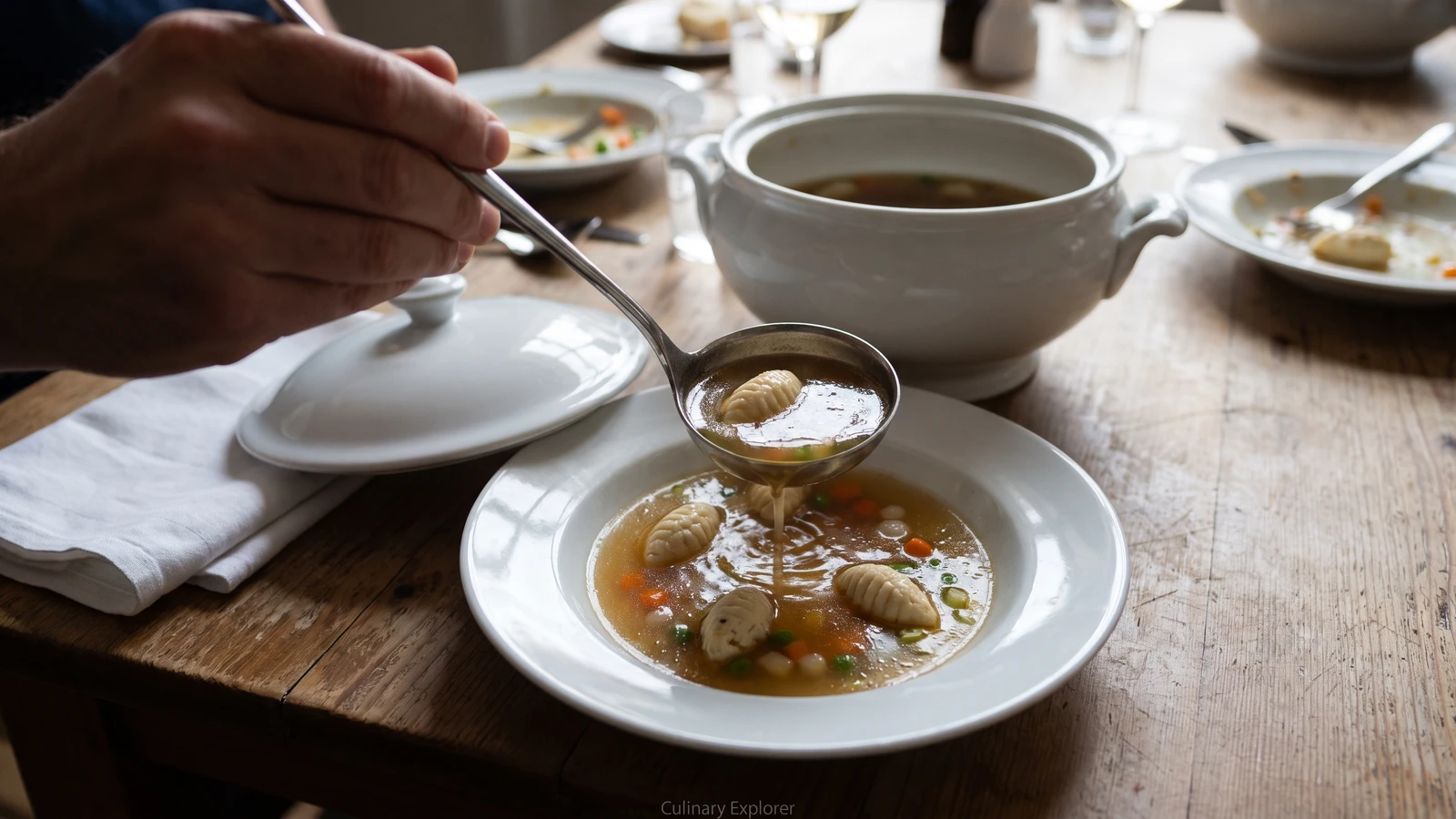
Based on No. 602, Consommé Printanier aux Quenelles, from Le Guide Culinaire (1907) by Auguste Escoffier
Clear consommé, spring vegetables cut with discipline, and eighteen tender chicken quenelles shaped like little grooved meringues: a lesson in restraint, temperature, and serving every element at its exact moment.
Consommé Printanier aux Quenelles (clear chicken consommé with spring vegetables and chicken dumplings) teaches one true thing before you touch a pan: clarity comes from separation. The broth, the printanier, and the quenelles are prepared with their own temperatures and timings, then brought together only at the table. Crowd them into one simmering pot and you lose the glass-clear broth that makes every small vegetable and ivory quenelle visible.
The brigade entry assumed a saucier holding consommé from a stockpot never off the fire, another pair of hands cutting the garnish, and someone ready to poach eighteen quenelles on command. Your equivalent is a strong chilled stock clarified in one pot, a food processor in place of prolonged pounding and sieving, and a small vegetable garnish cooked while the forcemeat chills. One cook, one stove, one evening.
The separate staff and service stockpots were scaffolding, and they can go. The clear consommé, the restrained printanier, the little grooved shape, and the ten-minute poach are the dish itself, so they stay. Keep the forcemeat truly cold and never let its poaching water boil; that gentle poach is the step that decides whether the quenelles arrive tender or tight.
Consommé printanier belongs to the Parisian classical table, where a clear soup displayed the cook's command of stock while an orderly garnish marked the season. Printanier does not mean a miscellaneous vegetable soup; it names early vegetables cut into deliberate, varied shapes and used sparingly so the consommé remains the principal element. The reference to Ordinary Meringue (No. 2382) concerns the quenelles' small grooved silhouette, not their composition, and no sugar enters the soup.
Quantity
12 cups (2.8 L / 2.8 kg)
chilled and defatted
Quantity
12 ounces (340 g)
for the clarification raft
Quantity
4 large
for clarification
Quantity
3/4 cup (180 ml / 90 g)
finely minced
Quantity
1/2 cup (120 ml / 65 g)
finely minced for the clarification raft
Quantity
1/2 cup (120 ml / 50 g)
finely minced
Quantity
1/2 cup (120 ml / 90 g)
finely chopped
Quantity
1 sprig
Quantity
1
Quantity
1/2 teaspoon (2.5 ml / 1 g)
lightly crushed
Quantity
2 large
for reclarifying a cloudy consommé
Quantity
1 tablespoon (15 ml / 14 g)
Quantity
1/2 cup (120 ml / 70 g)
cut into 1/4-inch pearls or neat dice
Quantity
1/2 cup (120 ml / 75 g)
cut into 1/4-inch pearls or neat dice
Quantity
1/3 cup (80 ml / 40 g)
cut into fine rings
Quantity
1/2 cup (120 ml / 55 g)
cut into small diamonds
Quantity
1/2 cup (120 ml / 70 g)
Quantity
8 ounces (225 g)
very cold and cubed
Quantity
1 large
for the quenelles
Quantity
1/2 cup (120 ml / 120 g)
ice-cold
Quantity
1 tablespoon (15 ml / 18 g)
divided
Quantity
1/4 teaspoon (1.25 ml / 0.5 g)
Quantity
1 pinch
Quantity
8 cups (1.9 L / 1.9 kg)
for poaching
Quantity
1 finished reference portion Ordinary Meringue (No. 2382)
used only as the grooved shape model; not added to the soup
| Ingredient | Quantity |
|---|---|
| cold strong unsalted chicken stockchilled and defatted | 12 cups (2.8 L / 2.8 kg) |
| lean ground chickenfor the clarification raft | 12 ounces (340 g) |
| egg whitesfor clarification | 4 large |
| yellow onionfinely minced | 3/4 cup (180 ml / 90 g) |
| carrotfinely minced for the clarification raft | 1/2 cup (120 ml / 65 g) |
| celeryfinely minced | 1/2 cup (120 ml / 50 g) |
| ripe tomatofinely chopped | 1/2 cup (120 ml / 90 g) |
| thyme | 1 sprig |
| bay leaf | 1 |
| black peppercornslightly crushed | 1/2 teaspoon (2.5 ml / 1 g) |
| egg whites for rescue (optional)for reclarifying a cloudy consommé | 2 large |
| unsalted butter | 1 tablespoon (15 ml / 14 g) |
| carrotcut into 1/4-inch pearls or neat dice | 1/2 cup (120 ml / 70 g) |
| young turnipcut into 1/4-inch pearls or neat dice | 1/2 cup (120 ml / 75 g) |
| leek whitecut into fine rings | 1/3 cup (80 ml / 40 g) |
| fine green beanscut into small diamonds | 1/2 cup (120 ml / 55 g) |
| fresh or frozen peas | 1/2 cup (120 ml / 70 g) |
| boneless skinless chicken breastvery cold and cubed | 8 ounces (225 g) |
| egg whitefor the quenelles | 1 large |
| heavy creamice-cold | 1/2 cup (120 ml / 120 g) |
| fine sea saltdivided | 1 tablespoon (15 ml / 18 g) |
| ground white pepper | 1/4 teaspoon (1.25 ml / 0.5 g) |
| freshly grated nutmeg | 1 pinch |
| waterfor poaching | 8 cups (1.9 L / 1.9 kg) |
| Ordinary Meringue, finished reference preparationused only as the grooved shape model; not added to the soup | 1 finished reference portion Ordinary Meringue (No. 2382) |
Combine the cold stock, ground chicken, four egg whites, minced onion, carrot, celery, tomato, thyme, bay leaf, and peppercorns in a 6-quart stockpot. Stir thoroughly while everything is cold, then place the pot over medium heat. Scrape the bottom steadily as the liquid warms so the proteins don't catch. Once they rise and knit into a raft across the surface, stop stirring, open a small chimney in its centre, and reduce the heat until the liquid barely trembles beneath it. Simmer undisturbed for 45 minutes. A rolling boil breaks the raft and throws its impurities back into the broth.
Dampen a double layer of cheesecloth and lay it in a fine sieve over a clean pot. Ladle the consommé slowly through the raft's chimney and then through the cloth, never tipping the pot or pressing the solids. Reduce the strained consommé gently to 8 cups (1.9 L), skimming away any surface fat, then season lightly. If it remains cloudy, cool it completely, whisk in the two optional egg whites, and repeat the gentle clarification for 20 minutes. Ça se rattrape. Hold the clear consommé just below a simmer until service.
Chill the food processor bowl and blade. Process the cold chicken breast with 3/4 teaspoon of the salt, the white pepper, and nutmeg until it becomes smooth and sticky. Add the egg white and process only until absorbed. With the machine running, pour in the ice-cold cream in three additions, stopping to scrape the bowl between them. The forcemeat should be pale, glossy, and firm enough to hold on a spoon. If it turns grainy or greasy, it has grown too warm; stop, chill the bowl over ice for 15 minutes, then pulse briefly until smooth. Don't force a warm emulsion.
Set the finished Ordinary Meringue (No. 2382) beside you only as the book's model for the little grooved silhouette; it never enters the soup. Dip two teaspoons in cold water and pass a rounded tablespoon of forcemeat between them to make a compact oval. Draw the damp tines of a small fork once along the top to leave shallow grooves. Make exactly eighteen quenelles, arranging them on a cold parchment-lined tray, then refrigerate them while the printanier cooks.
Melt the butter in a wide sauté pan over gentle heat. Add the carrot, turnip, leek, and a pinch of salt, then cook for two minutes without allowing any colour. Add 1/2 cup (120 ml) of the consommé, cover, and simmer gently for four minutes. Add the green beans, cook for two minutes, then add the peas and cook until every vegetable is just tender, another two minutes or so. Lift out any piece that finishes early and return it at service; patience, not vegetable collapse. Drain the garnish well and keep it warm.
Ten minutes before serving, warm a soup tureen with hot water and bring the poaching water, seasoned with the remaining salt, to 180°F (82°C) in a wide pan. Slide in all eighteen quenelles and hold the water between 175°F and 185°F (79°C and 85°C) for 10 minutes, without boiling, until the quenelles feel lightly resilient and reach 165°F (74°C) at the centre. If one frays, lower the heat at once and leave the others untouched; the loose edge will drain away, and the quenelle beneath remains sound. During the final minute, bring the consommé to a brisk boil. Drain and dry the tureen, add the printanier and drained quenelles, then pour the boiling consommé over them exactly as the entry directs. Serve at once. À table!
1 serving (about 320g)
Culinary guides, cultural storytelling, and the editorial depth that makes cooking meaningful.
Discover Culinary ExplorerChef Juliette
Marseille's great fish stew, saffron-gold and garlic-scented, proves that a hard boil can be the careful choice: it binds olive oil into broth before the whole pot meets bread.
Chef Juliette
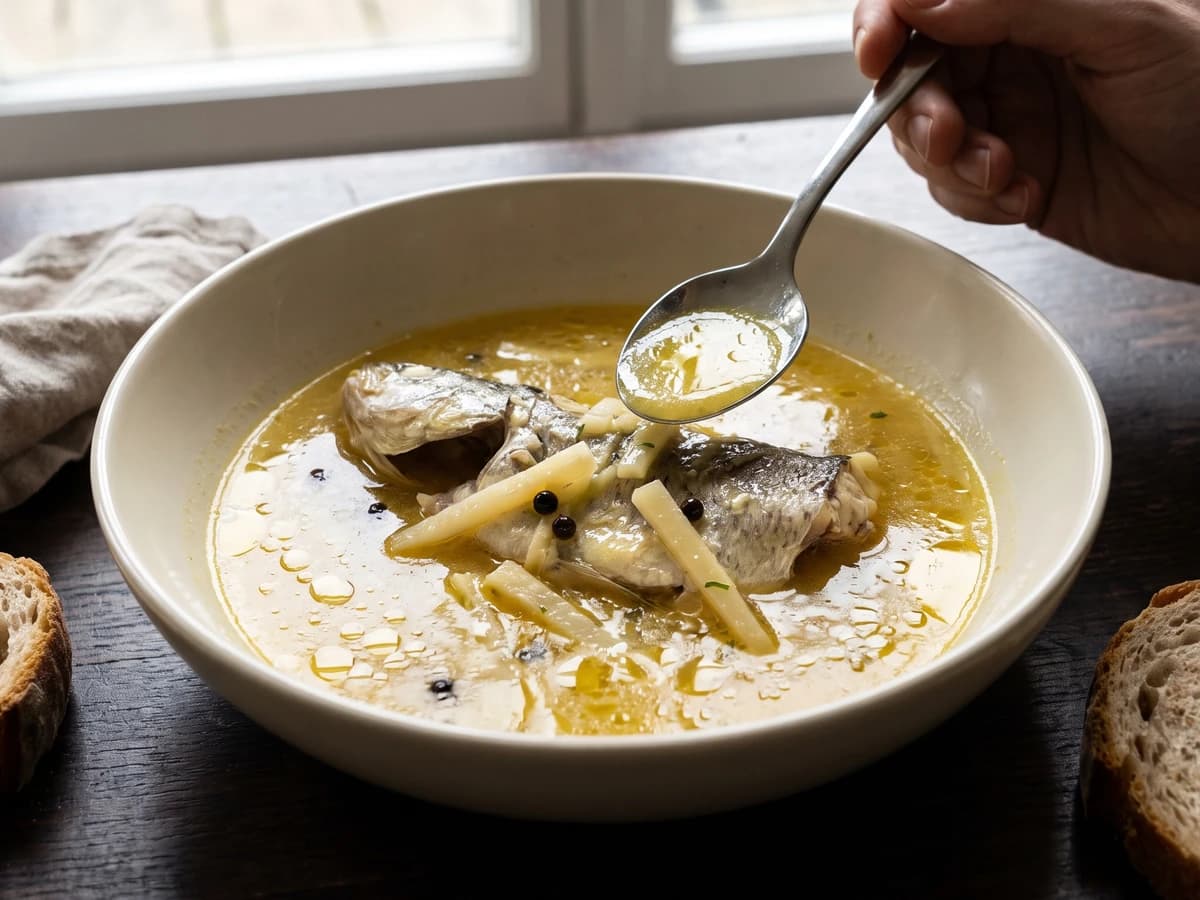
Waterzoi asks fresh, bone-in river fish to thicken its own buttery broth, with parsley root and pepper for company. No flour, no stockpot, just a brisk simmer watched closely.
Chef Juliette
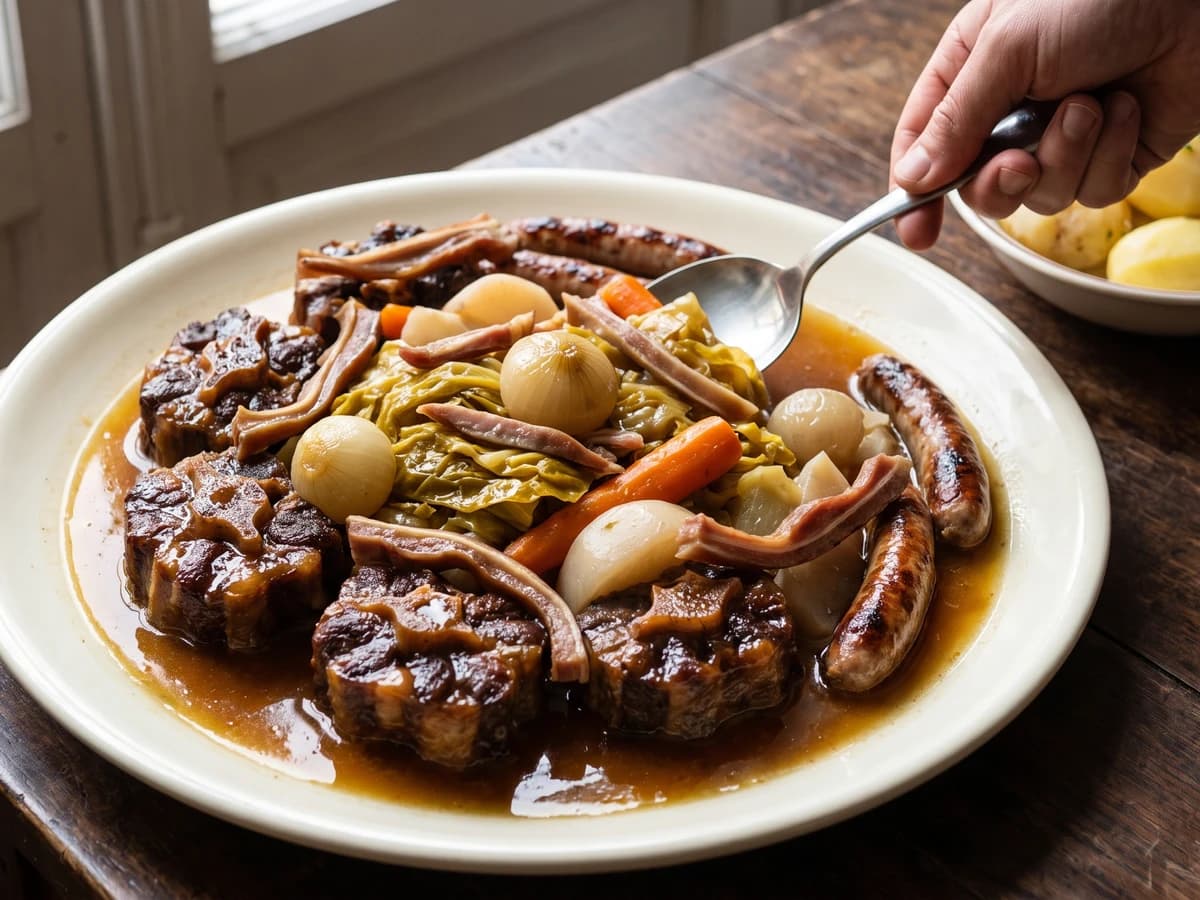
Queue de Bœuf en Hochepot gathers oxtail, pig's trotter and ear, cabbage, roots, and grilled chipolatas around a clear, gelatin-rich broth whose quiet simmer keeps every piece tender and distinct.
Chef Juliette
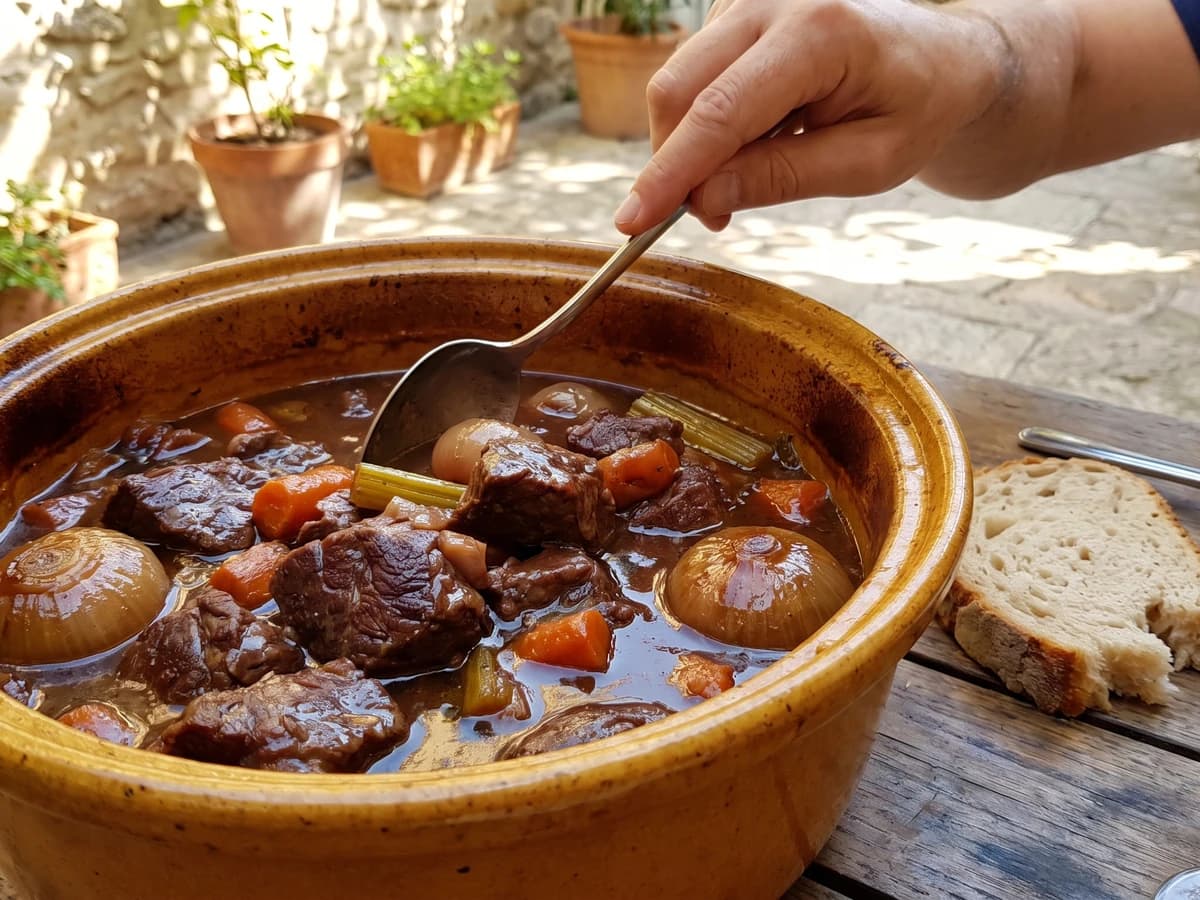
Beef shoulder larded with bacon, sharpened by red wine and vinegar, then sealed with garlic, vegetables, and dry lemon peel until the low oven turns it yielding and the gravy darkly glossy.