Chef Juliette
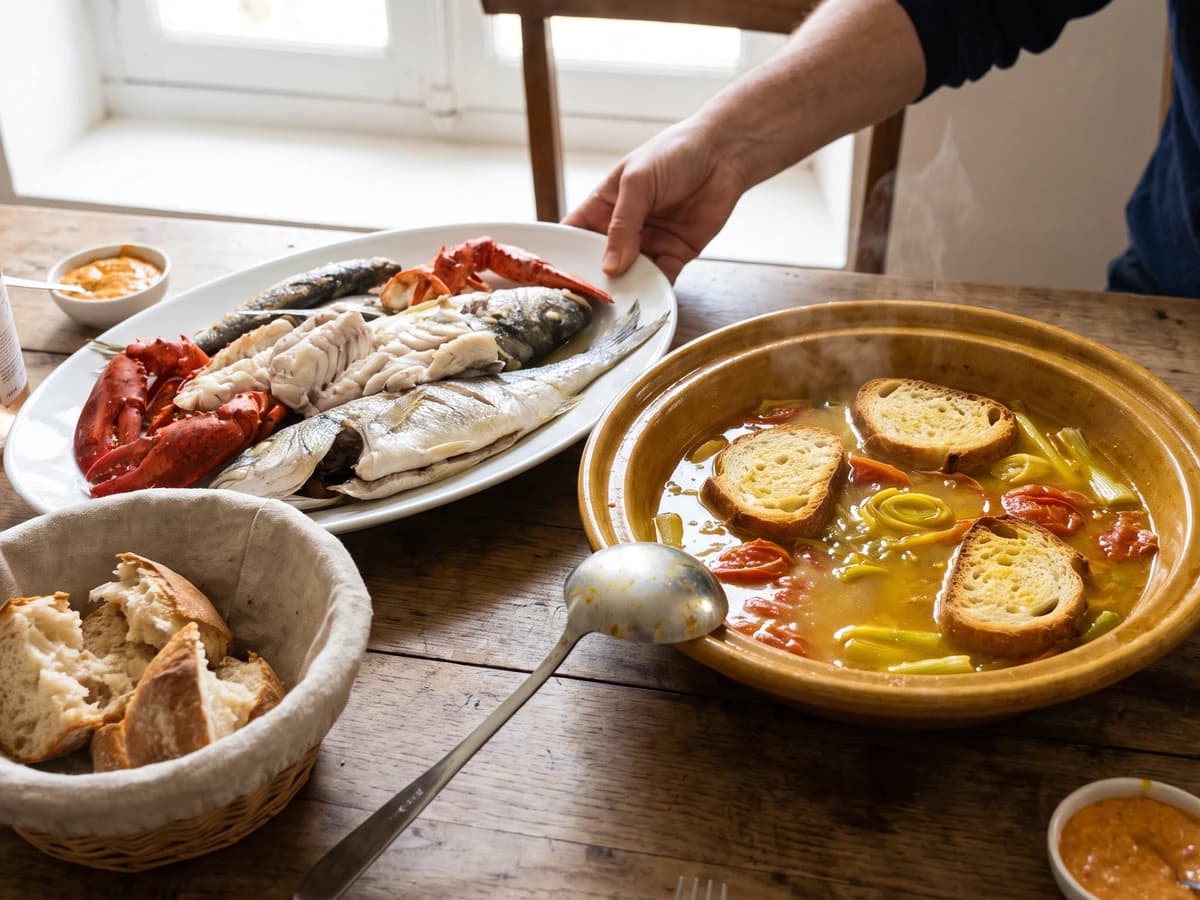
Bouillabaisse à la Marseillaise
Marseille's great fish stew, saffron-gold and garlic-scented, proves that a hard boil can be the careful choice: it binds olive oil into broth before the whole pot meets bread.
A cooking platform built around craft, culture, and the stories behind what we eat.
Created by Chef Juliette
Based on No. 585, Consommé Mireille, from Le Guide Culinaire (1907) by Auguste Escoffier
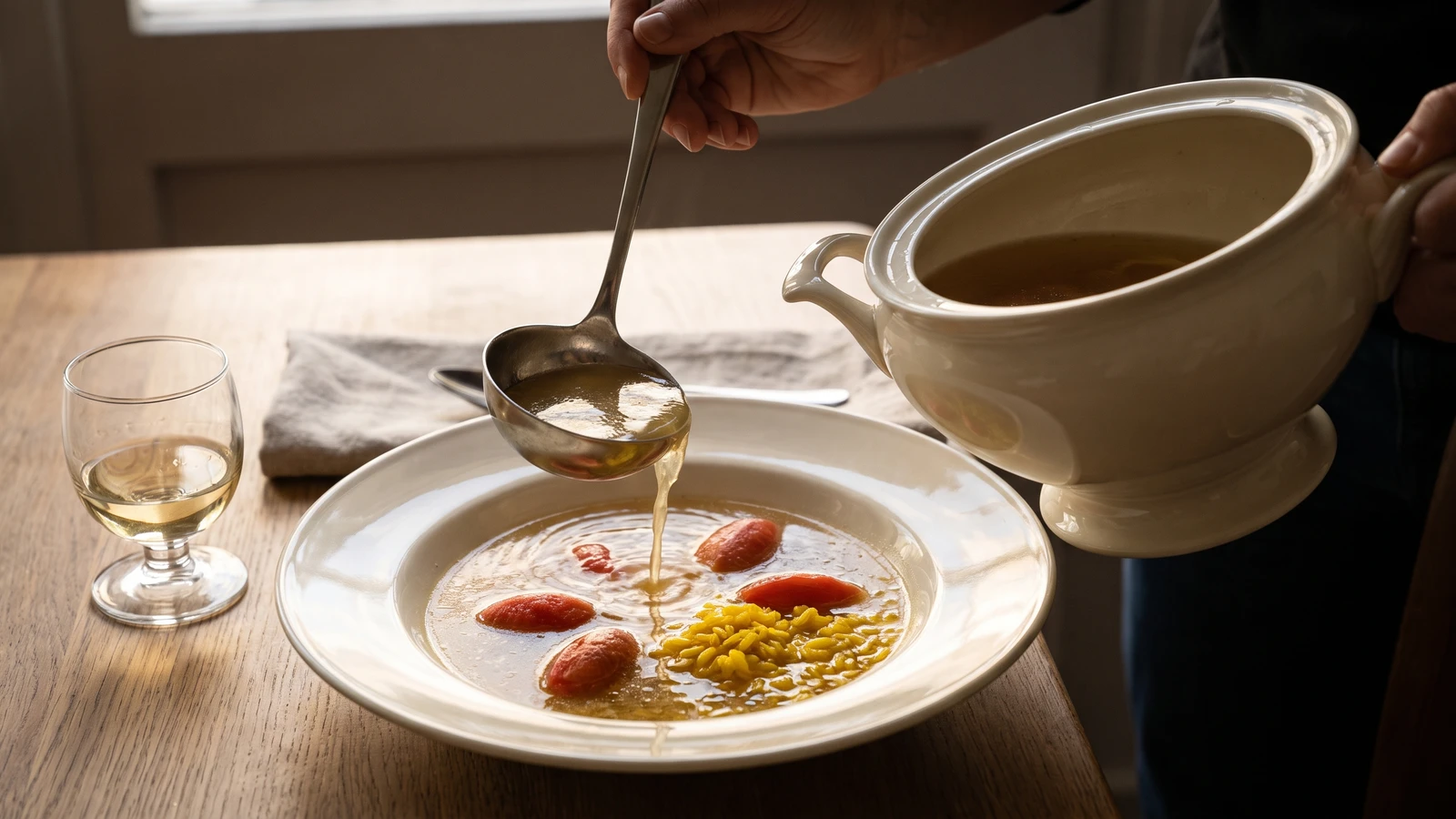
Consommé Mireille makes clarity visible: a limpid chicken broth carrying saffron-gold pilaff and vivid tomato chicken medallions, with every garnish precise enough to leave the consommé bright.
Consommé Mireille (clear chicken broth with tomato-forcemeat medallions and saffroned pilaff) teaches the discipline of clarity. The one true thing to know before touching a pan is this: once the clarification raft has set, stillness keeps the broth clear. Stir it, let it roll at a boil while it clarifies, or press it through the cloth, and every speck returns to the liquid.
The source's kitchen assumed a saucier, chicken consommé never off the fire, a pan of saffroned Riz Pilaff (No. 2255) ready for service, and a fancy oval cutter. A home kitchen gets one food processor, parchment and foil for the poached log, a paring knife when there is no cutter, and a warmed tureen. This version doubles the compact one-quart formula to a generous two-quart home-table yield while preserving its ratios exactly: six ounces of forcemeat, two tablespoons of very concentrated tomato, and four tablespoons of pilaff. The full clarification and separate pilaff are the dish; the perfect stamped oval is brigade scaffolding and may be cut by hand. One cook, one stove, one evening.
The finished bowl is limpid gold, its chicken medallions cleanly red and its saffroned grains visible beneath the surface. No herb confetti, no haze, no fuss. Keep the raft at a bare tremble and leave it untouched; that is the step that decides Mireille.
Consommé Mireille belongs to the Parisian classical repertoire of named consommés, in which a perfectly clear base was identified by an exact garnish rather than by heavy seasoning. Its name points toward Provence through Mireille, the Provençal heroine celebrated in poetry and opera, while the tomato-red medallions and saffroned rice carry that southern color into a formal soup tureen. It is not a Provençal household soup, a useful correction: the dish traveled from grand dining rooms to bourgeois dinner tables as a make-ahead first course assembled only when the broth was boiling.
Quantity
10 cups (2.4 L / 2.4 kg)
Quantity
about 2 cups (480 mL / 12 oz / 340 g)
coarsely ground for clarification
Quantity
4 large (½ cup / 120 mL / 120 g)
Quantity
1 medium (about 1 cup / 240 mL / 170 g)
very finely chopped
Quantity
1 medium (about ¾ cup / 180 mL / 100 g)
very finely chopped
Quantity
1 large rib (about ½ cup / 120 mL / 55 g)
very finely chopped
Quantity
1
Quantity
6
Quantity
1 teaspoon (5 mL / 6 g), plus more as needed
Quantity
1 large (2 tablespoons / 30 mL / 30 g)
Quantity
about ¾ cup (180 mL / 4½ oz / 125 g)
diced
Quantity
1 tablespoon (15 mL / 15 g), about half a large egg white
Quantity
2 tablespoons (30 mL / 30 g)
Quantity
½ teaspoon (2.5 mL / 3 g)
Quantity
⅛ teaspoon (0.6 mL / 0.3 g)
Quantity
2 tablespoons (30 mL / 34 g)
Quantity
¼ cup (60 mL / 60 g) saffroned Riz Pilaff (No. 2255)
cooked with the grains kept separate
| Ingredient | Quantity |
|---|---|
| cold, strong, unsalted chicken stock | 10 cups (2.4 L / 2.4 kg) |
| very cold skinless chicken breastcoarsely ground for clarification | about 2 cups (480 mL / 12 oz / 340 g) |
| egg whites for clarification | 4 large (½ cup / 120 mL / 120 g) |
| yellow onionvery finely chopped | 1 medium (about 1 cup / 240 mL / 170 g) |
| carrotvery finely chopped | 1 medium (about ¾ cup / 180 mL / 100 g) |
| celeryvery finely chopped | 1 large rib (about ½ cup / 120 mL / 55 g) |
| bouquet garni of parsley stems, thyme, and bay | 1 |
| black peppercorns | 6 |
| fine sea salt for the consommé | 1 teaspoon (5 mL / 6 g), plus more as needed |
| additional egg white for reclarifying (optional) | 1 large (2 tablespoons / 30 mL / 30 g) |
| very cold skinless chicken breast for the forcemeatdiced | about ¾ cup (180 mL / 4½ oz / 125 g) |
| cold egg white for the forcemeat | 1 tablespoon (15 mL / 15 g), about half a large egg white |
| cold heavy cream | 2 tablespoons (30 mL / 30 g) |
| fine sea salt for the forcemeat | ½ teaspoon (2.5 mL / 3 g) |
| ground white pepper | ⅛ teaspoon (0.6 mL / 0.3 g) |
| double-concentrated tomato paste | 2 tablespoons (30 mL / 34 g) |
| saffroned Riz Pilaffcooked with the grains kept separate | ¼ cup (60 mL / 60 g) saffroned Riz Pilaff (No. 2255) |
Chill the food-processor bowl and blade for 10 minutes. Process the diced chicken with the forcemeat salt and white pepper until the meat becomes smooth and tacky, then add the tablespoon of egg white. Pulse in the cold cream in two additions, stopping as soon as the forcemeat looks glossy and holds a firm ridge. Weigh 6 oz (170 g) into a chilled bowl, then fold in the double-concentrated tomato paste until the color is even. This preserves the source ratio exactly: one tablespoon of concentrated tomato to every 3 oz of chicken forcemeat. If the mixture grows warm, greasy, or grainy, stop, chill it for 10 minutes, then pulse it briefly until it tightens; processing it further while warm finishes the break.
Spoon the tomato forcemeat across a sheet of parchment and roll it into a tight sausage about 1¼ inches (3 cm) thick. Twist the parchment ends, wrap the parcel securely in foil, and lower it into water held between 175°F and 180°F (79°C and 82°C). Poach gently for 15 to 20 minutes, until the center reaches 165°F (74°C). The water should barely quiver. If it boils and the log swells, lower the heat immediately; chill the log thoroughly and trim any porous edge later. Cool it, still wrapped, in an ice bath for 15 minutes, then refrigerate for at least 45 minutes.
Combine the ground clarification chicken, four egg whites, onion, carrot, celery, bouquet garni, peppercorns, and consommé salt in a cold heavy stockpot. Stir in the cold chicken stock a cup at a time. Set the pot over medium-low heat and scrape the bottom continuously in slow strokes as the liquid warms. After 20 to 25 minutes, the proteins will rise and knit into a solid clarification raft. The instant that raft forms, stop stirring. Open a 2-inch (5 cm) chimney in its center with the handle of a spoon so the broth can circulate without breaking it.
Hold the consommé at the barest tremble for 45 minutes, with movement visible only inside the chimney. Never let it roll at a boil while it clarifies. If the raft splits, lower the heat and leave it untouched for 10 minutes; it will often close again. If the strained broth remains cloudy, cool it completely, whisk the optional egg white with ½ cup (120 mL) of the cold broth, stir this into the remainder, and repeat the slow heating without more meat or vegetables. Ça se rattrape. Ladle the clear broth carefully through the chimney and pass it through a damp cheesecloth-lined sieve into a clean pot. Do not squeeze the cloth. Skim away any surface fat and measure the result; there should be about 8 cups (1.9 L). If there is a little more, reduce it gently to that volume.
Unwrap the thoroughly cold forcemeat log and cut it crosswise into ¼-inch (6 mm) roundels. Stamp each slice with a small oval cutter to make a medallion, or trim it neatly with a sharp paring knife. Dip the blade or cutter in hot water and wipe it between cuts so the red edges stay clean. Keep the best 24 medallions for the tureen; the trimmings belong in the cook's bowl, not loose in the clear soup.
Fill a 2½-quart heatproof soup tureen with hot water and leave it for 5 minutes, then drain and dry it. Arrange the medallions across the bottom and add the ¼ cup, or four tablespoonfuls, of saffroned Riz Pilaff (No. 2255), loosening the grains gently with a fork first. The separate pilaff is not disposable brigade scaffolding; its saffron, butter, and distinct grains are part of Mireille's identity.
Taste the clarified consommé and correct the salt. Bring it to a clear, decisive boil only when the warmed tureen is ready, then pour it steadily around the garnish rather than directly onto the medallions. This follows the source precisely: very clear, boiling chicken consommé poured at the last moment. Ladle three medallions and a small spoonful of rice into each warm bowl. À table!
1 serving (about 240g)
Culinary guides, cultural storytelling, and the editorial depth that makes cooking meaningful.
Discover Culinary ExplorerChef Juliette
Marseille's great fish stew, saffron-gold and garlic-scented, proves that a hard boil can be the careful choice: it binds olive oil into broth before the whole pot meets bread.
Chef Juliette
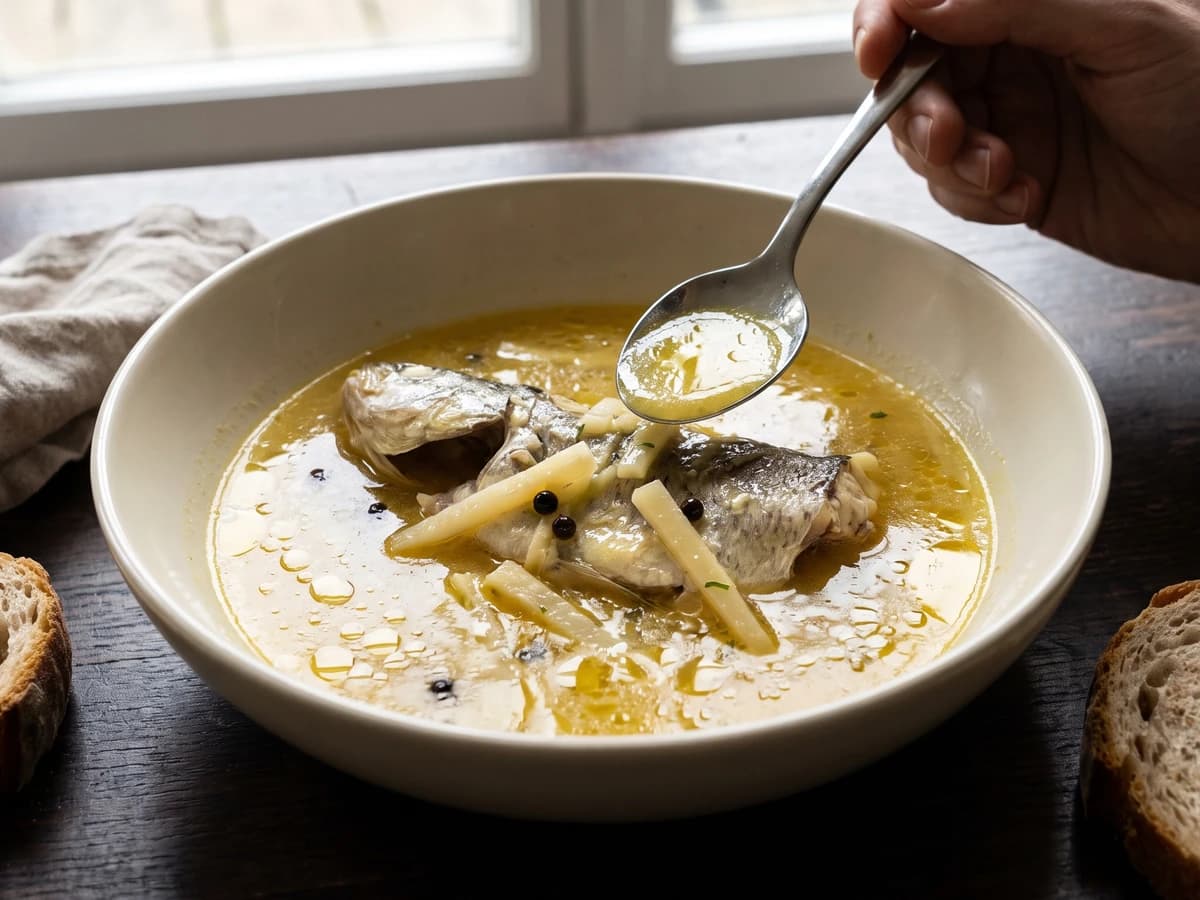
Waterzoi asks fresh, bone-in river fish to thicken its own buttery broth, with parsley root and pepper for company. No flour, no stockpot, just a brisk simmer watched closely.
Chef Juliette
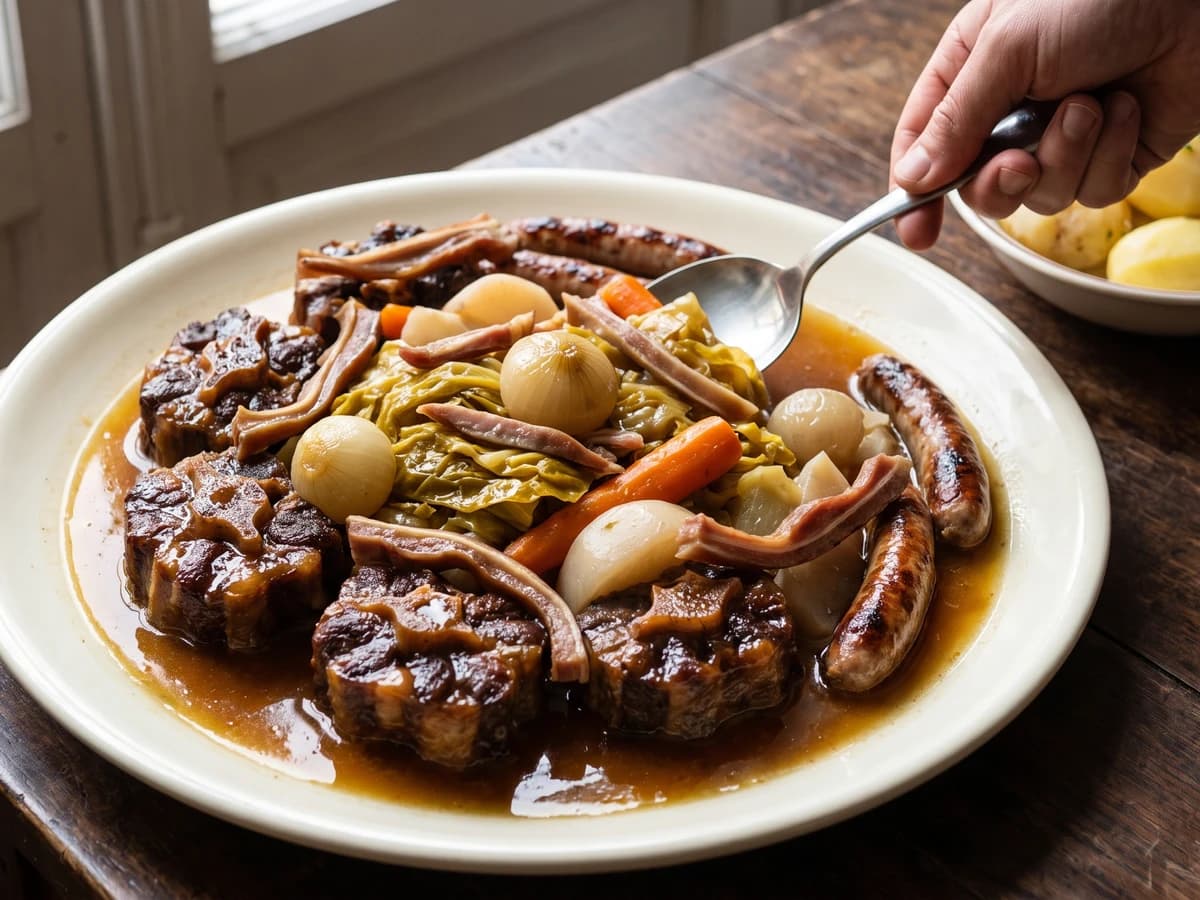
Queue de Bœuf en Hochepot gathers oxtail, pig's trotter and ear, cabbage, roots, and grilled chipolatas around a clear, gelatin-rich broth whose quiet simmer keeps every piece tender and distinct.
Chef Juliette
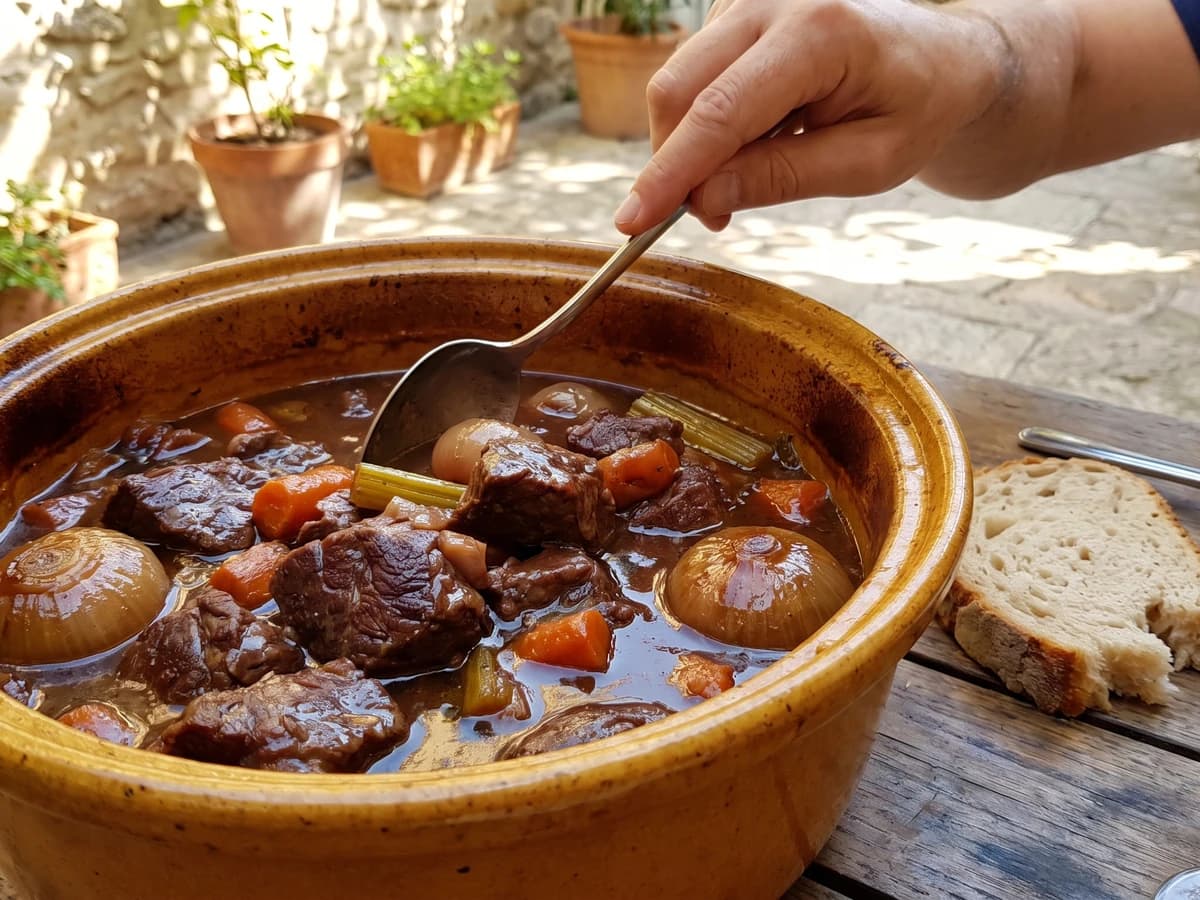
Beef shoulder larded with bacon, sharpened by red wine and vinegar, then sealed with garlic, vegetables, and dry lemon peel until the low oven turns it yielding and the gravy darkly glossy.