
Chef Juliette
Suet Dumpling
Boulettes au suif, poached beside salt beef, turn equal weights of flour and finely chopped suet into tender, rich dumplings. Keep the beef liquor at a bare tremble and the old garnish works beautifully at home.
A cooking platform built around craft, culture, and the stories behind what we eat.
Created by Chef Juliette
Based on No. 2255, Riz Pilaff, from Le Guide Culinaire (1907) by Auguste Escoffier
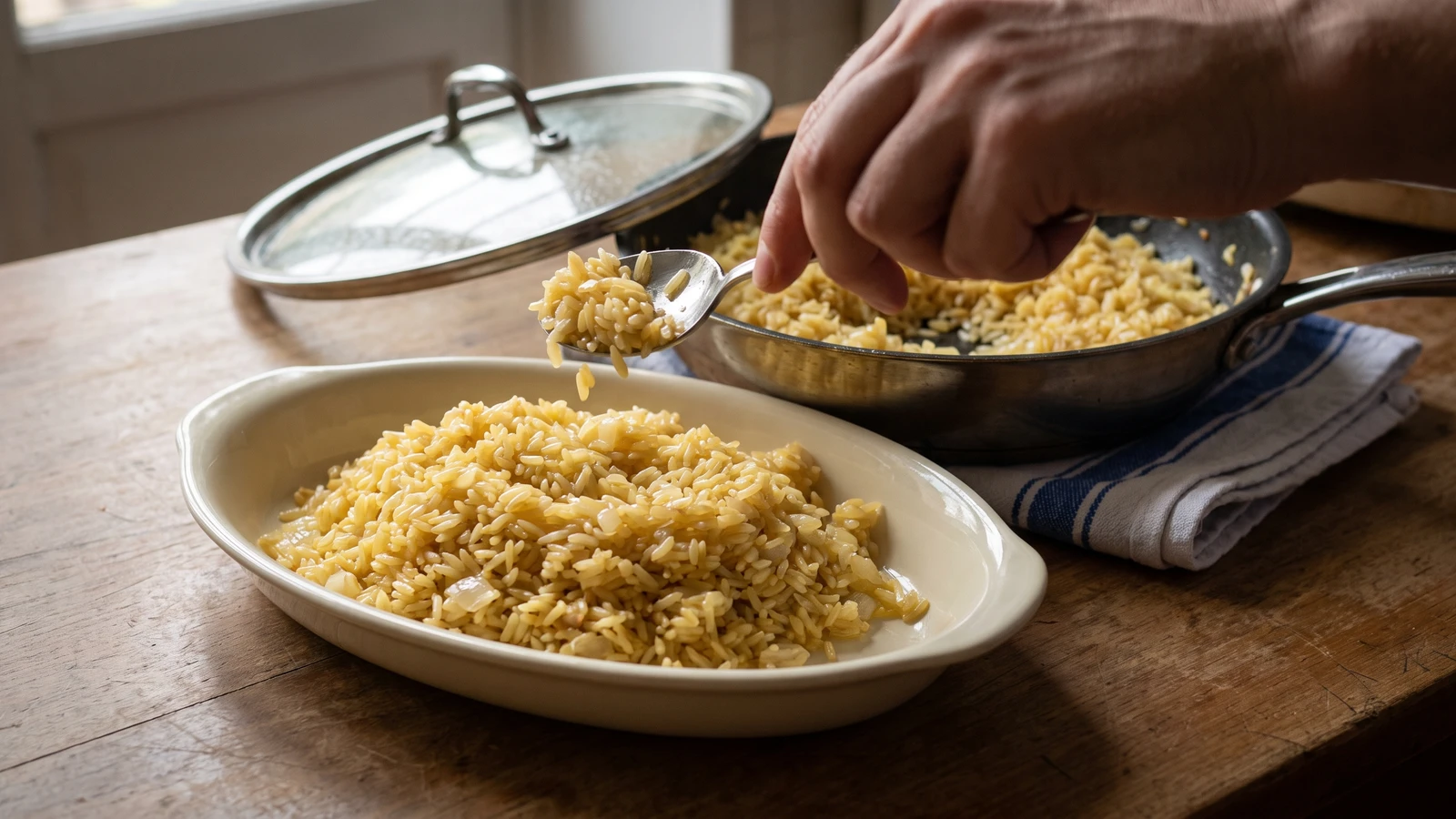
Riz pilaff teaches the buttering of every grain: onion, rice, and white consommé baked under a tight lid for eighteen minutes, then moved immediately so the tender base never cooks on.
Riz pilaff (butter-coated rice baked in consommé) teaches a quiet foundation of the French canon: liquid must never meet a naked grain. The dry rice is first turned in butter until its whole surface shines, a technique called nacrer, to coat the grains until pearly. That coating gives the finished rice its tenderness without surrendering every grain to its neighbor.
The original kitchen assumed white consommé always hot beside the range, a moderate oven judged by experience, and a clean saucepan waiting for the instant transfer. At home, that becomes prepared consommé brought to a bare simmer, an oven set to 180°C / 350°F, and a cool shallow dish beside the stove. The half-pound batch already makes four generous side portions, so its proportions stay intact. The second saucepan was brigade scaffolding; moving the rice off the hot base at once is the part that must stay. One cook, one stove, one evening.
After eighteen covered minutes, the onion has nearly disappeared and the rice carries a butter-gold sheen. Don't leave it sitting in the baking pan while the rest of supper catches up, because the bottom continues cooking even after the oven door opens. Before you touch the pan, remember the one true thing: the rice must be dry, and every grain must shine with butter before the consommé arrives.
Riz pilaff belongs in France to the Parisian classical kitchen rather than to one regional larder. Its method traveled west from Persian and eastern Mediterranean rice cookery, where grains were coated in fat before cooking under seasoned liquid. French kitchens made the method their own with butter, chopped onion, and white consommé; the immediate transfer was never ceremony, but a practical defense against an overcooked bottom layer.
Quantity
1/2 medium onion (about 1/2 cup / 75 g)
finely chopped
Quantity
1 1/4 cups (300 ml / 225 g)
kept dry
Quantity
4 tablespoons (60 ml / 57 g)
Quantity
4 cups (950 ml / 950 g)
heated to a bare simmer
| Ingredient | Quantity |
|---|---|
| yellow onionfinely chopped | 1/2 medium onion (about 1/2 cup / 75 g) |
| Carolina rice, preferably Carolina Gold or another long-grain white ricekept dry | 1 1/4 cups (300 ml / 225 g) |
| unsalted butter | 4 tablespoons (60 ml / 57 g) |
| prepared white consomméheated to a bare simmer | 4 cups (950 ml / 950 g) |
Set a rack in the middle of the oven and heat it to 180°C / 350°F, or 160°C fan. Bring the white consommé to a bare simmer in a small saucepan; the eighteen-minute cooking time assumes the liquid is already hot. Place a cool, shallow saucepan or serving dish beside the stove now, because the cooked rice must leave its hot pan without delay.
Melt the butter in a 25 cm / 10-inch ovenproof sauté pan over medium-low heat. Add the chopped onion and cook for 3 to 4 minutes, stirring often, until soft and translucent but not browned. Keep the heat patient: browned onion would pull this pale pilaff toward sweetness and away from the clean savor of the consommé.
Add the dry rice and nacrer it, turning constantly through the butter for 2 to 3 minutes until every grain glistens and some edges look faintly translucent. The rice should smell warm and buttery without taking color. If a few grains begin to toast, lower the heat immediately and move on to the consommé; the pilaff will taste a little nuttier, but it is still sound.
Pour in all the hot white consommé carefully, scraping down any grains clinging above the liquid. Bring the pan back to a bare simmer, stir once to distribute the onion, then cover tightly and place it in the oven for exactly 18 minutes. Don't lift the lid while it cooks; every look releases the heat on which the timing depends.
At 18 minutes, uncover and bite a grain. If its center is still chalky, re-cover and return the pan to the oven for 2 minutes. Once tender, transfer the rice immediately to the waiting cool saucepan or serving dish, fluffing it only once with a fork. If the rice is tender but a shallow pool of consommé remains, lift the grains with a slotted spoon and leave the surplus behind rather than cooking them to paste. If the bottom has caught, don't scrape it through the good rice; lift cleanly from above. Ça se rattrape. Serve at once. À table!
1 serving (about 290g)
Culinary guides, cultural storytelling, and the editorial depth that makes cooking meaningful.
Discover Culinary ExplorerChef Juliette
Boulettes au suif, poached beside salt beef, turn equal weights of flour and finely chopped suet into tender, rich dumplings. Keep the beef liquor at a bare tremble and the old garnish works beautifully at home.

Chef Juliette
Bread, flour, frangipane, and rice become four cool, supple panades for binding forcemeats, each changing body and flavor while preserving tenderness. The finest Mousselines need none, and knowing that distinction is the lesson.

Chef Juliette
Panade au pain is bread, milk, salt, heat, and attention: stir until the paste releases cleanly, butter it against a skin, and you have the quiet binder behind tender French farces.

Chef Juliette
Panade de farine teaches the drying stroke behind pâte à choux: flour meets boiling buttered water, then stays over the fire until the paste gathers, smooths, and quits the pan cleanly.