Chef Juliette
Bouillabaisse à la Marseillaise
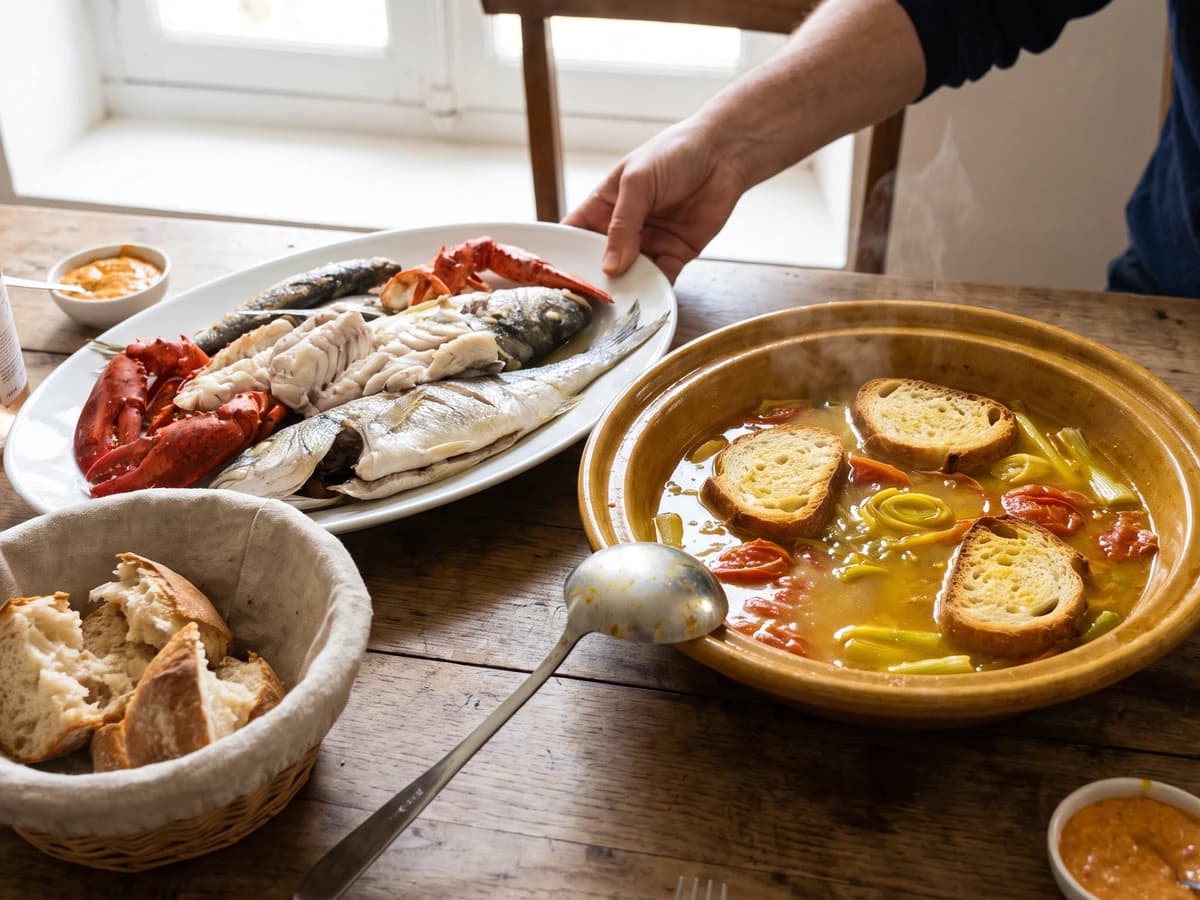
Marseille's great fish stew, saffron-gold and garlic-scented, proves that a hard boil can be the careful choice: it binds olive oil into broth before the whole pot meets bread.
A cooking platform built around craft, culture, and the stories behind what we eat.
Created by Chef Juliette
Based on No. 577, Consommé Lorette, from Le Guide Culinaire (1907) by Auguste Escoffier
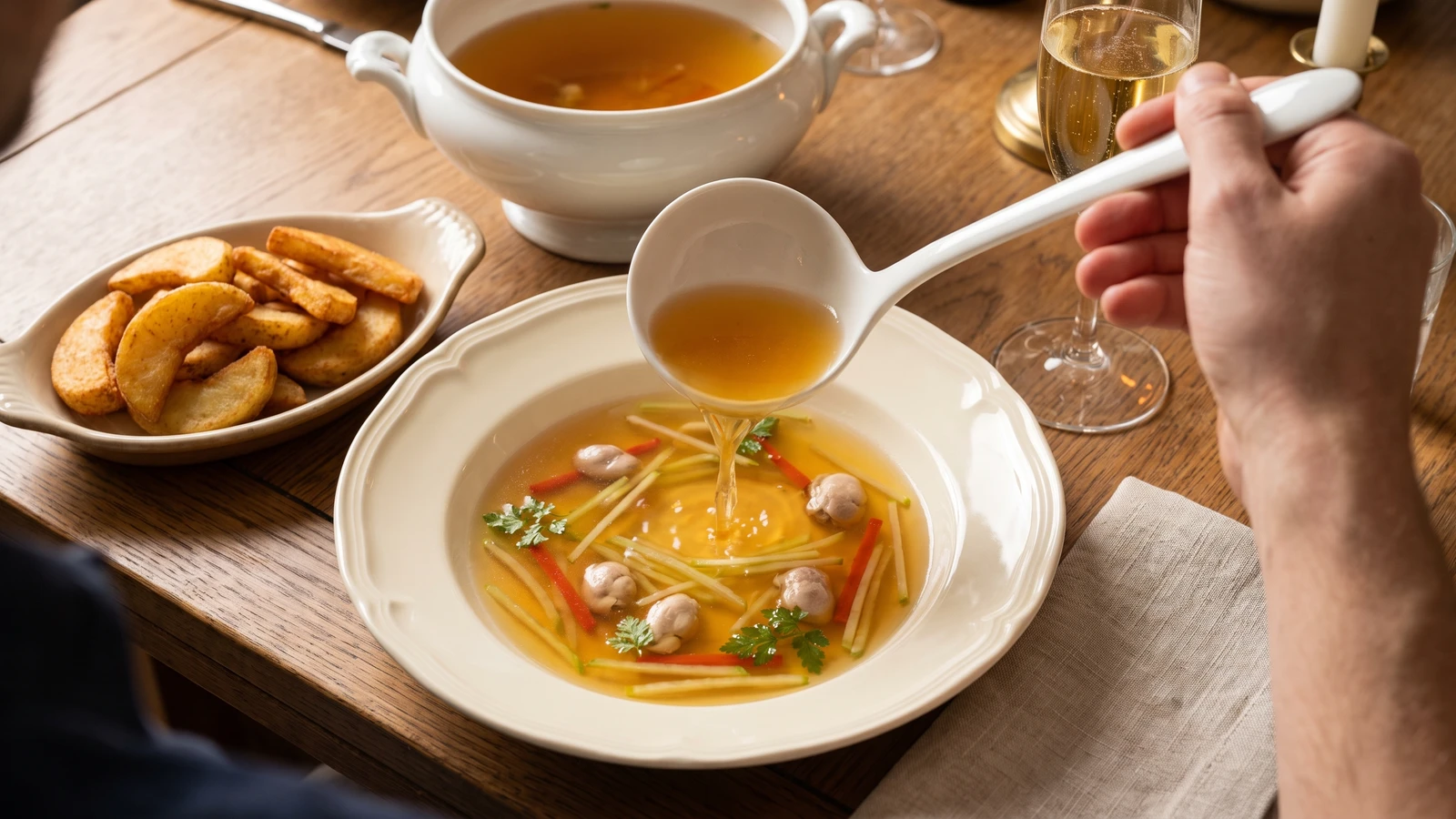
Crystal-clear chicken consommé gathers buttered celery, scarlet pimento, and freshly poached cocks' kidneys, while crisp cheese-enriched potato crescents arrive separately, preserving the contrast that makes Consommé Lorette worth the ceremony.
Consommé Lorette (clear chicken broth with buttered celery, pimento, poached cocks' kidneys, and crisp potato crescents) teaches the discipline of garnished consommé: every addition must deepen the spoonful without disturbing the broth's clarity. The one true thing to know before touching a pan is this: cook each garnish on its own terms, then unite it with the boiling consommé only at service. The potatoes stay separate. Their crispness is not decoration; it is half the dish.
The book assumed a saucier with chicken consommé never far from the fire, another pair of hands to poach the kidneys, and hot fat waiting for the Pommes de Terre Lorette (No. 2226). At home, begin with the finished consommé and the shaped potato preparation, use one small poaching pan and one modest pot of oil, and let timing replace the brigade. The quart formula is doubled without altering its ratios, giving about two quarts for eight first courses. One cook, one stove, one evening.
The brigade's simultaneous station work is scaffolding and can go. The separate frying, fresh poaching, fine julienne, and last-minute pour are the dish and must stay. If cocks' kidneys cannot be sourced, halved chicken hearts are the honest home equivalent: firmer, certainly, but they retain the poultry-offal note and neat spoon-size shape. Guard the clear broth above all; if it turns cloudy, ça se rattrape, and the method shows you where.
Consommé Lorette belongs to the Parisian grand-kitchen system of named consommé garnishes, where a perfectly clear base changed identity through a precise set of additions. Its name is carried chiefly by the cheese-enriched crescent potato garnish, while celery julienne, pimento, and poached cocks' kidneys make the combination distinctive; it is not a regional soup from Lorraine. Passing the fried potatoes separately preserves the contrast the dish was designed around: clear broth and tender garnish in the tureen, crisp potato at the diner's hand.
Quantity
8 cups (2 qt / 1.9 L / about 1.9 kg)
well clarified and seasoned
Quantity
1/4 cup (60 ml / 35 g)
cut into a very fine julienne
Quantity
1 tablespoon (15 ml / 14 g)
Quantity
24 kidneys (about 180 g / 6.3 oz), or 12 hearts (about 140 g / 5 oz)
kidneys cleaned; hearts trimmed and halved lengthwise
Quantity
4 cups (950 ml / 950 g)
for poaching
Quantity
1 teaspoon (5 ml / 6 g)
for the poaching water
Quantity
2 tablespoons (30 ml / 25 g)
cut into a very fine julienne
Quantity
2 generous pinches (about 2 teaspoons / 10 ml / 1 g)
small leaves picked from the stems
Quantity
24 hazelnut-size crescents (about 8 g each; 190 g / 6.7 oz total)
prepared through shaping and chilled
Quantity
4 cups (950 ml / about 870 g), or enough for a 2-inch (5 cm) depth
for frying
| Ingredient | Quantity |
|---|---|
| finished chicken consomméwell clarified and seasoned | 8 cups (2 qt / 1.9 L / about 1.9 kg) |
| celerycut into a very fine julienne | 1/4 cup (60 ml / 35 g) |
| unsalted butter | 1 tablespoon (15 ml / 14 g) |
| cocks' kidneys, meaning rooster testicles, or small chicken heartskidneys cleaned; hearts trimmed and halved lengthwise | 24 kidneys (about 180 g / 6.3 oz), or 12 hearts (about 140 g / 5 oz) |
| waterfor poaching | 4 cups (950 ml / 950 g) |
| fine saltfor the poaching water | 1 teaspoon (5 ml / 6 g) |
| drained red pimentocut into a very fine julienne | 2 tablespoons (30 ml / 25 g) |
| chervil pluchessmall leaves picked from the stems | 2 generous pinches (about 2 teaspoons / 10 ml / 1 g) |
| Pommes de Terre Lorette (No. 2226)prepared through shaping and chilled | 24 hazelnut-size crescents (about 8 g each; 190 g / 6.7 oz total) |
| refined peanut or sunflower oilfor frying | 4 cups (950 ml / about 870 g), or enough for a 2-inch (5 cm) depth |
Remove every trace of set fat from the cold consommé, then measure it into a 3-quart saucepan. Cut the celery into slender julienne no thicker than a matchstick and about 1 1/4 inches (3 cm) long; cut the pimento to match, drain it well, and pick the chervil into small pluches. Precision matters here because all three garnishes must sit lightly on the spoon rather than tangling like salad.
Étuver means to stew gently in butter without taking colour. Melt the butter in a small saucepan over low heat, add the celery, cover, and cook for 3 minutes, stirring once, until glossy but still pale. Add 1 cup (240 ml) of the measured consommé and simmer gently for 5 to 7 minutes, until the julienne is tender but retains its shape. If the butter begins to brown, move the celery immediately to a clean pan and continue with the consommé; the celery is saved, and browned milk solids stay out of the clear soup.
Bring the water and salt to a bare simmer in a small saucepan. Lower in the cleaned cocks' kidneys and poach for 4 to 5 minutes, until just firm, opaque at the centre, and at least 165°F (74°C). If using halved chicken hearts, allow 7 to 9 minutes. Drain well and hold them covered for no longer than 10 minutes. A hard boil makes either garnish rubbery; if the hearts tighten, slice them into thinner pieces across the grain. Their first tenderness won't return, but the spoonful will still eat pleasantly.
Lift the celery from its cooking liquor with a slotted spoon and reserve it for the tureen. Strain the liquor into the remaining consommé, then heat the broth gently, skimming away any fat or froth that rises. Warm the soup tureen and eight soup plates with hot water. Just before service, bring the consommé to one clean, decisive boil without whisking or letting it churn. If specks rise or the broth clouds, stop the heat, let it stand for 2 minutes, and ladle it through damp muslin or a damp paper coffee filter without pressing. Ça se rattrape. Return it to the boil only once.
Heat the frying oil in a small, deep, heavy saucepan to 350°F (180°C). Exactly 4 minutes before service, lower in the Pommes de Terre Lorette (No. 2226), working in two batches if the pan is narrow, and fry until evenly golden, crisp outside, and buoyant in the fat. Keep the oil between 340°F and 350°F (170°C and 180°C). Drain the crescents uncovered on a rack or absorbent paper; covering them traps moisture and undoes the crust. If one splits, remove the crumbs, restore the oil to temperature, dry the remaining crescents, and continue with a smaller batch.
Empty and dry the warmed tureen. Add the buttered celery, freshly poached kidneys or heart pieces, and pimento julienne, distributing them evenly. Pour the boiling consommé over the garnish, scatter in the chervil pluches, and carry the tureen straight to the table. Pass the fried crescents separately, allowing three per serving. Never drop them into the broth: separate service is not ceremony for its own sake, it protects the crisp contrast that makes this Consommé Lorette. À table!
1 serving (about 285g)
Culinary guides, cultural storytelling, and the editorial depth that makes cooking meaningful.
Discover Culinary ExplorerChef Juliette
Marseille's great fish stew, saffron-gold and garlic-scented, proves that a hard boil can be the careful choice: it binds olive oil into broth before the whole pot meets bread.
Chef Juliette
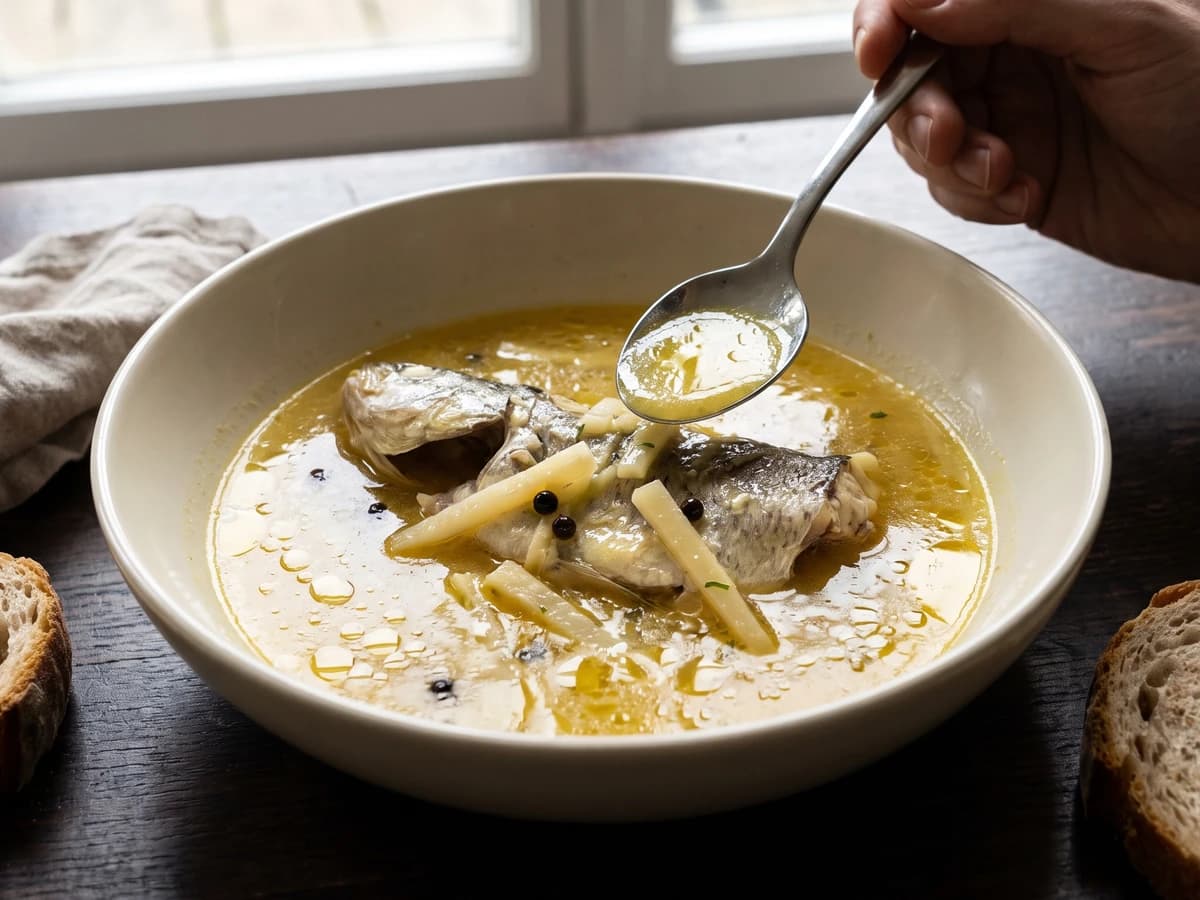
Waterzoi asks fresh, bone-in river fish to thicken its own buttery broth, with parsley root and pepper for company. No flour, no stockpot, just a brisk simmer watched closely.
Chef Juliette
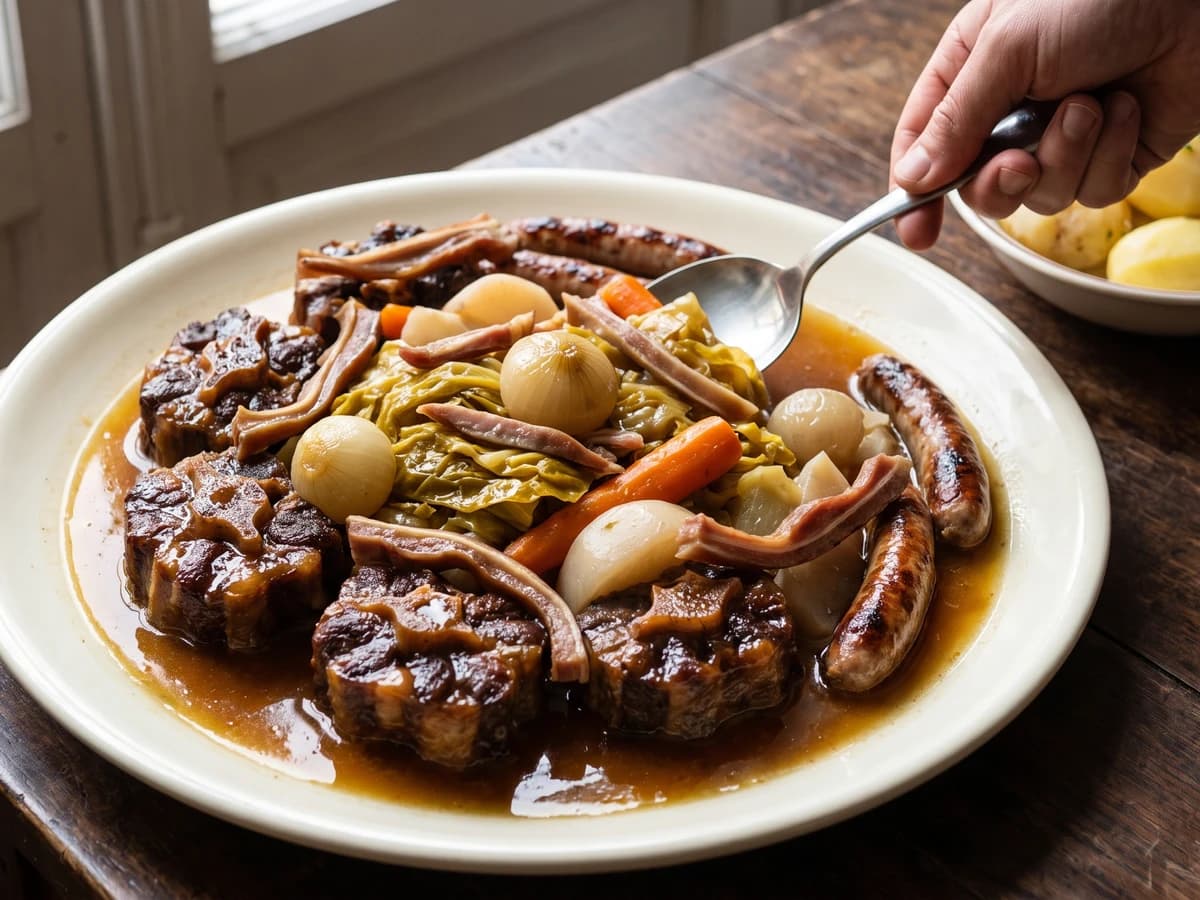
Queue de Bœuf en Hochepot gathers oxtail, pig's trotter and ear, cabbage, roots, and grilled chipolatas around a clear, gelatin-rich broth whose quiet simmer keeps every piece tender and distinct.
Chef Juliette
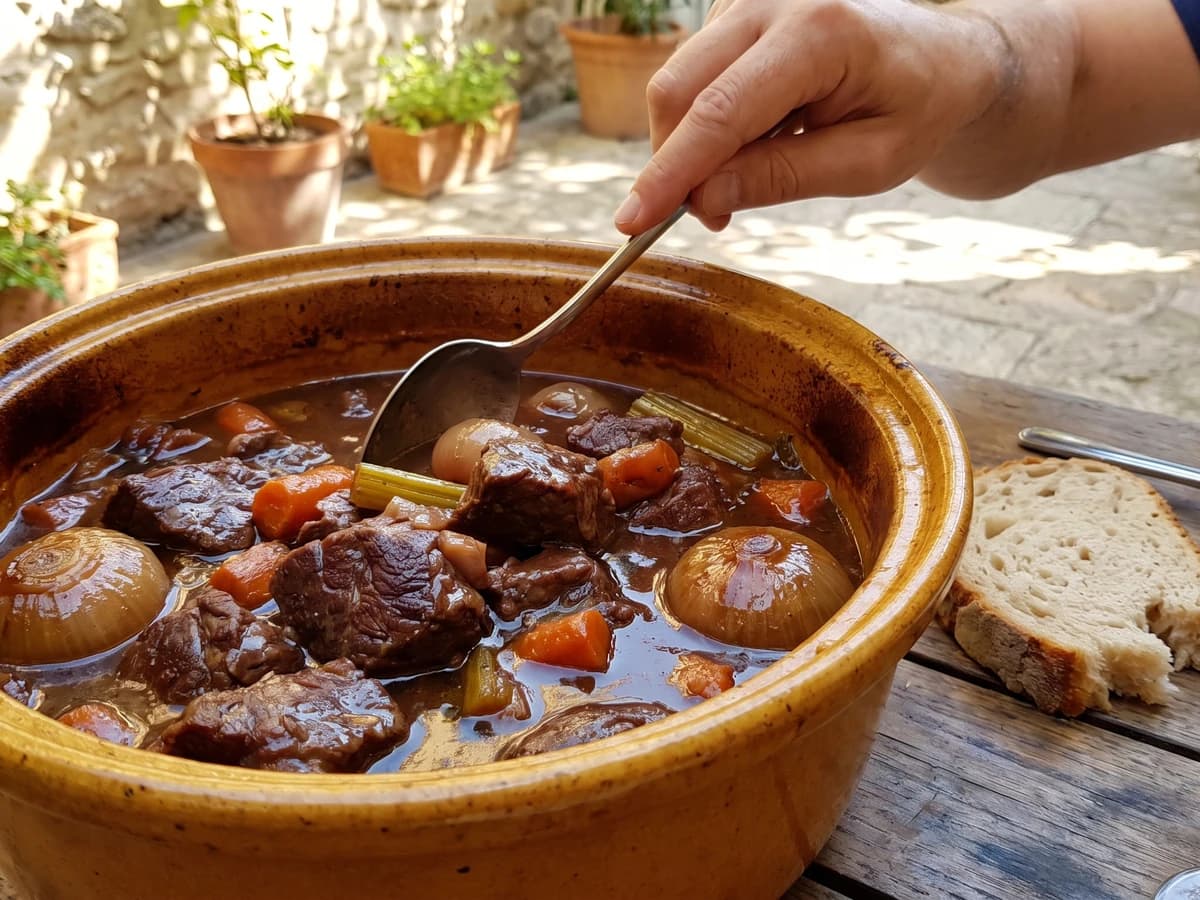
Beef shoulder larded with bacon, sharpened by red wine and vinegar, then sealed with garlic, vegetables, and dry lemon peel until the low oven turns it yielding and the gravy darkly glossy.