Chef Juliette
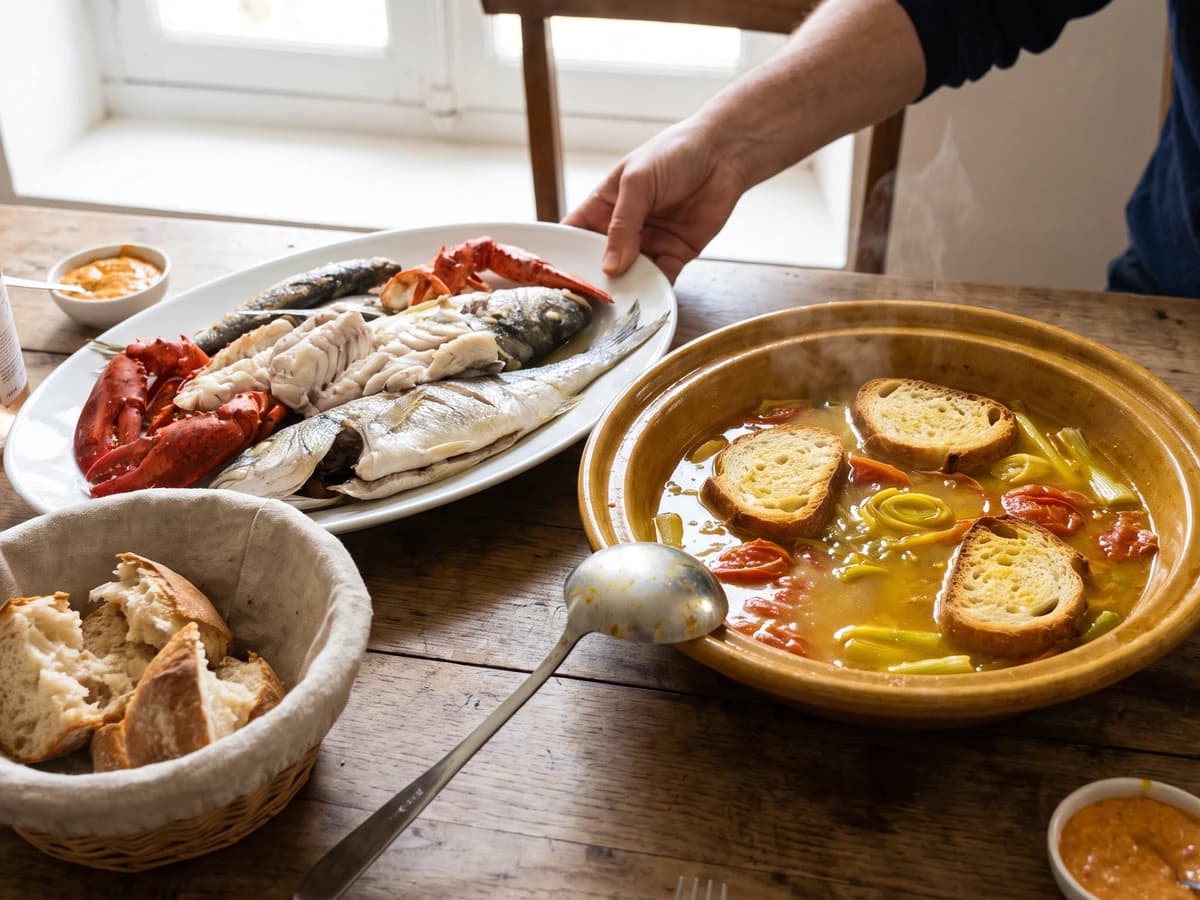
Bouillabaisse à la Marseillaise
Marseille's great fish stew, saffron-gold and garlic-scented, proves that a hard boil can be the careful choice: it binds olive oil into broth before the whole pot meets bread.
A cooking platform built around craft, culture, and the stories behind what we eat.
Created by Chef Juliette
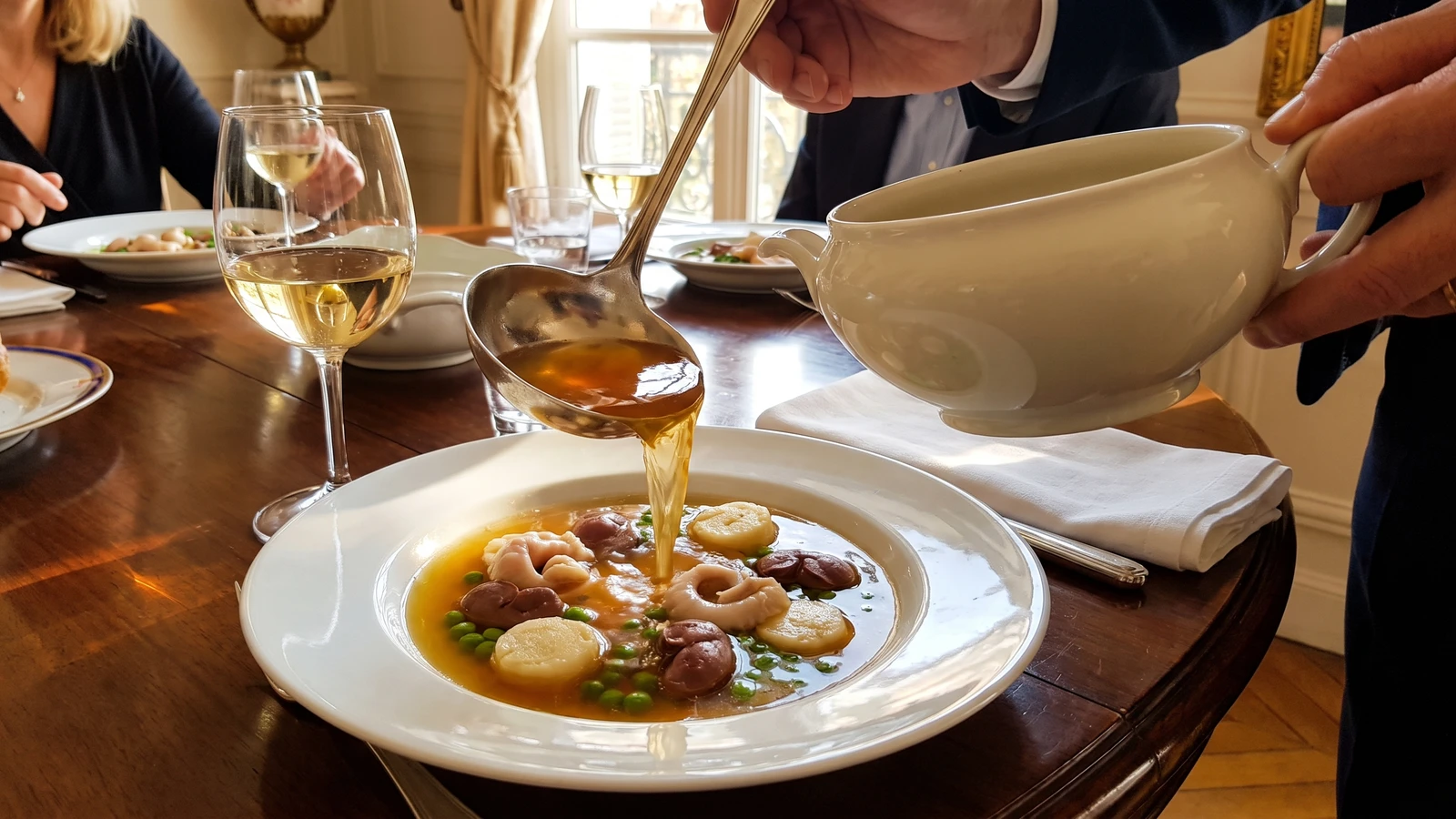
Based on No. 573, Consommé Imperiale, from Le Guide Culinaire (1907) by Auguste Escoffier
A crystal-clear chicken consommé carrying tender fowl mousseline rounds, cocks’ combs, sliced kidneys, green peas, and the faintest tapioca liaison, composed for celebration yet entirely manageable at home.
Consommé Impériale (clear chicken consommé garnished with fowl mousseline, cocks’ combs, kidneys, peas, and tapioca) teaches the discipline of a composed soup. The one true thing to know before touching a pan is that clarity is assembled, not repaired: every garnish must be cooked, chilled, trimmed, and ready before it meets the consommé, which should never suffer a hard boil.
The original formula assumed a saucier tending the broth, a stockpot never off the fire, prepared poultry offal, fine linen, and shelves of dariole-moulds beside a Charlotte mould. Your honest home equivalents are a shallow 15 cm cake pan, a fine sieve, and finished components prepared ahead in sensible order. A salamander has no work here because nothing is browned. The equipment and division of labor changed, not the garnish or its proportions. One cook, one stove, one evening.
The dariole-mould measure, the Charlotte mould, and the linen are brigade scaffolding and may go. The clear consommé, the cold Fine Chicken Forcemeat or “Mousseline” (No. 195), its gentle poaching, the original offal garnish, the green peas, and the strained tapioca are the dish and must stay. The decisive step is the final binding: add the tapioca gently and keep the consommé below a boil so its amber clarity survives.
Consommé Impériale belongs to the French grand-kitchen repertoire codified in Paris, where clear consommés were distinguished by precise garnishes and served at formal tables. The title Impériale does not establish a single imperial inventor; such names became menu shorthand, and this garnish is defined by fowl mousseline, cocks’ combs and kidneys, green peas, and tapioca. The soup traveled to bourgeois celebration tables when home cooks adopted the composed tureen while leaving behind the brigade required to maintain its many components.
Quantity
1½ cups (360 ml / about 360 g), or six small dariole-mould measures, Fine Chicken Forcemeat or “Mousseline” (No. 195)
finished and very cold
Quantity
12 small cocks’ combs prepared by Blanchings (No. 273)
cleansed, blanched, and cooked until tender
Quantity
6
gently poached and thinly sliced
Quantity
¼ cup (60 ml / 40 g)
cooked just tender and chilled
Quantity
¼ cup (60 ml / 40 g), yielding 6 tablespoons (90 ml / about 90 g) poached and strained
poached until transparent
Quantity
2 cups (475 ml / 475 g)
for poaching the tapioca
Quantity
8 cups (1.9 L / about 1.9 kg)
| Ingredient | Quantity |
|---|---|
| Fine Chicken Forcemeat or “Mousseline”finished and very cold | 1½ cups (360 ml / about 360 g), or six small dariole-mould measures, Fine Chicken Forcemeat or “Mousseline” (No. 195) |
| small cocks’ combscleansed, blanched, and cooked until tender | 12 small cocks’ combs prepared by Blanchings (No. 273) |
| cocks’ kidneysgently poached and thinly sliced | 6 |
| very green peascooked just tender and chilled | ¼ cup (60 ml / 40 g) |
| small-pearl tapiocapoached until transparent | ¼ cup (60 ml / 40 g), yielding 6 tablespoons (90 ml / about 90 g) poached and strained |
| waterfor poaching the tapioca | 2 cups (475 ml / 475 g) |
| finished chicken consommé | 8 cups (1.9 L / about 1.9 kg) |
Heat the oven to 300°F (150°C). Line the base and sides of a shallow 15 cm round cake pan with parchment. Spoon in the very cold Fine Chicken Forcemeat or “Mousseline” (No. 195), spreading it into an even layer about 2 cm thick without beating air into it. Cover the pan and set it in a roasting tin; pour hot water around it to reach halfway up the sides, making a bain-marie (hot-water bath). Poach until the centre feels just firm and reaches 165°F (74°C), about 20 to 25 minutes. If the edges rise while the centre remains loose, lower the oven to 275°F (135°C) and add a little cool water to the bain-marie. Ça se rattrape: gentler heat lets the centre set before the edges tighten.
Lift the mould from the bain-marie and let it cool, then refrigerate it until completely cold and firm, at least 1½ hours. Turn it onto a chilled board and remove the parchment. With a 2.5 cm round cutter dipped in cold water, cut neat roundels the size of a small coin. Do not cut the mousseline warm or the edges will drag. If they look ragged, chill it another 20 minutes and cut again with a clean, wet cutter. Reserve the trimmings for another soup rather than crowding this tureen.
Combine the small-pearl tapioca and water in a small saucepan. Bring them slowly to a bare simmer, then cook gently for 25 to 35 minutes, stirring often, until the pearls have no white cores and the surrounding liquid is glossy. While hot, press the tapioca and its clinging liquid through a dampened fine-mesh sieve with a flexible spatula. Fine linen performed this job in the brigade; the sieve is its honest home equivalent. Measure exactly 6 tablespoons (90 ml / about 90 g). If the tapioca becomes too gummy to pass, loosen it with a spoonful of hot consommé and continue pressing. Ça se rattrape.
Fill the soup tureen with hot water, leave it for 5 minutes, then empty and dry it. Arrange the mousseline roundels across the bottom with the cocks’ combs prepared by Blanchings (No. 273), the sliced cocks’ kidneys, and the green peas. Spread the garnish evenly so each serving receives a little of everything. Handle the roundels with a spoon, not tongs, because their tenderness is part of the pleasure.
Reserve 1 cup of the chicken consommé and bring the remaining 7 cups to a bare simmer in a clean saucepan. Whisk in the 6 tablespoons of strained poached tapioca one spoonful at a time, keeping the liquid below a boil. Add the reserved consommé and heat only until the broth carries a faint satin body while remaining clear enough to see the bottom of a spoon. This is a light liaison, not a thick soup. If flecks appear or the broth turns cloudy, remove it from the heat and pass it through clean damp linen or a very fine sieve without pressing. Ça se rattrape.
Pour the hot bound consommé slowly over the garnish at one side of the warmed tureen so the stream does not break the mousseline roundels. Cover for 1 minute, just long enough for the small garnishes to warm through, then ladle into heated soup plates. Serve at once, while the broth is brilliant and the peas are still green. À table!
1 serving (about 315g)
Culinary guides, cultural storytelling, and the editorial depth that makes cooking meaningful.
Discover Culinary ExplorerChef Juliette
Marseille's great fish stew, saffron-gold and garlic-scented, proves that a hard boil can be the careful choice: it binds olive oil into broth before the whole pot meets bread.
Chef Juliette
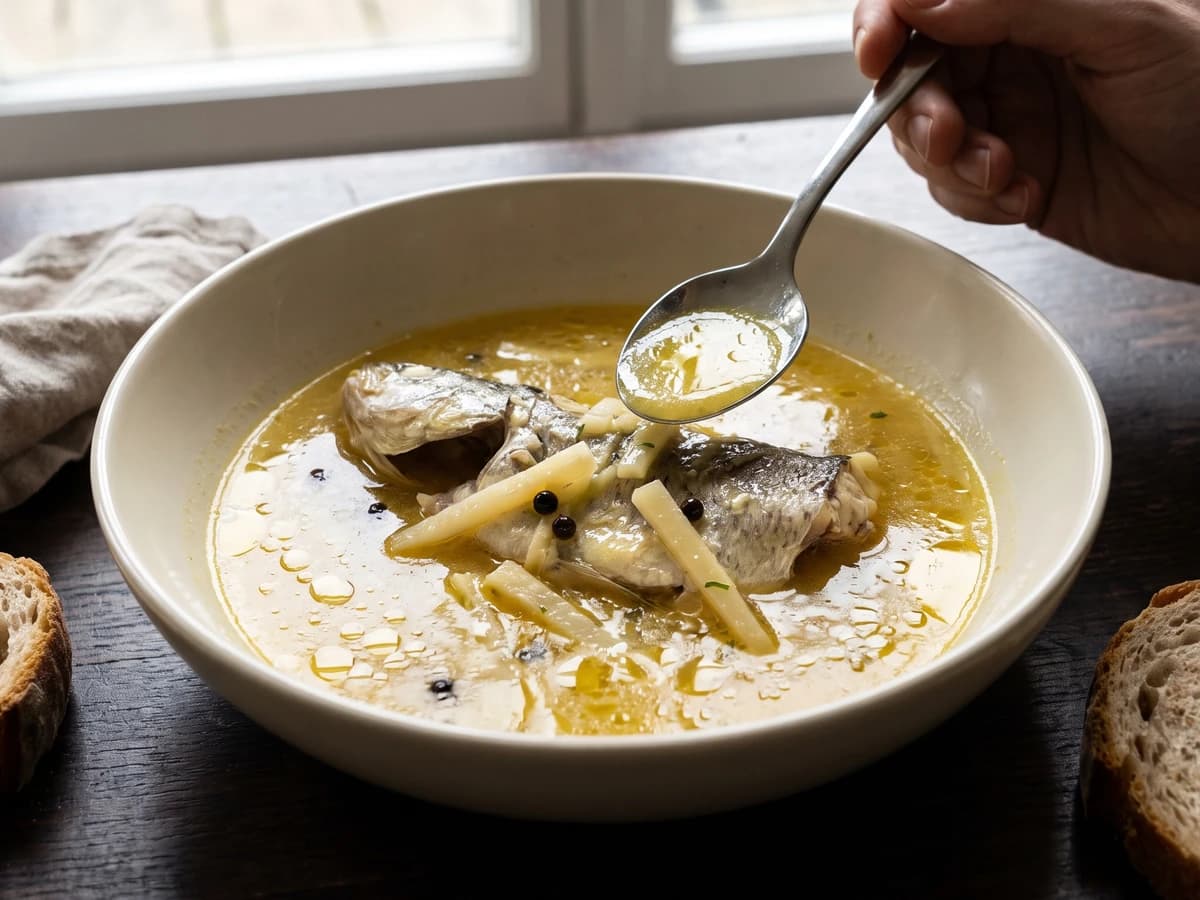
Waterzoi asks fresh, bone-in river fish to thicken its own buttery broth, with parsley root and pepper for company. No flour, no stockpot, just a brisk simmer watched closely.
Chef Juliette
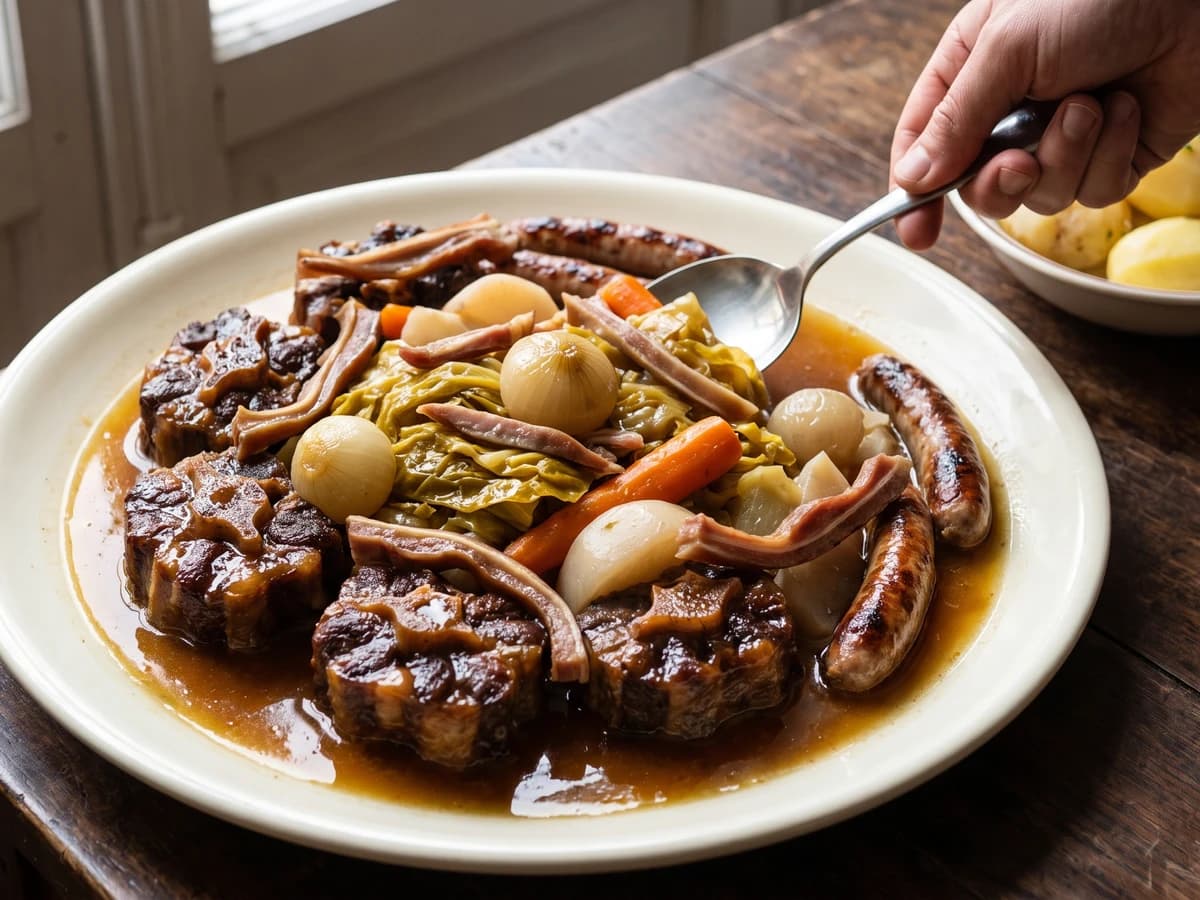
Queue de Bœuf en Hochepot gathers oxtail, pig's trotter and ear, cabbage, roots, and grilled chipolatas around a clear, gelatin-rich broth whose quiet simmer keeps every piece tender and distinct.
Chef Juliette
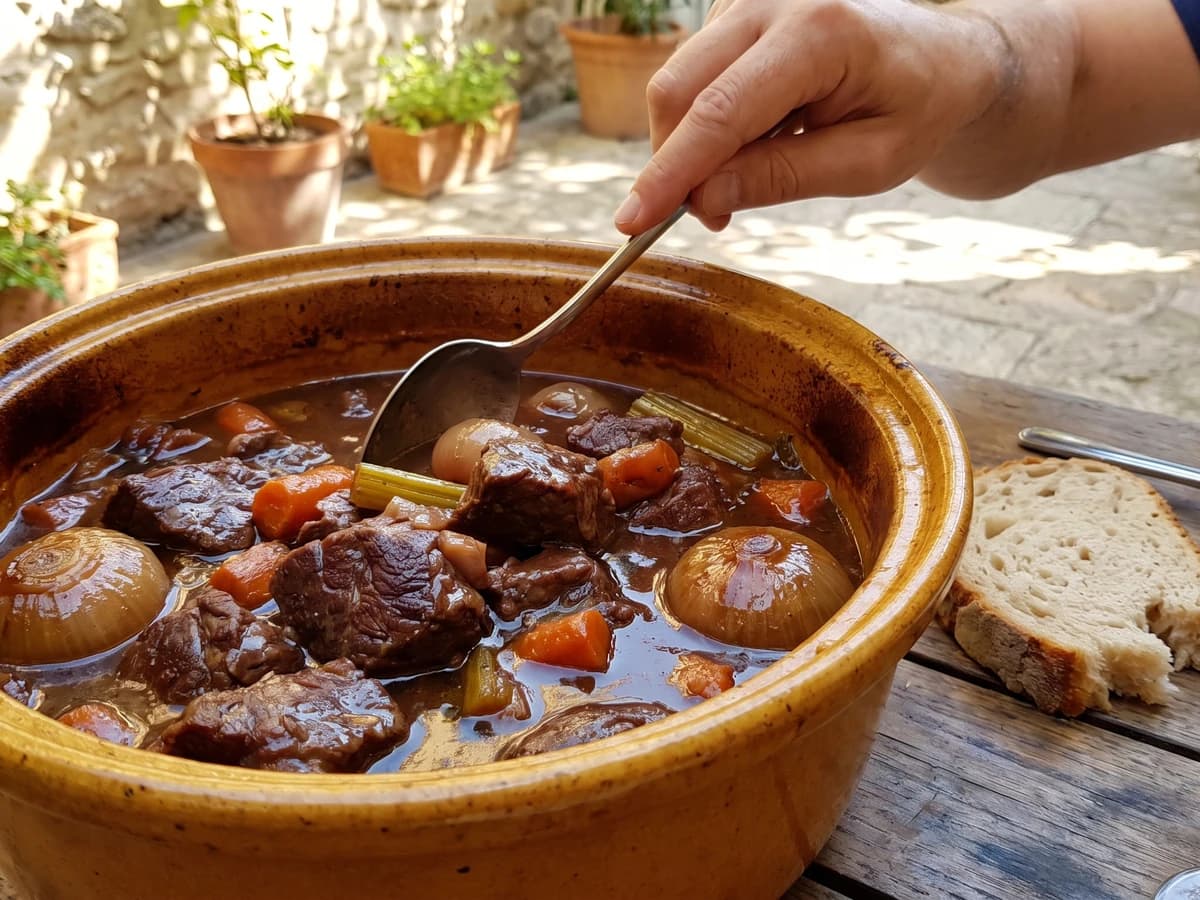
Beef shoulder larded with bacon, sharpened by red wine and vinegar, then sealed with garlic, vegetables, and dry lemon peel until the low oven turns it yielding and the gravy darkly glossy.