Culinary Explorer

A cooking platform built around craft, culture, and the stories behind what we eat.
Discover Culinary Explorer
Consommé à la Bohémienne

Consommé à la Bohémienne

Created by Chef Juliette

Based on No. 543, Consommé à la Bohémienne, from Le Guide Culinaire (1907) by Auguste Escoffier

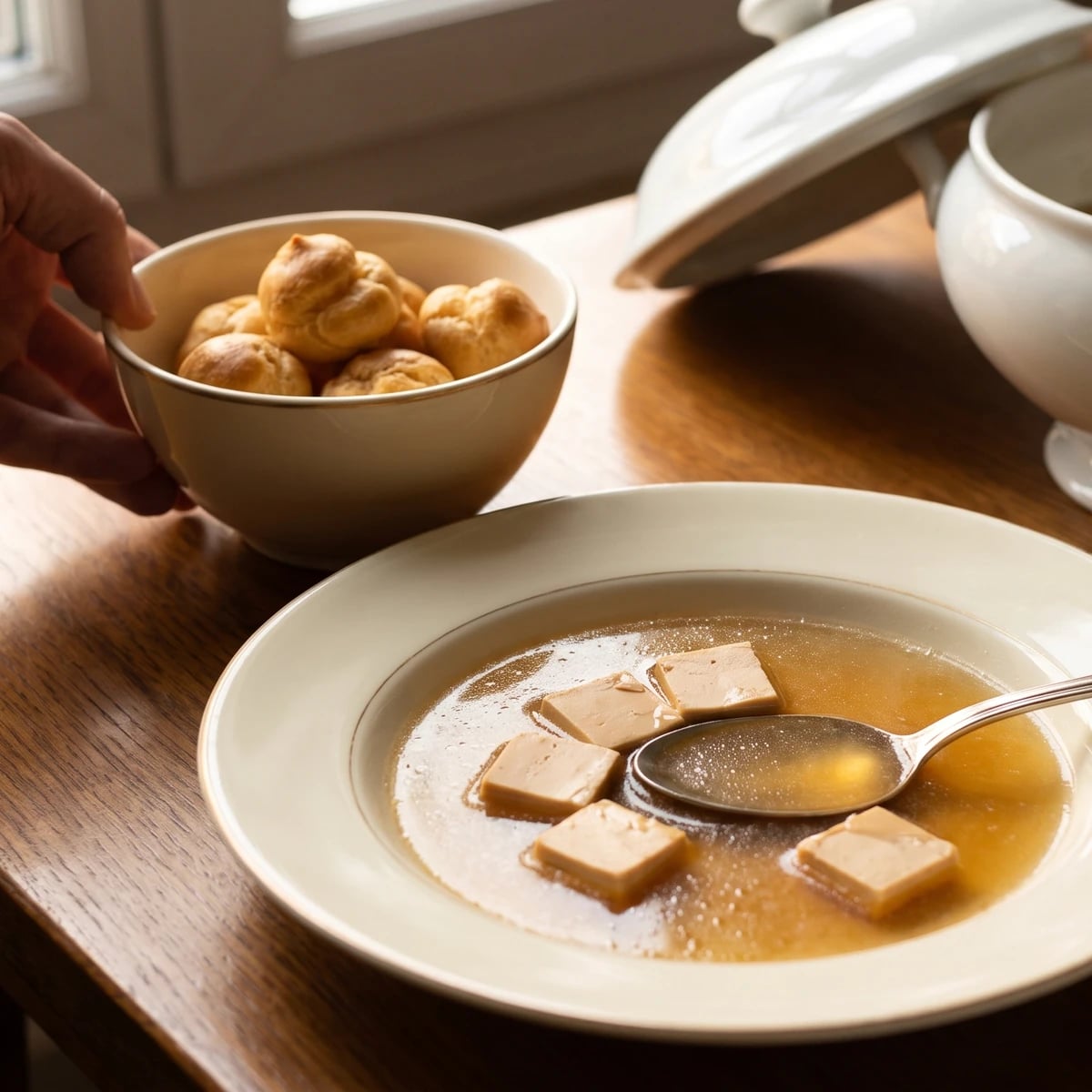
A crystalline chicken consommé with the faint silk of tapioca, tender foie-gras royale cut into neat squares, and tiny crisp profiterolles delivered hot at the table, where each guest adds them at the last possible moment.

Soups & Stews
French
Dinner Party
Special Occasion
Make Ahead
35 min
Active Time
1 hr 10 min cook3 hr 35 min total
YieldAbout 2 quarts (6 generous first-course servings)

Consommé à la Bohémienne (clear chicken consommé with foie-gras royale, a savory foie-gras custard, and crisp soup profiterolles) teaches separation. The broth receives its tender royale squares only at service, while the profiterolles arrive hot and apart, because the instant crisp choux sits in broth it begins to surrender. Keep that contrast and the dish lives. Lose it and you have soggy pastry in very fine soup.

The old entry assumes a saucier beside a stockpot never off the fire and dariole-moulds lined up by the rank; a salamander has no part in this particular service. At home, begin with finished chicken consommé, set the royale in one shallow cake tin instead of six little moulds, and use damp muslin in a fine sieve where the brigade used linen. Those moulds and extra hands are scaffolding. The clear consommé, its measured tapioca body, the neat royale, and the dry choux carried separately are the dish, so none of those goes. This version makes six generous first-course portions for one cook, one stove, one evening.

The step that matters most is straining the tapioca-bound consommé without squeezing the cloth. You want the delicate body released by the tapioca, never crushed pearls or cloudiness. If the cloth blocks, wait and replace it rather than forcing the liquid through. Ça se rattrape.

Consommé à la Bohémienne belongs to the formal French grand-kitchen table, particularly the Parisian service in which clear consommés were distinguished by precisely composed garnishes. Its name does not make it a household soup from Bohemia; here Bohémienne identifies the canonical combination of foie-gras royale, tapioca-bound chicken consommé, and tiny soup profiterolles. It traveled into home repertoires as an assembly of finished components, preserving the grand kitchen's clarity and contrast while shedding its ranks of moulds and cooks.

The technique, the tradition, and the story behind every dish.

Discover Culinary Explorer

Ingredients

finished chicken consommé

Quantity

2 quarts (1.9 L / 1.9 kg)

perfectly clear and fully seasoned

small pearl tapioca

Quantity

6 tablespoons (90 ml / 72 g)

additional finished chicken consommé

Quantity

¾ cup (180 ml / 180 g)

for the royale

plain bloc de foie gras or cooked foie gras terrine

Quantity

about 1 cup (240 ml / 200 g)

brought to room temperature

heavy cream

Quantity

¼ cup (60 ml / 60 g)

large eggs

Quantity

2

large egg yolks

Quantity

4

unsalted butter

Quantity

1 teaspoon (5 ml / 5 g)

for the tin

Profiterolles for Soups

Quantity

24 Profiterolles for Soups (No. 218)

hazelnut-size, fully baked and dry

Equipment Needed

  • 8-inch (20 cm) square metal cake tin
  • Deep roasting pan for the bain-marie
  • Fine-mesh sieve
  • Muslin or cheesecloth
  • Broad heavy-bottomed saucepan
  • Warm soup tureen
  • Baking sheet

Instructions

  1. 1

    Blend the royale

    Heat the oven to 300°F (150°C). Butter an 8-inch (20 cm) square metal cake tin and line its base with parchment. Blend the room-temperature foie gras with the additional chicken consommé and cream until smooth, then add the eggs and yolks and blend only until combined. Pass the mixture through a fine sieve into the prepared tin and skim away any surface bubbles. Air makes holes in a royale, so work quietly rather than whipping it.

    The shallow square tin replaces six small dariole-moulds. It changes only the shape before cutting, while giving one cook a level custard that divides into regular squares without juggling a tray of little moulds.
  2. 2

    Poach it gently

    Cover the tin loosely with foil and set it in a deep roasting pan. Pour hot water around it to come halfway up the sides, making a bain-marie, then bake for 25 to 35 minutes. The royale is ready when the edges are set and the center trembles as one piece; its internal temperature should reach about 160°F (71°C). If it begins puffing or the water boils, lift the tin out, replace some water with cool water, and lower the oven to 275°F (135°C). Ça se rattrape if you catch it before the custard turns grainy.

  3. 3

    Chill and cut

    Lift the royale from its bain-marie, uncover it, and let it cool for 20 minutes. Chill it for at least 1½ hours, until completely firm. Run a thin knife around the edge, turn it onto a board, remove the parchment, and cut it into regular ½-inch (1.25 cm) squares with a knife dipped in hot water and wiped between cuts. Keep the squares chilled and covered until service.

  4. 4

    Poach the tapioca

    Reserve 1 cup (240 ml) of the chicken consommé. Put the rest in a broad saucepan, stir in the tapioca, and bring it slowly to the barest simmer. Cook for 25 to 30 minutes, stirring across the pan floor often, until the pearls are translucent and the consommé has gained a faint, silky body. A hard boil muddies the broth and may catch the tapioca on the bottom, so keep only a quiet tremble.

  5. 5

    Strain without force

    Wet a piece of muslin or two layers of cheesecloth, wring it out, and use it to line a fine sieve over a clean saucepan. Pour in the tapioca-bound consommé and let gravity carry the liquid through. Do not squeeze, scrape, or press the pearls. Stir in the reserved consommé once the straining is complete. If the cloth clogs or the liquid looks cloudy, let it settle for 5 minutes and pass it through fresh damp cloth. Ça se rattrape, but pressure only makes it worse.

  6. 6

    Recrisp the choux

    Set the finished Profiterolles for Soups (No. 218) on a baking sheet and warm them at 325°F (165°C) for 6 to 8 minutes, until their thin shells are thoroughly dry and crisp. Hold them uncovered in a warm bowl. If one still yields when pressed lightly, return the batch to the oven for 3 minutes; trapped moisture, not insufficient heat, is what softens them.

  7. 7

    Assemble the tureen

    Warm the soup tureen with hot water, then empty and dry it. Heat the strained consommé until it is nearly simmering and its surface carries a delicate shimmer, but do not boil it. Taste once for seasoning. Arrange the cold royale squares in the tureen and pour the very hot consommé over them immediately. Stirring would bruise the squares, so let the pouring distribute them.

  8. 8

    Serve them apart

    Ladle the consommé and royale into warmed bowls. Carry the Profiterolles for Soups (No. 218) to the table separately and very hot, allowing four per person. Each guest should add one or two at a time, preserving the crisp shell until the spoon reaches it. This separation is not ceremony; it is the texture of the dish. À table!

Chef Tips

  • Consommé is the foundation, not background. Use a true, finished chicken consommé with clear amber color, clean poultry flavor, and enough natural gelatin to feel round on the tongue. A cloudy stock cannot be hidden beneath the tapioca.
  • Choose plain bloc de foie gras or a firm cooked foie gras terrine, not an aerated mousse flavored with alcohol or truffle. Mousse carries extra air and liquid, which can leave the royale porous or too soft to cut cleanly.
  • The finished soup should have no visible tapioca pearls. Their work is to lend the consommé a restrained silkiness before the linen removes them; if the broth eats like pudding, it has gone far beyond the entry's intent.
  • The Profiterolles for Soups (No. 218) must be fully dry before service and must remain separate from the tureen. Pass them in an uncovered warm bowl, with four for each guest.
  • A dry Champagne suits the clear chicken broth and foie gras without burdening them. Serve modest glasses with the first course, then let the consommé keep the attention.

Advance Preparation

  • The royale can be poached, chilled, and cut up to 2 days ahead. Keep the squares covered in the cold so their surfaces do not dry or absorb refrigerator odors.
  • The tapioca-bound consommé can be strained a day ahead, chilled promptly, and reheated gently. Do not store the royale in the broth, because its foie gras will soften the consommé's clean finish.
  • Prepare the Profiterolles for Soups (No. 218) according to their own entry ahead of time, then hold them airtight once completely cool. Recrisp them only as the consommé is being reheated.
  • The stated cooking time begins with the finished chicken consommé and Profiterolles for Soups (No. 218) in hand, just as the source entry assumes. Only the final assembly waits until guests are seated.

Frequently Asked Questions

Nutrition Information

1 serving (about 415g)

Calories
355 calories
Total Fat
26 g
Saturated Fat
10 g
Trans Fat
0 g
Unsaturated Fat
15 g
Cholesterol
265 mg
Sodium
1500 mg
Total Carbohydrates
16 g
Dietary Fiber
0 g
Sugars
2 g
Protein
12 g

Note: Chef personas and recipes are created with AI assistance. Cook with care: follow safe food-handling practices, check doneness with a thermometer when needed, and adapt for allergies and your kitchen.

Where cooking meets culture.

Culinary guides, cultural storytelling, and the editorial depth that makes cooking meaningful.

Discover Culinary Explorer