Chef Juliette
Omelette à l’Écossaise
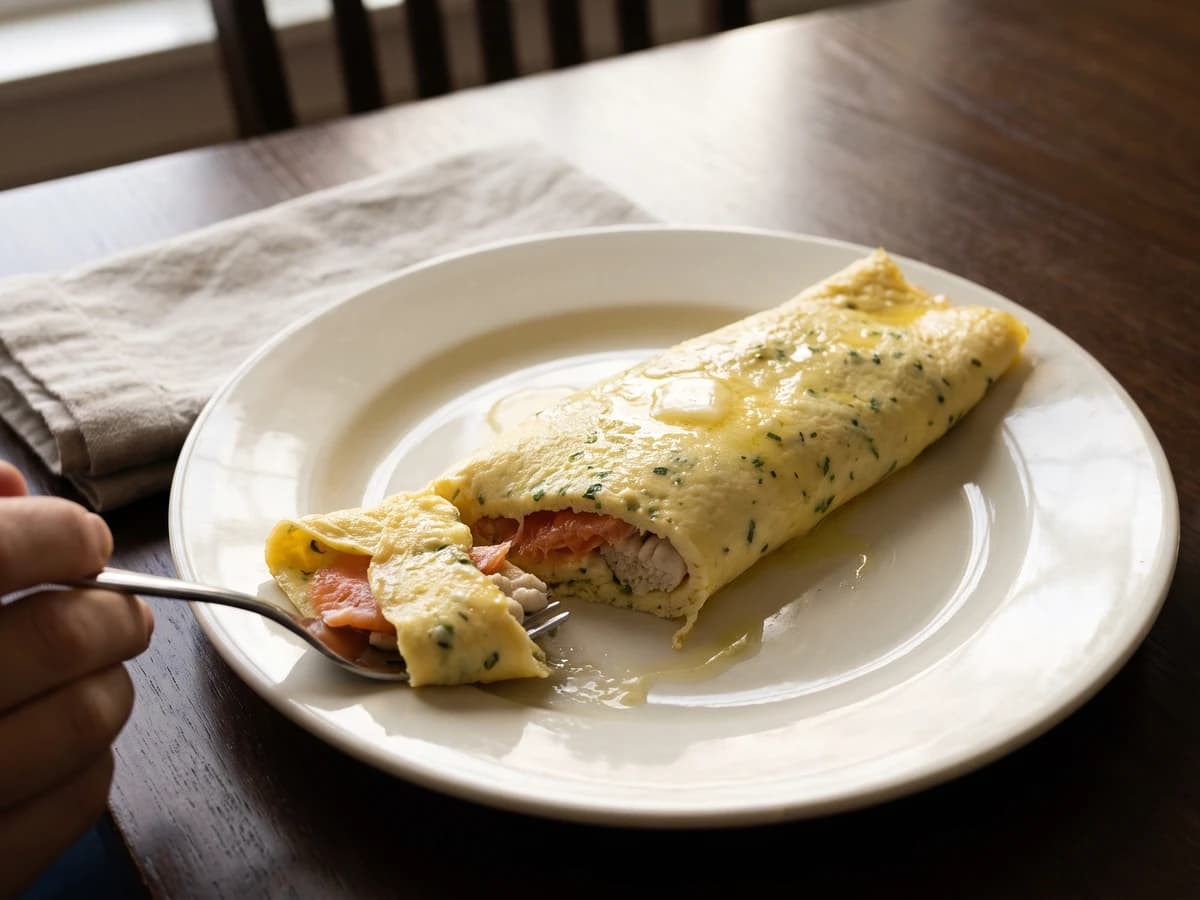
A creamy omelette aux fines herbes closes around smoked-salmon-wrapped herring milts, gently poached in butter. Have the filling ready, then roll the eggs while they still shine.
A cooking platform built around craft, culture, and the stories behind what we eat.
Created by Chef Juliette
Based on No. 458, Printanier Moulded Eggs, from Le Guide Culinaire (1907) by Auguste Escoffier
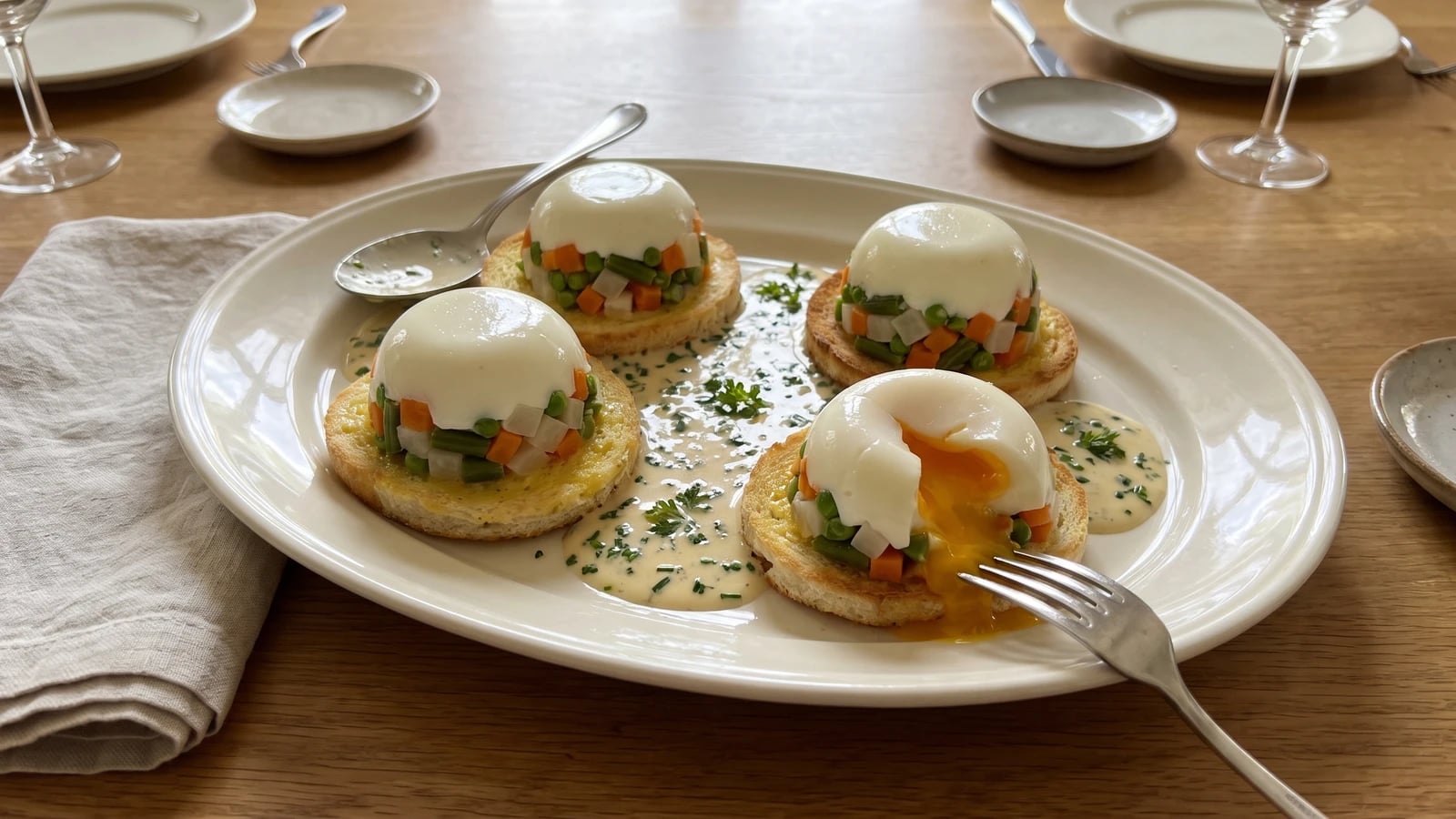
Jewel-cut spring vegetables cling to gently poached eggs, each set on crisp toast around a pool of herb-flecked cream sauce, a composed classical first course made for four.
Œufs moulés printaniers (moulded eggs with spring vegetables) teach one exact lesson: gentle heat lets an egg take a beautiful shape without turning hard. Before you touch a pan, know that the bain-marie must barely tremble. The coloured vegetable lining catches the eye, but the tender white and flowing yolk are what make the dish worth eating.
The original recipe assumed a rack of hexagonal moulds, several cooks tending vegetables in separate pans, and a saucier keeping cream sauce ready for service. At home, use four small dariole moulds or ramekins, blanch every vegetable in one saucepan, then clean that saucepan and make the sauce in it. The six sides are presentation, not technique. Separate pans are brigade scaffolding and can go; the Chartreuse-fashion mosaic, the bain-marie, and the prescribed proportion of Printanier butter to sauce are the dish and must stay. One cook, one stove, one evening.
You will press firm, bright vegetables into cold butter, settle an egg inside each little mosaic, and turn it out onto crisp toast with ivory sauce pooled at the centre of the dish. Work patiently when you line the moulds, but save your sharpest attention for the poaching water. Keep it below a simmer. That is the step that decides everything.
Œufs moulés printaniers belong to the classical Parisian table, where individual egg entrées used the first tender vegetables of the season as patterned garnishes. Their lining borrows the chartreuse method represented by Chartreuse de Ris de Veau (No. 1220), reducing a large composed mould to a single gently poached egg; printanier names the early vegetables and their varied colours, not a Provençal style. The preparation moved readily from grand kitchens to bourgeois dining rooms because its ornament depends on careful cutting and a bain-marie, not rare ingredients.
Quantity
1 four-mould arrangement from Chartreuse de Ris de Veau (No. 1220)
made with the carrot, turnip, green beans, and peas listed below
Quantity
1/4 cup (60 ml / 40 g)
peeled and cut into tiny diamonds about 1/8 inch (3 mm) thick
Quantity
1/4 cup (60 ml / 35 g)
peeled and cut into tiny diamonds about 1/8 inch (3 mm) thick
Quantity
1/4 cup (60 ml / 35 g)
cut into 1/4-inch (6 mm) pieces
Quantity
1/4 cup (60 ml / 40 g)
fresh or frozen
Quantity
1 tablespoon (15 ml / 18 g)
Quantity
1 tablespoon (15 ml / 14 g)
softened
Quantity
4
at room temperature
Quantity
3/4 teaspoon (4 ml / 4 g)
divided
Quantity
1/8 teaspoon (0.6 ml / 0.25 g)
Quantity
4 slices, about 4 ounces / 120 g
cut about 1/2 inch (1.25 cm) thick
Quantity
1 tablespoon (15 ml / 14 g)
melted
Quantity
1 tablespoon (15 ml / 14 g)
Quantity
1 tablespoon (15 ml / 8 g)
Quantity
1/2 cup (120 ml / 123 g)
Quantity
1/2 cup (120 ml / 120 g)
reserve 1 teaspoon in case the finished sauce needs rescuing
Quantity
2 1/2 tablespoons (37 ml / 36 g)
softened
Quantity
2 teaspoons (10 ml / 2 g)
finely chopped
Quantity
1 teaspoon (5 ml / 1 g)
finely snipped
Quantity
1 teaspoon (5 ml / 1 g)
finely chopped
| Ingredient | Quantity |
|---|---|
| Chartreuse-fashion vegetable liningmade with the carrot, turnip, green beans, and peas listed below | 1 four-mould arrangement from Chartreuse de Ris de Veau (No. 1220) |
| carrotpeeled and cut into tiny diamonds about 1/8 inch (3 mm) thick | 1/4 cup (60 ml / 40 g) |
| turnippeeled and cut into tiny diamonds about 1/8 inch (3 mm) thick | 1/4 cup (60 ml / 35 g) |
| slender green beanscut into 1/4-inch (6 mm) pieces | 1/4 cup (60 ml / 35 g) |
| petite peasfresh or frozen | 1/4 cup (60 ml / 40 g) |
| fine sea salt for blanching | 1 tablespoon (15 ml / 18 g) |
| unsalted butter for the mouldssoftened | 1 tablespoon (15 ml / 14 g) |
| large eggsat room temperature | 4 |
| fine sea saltdivided | 3/4 teaspoon (4 ml / 4 g) |
| finely ground white pepper | 1/8 teaspoon (0.6 ml / 0.25 g) |
| pain de mie or fine white sandwich breadcut about 1/2 inch (1.25 cm) thick | 4 slices, about 4 ounces / 120 g |
| unsalted butter for the toastmelted | 1 tablespoon (15 ml / 14 g) |
| unsalted butter for the white roux | 1 tablespoon (15 ml / 14 g) |
| plain flour | 1 tablespoon (15 ml / 8 g) |
| whole milk | 1/2 cup (120 ml / 123 g) |
| heavy creamreserve 1 teaspoon in case the finished sauce needs rescuing | 1/2 cup (120 ml / 120 g) |
| unsalted butter for the Printanier buttersoftened | 2 1/2 tablespoons (37 ml / 36 g) |
| chervilfinely chopped | 2 teaspoons (10 ml / 2 g) |
| chivesfinely snipped | 1 teaspoon (5 ml / 1 g) |
| flat-leaf parsleyfinely chopped | 1 teaspoon (5 ml / 1 g) |
Heat the oven to 325°F (160°C). Butter four 4-ounce (120 ml) hexagonal moulds, metal dariole moulds, or straight-sided ramekins generously, carrying the butter right into every corner. Set them in a deep roasting tin and bring a kettle of water almost to the boil for the bain-marie. The butter must be thick enough to hold the vegetable pattern as well as release the eggs.
Bring a medium saucepan of water to a boil and add the tablespoon of salt. Cook each vegetable separately in the same water, lifting it into ice water before adding the next: turnip for about 90 seconds, carrot for 2 minutes, green beans for 90 seconds, and peas for 30 seconds. They should be cooked but still firm, because soft vegetables lose their edges against the egg. Drain them and pat them completely dry; damp pieces will slide off the buttered mould.
Use the vegetable arrangement of Chartreuse de Ris de Veau (No. 1220) as the model, reduced to four individual moulds. Press a pea or turnip diamond into the centre of each base, surround it with alternating carrot, turnip, bean, and pea shapes, then continue the pattern up the sides in neat bands. Small gaps are welcome, because the egg white must reach the mould and bind the mosaic. If the pieces slide, the butter or vegetables are too warm; dry the vegetables again, chill the moulds for 3 minutes, and reset them. Refrigerate the finished moulds for 10 minutes.
Work the 2 1/2 tablespoons (36 g) softened butter with the chervil, chives, and parsley until the herbs are evenly dispersed. This is the Printanier butter with herbs that finishes the sauce, not a garnish scattered on afterward. Keep it cool but pliable while you make the cream sauce.
Melt the tablespoon of butter in the cleaned vegetable saucepan over low heat. Stir in the flour and cook the white roux for 90 seconds without letting it colour. Whisk in the milk gradually, then all but 1 teaspoon of the cream. Bring the sauce to the barest simmer and cook for 6 to 8 minutes, whisking often, until smooth, ivory, and thick enough to coat a spoon while still pouring freely. If it has lumps, pass it through a fine sieve. Measure the sauce: reduce it gently if you have more than 3/4 cup (180 ml), or loosen it with a spoonful of water if you have less. Cover its surface and set it aside off the heat.
Cut four bread rounds just wider than the mouths of the moulds. Brush both sides lightly with melted butter and toast them in a skillet over medium heat until evenly golden and crisp at the edges, about 2 minutes per side. Arrange the rounds in a circle on a warmed serving dish. They are supports for the eggs, but they also catch the sauce, so pale or soft toast won't do.
Crack each egg first into a small cup, then slide it carefully into a chilled lined mould without disturbing the vegetables. Season with the remaining salt and white pepper. Set the roasting tin in the oven and pour in very hot water to reach halfway up the moulds. Poach for 10 to 13 minutes, until the whites are opaque and softly set while the yolks still give beneath a gentle touch. The water must barely tremble. If it begins bubbling, pull out the tin and replace a cupful of bath water with cool water before the whites toughen. Ça se rattrape.
Warm the cream sauce gently without boiling, then remove it from the heat. Whisk in the 2 1/2 tablespoons (36 g) of Printanier butter a little at a time until the sauce gleams and the herbs are suspended through it; this preserves the book's proportion of herb butter to 3/4 cup (180 ml) sauce. If the sauce turns oily, put the reserved teaspoon of cold cream in a clean warm bowl and whisk in the broken sauce one spoonful at a time until it comes together. Lift the moulds from the bath, rest them for 30 seconds, and loosen only the top edge with a fine knife. Invert each egg onto a toast round. If one clings, lay a hot damp cloth over the mould for 10 seconds and try again. Pour the cream sauce into the middle of the circle, allowing it to meet the toast without hiding the vegetable mosaic. Serve at once. À table!
1 serving (about 190g)
Culinary guides, cultural storytelling, and the editorial depth that makes cooking meaningful.
Discover Culinary ExplorerChef Juliette
A creamy omelette aux fines herbes closes around smoked-salmon-wrapped herring milts, gently poached in butter. Have the filling ready, then roll the eggs while they still shine.
Chef Juliette
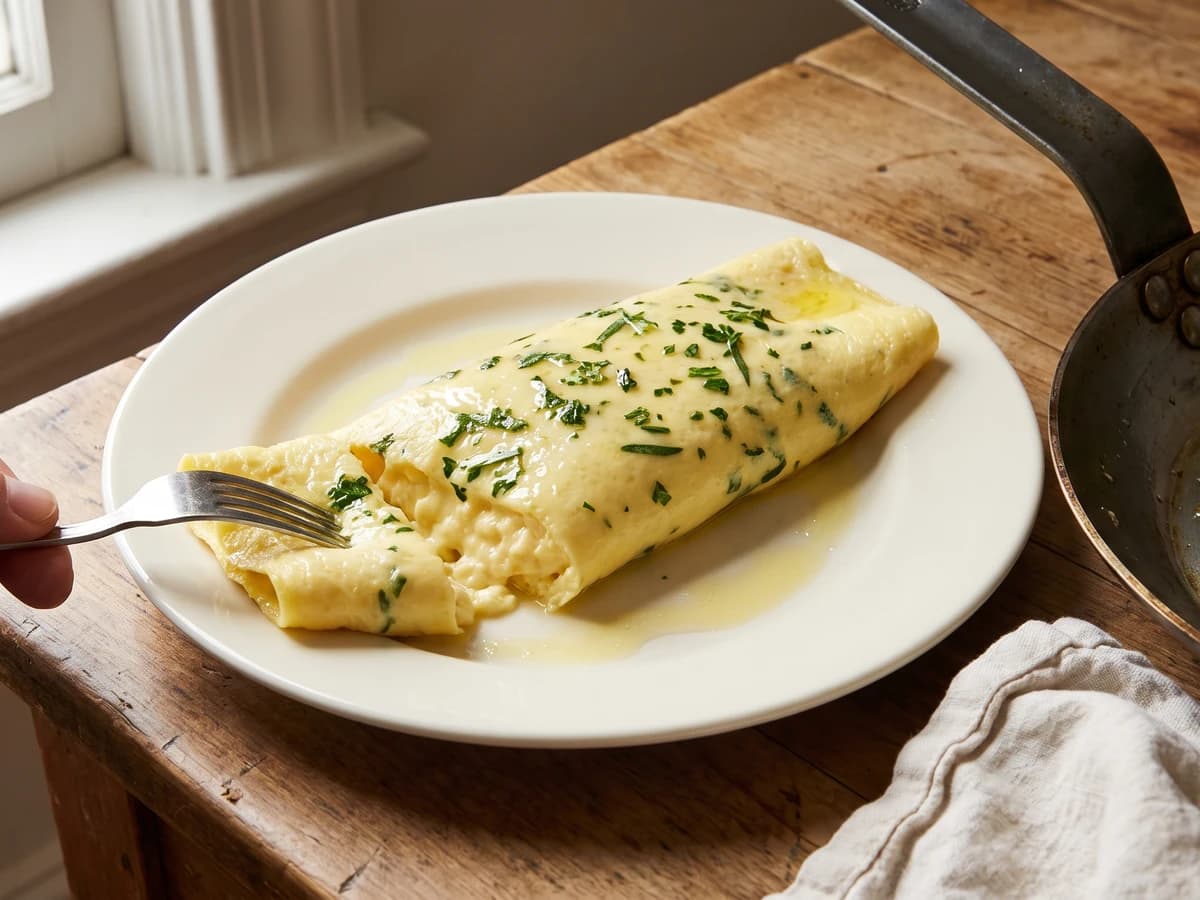
Four tender herbs, hot butter, and two eggs per pan: this rolled omelette teaches the quick hand and good judgment that keep the outside pale and the center creamy.
Chef Juliette
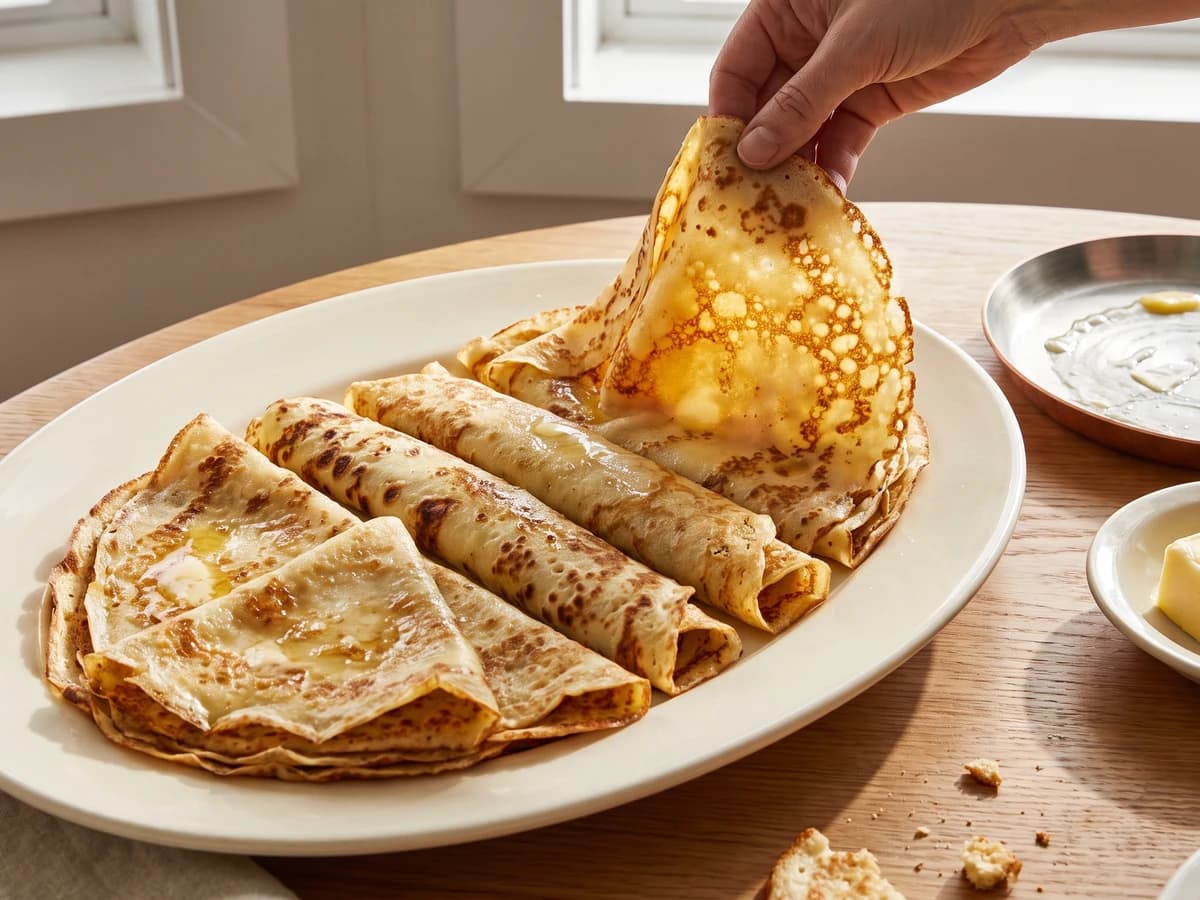
Four batters, one lesson: let the flour drink deeply before cooking, then spread the batter thinly in butter for crêpes and pannequets that bend without becoming tough.
Chef Juliette
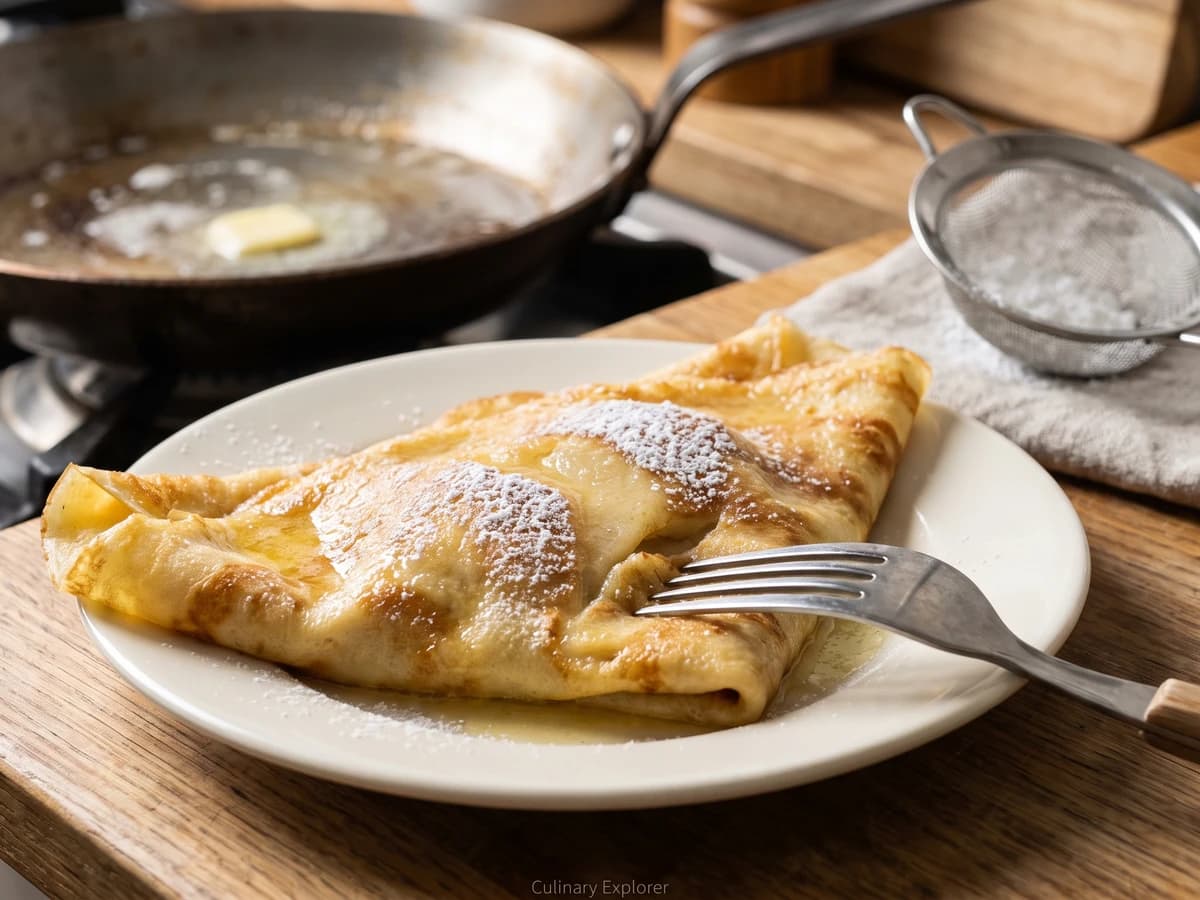
Crêpes au Couvent trap ripe Williams pear dice between two thin pours of sweet batter, then turn in one clean toss and reach the table butter-gold, powdered, and burning hot.