Chef Juliette
Mayonnaise de Volaille
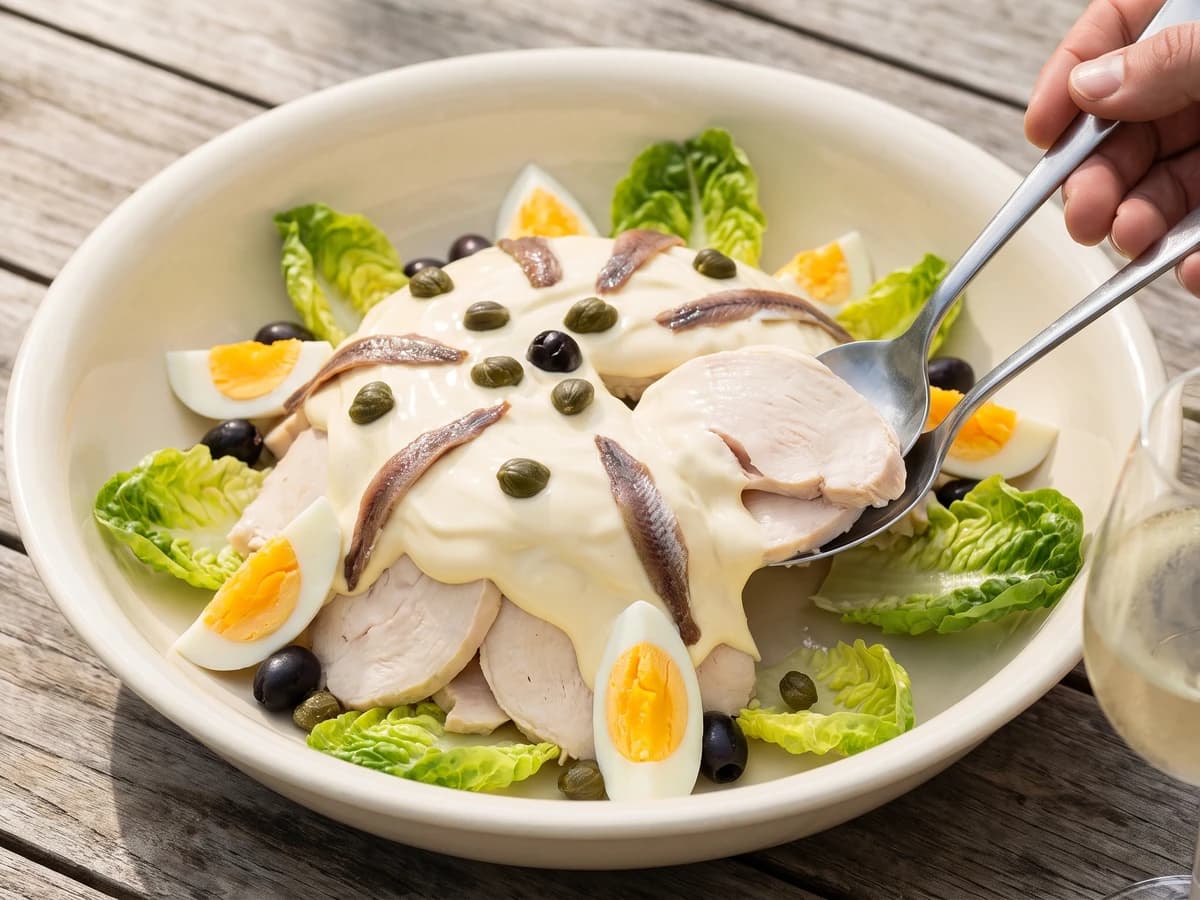
Cold roast chicken, ciseled lettuce, and a shining coat of homemade mayonnaise, arranged with capers, olives, anchovies, eggs, and lettuce hearts, then tossed at the table as the canon intends.
A cooking platform built around craft, culture, and the stories behind what we eat.
Created by Chef Juliette
Based on No. 381, Salads, from Le Guide Culinaire (1907) by Auguste Escoffier
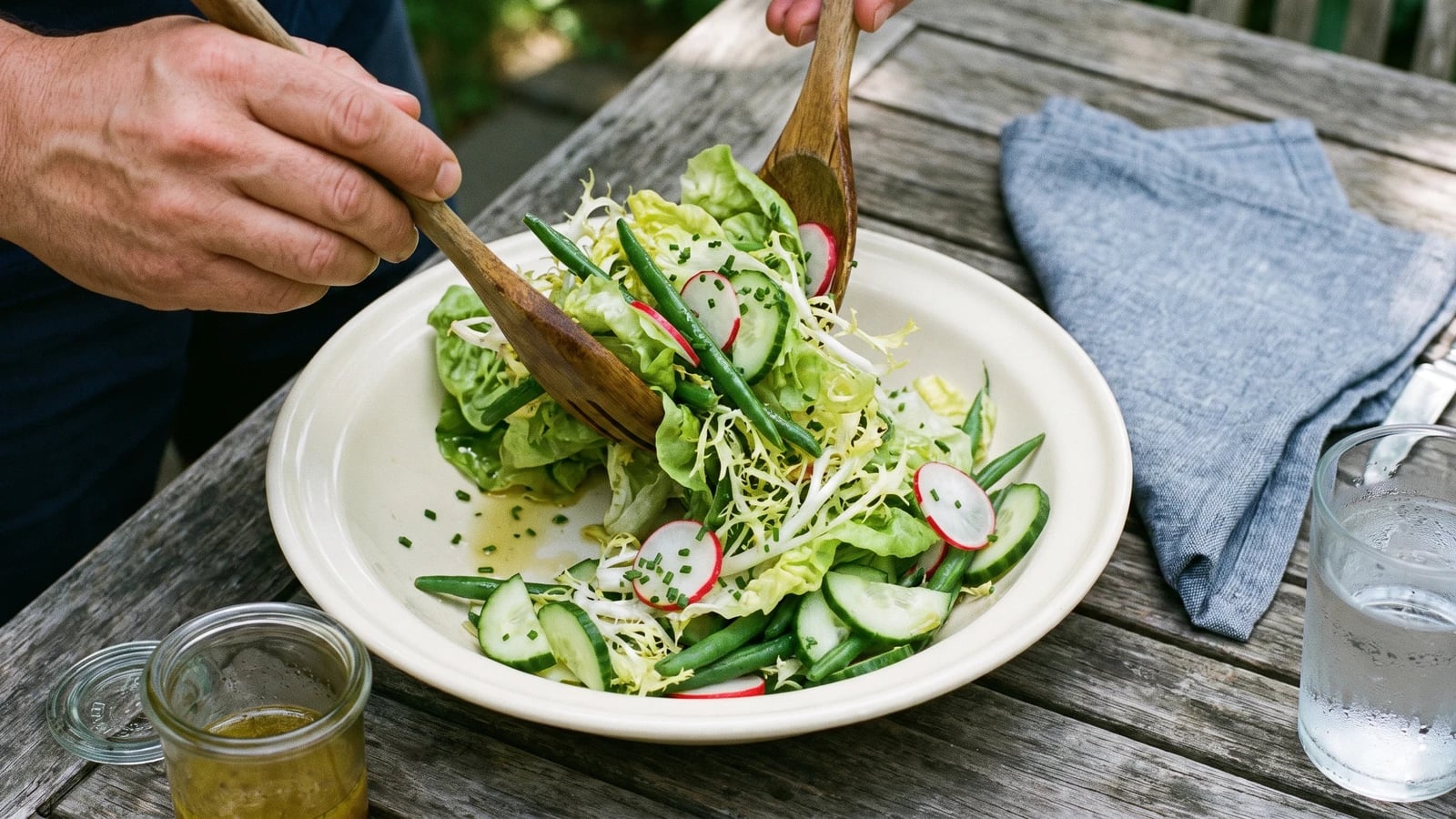
Salade verte d’hors-d’œuvre proves that restraint is a technique: dry leaves, crisp vegetables, and just enough vinaigrette to brighten each surface without weighing down the first course.
Salade verte d’hors-d’œuvre teaches restraint. Before you touch the saucepan for the beans, know one true thing: vinaigrette clings to dry vegetables and slides off wet ones. Water leaves the salad dull, heavy at the bottom, and strangely underseasoned. Dryness is not housekeeping; it is the technique.
The original entry assumed a garde-manger, the cold-station cook, with trays of prepared leaves and vegetables, not a saucier, a stockpot never off the fire, or a salamander. At home, a salad spinner, one small saucepan, and a mixing bowl replace that cold station honestly. I’ve given one balanced arrangement for four because a home cook needs quantities; the canon did not demand these exact vegetables, and neither do I.
Those trays and endless choices are brigade scaffolding. The dish itself is the proportion: mostly leaves, a few crisp contrasts, a restrained vinaigrette, and enough air in the bowl for everything to remain itself. One cook, one stove, one evening. Dry every element completely before the vinaigrette touches it. That is the step that decides the salad.
Salades d’hors-d’œuvre belong to the French cold table, from Parisian bistros to bourgeois dining rooms, where an opening plate is meant to wake the appetite rather than satisfy it. Classical manuals deliberately declined to impose a fixed formula, asking instead that these salads remain light and sightly, whatever the market or prepared larder supplied. The green salad became the most immediate home expression of that rule, but judgment, not a prescribed list of ingredients, remains the tradition.
Quantity
5 loosely packed cups (5 oz / 140 g)
washed and thoroughly dried
Quantity
1 loosely packed cup (1¼ oz / 35 g)
washed and thoroughly dried
Quantity
1 cup (4 oz / 115 g)
trimmed
Quantity
6 (3 oz / 85 g)
thinly sliced
Quantity
½ (5 oz / 140 g)
thinly sliced into half-moons
Quantity
2 tablespoons (¼ oz / 6 g)
finely snipped
Quantity
1 tablespoon (15 ml / 15 g)
Quantity
1 teaspoon (5 ml / 5 g)
Quantity
1 teaspoon (5 ml / 5 g)
Quantity
3 tablespoons (45 ml / 41 g)
Quantity
2 teaspoons (10 ml / 12 g)
divided
Quantity
¼ teaspoon (1.25 ml / 0.5 g)
| Ingredient | Quantity |
|---|---|
| tender green leaves, such as butter lettuce and mâchewashed and thoroughly dried | 5 loosely packed cups (5 oz / 140 g) |
| pale inner frisée leaveswashed and thoroughly dried | 1 loosely packed cup (1¼ oz / 35 g) |
| slender green beanstrimmed | 1 cup (4 oz / 115 g) |
| medium radishesthinly sliced | 6 (3 oz / 85 g) |
| medium cucumberthinly sliced into half-moons | ½ (5 oz / 140 g) |
| fresh chivesfinely snipped | 2 tablespoons (¼ oz / 6 g) |
| red wine vinegar | 1 tablespoon (15 ml / 15 g) |
| Dijon mustard | 1 teaspoon (5 ml / 5 g) |
| cold water | 1 teaspoon (5 ml / 5 g) |
| sunflower or grapeseed oil | 3 tablespoons (45 ml / 41 g) |
| fine sea saltdivided | 2 teaspoons (10 ml / 12 g) |
| freshly ground black pepper | ¼ teaspoon (1.25 ml / 0.5 g) |
Separate the leaves and wash them in a deep bowl of cold water, lifting them out so any grit remains behind. If the leaves look tired, leave them in fresh cold water for ten minutes; they will regain some crispness. Spin them in small batches, then spread them on a clean towel until no droplets remain. Wet leaves repel vinaigrette, and no amount of extra dressing repairs that.
Bring a small saucepan of water to a lively boil and add 1⅔ teaspoons of the salt. Drop in the green beans and cook for 3 to 4 minutes, until vividly green and tender enough to bite without squeaking. Move them immediately into ice water, then drain and dry them as carefully as the leaves. If they soften too far, chill them at once and cut them slightly shorter; ça se rattrape, and the leaves will restore the necessary crispness.
Cut the cooled beans into two-bite lengths. Slice the radishes thin enough to bend without becoming transparent, and cut the cucumber into neat half-moons. Keep the vegetables separate and cold until serving. A professional cold station would hold each element on its own tray; a towel-lined container and a few small bowls do the same work at home.
Whisk the vinegar with the remaining ⅓ teaspoon salt until the grains dissolve. Add the Dijon mustard, cold water, and pepper, then pour in the oil slowly while whisking until the vinaigrette becomes smooth and lightly creamy. Taste it on a leaf, not from the spoon, because the salad is what must be seasoned. If the vinaigrette separates, whisk it again with a few drops of cold water. If it tastes too sharp, add oil a teaspoon at a time; if dull, add vinegar by the drop. Ça se rattrape.
Reserve about one cup of the driest leaves, then place the remaining greens, frisée, beans, radishes, and cucumber in a wide mixing bowl. Spoon half the vinaigrette around the sides rather than pouring it onto one spot. Toss upward gently with clean hands or salad servers, taste a leaf, and add only as much of the remaining vinaigrette as the salad needs. If a puddle forms, lift the salad into a clean bowl and fold in the reserved dry leaves, leaving the excess dressing behind. The salad should gleam, not swim.
Lift the dressed salad loosely into a wide shallow bowl without pressing it down. Turn a few radish slices, cucumber half-moons, and green beans toward the surface so the arrangement looks generous but unforced, then scatter over the chives. Serve immediately as a light hors-d’œuvre. For a picnic, carry the vinaigrette separately and perform the final toss at the table. À table!
1 serving (about 150g)
Culinary guides, cultural storytelling, and the editorial depth that makes cooking meaningful.
Discover Culinary ExplorerChef Juliette
Cold roast chicken, ciseled lettuce, and a shining coat of homemade mayonnaise, arranged with capers, olives, anchovies, eggs, and lettuce hearts, then tossed at the table as the canon intends.

Chef Juliette
Cold roast or poached chicken with fine ribbons of lettuce, dressed at the final moment with oil and vinegar: a composed salad whose freshness depends entirely on timing.

Chef Juliette
Five leaves, one living rule: laitue, romaine, chicorée, mâche, or pissenlit must be washed, dried, and dressed only as they go to the table, while every leaf still carries its light vinaigrette.

Chef Juliette
Salade de Betteraves proves that baking, not boiling, is the whole argument: concentrated garnet sweetness, tender baked onion, sharp mustard, and herbs cut into a weeknight salad worth making ahead.