Chef Juliette
Mayonnaise de Volaille
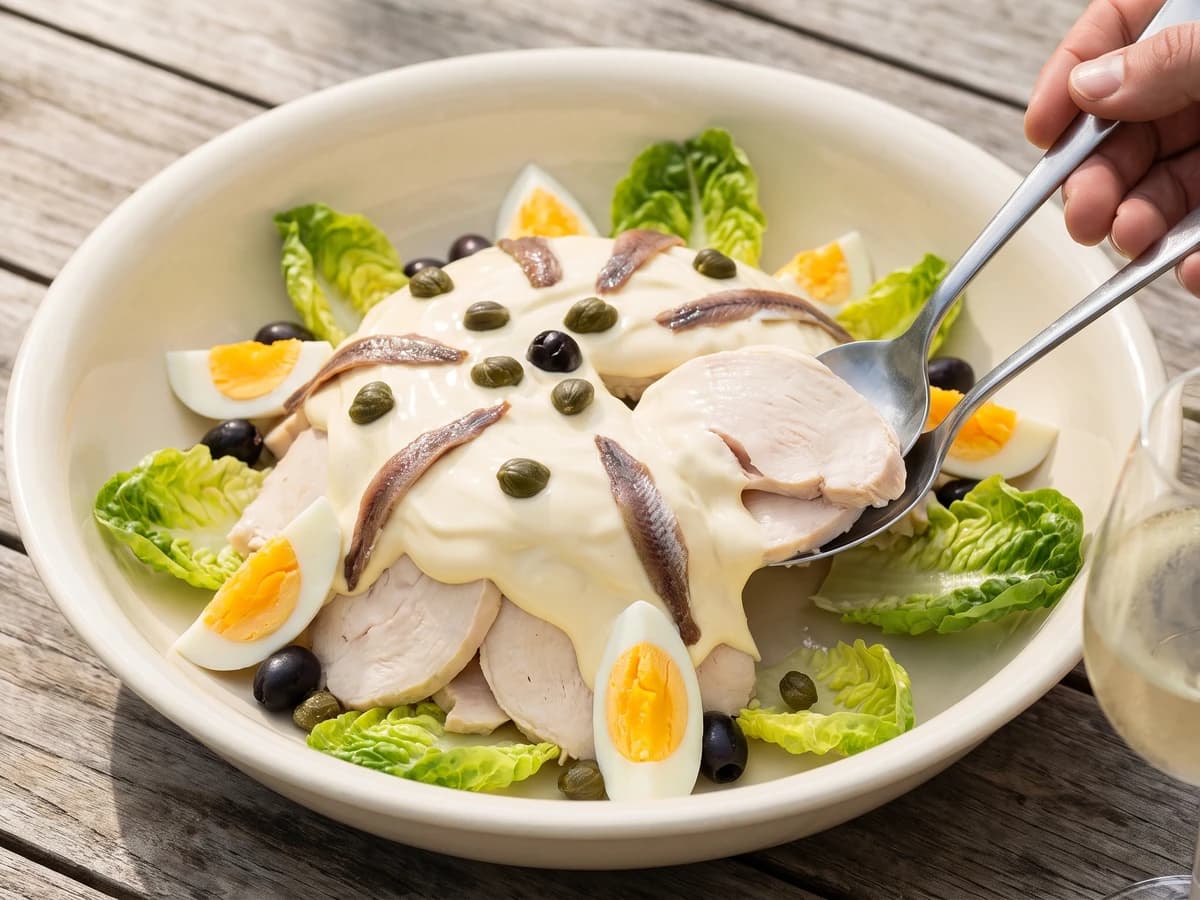
Cold roast chicken, ciseled lettuce, and a shining coat of homemade mayonnaise, arranged with capers, olives, anchovies, eggs, and lettuce hearts, then tossed at the table as the canon intends.
A cooking platform built around craft, culture, and the stories behind what we eat.
Created by Chef Juliette
Based on No. 376, Radishes, from Le Guide Culinaire (1907) by Auguste Escoffier
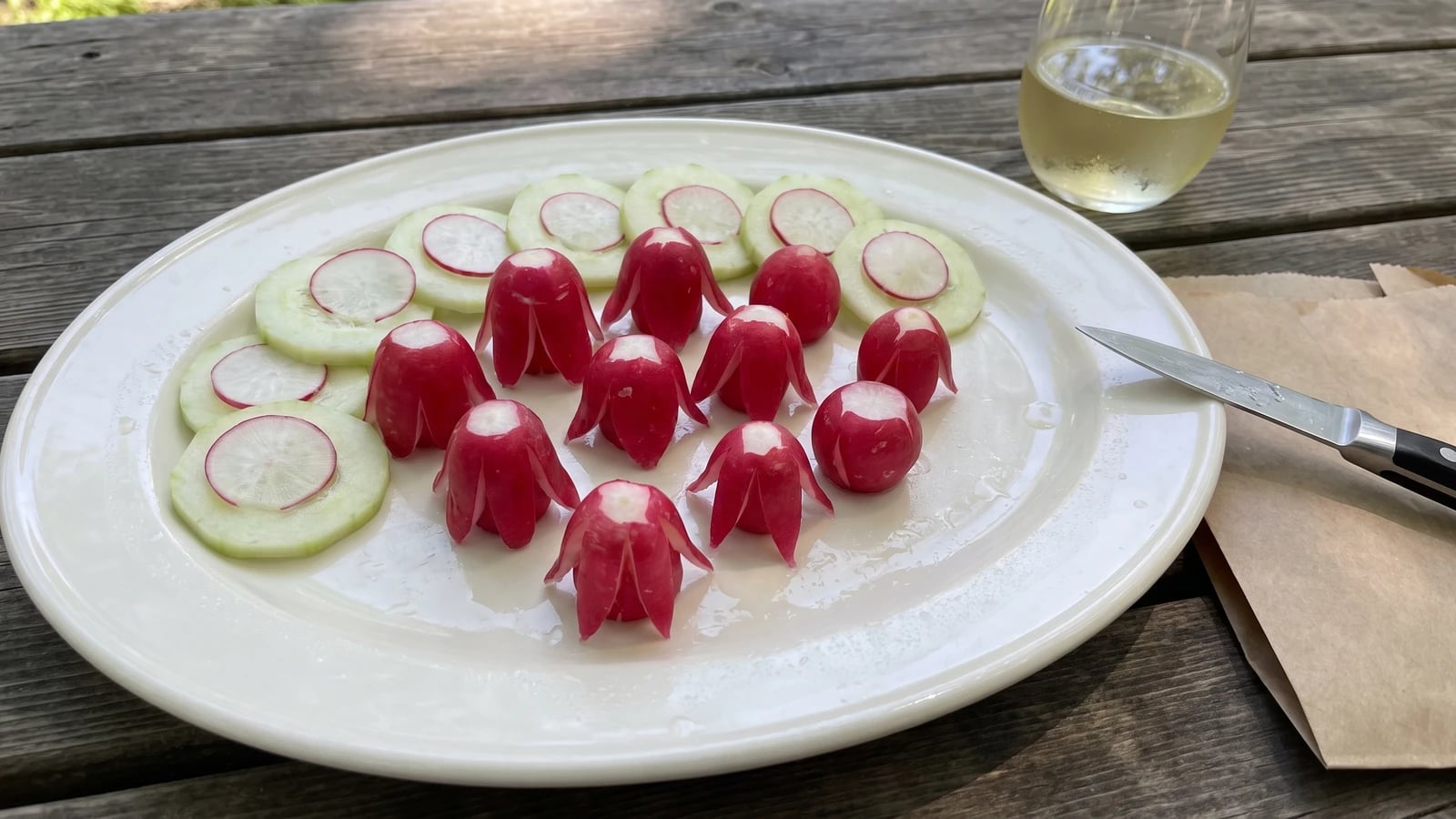
Radis en Fleurs de Fuchsia turns the pantry's humblest root into a cold, peppery hors-d'oeuvre: twelve opened flowers, a cucumber border, and one lesson in clean knife work.
Radis en Fleurs de Fuchsia (fuchsia-flower radishes) teaches the discipline behind every cold garnish: the knife makes the cuts, but cold water makes the flower. Stop each stroke before the leafy crown and the red skin will curl away from the white heart; cut through that crown and the petals fall apart.
The classical entry assumed a pantry hand preparing dozens of identical garnishes while the hot kitchen worked elsewhere. At home, twelve carved radishes and four sliced ones make a generous platter with nothing more specialized than a sharp paring knife and a bowl of ice water. Perfect uniformity was brigade scaffolding and can go. Clean cuts and deep chilling are the dish and must stay. This is one cook, no stove, half an hour.
When the radishes are ready, their scarlet skins flare around crisp white centers, while the cucumber border stays cool and pale beneath thin peppery slices. Before you begin, remember the one stroke that decides everything: cut toward the stem, then stop a good 6 mm short of it.
These radishes belong to the garde-manger, the cold pantry of French classical service, where hors-d'oeuvres and garnishes were prepared apart from the hot range. Pantry cooks carved whole radishes into pendulous fuchsia flowers or laid thin slices over cucumber to border composed platters, making decoration that was always intended to be eaten. On Parisian and bourgeois tables, the same cold radish also stood alone as the opening bite, so the boundary between garnish and hors-d'oeuvre was never absolute.
Quantity
16 (about 2 bunches / 280 g)
scrubbed, with the leaves trimmed to short stems
Quantity
1/2 cucumber (about 5 oz / 140 g)
scrubbed, unpeeled, and chilled
Quantity
4 cups (960 ml / 960 g)
Quantity
2 cups (480 ml / 450 g)
| Ingredient | Quantity |
|---|---|
| medium red radishesscrubbed, with the leaves trimmed to short stems | 16 (about 2 bunches / 280 g) |
| English cucumberscrubbed, unpeeled, and chilled | 1/2 cucumber (about 5 oz / 140 g) |
| very cold water | 4 cups (960 ml / 960 g) |
| ice cubes | 2 cups (480 ml / 450 g) |
Combine the cold water and ice in a wide bowl. The water must be thoroughly cold before the first carved radish enters it; cold firms the flesh and encourages the thin outer cuts to curl away like petals.
Choose 12 evenly shaped radishes for carving and reserve four for slicing. Trim the leaves from the carving radishes, leaving about 1 inch of stem as a handle, but keep the root ends intact. Scrub away every trace of soil without scraping off the scarlet skin.
Set one radish on its side on a board secured with a damp towel. Starting near the root tip, shave a narrow strip of red skin with a sliver of white flesh beneath it, cutting lengthwise toward the stem and stopping 1/4 inch, about 6 mm, before the crown. Turn the radish and repeat until it has five or six attached strips around its center. Keep each cut shallow and deliberate. The strips must remain joined at the stem end, because that hinge is what lets them open into a flower.
Drop each carved radish into the ice bath as soon as it is cut. Chill for 20 to 30 minutes, until the red strips curl outward and expose the crisp white center. If a flower remains tight, deepen the existing cuts slightly and return it to the water. If a strip comes off completely, don't discard the radish. Ça se rattrape: slice it thinly with the four reserved radishes and use it on the cucumber border.
While the flowers open, slice the cucumber into 16 to 20 rounds about 1/8 inch, or 3 mm, thick. Slice the four reserved radishes almost paper-thin. Blot both well, then place one or two radish slices on each cucumber round. Arrange the rounds in a slightly overlapping border around a chilled oval platter.
Lift the flowered radishes from the bath by their stems and drain them upside down on a clean towel, gently blotting any water caught between the cuts. Arrange them inside the cucumber border with their opened ends facing outward. Serve at once while everything is very cold and crisp. Cooking well is not cooking fancy. À table!
1 serving (about 105g)
Culinary guides, cultural storytelling, and the editorial depth that makes cooking meaningful.
Discover Culinary ExplorerChef Juliette
Cold roast chicken, ciseled lettuce, and a shining coat of homemade mayonnaise, arranged with capers, olives, anchovies, eggs, and lettuce hearts, then tossed at the table as the canon intends.

Chef Juliette
Cold roast or poached chicken with fine ribbons of lettuce, dressed at the final moment with oil and vinegar: a composed salad whose freshness depends entirely on timing.

Chef Juliette
Five leaves, one living rule: laitue, romaine, chicorée, mâche, or pissenlit must be washed, dried, and dressed only as they go to the table, while every leaf still carries its light vinaigrette.

Chef Juliette
Salade de Betteraves proves that baking, not boiling, is the whole argument: concentrated garnet sweetness, tender baked onion, sharp mustard, and herbs cut into a weeknight salad worth making ahead.