Chef Juliette
Mayonnaise de Volaille
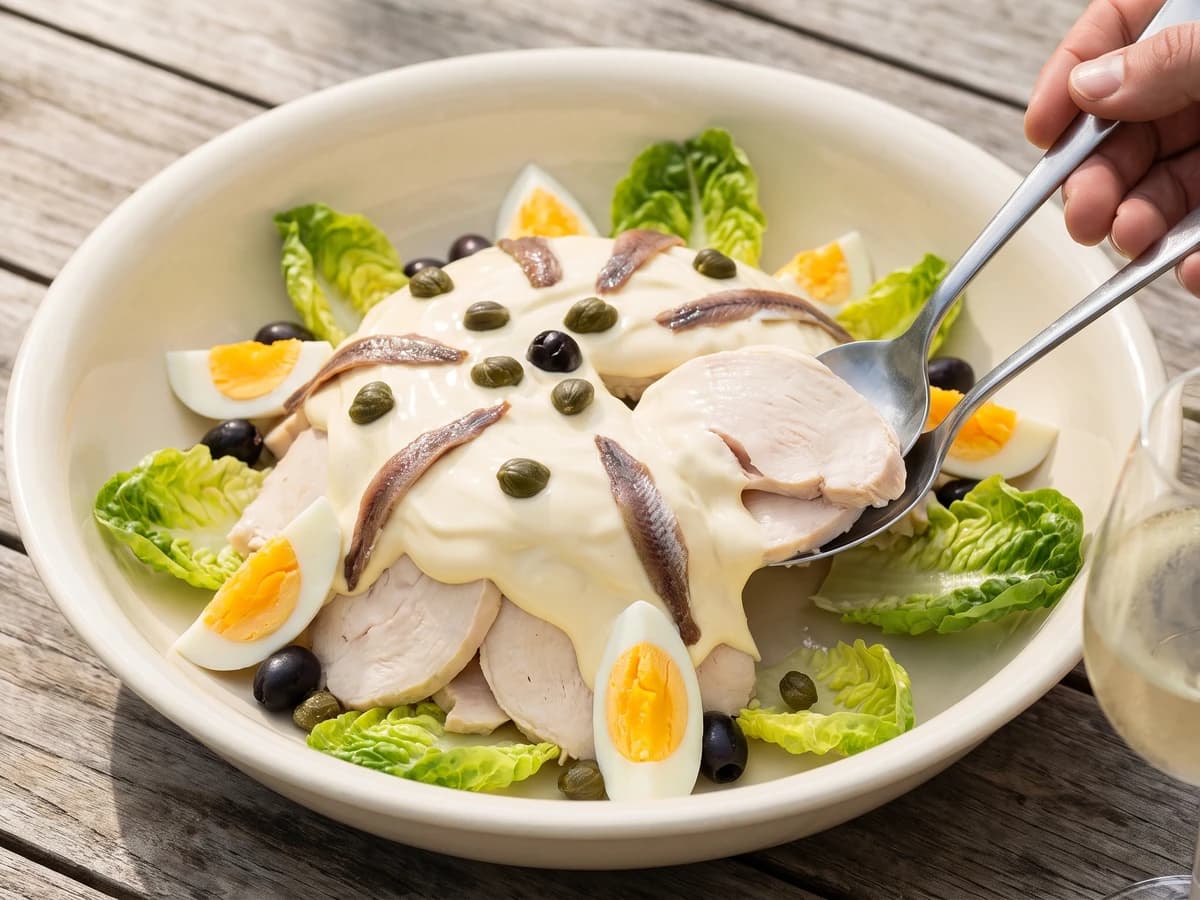
Cold roast chicken, ciseled lettuce, and a shining coat of homemade mayonnaise, arranged with capers, olives, anchovies, eggs, and lettuce hearts, then tossed at the table as the canon intends.
A cooking platform built around craft, culture, and the stories behind what we eat.
Created by Chef Juliette
Based on No. 356, Herrings à la Russe, from Le Guide Culinaire (1907) by Auguste Escoffier
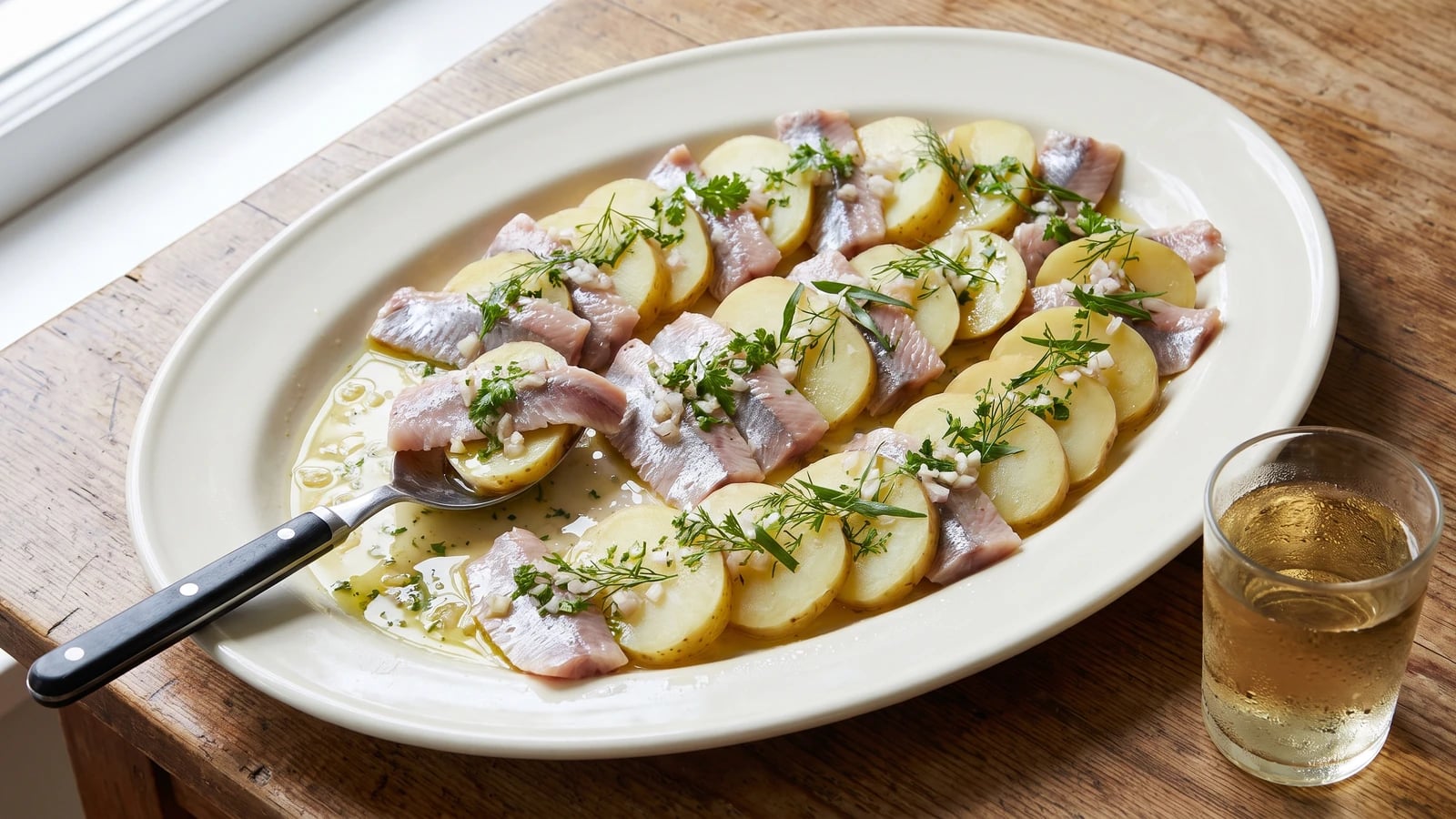
Salt-cured herring and cold waxy potatoes, laid in alternating rows and sharpened with oil, vinegar, shallot, chervil, fennel, and tarragon: a composed salad whose discipline is balance, not ornament.
Harengs à la russe (Russian-style salted herring and potato salad) teaches proportion. The fish brings salt and firmness, the potato quiets it, and oil and vinegar draw the two together. Before you touch the pan, taste the herring. Its salt level decides every other choice.
The original asked for no saucier, stockpot, or salamander. It assumed something more relevant: a cold larder with cleaned herring fillets and boiled potatoes already waiting, plus enough hands to cut and arrange them for service. The source gives no quantities, so I have fixed a home scale for four while preserving the alternating rows and every named flavoring. Ready-to-eat fillets, one saucepan, and a tray for cooling the potatoes give us the honest equivalent. One cook, one stove, one evening.
The brigade's advance preparation was scaffolding and can go. Completely cold potatoes, thin herring slices, and the alternating composition are the dish and must stay. Done properly, Harengs à la russe is silver-pink fish against pale potato, lightly glossed rather than drowned, with green herbs and shallot waking each cold bite. Taste and, only if needed, temper the herring before slicing. Once the platter is built, its salt cannot be pulled back out.
Harengs à la russe belongs to the Parisian classical hors-d'oeuvre table, where French cooks arranged the salted fish, potatoes, and sharp dressings associated with Russian and Baltic cold tables into formal composed salads. Salt herring with boiled potato was everyday food across northern and eastern Europe, so the title marks a French interpretation rather than an exclusively Russian origin. Its passage into the French canon changed the presentation more than the substance: humble companions were cut finely, ranked in rows, and finished with the herbs of the cold larder.
Quantity
4 fillets (8 oz / 225 g)
drained
Quantity
4 potatoes (1 lb / 450 g)
Quantity
1/4 cup (60 ml / 55 g)
Quantity
2 tablespoons (30 ml / 30 g)
Quantity
2 tablespoons (30 ml / 5 g)
finely chopped
Quantity
1 tablespoon (15 ml / 2 g)
finely chopped
Quantity
1 tablespoon (15 ml / 2 g)
finely chopped
Quantity
1 shallot, about 2 tablespoons (30 ml / 20 g)
finely minced
| Ingredient | Quantity |
|---|---|
| cleaned, ready-to-eat salt-cured herring filletsdrained | 4 fillets (8 oz / 225 g) |
| medium waxy potatoes | 4 potatoes (1 lb / 450 g) |
| mild olive oil or neutral salad oil | 1/4 cup (60 ml / 55 g) |
| white wine vinegar | 2 tablespoons (30 ml / 30 g) |
| fresh chervil leavesfinely chopped | 2 tablespoons (30 ml / 5 g) |
| tender fennel frondsfinely chopped | 1 tablespoon (15 ml / 2 g) |
| fresh tarragon leavesfinely chopped | 1 tablespoon (15 ml / 2 g) |
| small shallotfinely minced | 1 shallot, about 2 tablespoons (30 ml / 20 g) |
Cut a small piece from one herring fillet and taste it before doing anything else. It should be distinctly salty but pleasant enough to eat by itself. If the salt bites hard, ça se rattrape: cover the fillets with cold water for 10 minutes, drain, dry, and taste again. Repeat once only if needed, working in short intervals so you temper the fish without washing away its character. Pat the fillets thoroughly dry and return them to the refrigerator.
Put the unpeeled potatoes in a saucepan and cover them with cold water by about 1 inch. Bring slowly to a simmer, then cook at the gentlest tremble for 18 to 25 minutes, depending on size. A thin knife should enter the center without force, but the potatoes must remain whole and firm. If one begins to crack, drain them all immediately; a split potato is warning enough.
Drain the potatoes and spread them on a tray so moisture can escape. Let them cool completely, then peel them and cut them crosswise into slices about 1/4 inch thick. Warm potato turns greasy under an oil dressing and breaks when arranged, while cold waxy potato keeps a clean edge. If one potato became crumbly, chill it thoroughly and cut it slightly thicker. It will still hold its place on the platter.
Whisk the white wine vinegar in a small bowl, then pour in the oil in a thin thread while whisking to make a vinaigrette, a temporary oil-and-vinegar emulsion. Taste it on a potato slice rather than from the spoon, because the potato mutes acidity. If it tastes too sharp, whisk in a little more of the measured oil; if it seems dull, add the final drops of vinegar. Without mustard, the vinaigrette will separate as it waits. That is not failure. Whisk it again just before dressing.
Slice the cold herring fillets thinly on a slight diagonal. On a shallow oval platter, arrange a neat row of overlapping potato slices, then a row of herring, continuing until the platter is full. Keep the two ingredients visibly distinct rather than tossing them together. The alternating composition is not decoration added after the fact; it gives each forkful its proper measure of salty fish and quiet potato.
Whisk the vinaigrette once more and spoon it evenly over the arranged rows, lifting a few overlapping edges so the dressing reaches underneath. Scatter the minced shallot over the whole platter, then finish with the chopped chervil, fennel fronds, and tarragon. Refrigerate for 15 minutes so the dressing settles into the potato, then let the platter stand out of the cold for 10 minutes before serving. It should be cool, not numb. À table!
1 serving (about 200g)
Culinary guides, cultural storytelling, and the editorial depth that makes cooking meaningful.
Discover Culinary ExplorerChef Juliette
Cold roast chicken, ciseled lettuce, and a shining coat of homemade mayonnaise, arranged with capers, olives, anchovies, eggs, and lettuce hearts, then tossed at the table as the canon intends.

Chef Juliette
Cold roast or poached chicken with fine ribbons of lettuce, dressed at the final moment with oil and vinegar: a composed salad whose freshness depends entirely on timing.

Chef Juliette
Five leaves, one living rule: laitue, romaine, chicorée, mâche, or pissenlit must be washed, dried, and dressed only as they go to the table, while every leaf still carries its light vinaigrette.

Chef Juliette
Salade de Betteraves proves that baking, not boiling, is the whole argument: concentrated garnet sweetness, tender baked onion, sharp mustard, and herbs cut into a weeknight salad worth making ahead.