Chef Juliette
Mayonnaise de Volaille
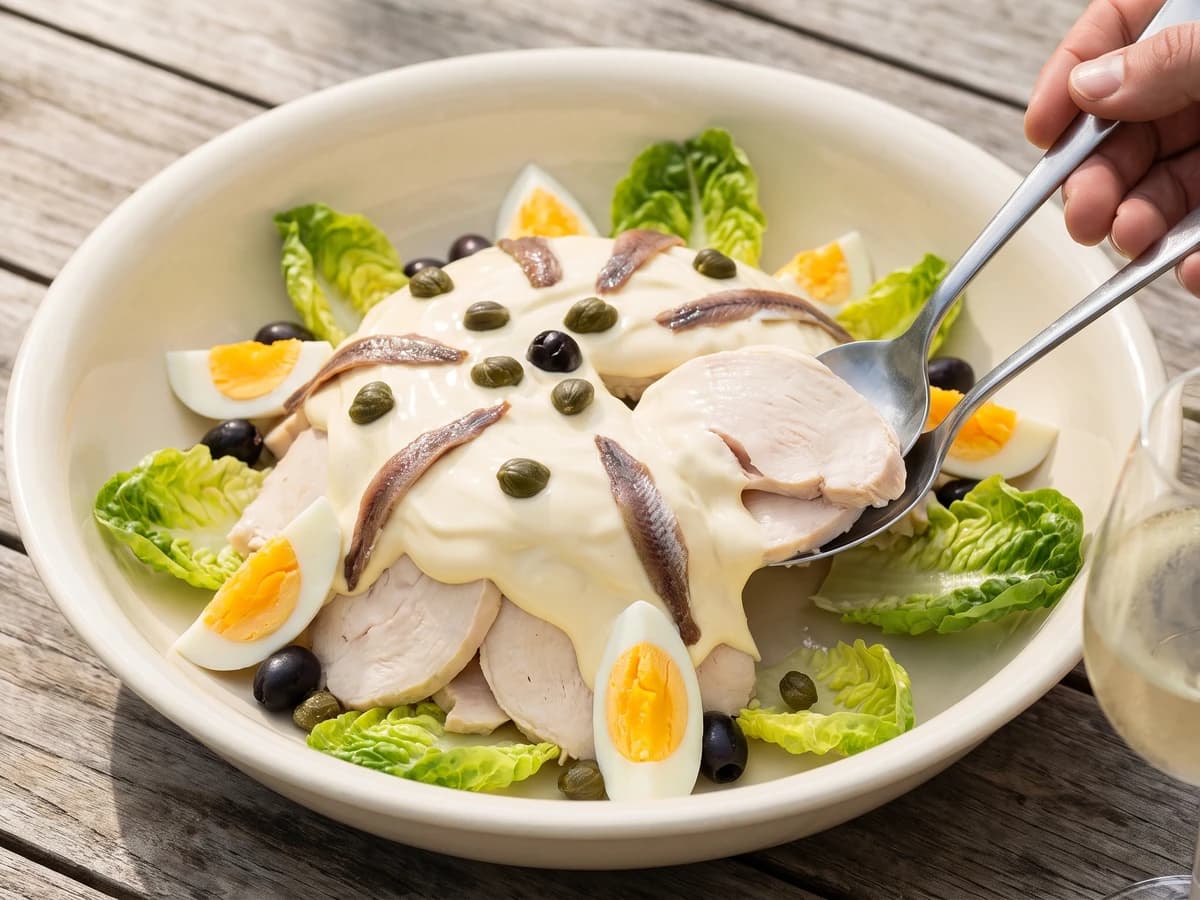
Cold roast chicken, ciseled lettuce, and a shining coat of homemade mayonnaise, arranged with capers, olives, anchovies, eggs, and lettuce hearts, then tossed at the table as the canon intends.
A cooking platform built around craft, culture, and the stories behind what we eat.
Created by Chef Juliette
Based on No. 355, Herrings à la Livonienne, from Le Guide Culinaire (1907) by Auguste Escoffier
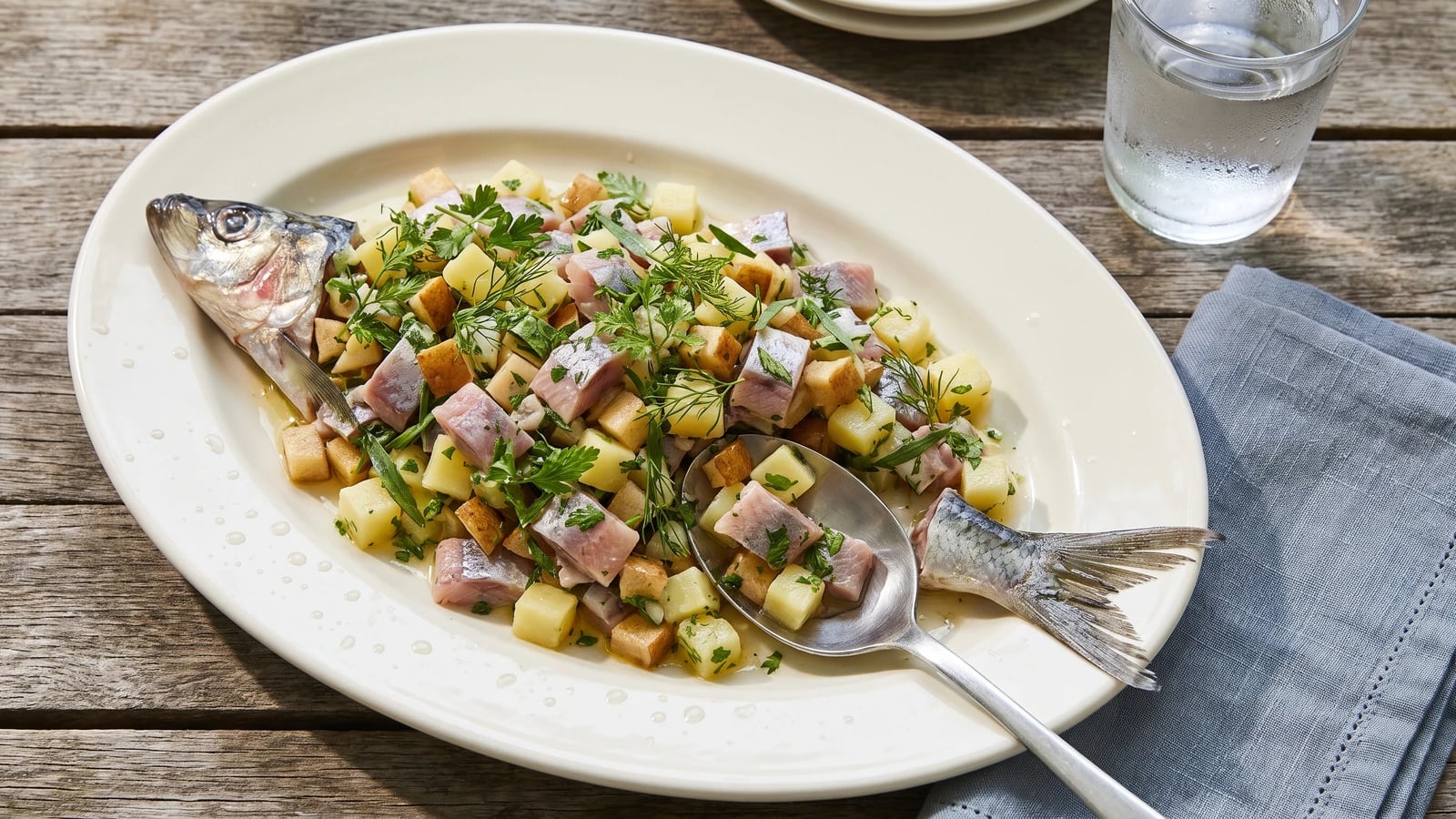
Equal measures of salt herring, cold potato, and russet apple meet a sharp green vinaigrette, then take the fish’s own shape on the platter: composed salad as balance, wit, and supper.
Harengs à la Livonienne (salt-herring, potato, and apple salad) teaches the architecture of a salade composée, a composed salad: each dice stays itself, but salt, starch, fruit, herbs, oil, and vinegar meet in one balanced forkful. The one true thing to know before touching a pan is this: the herring must taste pleasantly briny, not punishingly salty, before it ever meets the potatoes.
The old entry assumed whole salt herrings, cold boiled potatoes waiting in the larder, and enough hands to fashion several little fish with their heads and tails restored. A home table needs less choreography. Soak and clean the herring yourself, cook one saucepan of potatoes, and form one generous fish on a platter for four. The individual portions were brigade scaffolding; the equal measures of herring, potato, and russet apple are the dish and must stay. One cook, one stove, one evening.
When it is right, the dice glisten rather than swim, the apple snaps gently against the tender potato, and the herbs lift the rich fish without disguising it. Taste the herring after soaking and trust your mouth, because every cure carries a different measure of salt.
Livonia lies on the eastern Baltic, across lands now divided chiefly between Estonia and Latvia, where salted herring, potatoes, apples, and sharp dressings belong naturally to the preserved-fish table. French classical cookery brought that larder into its repertoire under the name à la Livonienne, keeping the Baltic flavor logic while arranging the mixture as a salade composée. The returned head and tail are French service grammar rather than a necessary Baltic custom: they tell the diner what is in the salad before the first spoonful.
Quantity
3 small (about 1¼ pounds / 570 g before cleaning; yielding 1½ cups / 250 g soaked diced fillet)
cleaned, with 1 head and 1 tail reserved
Quantity
8 cups (2 L / 2 kg) per change, plus more as needed
for soaking
Quantity
2 medium (about 10 ounces / 285 g raw; yielding 1½ cups / 225 g cooked dice)
boiled whole, cooled, and peeled
Quantity
2 small (about 9 ounces / 255 g whole; yielding 1½ cups / 190 g prepared dice)
peeled and cored
Quantity
¼ cup (60 ml / 15 g)
finely chopped
Quantity
2 tablespoons (30 ml / 4 g)
finely chopped
Quantity
2 tablespoons (30 ml / 4 g)
finely chopped
Quantity
1 tablespoon (15 ml / 3 g)
finely chopped
Quantity
5 tablespoons (75 ml / 69 g)
Quantity
2½ tablespoons (37 ml / 38 g)
Quantity
½ teaspoon (2.5 ml / 1 g)
Quantity
Up to ¼ teaspoon (1.25 ml / 1.5 g)
| Ingredient | Quantity |
|---|---|
| whole ready-to-eat salted herringscleaned, with 1 head and 1 tail reserved | 3 small (about 1¼ pounds / 570 g before cleaning; yielding 1½ cups / 250 g soaked diced fillet) |
| cold waterfor soaking | 8 cups (2 L / 2 kg) per change, plus more as needed |
| waxy potatoesboiled whole, cooled, and peeled | 2 medium (about 10 ounces / 285 g raw; yielding 1½ cups / 225 g cooked dice) |
| firm russet applespeeled and cored | 2 small (about 9 ounces / 255 g whole; yielding 1½ cups / 190 g prepared dice) |
| flat-leaf parsley leavesfinely chopped | ¼ cup (60 ml / 15 g) |
| fresh chervilfinely chopped | 2 tablespoons (30 ml / 4 g) |
| fresh fennel frondsfinely chopped | 2 tablespoons (30 ml / 4 g) |
| fresh tarragon leavesfinely chopped | 1 tablespoon (15 ml / 3 g) |
| sunflower or grapeseed oil | 5 tablespoons (75 ml / 69 g) |
| white wine vinegar | 2½ tablespoons (37 ml / 38 g) |
| freshly ground black pepper | ½ teaspoon (2.5 ml / 1 g) |
| fine sea salt (optional) | Up to ¼ teaspoon (1.25 ml / 1.5 g) |
Ask the fishmonger how long this particular cure needs, then work accordingly. Remove the heads and tails, clean one handsome head and tail inside and out, dry them well, and refrigerate them covered for the finished platter; they mark the shape and are not eaten. Fillet, skin, and pin-bone the fish, then soak the fillets under cold water in the refrigerator, usually for 8 to 12 hours, changing the water twice. Taste a small piece after 6 hours. If the salt reaches you before the flavor of the fish, change the water and continue soaking for 1 to 2 hours at a time. Ça se rattrape. Stop when the herring tastes savory and distinctly cured, then drain and dry it thoroughly.
Put the unpeeled potatoes in a saucepan, cover them with cold unsalted water, and bring it gently to a simmer. Cook for 18 to 25 minutes, depending on size, until a thin knife enters the center with slight resistance. Drain at once and let them cool completely before peeling. If a potato has begun to split, chill it before cutting; the cold firms its starch enough to make a respectable dice. Warm potatoes crumble and drink the vinegar unevenly.
Cut the dried herring and cold potatoes into neat ⅓-inch (8 mm) dice, measuring 1½ cups (375 ml) of each. Peel and core the apples, cut them to the same size, and measure another 1½ cups (375 ml). Cut the apple last so it goes directly into the dressing rather than browning on the board. Equal finished measures are the principle of the dish: the herring gives salt and richness, the potato carries the dressing, and the apple brings tartness and bite.
Whisk 2 tablespoons (30 ml) of the vinegar with the pepper, then whisk in 4 tablespoons (60 ml) of the oil to make a loose vinaigrette. Put the herring in a bowl, add the equal measures of potato and apple, then add the parsley, chervil, fennel fronds, and tarragon in the sequence of the original preparation. Pour over the vinaigrette and fold gently with a broad spoon so the potato keeps its edges. Rest for 10 minutes, then taste. If it is too sharp, add the reserved oil; if it tastes heavy or dull, add the reserved vinegar. Add salt only if the finished mixture truly asks for it.
Spoon the salad onto a chilled long platter and use the back of a damp spoon to form one broad fish shape, full through the middle and tapered at both ends. Do not mash or pack it tightly; this is a gathering of distinct dice, not a paste. Set the cleaned reserved head at one end and the tail at the other. If the shape slumps, return the mixture to the cold for 15 minutes, drain away any liquid that has pooled, and form it again with the damp spoon.
Cover without pressing on the surface and refrigerate for at least 30 minutes, or up to 4 hours, so the dressing settles through the potato. Bring the platter out 10 minutes before serving; it should be cool but not so cold that the herbs and apple disappear. Spoon portions from the side while keeping the fish shape visible for the table. À table!
1 serving (about 200g)
Culinary guides, cultural storytelling, and the editorial depth that makes cooking meaningful.
Discover Culinary ExplorerChef Juliette
Cold roast chicken, ciseled lettuce, and a shining coat of homemade mayonnaise, arranged with capers, olives, anchovies, eggs, and lettuce hearts, then tossed at the table as the canon intends.

Chef Juliette
Cold roast or poached chicken with fine ribbons of lettuce, dressed at the final moment with oil and vinegar: a composed salad whose freshness depends entirely on timing.

Chef Juliette
Five leaves, one living rule: laitue, romaine, chicorée, mâche, or pissenlit must be washed, dried, and dressed only as they go to the table, while every leaf still carries its light vinaigrette.

Chef Juliette
Salade de Betteraves proves that baking, not boiling, is the whole argument: concentrated garnet sweetness, tender baked onion, sharp mustard, and herbs cut into a weeknight salad worth making ahead.