Chef Juliette
Mayonnaise de Volaille
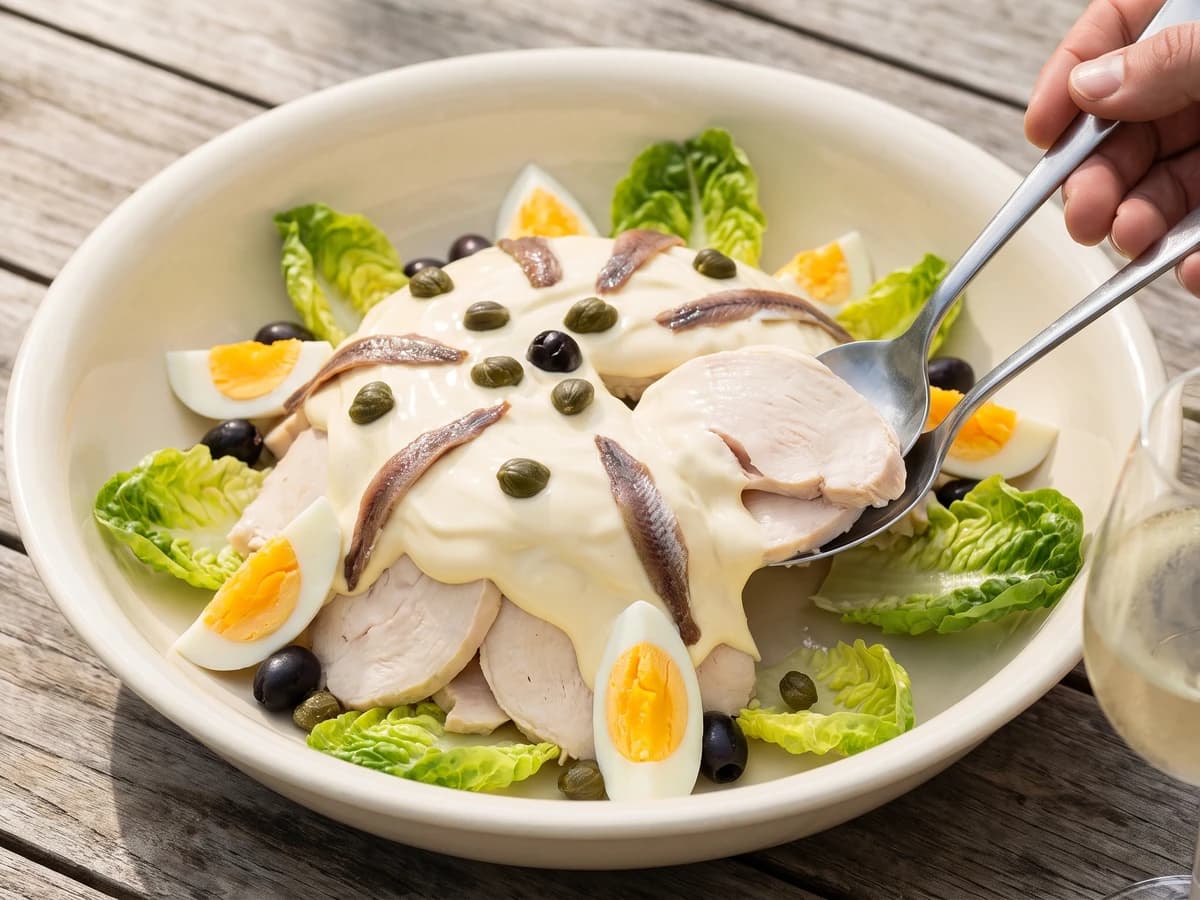
Cold roast chicken, ciseled lettuce, and a shining coat of homemade mayonnaise, arranged with capers, olives, anchovies, eggs, and lettuce hearts, then tossed at the table as the canon intends.
A cooking platform built around craft, culture, and the stories behind what we eat.
Created by Chef Juliette
Based on No. 352, Salad of Filleted Salted Herrings, from Le Guide Culinaire (1907) by Auguste Escoffier
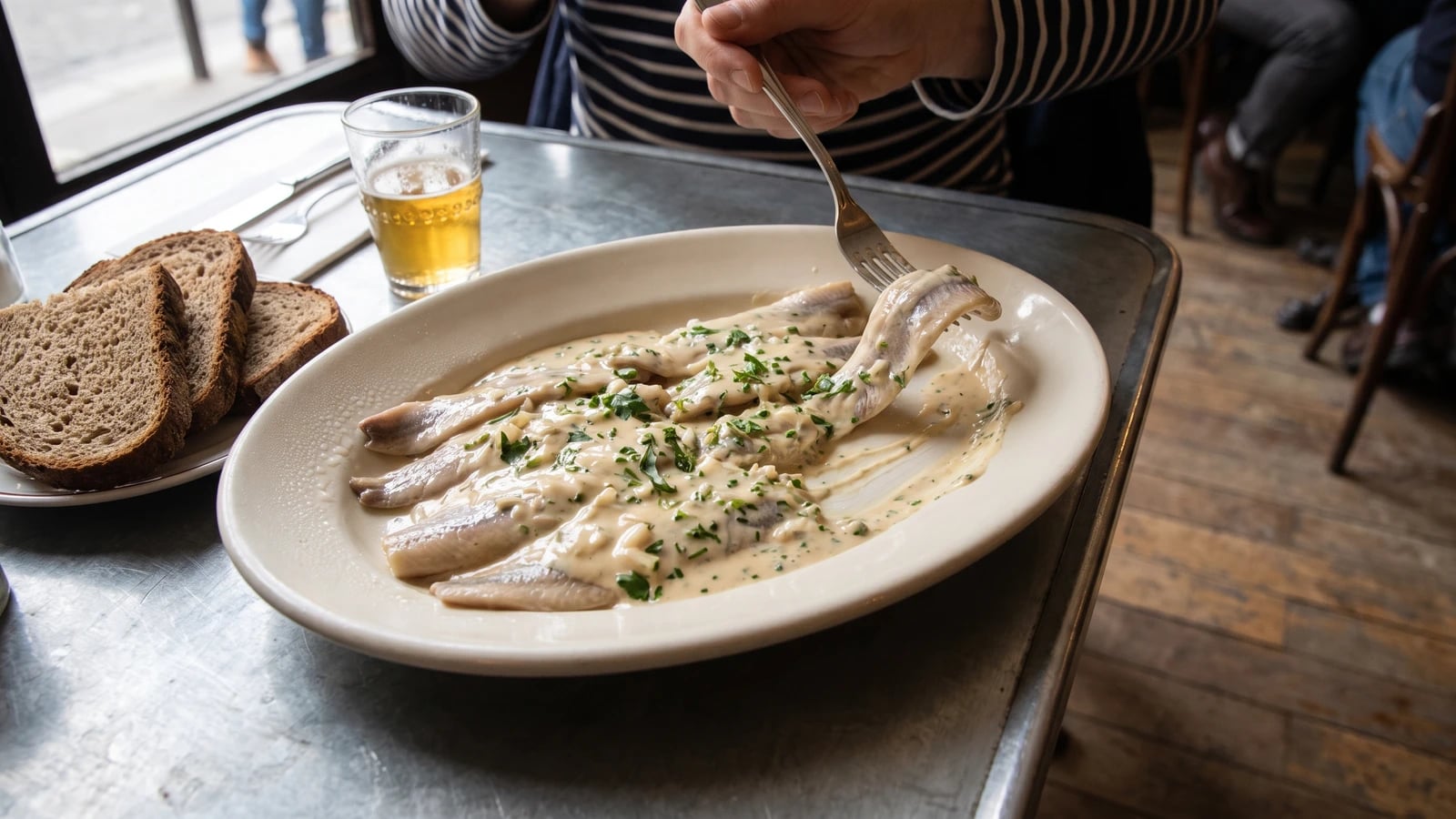
Salted herring, properly soaked and kept whole, wears a pale sauce of mayonnaise, soft roe, vinegar, onion, and fine herbs: a cold hors-d'oeuvre whose strength is disciplined balance.
Salade de filets de harengs salés (salad of filleted salted herrings) teaches restraint through desalting. Before you touch a knife, know the one true thing: the clock cannot tell you when a cured herring is ready, your tongue must. Soak until the salt has softened enough to let the fish taste of itself, not until it becomes bland. There is no pan here, only judgment.
The original entry assumed whole salted male herrings, a cold larder, mayonnaise already made, and enough diners to absorb a sauce built from eight soft roes. For four servings, the sauce is halved exactly to four roes, one tablespoon of vinegar, and two tablespoons of mayonnaise. A refrigerator, a fine sieve, and a small whisk replace the cold pantry and spare hands. Filleting is brigade scaffolding and may be entrusted to a fishmonger, provided the whole fillets and soft roes come home together. The soaking, roe purée, and masking sauce are the dish and must stay.
Done properly, the fillets remain firm and pearly beneath a pale, herb-flecked sauce with acidity, gentle heat, and the deep marine savor of the roe. One cook, one stove left cold, one evening, once the fish has soaked. Taste during that soak. It is the step that decides everything.
Salade de filets de harengs salés belongs to the cold hors-d'oeuvre repertoire of northern France and Paris, its pantry supplied by Channel curing ports such as Boulogne-sur-Mer and Fécamp. Salting carried herring inland, while classical kitchens transformed the preserved fish by skinning, soaking, trimming, and masking it with an emulsion rather than hiding it with sweetness. Soft roe is milt from the male fish, not eggs, and using it to deepen the mayonnaise carries the thrifty intelligence of the coastal table into a composed salad.
Quantity
4 (about 1 lb 12 oz / 800 g total)
filleted whole and skinned, with 4 soft roes reserved
Quantity
About 7 quarts (6.6 L / 6.6 kg)
divided, for soaking
Quantity
1 tablespoon (15 ml / 15 g)
Quantity
2 tablespoons (30 ml / 28 g)
Quantity
1 tablespoon (15 ml / 10 g)
very finely chopped
Quantity
2 teaspoons (10 ml / 2 g)
finely chopped
Quantity
2 teaspoons (10 ml / 1 g)
finely chopped
Quantity
2 teaspoons (10 ml / 2 g)
finely chopped
Quantity
1 teaspoon (5 ml / 1 g)
finely chopped
Quantity
1 small pinch (about 1/16 teaspoon / 0.15 g)
| Ingredient | Quantity |
|---|---|
| whole ready-to-eat salt-cured male herringsfilleted whole and skinned, with 4 soft roes reserved | 4 (about 1 lb 12 oz / 800 g total) |
| cold waterdivided, for soaking | About 7 quarts (6.6 L / 6.6 kg) |
| white wine vinegar | 1 tablespoon (15 ml / 15 g) |
| thick plain mayonnaise | 2 tablespoons (30 ml / 28 g) |
| yellow onionvery finely chopped | 1 tablespoon (15 ml / 10 g) |
| flat-leaf parsleyfinely chopped | 2 teaspoons (10 ml / 2 g) |
| chervilfinely chopped | 2 teaspoons (10 ml / 1 g) |
| chivesfinely chopped | 2 teaspoons (10 ml / 2 g) |
| tarragon leavesfinely chopped | 1 teaspoon (5 ml / 1 g) |
| cayenne pepper | 1 small pinch (about 1/16 teaspoon / 0.15 g) |
Rinse the outside of each herring briefly and pat it dry. Open the belly, lift out the soft roe intact, and keep it cold in a separate bowl. Remove the head, then run a flexible knife closely along the backbone and lift off both fillets whole. Pull any remaining pin bones with tweezers. Loosen the skin at the tail and peel it toward the head, keeping the flesh intact. Do not trim the fillets yet; their thin edges protect them during soaking.
Lay the fillets in a nonreactive container and cover them with about 2 quarts of cold water. Cover the roes separately with about 2 cups of cold water. Refrigerate throughout. Drain the roes after 1 hour; if a tiny taste remains fiercely saline, soak them for another 30 minutes. Change the fillets' water after 4 hours and again after 8 hours, then taste a sliver from the thickest part. They should remain assertively seasoned without making the throat prickle. If they are still too salty, give them fresh water for another hour and taste again. The fish decides when it is ready.
Drain the fillets and roes, then pat both thoroughly dry. Trim away ragged belly edges, fin remnants, tail tips, and any dark membrane, leaving the fillets whole as the source directs. Arrange them in two slightly overlapping rows on a chilled oval platter, alternating the thick ends for an even shape. Cover and return the platter to the refrigerator while you make the sauce. Drying matters: water left on the fish thins the emulsion and makes it slide away.
Remove any coarse membrane from the four soft roes. Press them through a fine-mesh sieve with the back of a spoon, scraping the smooth purée from underneath. Stir the white wine vinegar into the purée until evenly loosened but still thick. Do not add more liquid; this ratio, four roes to one tablespoon of vinegar, is the exact half-scale of the original formula.
Reserve 1 teaspoon of the measured mayonnaise and place the remainder in a small bowl. Whisk in the roe and vinegar purée a spoonful at a time so the mayonnaise keeps its body. Fold in the onion, parsley, chervil, chives, and tarragon, then add the cayenne cautiously. It should warm the finish without announcing itself. If the sauce loosens or shows oil at the rim, stop. Ça se rattrape: put the reserved mayonnaise in a clean bowl and whisk the broken sauce into it slowly, one spoonful at a time. If the sauce remains stable, simply fold in the reserved teaspoon.
Masquer (to cloak) the fillets by spooning the sauce evenly along their length, covering the flesh while leaving their shape visible. Refrigerate for at least 1 hour so the onion softens and the herbs settle into the emulsion. Bring the platter out 10 minutes before serving; it should be properly cold, not numb. Serve the fillets whole with dark bread alongside. À table!
1 serving (about 145g)
Culinary guides, cultural storytelling, and the editorial depth that makes cooking meaningful.
Discover Culinary ExplorerChef Juliette
Cold roast chicken, ciseled lettuce, and a shining coat of homemade mayonnaise, arranged with capers, olives, anchovies, eggs, and lettuce hearts, then tossed at the table as the canon intends.

Chef Juliette
Cold roast or poached chicken with fine ribbons of lettuce, dressed at the final moment with oil and vinegar: a composed salad whose freshness depends entirely on timing.

Chef Juliette
Five leaves, one living rule: laitue, romaine, chicorée, mâche, or pissenlit must be washed, dried, and dressed only as they go to the table, while every leaf still carries its light vinaigrette.

Chef Juliette
Salade de Betteraves proves that baking, not boiling, is the whole argument: concentrated garnet sweetness, tender baked onion, sharp mustard, and herbs cut into a weeknight salad worth making ahead.