Chef Juliette
Mayonnaise de Volaille
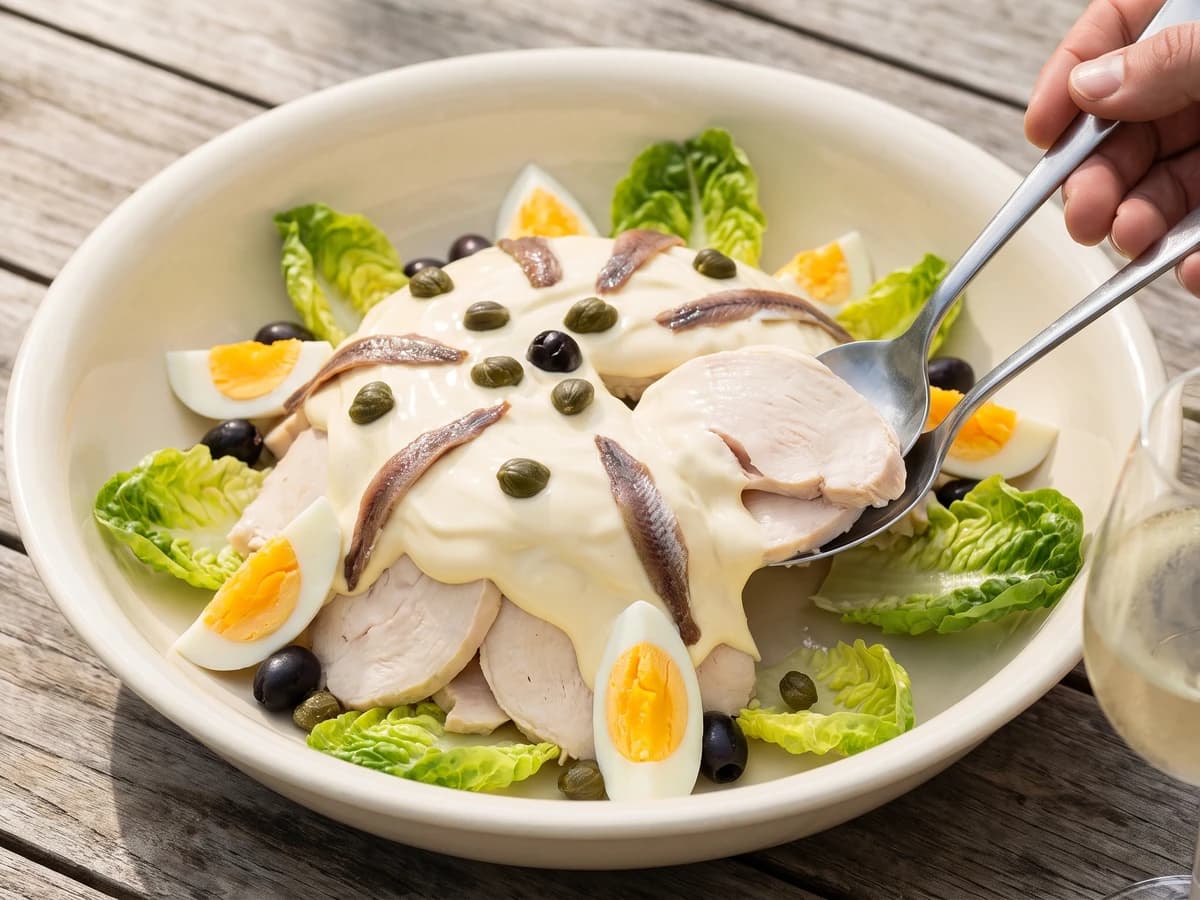
Cold roast chicken, ciseled lettuce, and a shining coat of homemade mayonnaise, arranged with capers, olives, anchovies, eggs, and lettuce hearts, then tossed at the table as the canon intends.
A cooking platform built around craft, culture, and the stories behind what we eat.
Created by Chef Juliette
Based on No. 329, Celeriac, from Le Guide Culinaire (1907) by Auguste Escoffier
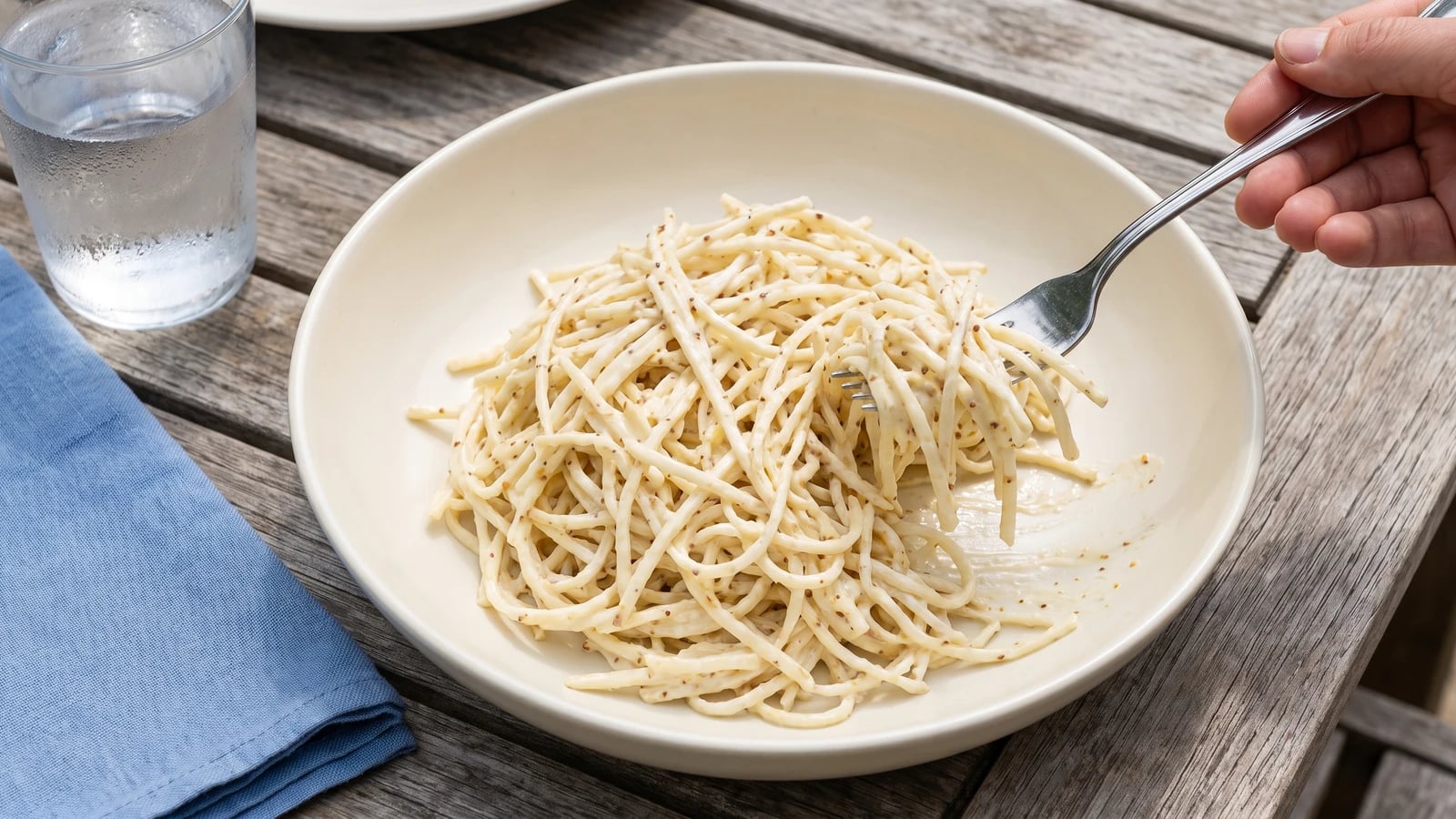
Céleri-rave teaches the discipline of julienne: cut the root evenly, let mustard and vinegar soften every matchstick, then fold in cream for a cool, crisp salad with real nerve.
Céleri-rave à la crème moutardée teaches a small, exact lesson: julienne (match-shaped rods) is not decoration here, it controls how evenly the root softens and how completely the dressing clings. Cut it carelessly and every mouthful argues with itself. Cut it evenly and mustard, vinegar, and cream turn a knobbly root into a salad of remarkable delicacy.
The source is terse because it assumed a garde-manger, the cold-kitchen cook, with a quick knife hand and the experience to judge seasoning by touch. No saucier, stockpot, or salamander belongs here. The honest home translation is one medium root, a 3 mm mandoline and knife if you want them, and measured dressing for four. Judging a brigade-sized basin by instinct is scaffolding and can go. The julienne and thorough mixing are the dish, so they stay. One cook, one stove, one evening, although the stove gets the night off.
The original gives mustard, salt, pepper, and vinegar, then prefers mustard cream when the root is tender. Here a measured maceration makes that judgment teachable: the vinegar softens the cut for twenty minutes, then the cream rounds its sharp edges without smothering the celeriac. Have the dressing ready before you cut, because even julienne and an immediate toss decide everything.
Céleri-rave dressed with mustard belongs to the Parisian bistro and the French traiteur counter, where cold hors-d'oeuvre salads are prepared ahead and served beside ham, pâté, and roast meats. The root suited the garde-manger because it kept its bite after cutting while absorbing a sharp dressing during the wait. This spare treatment of mustard, vinegar, and cream contains the foundation of céleri rémoulade, but it is not the fuller rémoulade sauce enriched with mayonnaise, capers, and herbs.
Quantity
1 medium (about 2 lb / 900 g whole; about 1½ lb / 680 g after trimming)
quartered and thickly peeled
Quantity
2 tablespoons (30 ml / 30 g)
divided
Quantity
2 tablespoons (30 ml / 30 g)
Quantity
1¼ teaspoons (6 ml / 7 g)
divided
Quantity
½ teaspoon (2.5 ml / 1 g)
divided
Quantity
½ cup (120 ml / 120 g)
well chilled and divided
| Ingredient | Quantity |
|---|---|
| celeriacquartered and thickly peeled | 1 medium (about 2 lb / 900 g whole; about 1½ lb / 680 g after trimming) |
| smooth Dijon mustarddivided | 2 tablespoons (30 ml / 30 g) |
| white wine vinegar | 2 tablespoons (30 ml / 30 g) |
| fine sea saltdivided | 1¼ teaspoons (6 ml / 7 g) |
| freshly ground black pepperdivided | ½ teaspoon (2.5 ml / 1 g) |
| heavy creamwell chilled and divided | ½ cup (120 ml / 120 g) |
In a large bowl, whisk 1 tablespoon (15 ml / 15 g) of the Dijon mustard with the white wine vinegar, 1 teaspoon (5 ml / 6 g) of the salt, and ¼ teaspoon (1.25 ml / 0.5 g) of the pepper. Keep whisking until the salt dissolves and the dressing looks smooth and ochre-coloured. Make this before cutting the root so every fresh piece can meet the vinegar immediately.
Set each celeriac quarter on a flat side and cut away the rough skin, root hairs, and brown channels until only clean ivory flesh remains. Cut the quarters into ⅛-inch (3 mm) sheets, then stack a few sheets at a time and cut them into rods of the same width, about 2 inches (5 cm) long. A mandoline may make the sheets, but use its hand guard and finish the rods with a knife. Drop each handful into the seasoning as soon as it is cut and toss. If some rods are noticeably thicker, pull them out and recut them now. Ça se rattrape.
Toss the julienne thoroughly for a full minute, lifting from the bottom so mustard and vinegar reach every surface. Cover and leave it for 20 minutes in the refrigerator, tossing once halfway through. Test one of the thickest pieces: it should bend slightly before snapping but retain a clean bite. If it still feels woody, give it another 10 minutes. Time softens the root more evenly than rough handling.
Lift the softened celeriac temporarily onto a plate, leaving its seasoned liquor in the bowl. If there is more than 2 tablespoons (30 ml), reserve the excess nearby. Whisk the remaining 1 tablespoon (15 ml / 15 g) Dijon into the liquor, then pour in 6 tablespoons (90 ml / 90 g) of the chilled cream in a thin stream, whisking until the sauce is smooth and lightly thickened. If the acid makes it look grainy, stop. Ça se rattrape: put 1 tablespoon (15 ml / 15 g) of the reserved cream in a clean bowl and whisk the troubled sauce into it one spoonful at a time.
Return the celeriac to the bowl and fold until the pale sauce catches every rod without leaving a heavy puddle. Cover and chill for 15 minutes, then taste. Add the remaining salt and pepper as needed. If the vinegar feels too pointed or the dressing has tightened, fold in the remaining cream a teaspoon at a time. If it tastes too creamy, correct it with a teaspoon of the reserved seasoned liquor. The final dressing should be tangy first, rounded by cream, with the celeriac still plainly itself.
Stir once from the bottom and mound the céleri-rave in a broad, shallow serving bowl. Serve it cool rather than numbingly cold, beside ham, pâté, cold roast chicken, or simply good bread and a sharp green salad. À table!
1 serving (about 217g)
Culinary guides, cultural storytelling, and the editorial depth that makes cooking meaningful.
Discover Culinary ExplorerChef Juliette
Cold roast chicken, ciseled lettuce, and a shining coat of homemade mayonnaise, arranged with capers, olives, anchovies, eggs, and lettuce hearts, then tossed at the table as the canon intends.

Chef Juliette
Cold roast or poached chicken with fine ribbons of lettuce, dressed at the final moment with oil and vinegar: a composed salad whose freshness depends entirely on timing.

Chef Juliette
Five leaves, one living rule: laitue, romaine, chicorée, mâche, or pissenlit must be washed, dried, and dressed only as they go to the table, while every leaf still carries its light vinaigrette.

Chef Juliette
Salade de Betteraves proves that baking, not boiling, is the whole argument: concentrated garnet sweetness, tender baked onion, sharp mustard, and herbs cut into a weeknight salad worth making ahead.