Chef Juliette
Mayonnaise de Volaille
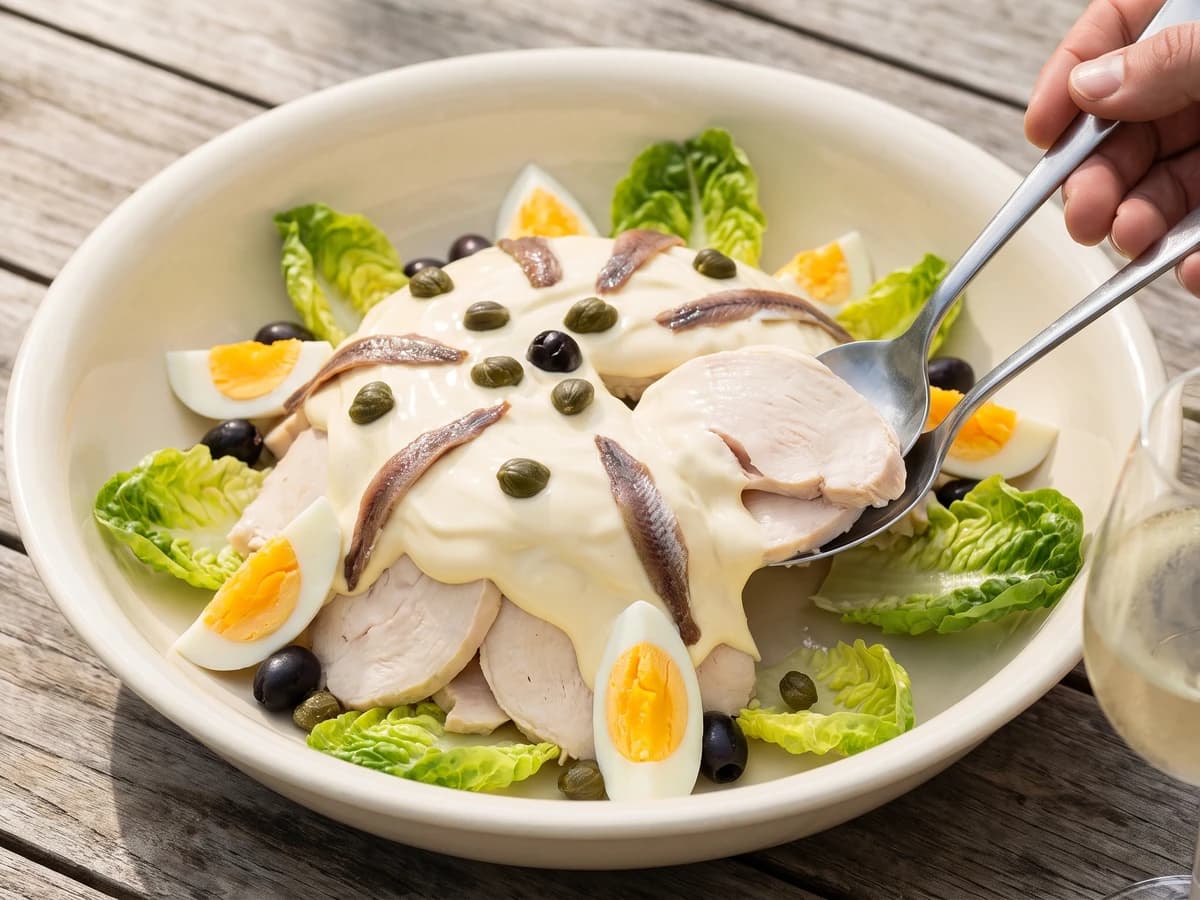
Cold roast chicken, ciseled lettuce, and a shining coat of homemade mayonnaise, arranged with capers, olives, anchovies, eggs, and lettuce hearts, then tossed at the table as the canon intends.
A cooking platform built around craft, culture, and the stories behind what we eat.
Created by Chef Juliette
Based on No. 328, Celery à la Grecque, from Le Guide Culinaire (1907) by Auguste Escoffier
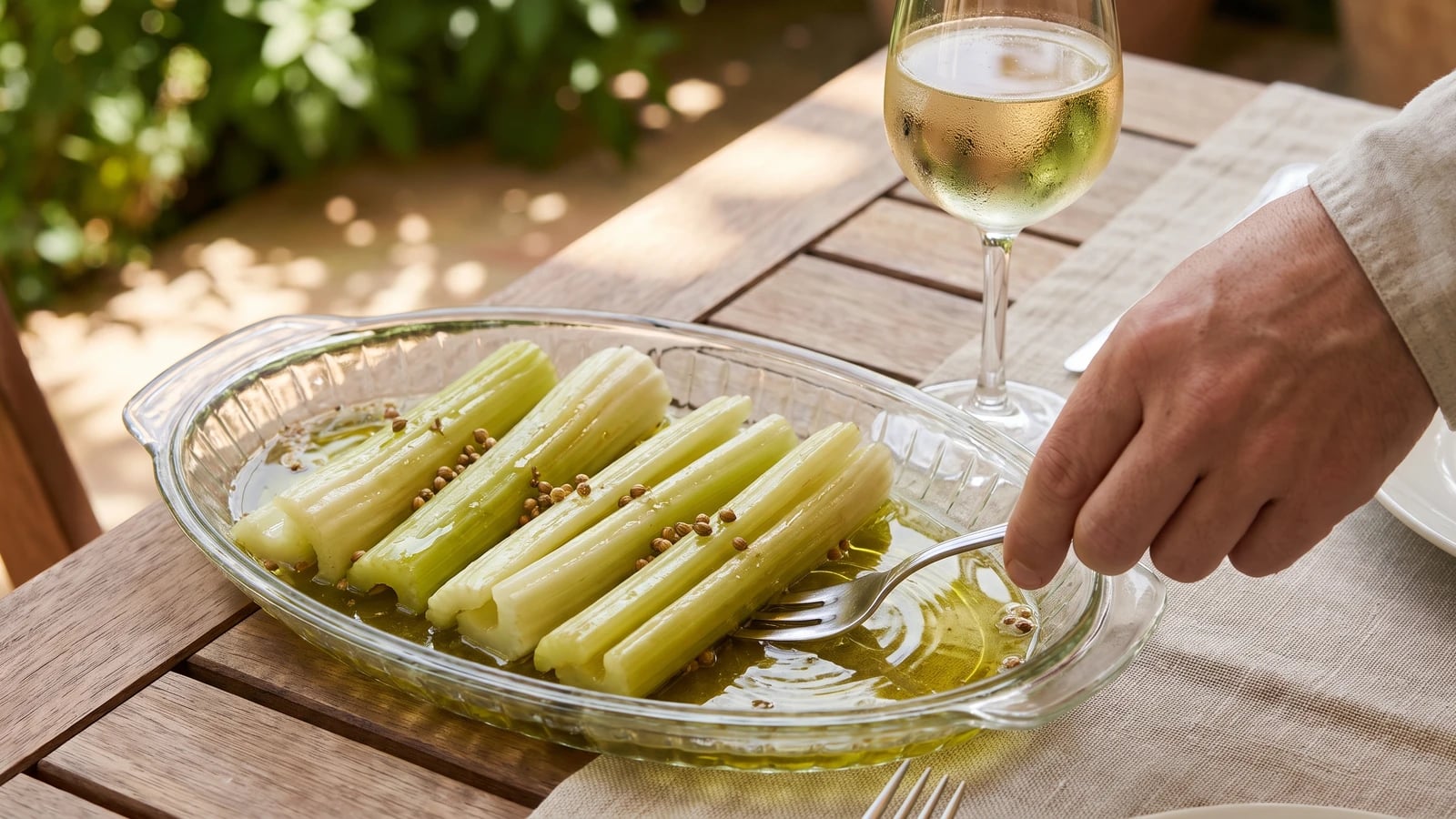
Céleri à la Grecque turns humble celery hearts into a bright, cold hors d'oeuvre, gently cooked in lemon, olive oil, white wine, and coriander, then cooled in the same fragrant liquor.
Céleri à la Grecque (celery hearts cooked and chilled in lemon-coriander liquor) teaches one essential principle: cooling in the cooking liquor is part of the cooking. The celery must leave the heat tender but still holding itself, because it continues to absorb salt, acidity, coriander, and olive oil as it chills.
The original entry assumed Artichokes à la Grecque was already part of the kitchen's working grammar, with uniform hearts sorted by a brigade and a crystal hors-d'oeuvre dish waiting for service. At home, make a small batch of the same liquor in the saucepan used for parboiling, cut two compact hearts into four equal portions, and serve them in shallow glass or porcelain. The cross-reference and formal crystal service are brigade scaffolding; the acidulated parboil, the oil-lemon-coriander liquor, and the long cooling remain. One cook, one stove, one evening.
The second simmer decides the dish. Stop when a knife enters the thick base with slight resistance, then let the liquor finish its work in the cold. Boil the celery until limp and no marinade can restore its character.
À la grecque belongs to the French classical hors-d'oeuvre table shaped in Parisian professional kitchens, where artichokes, mushrooms, and celery were cooked in an acidulated olive-oil liquor and served cold with a portion of it. The name reflects the French canon's association of Greece with olive oil, lemon, and coriander rather than claiming the preparation as a Greek household recipe. Celery entered the family by borrowing the artichoke method exactly, including the preliminary blanch and the cooling in liquor rather than a dressing added afterward.
Quantity
2 hearts (about 1½ lb / 680 g total)
outer stalks removed and hearts halved lengthwise
Quantity
8 cups (1.9 L / 1.9 kg)
Quantity
2 tablespoons (30 ml / 30 g)
Quantity
2 teaspoons (10 ml / 12 g)
Quantity
½ cup (120 ml / 118 g)
Quantity
½ cup (120 ml / 120 g)
Quantity
⅓ cup (80 ml / 73 g)
Quantity
¼ cup (60 ml / 60 g)
Quantity
2 teaspoons (10 ml / 4 g)
lightly crushed
Quantity
½ teaspoon (2.5 ml / 1 g)
Quantity
1 teaspoon (5 ml / 6 g)
Quantity
1
Quantity
2
| Ingredient | Quantity |
|---|---|
| compact celery heartsouter stalks removed and hearts halved lengthwise | 2 hearts (about 1½ lb / 680 g total) |
| cold water for parboiling | 8 cups (1.9 L / 1.9 kg) |
| fresh lemon juice for the acidulated water | 2 tablespoons (30 ml / 30 g) |
| fine sea salt for the acidulated water | 2 teaspoons (10 ml / 12 g) |
| dry white wine | ½ cup (120 ml / 118 g) |
| water for the cooking liquor | ½ cup (120 ml / 120 g) |
| olive oil | ⅓ cup (80 ml / 73 g) |
| fresh lemon juice for the cooking liquor | ¼ cup (60 ml / 60 g) |
| coriander seedslightly crushed | 2 teaspoons (10 ml / 4 g) |
| black peppercorns | ½ teaspoon (2.5 ml / 1 g) |
| fine sea salt for the cooking liquor | 1 teaspoon (5 ml / 6 g) |
| bay leaf | 1 |
| fresh thyme sprigs | 2 |
Remove any dark, coarse outer stalks, leaving the compact pale hearts. Trim each heart to about 6 inches (15 cm), but keep enough of the root end intact to hold the ribs together. Halve the hearts lengthwise and wash carefully between the ribs. If one half is much thicker, divide it again; equal size matters because every piece must reach tenderness together.
Bring the 8 cups (1.9 L / 1.9 kg) water to a full boil with the 2 tablespoons (30 ml / 30 g) lemon juice and 2 teaspoons (10 ml / 12 g) salt. Add the celery and parboil for 5 minutes. The ribs should bend slightly while their thick bases remain firm. Drain at once and rinse the saucepan; the blanching water has done its work and is not part of the finished liquor.
Combine the white wine, water, olive oil, lemon juice, coriander seeds, peppercorns, salt, bay leaf, and thyme in the clean saucepan. Bring the liquor just to a simmer and hold it there for 5 minutes so the coriander opens and the wine loses its raw edge. Taste a cooled spoonful. It should seem brighter and slightly more seasoned than a warm sauce, because cold quiets both salt and acidity.
Nestle the celery into the liquor in one layer, cut sides down. Cover loosely and maintain the barest simmer for 12 to 15 minutes, turning the pieces once, until a small knife enters the thick base with slight resistance. Do not wait for complete softness. If a thinner piece becomes tender early, lift it out and return it when the celery cools in the liquor. Ça se rattrape. If every piece begins to slump, stop the heat immediately and transfer them gently to the cooling dish; they won't regain firmness, but they can still keep their shape.
Arrange the celery in a shallow nonreactive dish and pour over all the cooking liquor and spices. Let it cool uncovered until no longer warm, no more than 45 minutes, then cover and refrigerate for at least 3 hours. Turn the pieces once during chilling so both sides drink in the marinade. The oil will separate into shining droplets rather than forming an emulsion. That is exactly right.
Remove the bay leaf and thyme. Arrange one celery portion per person on a chilled shallow platter and spoon over enough cooking liquor to pool lightly beneath it, carrying a few coriander seeds onto each piece. Serve very cold, while the celery is firm, glossy, and sharply fragrant. À table!
1 serving (about 235g)
Culinary guides, cultural storytelling, and the editorial depth that makes cooking meaningful.
Discover Culinary ExplorerChef Juliette
Cold roast chicken, ciseled lettuce, and a shining coat of homemade mayonnaise, arranged with capers, olives, anchovies, eggs, and lettuce hearts, then tossed at the table as the canon intends.

Chef Juliette
Cold roast or poached chicken with fine ribbons of lettuce, dressed at the final moment with oil and vinegar: a composed salad whose freshness depends entirely on timing.

Chef Juliette
Five leaves, one living rule: laitue, romaine, chicorée, mâche, or pissenlit must be washed, dried, and dressed only as they go to the table, while every leaf still carries its light vinaigrette.

Chef Juliette
Salade de Betteraves proves that baking, not boiling, is the whole argument: concentrated garnet sweetness, tender baked onion, sharp mustard, and herbs cut into a weeknight salad worth making ahead.