Chef Juliette
Mayonnaise de Volaille
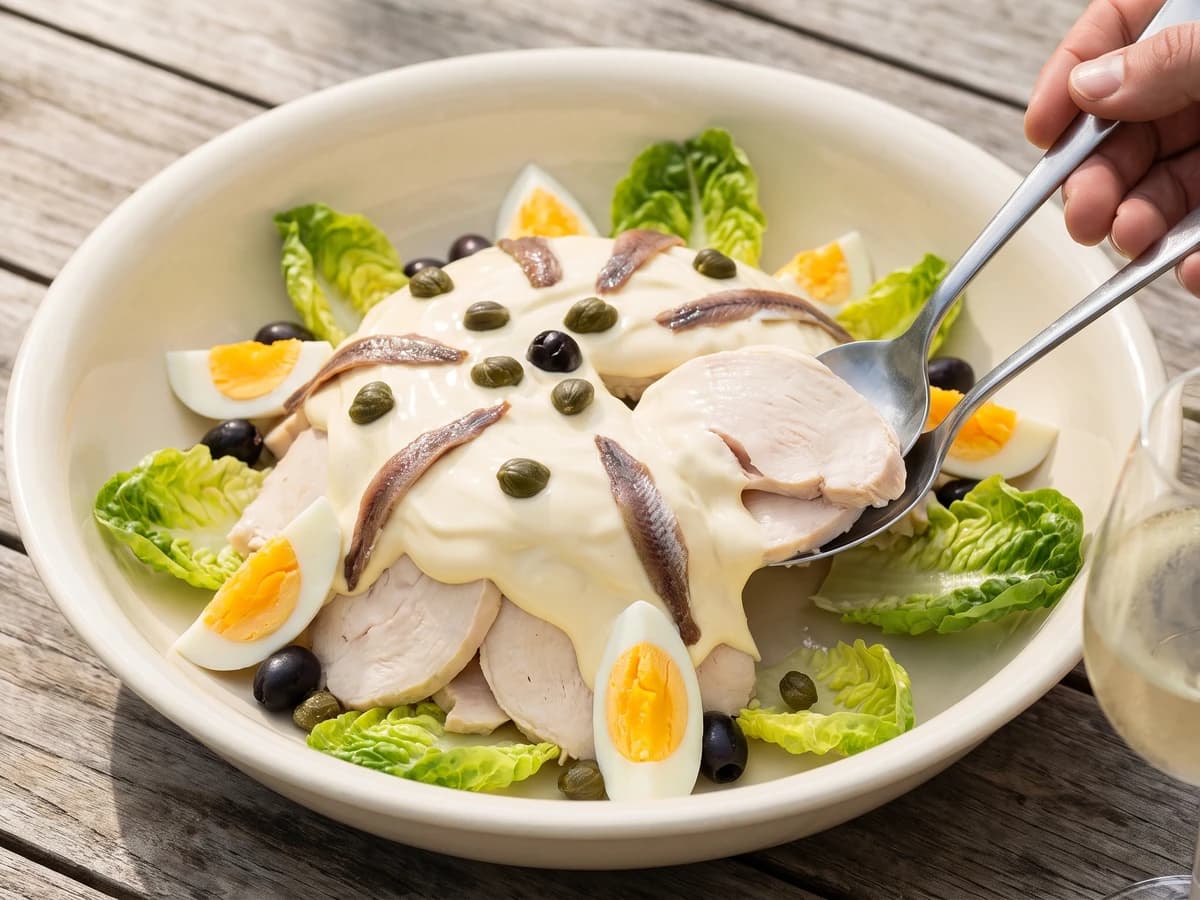
Cold roast chicken, ciseled lettuce, and a shining coat of homemade mayonnaise, arranged with capers, olives, anchovies, eggs, and lettuce hearts, then tossed at the table as the canon intends.
A cooking platform built around craft, culture, and the stories behind what we eat.
Created by Chef Juliette
Based on No. 327, Celery “A la Bonne-femme”, from Le Guide Culinaire (1907) by Auguste Escoffier
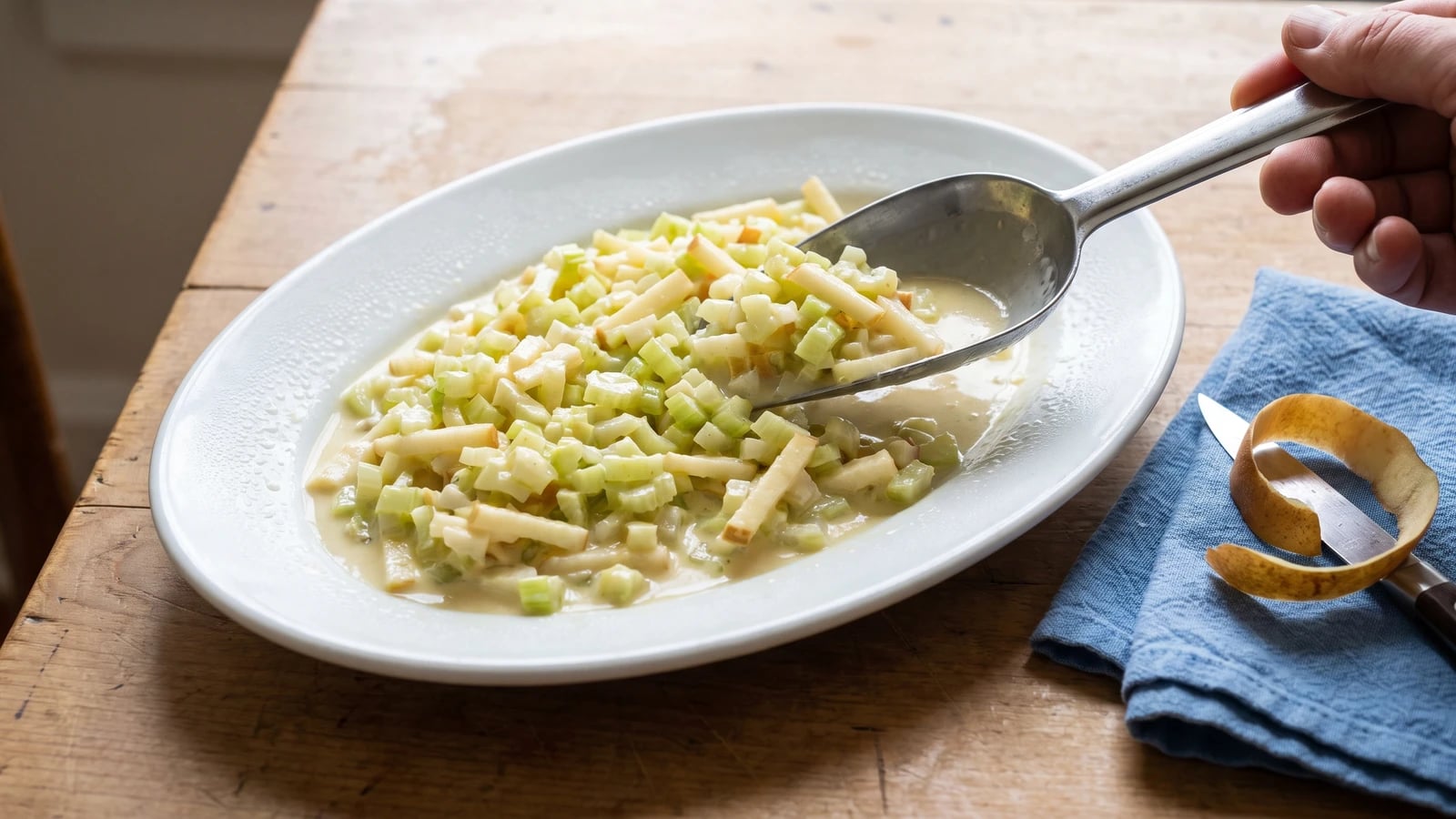
Céleri à la bonne femme turns equal weights of tender celery and russet apple into a crisp, pale hors-d’œuvre, finely minced and bound with cool Dijon cream before the apple can darken.
Céleri à la bonne femme (finely minced celery and russet apple in mustard cream) teaches the discipline of the matched cut. Equal weights are only half the promise: celery and apple must meet the teeth together, one crisp, tender spoonful rather than hard stalk beside soft fruit. The sauce must be waiting before the first apple is peeled, because immediate coating, not lemon added later, keeps the fruit pale without changing the dish.
The source entry assumes a garde-manger, the cold station, with mustard-and-cream sauce ready, another pair of hands for the mincing, and a broad hors-d’œuvre dish waiting for service. Your kitchen needs one bowl and a sharp knife. Only the scale and order have changed: equal prepared weights for four, sauce first, apples cut one quarter at a time. The separate sauce station was brigade scaffolding; the equal ratio, tender celery, and fine mince are the dish, and they stay.
After a short chill, the cream clings rather than pools, the mustard gives the apple a quiet edge, and every spoonful carries the same cool crunch. Cooking well is not cooking fancy. Have the sauce smooth and ready before you touch the apple.
Céleri à la bonne femme belongs to the French bourgeois hors-d’œuvre table, the cold opening of a meal where modest vegetables were chopped neatly, seasoned, and arranged on serving dishes. In classical naming, à la bonne femme suggests plain household treatment rather than one universal garnish, so it changes meaning from dish to dish; here its identity is the equal measure of tender celery and russet apple bound with mustard cream. The written canon carried that domestic combination into professional cold-kitchen practice without disguising its simplicity.
Quantity
3 cups (720 ml / 300 g)
trimmed
Quantity
about 3 medium, yielding 2 cups (480 ml / 300 g)
peeled, quartered, and cored
Quantity
½ cup (120 ml / 120 g)
Quantity
2 tablespoons (30 ml / 30 g)
Quantity
½ teaspoon (2.5 ml / 3 g)
Quantity
⅛ teaspoon (0.6 ml / 0.3 g)
Quantity
1 tablespoon (15 ml / 15 g)
| Ingredient | Quantity |
|---|---|
| very tender inner celery ribstrimmed | 3 cups (720 ml / 300 g) |
| russet applespeeled, quartered, and cored | about 3 medium, yielding 2 cups (480 ml / 300 g) |
| cold heavy cream, preferably 35% fat | ½ cup (120 ml / 120 g) |
| Dijon mustard | 2 tablespoons (30 ml / 30 g) |
| fine salt | ½ teaspoon (2.5 ml / 3 g) |
| finely ground white pepper | ⅛ teaspoon (0.6 ml / 0.3 g) |
| cold heavy cream for rescuing the sauce (optional) | 1 tablespoon (15 ml / 15 g) |
Whisk the Dijon mustard, salt, and white pepper together in a chilled, nonreactive bowl. Add 2 tablespoons of the measured cream and whisk until perfectly smooth, then add the remaining measured cream in a thin stream. Whisk only until the sauce falls from the whisk in a broad ribbon and lightly coats a spoon; it must flow, not stand in peaks. If it turns grainy because it was whisked too far, stop and work in the optional cold cream one teaspoon at a time until it smooths. Ça se rattrape.
Taste a piece from each celery rib. If it carries tough strings, pull them away with a paring knife; tenderness is part of the dish, not a shopping suggestion. Weigh 300 g after trimming, split the ribs lengthwise into narrow strips, and cut across them into an even 2 to 3 mm mince. A knife preserves the crisp bite that a food processor bruises away. Fold the celery into the mustard cream.
Peel, quarter, and core one russet apple at a time. Mince each quarter to match the celery, then fold it into the sauce immediately before cutting the next. Continue until you have exactly 300 g of prepared apple, equal in weight to the celery. The mustard cream coats the cut surfaces and slows browning without introducing lemon, which the source preparation does not call for. If a few edges begin to color, fold them in at once; the taste is unharmed, though the color cannot be reversed.
Fold the salad from the bottom just until every piece is coated, taking care not to crush the fine mince. Cover and chill for 30 minutes so the mustard softens into the cream and the celery perfumes the dressing. Stir once and taste it cold, when seasoning is quieter. If liquid has gathered at the bottom, lift the solids with a slotted spoon, whisk the dressing smooth, and fold everything together once more.
Spoon the bonne femme loosely onto a chilled, shallow hors-d’œuvre dish. Do not press it into a mold or bury its texture under garnish; the finish should be pale, close-grained, and moist with cream, never swimming in it. Serve cold as an opening salad or alongside a simple supper. À table!
1 serving (about 190g)
Culinary guides, cultural storytelling, and the editorial depth that makes cooking meaningful.
Discover Culinary ExplorerChef Juliette
Cold roast chicken, ciseled lettuce, and a shining coat of homemade mayonnaise, arranged with capers, olives, anchovies, eggs, and lettuce hearts, then tossed at the table as the canon intends.

Chef Juliette
Cold roast or poached chicken with fine ribbons of lettuce, dressed at the final moment with oil and vinegar: a composed salad whose freshness depends entirely on timing.

Chef Juliette
Five leaves, one living rule: laitue, romaine, chicorée, mâche, or pissenlit must be washed, dried, and dressed only as they go to the table, while every leaf still carries its light vinaigrette.

Chef Juliette
Salade de Betteraves proves that baking, not boiling, is the whole argument: concentrated garnet sweetness, tender baked onion, sharp mustard, and herbs cut into a weeknight salad worth making ahead.