Chef Juliette
Mayonnaise de Volaille
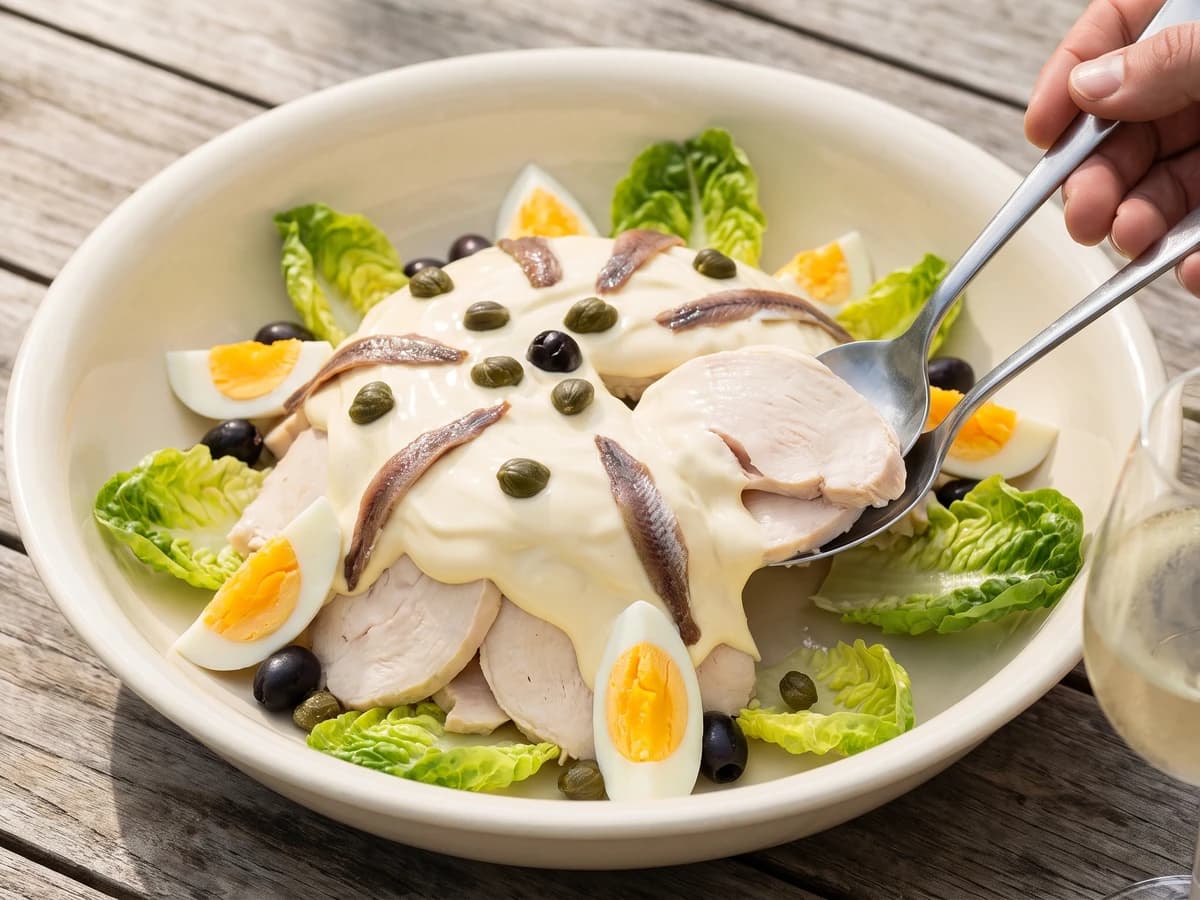
Cold roast chicken, ciseled lettuce, and a shining coat of homemade mayonnaise, arranged with capers, olives, anchovies, eggs, and lettuce hearts, then tossed at the table as the canon intends.
A cooking platform built around craft, culture, and the stories behind what we eat.
Created by Chef Juliette
Based on No. 2953, Mixed Stewed Fruit, from Le Guide Culinaire (1907) by Auguste Escoffier
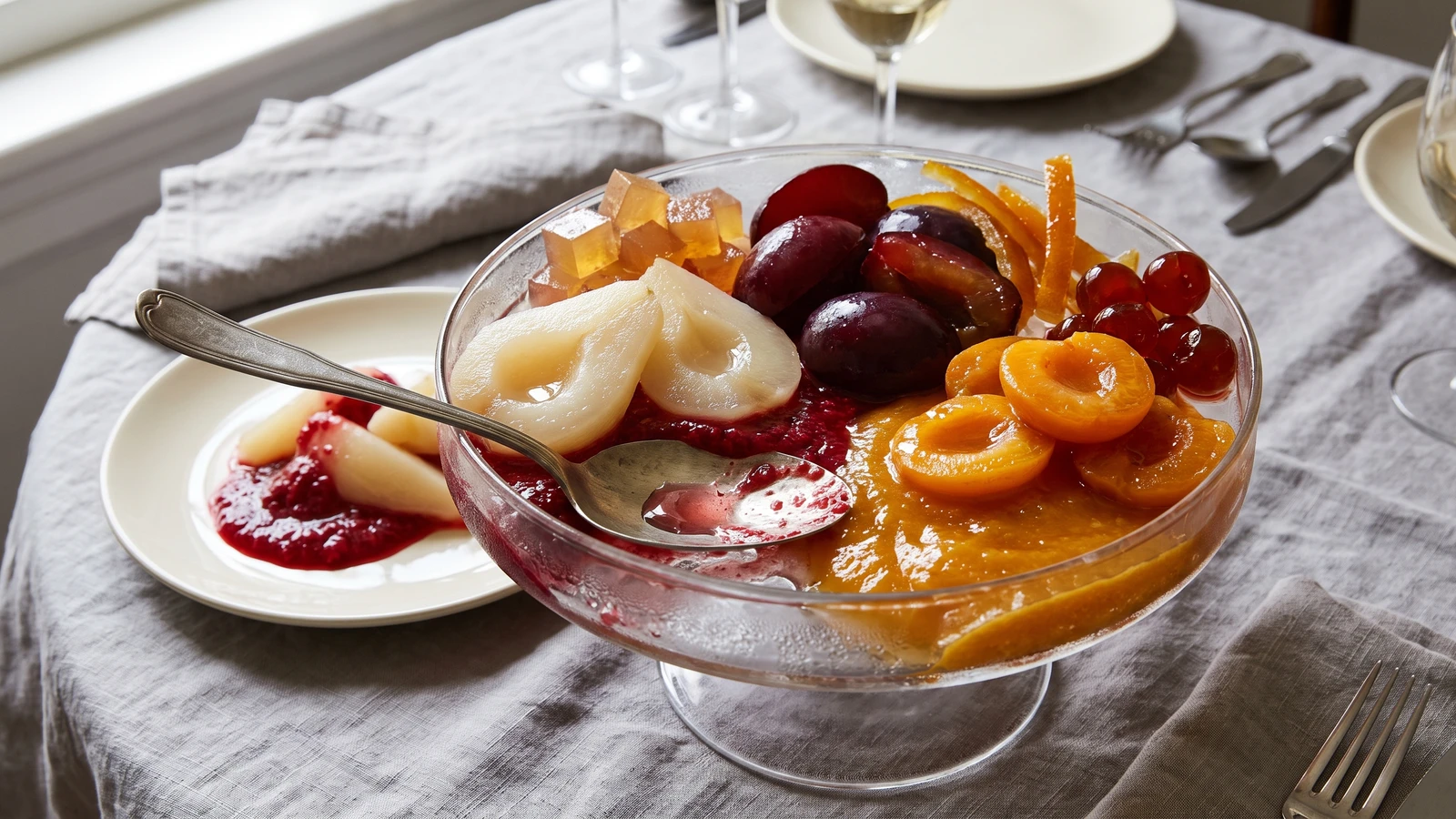
Compote de Fruits Mélangés keeps pears, plums, apricots, two fruit purées, quince jelly, and candied fruit distinct on one generous platter. Poach each fruit alone, or the composition becomes one sweet blur.
Compote de Fruits Mélangés (mixed stewed fruit) teaches separation. Pears need a patient poach, plums need scarcely more than a hot bath, and apricots fall somewhere between. Put them in one pan and the firm fruit stays raw while the tender fruit collapses. The one true thing to know before touching the stove is simple: once the fruit enters the syrup, each kind keeps its own pan, timing, and poaching liquor.
The original entry assumed a cold larder already holding several fruit compotes, purées, jellies, and preserved fruits, with enough hands to assemble them at service. It needed neither a saucier, a stockpot always on the fire, nor a salamander. Its professional luxury was parallel mise en place. A refrigerator and three small stainless-steel saucepans now do that work, and the source's open choice of fruits becomes a home-scale composition of pears, plums, apricots, raspberry purée, quince jelly, and candied fruit. A shelf of ready components is brigade scaffolding and can go. Separate poaching is the dish and must stay. One cook, one stove, one evening.
When it is right, the platter is cool, glossy, and generous: pale pears, garnet plums, apricot gold, ruby purée, translucent jelly, and bright preserved fruit, each tasting unmistakably of itself. The decisive step is reducing and cooling every syrup separately before it returns to its fruit. Keep those syrups distinct and the whole composition holds.
Compotes composées belong to the French service of entremets, particularly the Parisian grand kitchen, where poached fruits were arranged with purées, jellies, and preserves rather than tipped together as a household stew. The form traveled easily to bourgeois tables because the preserving cupboard already held apple or quince jelly and candied fruit through the seasons. A classical compote need not be mashed or uniform; in this branch of the canon, whole fruit, clear syrup, and a composed border are precisely the point.
Quantity
4 cups (960 ml / 960 g)
Quantity
2 cups (480 ml / 400 g)
Quantity
1 large, yielding about ¼ cup (60 ml / 60 g) juice
peel removed in 3 wide strips, then juiced
Quantity
1
split lengthwise
Quantity
3 (about 1 lb / 450 g)
peeled, quartered, and cored
Quantity
6 (about 13 oz / 360 g)
halved and pitted
Quantity
8 (about 14 oz / 400 g)
halved and pitted
Quantity
2 cups (480 ml / 250 g)
Quantity
¾ cup (180 ml / 180 g)
chilled and cut into ½-inch dice
Quantity
⅓ cup (80 ml / 60 g)
cut into fine strips
Quantity
⅓ cup (80 ml / 65 g)
halved
| Ingredient | Quantity |
|---|---|
| water | 4 cups (960 ml / 960 g) |
| granulated sugar | 2 cups (480 ml / 400 g) |
| unwaxed lemonpeel removed in 3 wide strips, then juiced | 1 large, yielding about ¼ cup (60 ml / 60 g) juice |
| vanilla beansplit lengthwise | 1 |
| firm pearspeeled, quartered, and cored | 3 (about 1 lb / 450 g) |
| firm-ripe plumshalved and pitted | 6 (about 13 oz / 360 g) |
| firm-ripe apricotshalved and pitted | 8 (about 14 oz / 400 g) |
| raspberries | 2 cups (480 ml / 250 g) |
| firm quince or apple jellychilled and cut into ½-inch dice | ¾ cup (180 ml / 180 g) |
| candied orange peelcut into fine strips | ⅓ cup (80 ml / 60 g) |
| candied cherrieshalved | ⅓ cup (80 ml / 65 g) |
Keep the three poaching fruits in separate bowls from the beginning. Toss the pear quarters with 1 tablespoon of the lemon juice so they don't discolor, then set the plums and apricots beside them. Pick through the raspberries without crushing them and keep them cold. Separation begins here, before heat enters the matter.
Combine the water, sugar, lemon peel, vanilla bean, and 1 tablespoon of lemon juice in a wide saucepan. Bring slowly to a boil, stirring only until the sugar dissolves, then simmer gently for 5 minutes. Remove the peel and vanilla. Reserve ¼ cup of the untouched syrup for the raspberry purée, then divide the remainder among three small saucepans. Once a fruit enters its syrup, the syrups never meet again.
Bring the first syrup to the barest tremble and add the pears. Cover them with a round of parchment if they float, then poach for 12 to 18 minutes, turning once, until translucent at the edges and easily pierced with a knife but still holding their corners. Lift them carefully into their own shallow bowl. Pears vary shamelessly, so remove each quarter when it is ready rather than waiting for the slowest one.
Bring the second syrup just below a boil and lower in the plum halves. Poach for 2 to 5 minutes, depending on ripeness, until the flesh yields slightly but the skins remain attached. Lift them out immediately. If a plum collapses, don't discard it. Ça se rattrape: press that half through a sieve and keep the resulting plum purée separate as an additional pool on the platter.
Lower the apricot halves into the third syrup and poach at a faint tremble for 2 to 4 minutes. They are ready when supple enough to take syrup but still firm enough to lift intact. Transfer them to their own bowl, reserving 6 neat halves separately for the apricot purée once cool.
Simmer the three poaching syrups separately until each lightly coats a cold spoon, about 5 to 8 minutes. They should remain fluid, not sticky. If one catches at the edge or tightens toward caramel, take it off the heat and stir in boiling water a tablespoon at a time until it runs freely again. Ça se rattrape. Cool completely before pouring each syrup back over its own fruit, or the fruit will continue cooking into softness.
Blend the raspberries with the reserved plain syrup and the remaining lemon juice, then press the purée through a fine sieve to remove the seeds. Clean the blender and purée the reserved apricot halves with just enough of their own syrup to make a thick, spoonable cream. Keep the raspberry and apricot purées in separate covered containers. Their distinct color and acidity are part of the composition.
Cover the pears, plums, apricots, and both purées separately and chill for at least 3 hours. Keep the diced jelly, candied orange peel, and candied cherries cold in their own containers. This rest lets the poached fruits drink in their syrups without surrendering their shapes.
Spoon the raspberry and apricot purées into separate generous pools on a chilled shallow compotier. Drain the poached fruits, saving every syrup, and arrange pears, plums, and apricots in distinct groups over and beside the purées. Border the platter with the quince or apple jelly dice, then place the candied orange peel and cherries in small clusters alongside the fresh fruit. Spoon a little pear syrup over the pears, plum syrup over the plums, and apricot syrup over the apricots. Never toss the platter. The composition should read fruit by fruit, not as one sweet blur.
Return the composed compote to the cold for 20 to 30 minutes so the purées settle and the jelly firms around the border. Serve with a broad spoon, reaching through purée, poached fruit, jelly, and a little candied fruit in each helping. À table!
1 serving (about 430g)
Culinary guides, cultural storytelling, and the editorial depth that makes cooking meaningful.
Discover Culinary ExplorerChef Juliette
Cold roast chicken, ciseled lettuce, and a shining coat of homemade mayonnaise, arranged with capers, olives, anchovies, eggs, and lettuce hearts, then tossed at the table as the canon intends.

Chef Juliette
Cold roast or poached chicken with fine ribbons of lettuce, dressed at the final moment with oil and vinegar: a composed salad whose freshness depends entirely on timing.

Chef Juliette
Five leaves, one living rule: laitue, romaine, chicorée, mâche, or pissenlit must be washed, dried, and dressed only as they go to the table, while every leaf still carries its light vinaigrette.

Chef Juliette
Salade de Betteraves proves that baking, not boiling, is the whole argument: concentrated garnet sweetness, tender baked onion, sharp mustard, and herbs cut into a weeknight salad worth making ahead.