Chef Juliette
Mayonnaise de Volaille
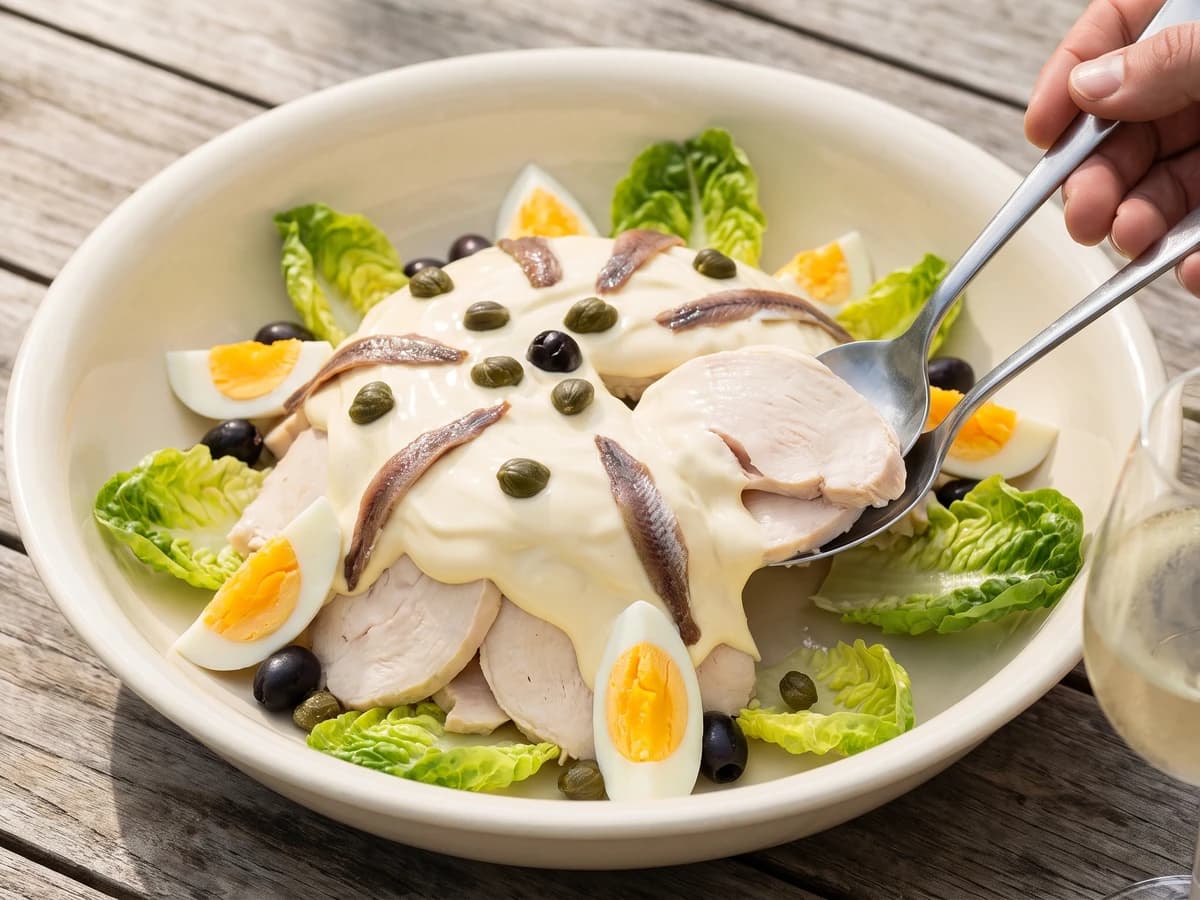
Cold roast chicken, ciseled lettuce, and a shining coat of homemade mayonnaise, arranged with capers, olives, anchovies, eggs, and lettuce hearts, then tossed at the table as the canon intends.
A cooking platform built around craft, culture, and the stories behind what we eat.
Created by Chef Juliette
Based on No. 2952, Plain Stewed Fruit, from Le Guide Culinaire (1907) by Auguste Escoffier
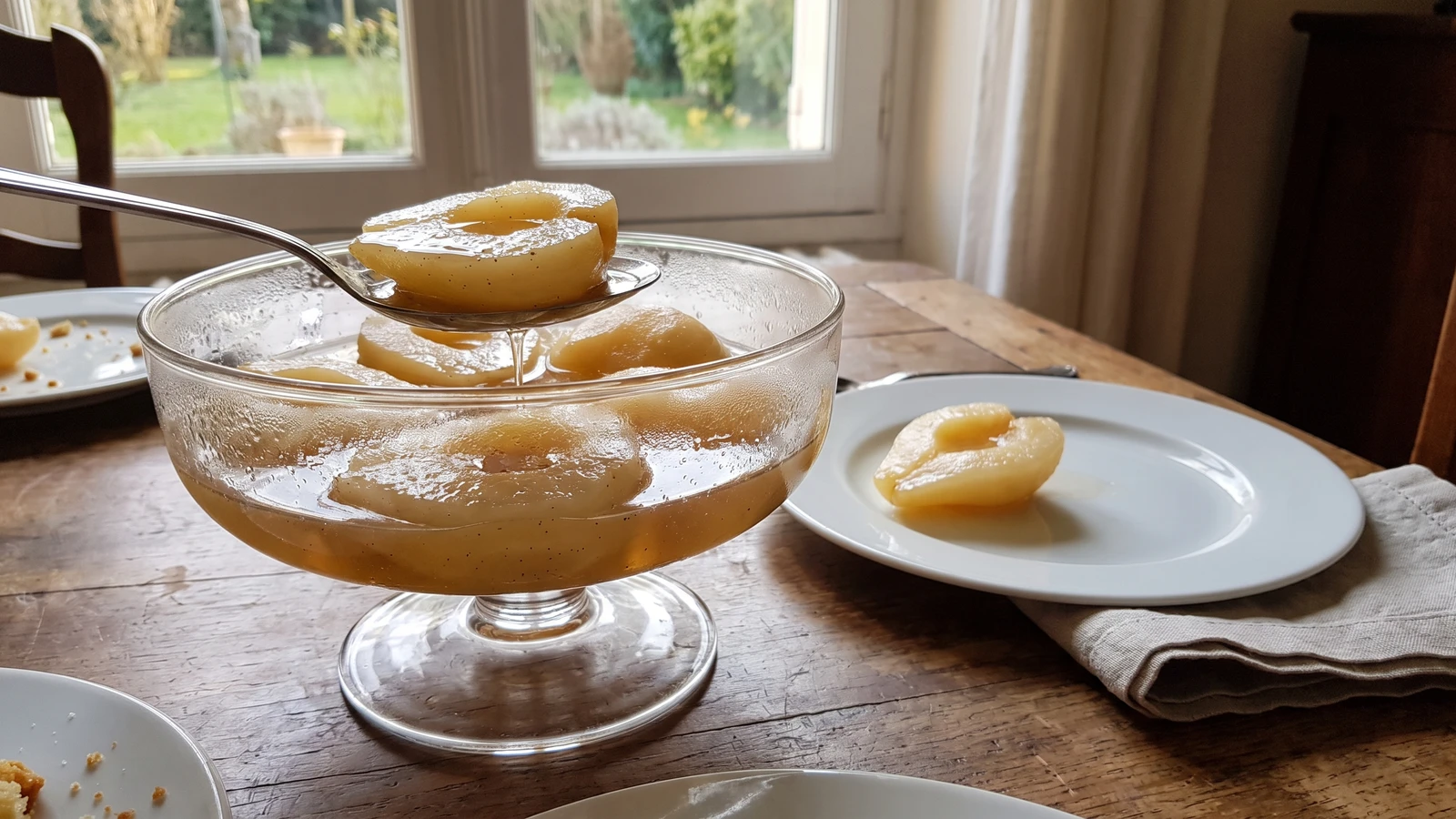
Compote de fruits keeps firm pears intact in a clear vanilla-lemon syrup, tender enough for a spoon but never collapsing, with the liquor reduced to a bright gloss and served hot or cold.
Compote de fruits (plain stewed fruit) teaches the discipline of poaching: the fruit must soften before it loses its shape. The one truth to know before touching a pan is that ripeness sets the outcome. Choose pears just short of eating ripe, fragrant but still firm at the neck, because syrup can bring firm fruit to tenderness but cannot put structure back into soft fruit.
The classical entry is a working formula rather than a fixed combination: whole, halved, or quartered fruit, a syrup flavored in sympathy, then its own liquor reduced or lightly bound with arrowroot. A brigade could run several fruits in separate pans and send each to the dining room in a tazza. Here, four pears, one wide saucepan, and one deep bowl do the same work. The parade of syrups and serving pieces was scaffolding; fruit poached gently and covered with its own syrup is the dish. Nothing in the technique has been cut.
Vanilla and lemon suit pear without masking it. Keep the syrup below a boil, test each half rather than trusting the clock, and lift it the moment a knife enters with slight resistance. That quiet poach is the step that matters most. Get it right and the compote will be clear, fragrant, and generous. One cook, one stove, one evening.
Compote belongs not to one province but to bourgeois and household tables across France, where poaching made firm fruit just shy of ripeness tender enough to serve. Classical kitchens brought it into formal service in tazzas or deep dishes, sometimes reducing the syrup and sometimes binding it with arrowroot for a clear, delicate body. A compote in this register is not necessarily a crushed purée; the fruit may remain whole, halved, or quartered and should keep its shape beneath its own liquor.
Quantity
4 (about 2 lb / 900 g total)
Quantity
4 cups (950 ml / 950 g)
Quantity
1 cup (240 ml / 200 g)
Quantity
2 tablespoons (30 ml / 30 g)
Quantity
2 wide strips
removed with no white pith
Quantity
1/2 bean
split lengthwise
Quantity
2 teaspoons (10 ml / 5 g)
Quantity
1 tablespoon (15 ml / 15 g)
for the arrowroot slurry
| Ingredient | Quantity |
|---|---|
| medium firm pears, just short of ripe | 4 (about 2 lb / 900 g total) |
| water | 4 cups (950 ml / 950 g) |
| granulated sugar | 1 cup (240 ml / 200 g) |
| fresh lemon juice | 2 tablespoons (30 ml / 30 g) |
| lemon zestremoved with no white pith | 2 wide strips |
| vanilla beansplit lengthwise | 1/2 bean |
| arrowroot (optional) | 2 teaspoons (10 ml / 5 g) |
| cold water (optional)for the arrowroot slurry | 1 tablespoon (15 ml / 15 g) |
Combine the water, sugar, lemon juice, lemon zest, and split vanilla bean in a wide saucepan. Warm gently, stirring only until the sugar dissolves, then bring the syrup to one quiet boil and lower the heat. Simmer for 5 minutes so the lemon and vanilla open into the liquor. If sugar crystals cling around the rim, cover the pan for 1 minute; the trapped moisture will wash them back into the syrup. Ça se rattrape.
While the syrup infuses, peel the pears thinly and halve them lengthwise. Scoop out each core with a melon baller or teaspoon, then trim away the narrow fibrous channel leading toward the stem. Slide each half into the syrup as soon as it is ready so the lemon keeps the cut surface pale.
Arrange the pears in one layer and lay a round of baking parchment directly on their surface. Hold the syrup at the faintest tremble, with only an occasional bubble at the edge, for 18 to 25 minutes. Turn the halves once and begin testing after 15 minutes. A thin knife should enter with slight resistance near the core. A rolling boil bruises the fruit and breaks its edges, so lower the heat at once if the pan becomes lively.
Remove each pear half with a slotted spoon as soon as it is tender; they may not finish together. Set them in a deep serving bowl without piling them heavily while hot. If one begins to split or fray, lift it immediately and cool it apart from the others. If it breaks, place those pieces beneath the intact halves in the serving bowl. The shape on top remains handsome, and no fruit is wasted.
Remove the lemon zest and vanilla bean, then taste the syrup. If its flavor is delicate and its body lightly syrupy, leave it alone. If it tastes weak and watery, boil it uncovered for 5 to 10 minutes to concentrate it. If the flavor is already right but the body is too thin, mix the arrowroot with the cold water until perfectly smooth, return the syrup to a bare simmer, and whisk in half the slurry. Wait 20 seconds before adding more. Do not boil hard after adding arrowroot or it may lose its body. If the liquor turns too thick, loosen it with cold water, 1 tablespoon at a time; if it forms lumps, strain it.
Pour the finished liquor over the pears, covering them well. Serve the compote hot at once, or cool it uncovered for no more than 30 minutes, then cover and chill for at least 2 hours. Turn the pears once as they chill so every surface drinks the syrup. Spoon one pear and plenty of its clear liquor into each bowl. Nothing else is required. À table!
1 serving (about 430g)
Culinary guides, cultural storytelling, and the editorial depth that makes cooking meaningful.
Discover Culinary ExplorerChef Juliette
Cold roast chicken, ciseled lettuce, and a shining coat of homemade mayonnaise, arranged with capers, olives, anchovies, eggs, and lettuce hearts, then tossed at the table as the canon intends.

Chef Juliette
Cold roast or poached chicken with fine ribbons of lettuce, dressed at the final moment with oil and vinegar: a composed salad whose freshness depends entirely on timing.

Chef Juliette
Five leaves, one living rule: laitue, romaine, chicorée, mâche, or pissenlit must be washed, dried, and dressed only as they go to the table, while every leaf still carries its light vinaigrette.

Chef Juliette
Salade de Betteraves proves that baking, not boiling, is the whole argument: concentrated garnet sweetness, tender baked onion, sharp mustard, and herbs cut into a weeknight salad worth making ahead.