
Chef Juliette
Various Almond Preparations
Five almond preparations, one discipline: remove the skins cleanly, dry every kernel through, then cut, toast, or cloak it in pale caramel without letting its fragrant oils escape.
A cooking platform built around craft, culture, and the stories behind what we eat.
Created by Chef Juliette
Based on No. 2913, Bombe Victoria, from Le Guide Culinaire (1907) by Auguste Escoffier
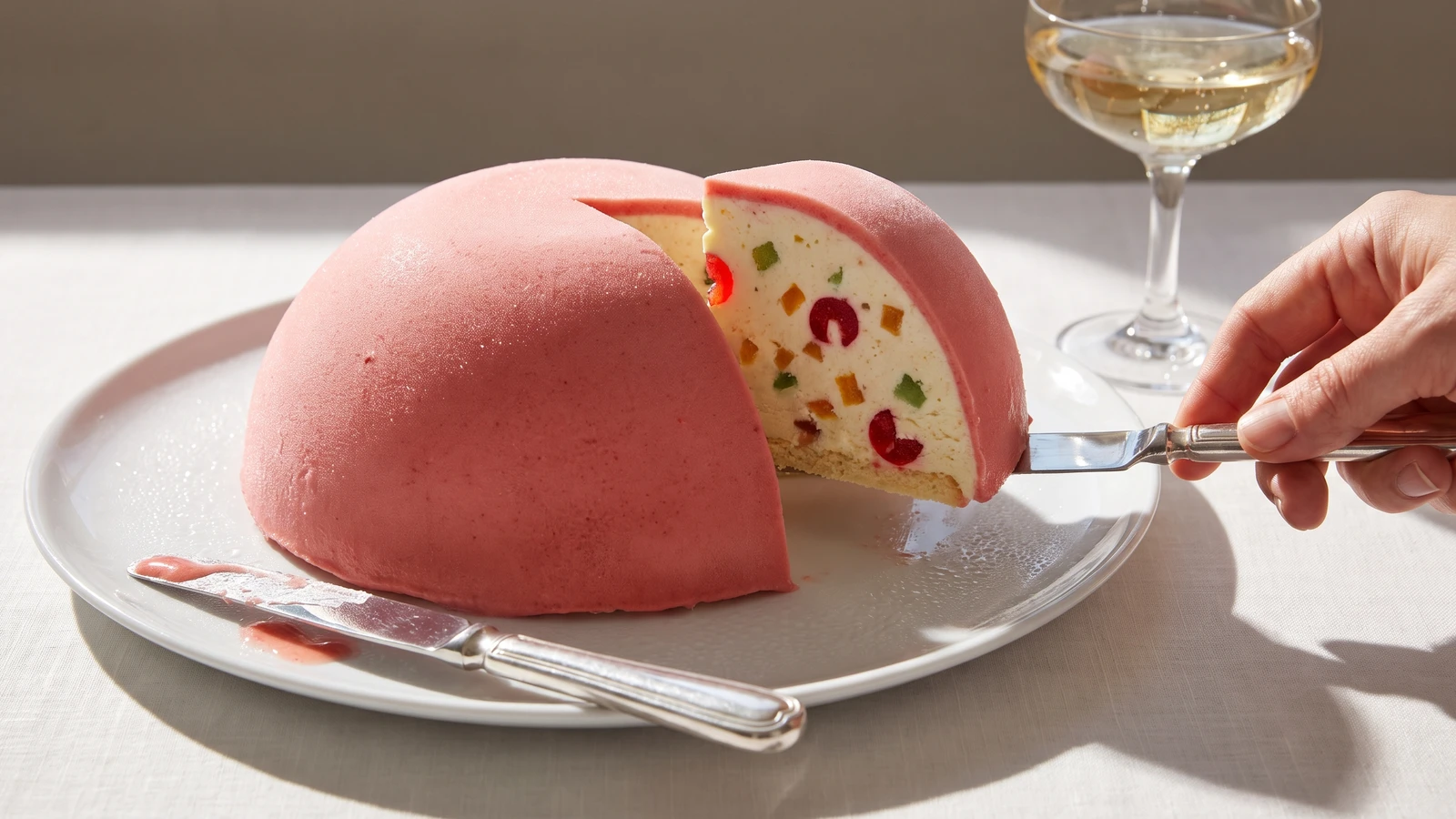
Strawberry ice forms the vivid shell, while vanilla-rich glace Plombière carries kirsch-soaked candied fruit within. Drain the fruit fiercely, because stray syrup separates a clean slice from a soft centre.
Bombe Victoria (a strawberry-clothed frozen bombe filled with glace Plombière) teaches the architecture of frozen desserts. The bright strawberry shell must be even and firm, the vanilla custard ice must stay creamy, and the candied fruit must be dry enough that its kirsch perfume enters the centre without carrying syrup behind it.
The original kitchen assumed a glacier handing over two finished ices, a metal bombe mould packed in salted ice, and enough hands to assemble everything while both mixtures remained supple. At home, a shallow tray and food processor prepare the strawberry ice, a countertop machine churns the glace Plombière, and the freezer replaces the salted-ice choreography. That choreography was brigade scaffolding and can go. The strawberry clothing, contrasting centre, and kirsch-soaked fruit are the dish itself, so they stay. One cook, one stove, one evening of work, then a proper night in the cold.
Drain the candied fruit until it leaves no wet mark on a towel. This is the one step that decides the Bombe Victoria before you touch a pan: excess syrup and kirsch lower the freezing point, and no amount of ceremony can make a wet centre slice cleanly.
Bombe Victoria belongs to the Parisian grand-kitchen repertoire of frozen entremets, where domed moulds revealed contrasting ices in clean slices at the dessert course. Glace Plombière carries the name of Plombières-les-Bains in the Vosges, but the canonical preparation is defined through practice: vanilla custard ice enriched with candied fruit scented by kirsch. The unlikely sole-aspic cross-reference records a shared moulding technique, chemiser, because both a thin jelly lining and a frozen lining were said to clothe the mould.
Quantity
3 packed cups (710 ml / 450 g)
hulled; unsweetened frozen strawberries may be thawed and drained
Quantity
1/2 cup (120 ml / 100 g)
Quantity
1/4 cup (60 ml / 60 g)
Quantity
1 tablespoon (15 ml / 15 g)
Quantity
1 1/4 cups (300 ml / 310 g)
Quantity
1 1/4 cups (300 ml / 295 g)
Quantity
6
Quantity
1/2 cup plus 1 tablespoon (135 ml / 115 g)
Quantity
1
split lengthwise
Quantity
1/8 teaspoon (0.6 ml / 0.8 g)
Quantity
3/4 cup (180 ml / 120 g)
cut into 5 mm dice; candied cherries, orange peel, and angelica are suitable
Quantity
3 tablespoons (45 ml / 42 g)
Quantity
1 method reference (No. 916)
consulted only for the mould-clothing technique; it contributes no edible component
| Ingredient | Quantity |
|---|---|
| ripe strawberrieshulled; unsweetened frozen strawberries may be thawed and drained | 3 packed cups (710 ml / 450 g) |
| granulated sugar for the strawberry ice | 1/2 cup (120 ml / 100 g) |
| water | 1/4 cup (60 ml / 60 g) |
| fresh lemon juice | 1 tablespoon (15 ml / 15 g) |
| whole milk | 1 1/4 cups (300 ml / 310 g) |
| heavy cream | 1 1/4 cups (300 ml / 295 g) |
| large egg yolks | 6 |
| granulated sugar for the glace Plombière | 1/2 cup plus 1 tablespoon (135 ml / 115 g) |
| vanilla beansplit lengthwise | 1 |
| fine salt | 1/8 teaspoon (0.6 ml / 0.8 g) |
| mixed candied fruitcut into 5 mm dice; candied cherries, orange peel, and angelica are suitable | 3/4 cup (180 ml / 120 g) |
| dry kirsch | 3 tablespoons (45 ml / 42 g) |
| Another Method of Preparing Aspics de Filets de Solesconsulted only for the mould-clothing technique; it contributes no edible component | 1 method reference (No. 916) |
Combine the diced candied fruit with the kirsch and leave it for 30 minutes, turning it once so every piece is scented. Tip it into a fine sieve and drain for another 30 minutes, then spread the fruit over a clean towel and blot until no wet mark remains. Do not pour the collected kirsch syrup into the ice. If the fruit still glistens wet, give it more time and fresh towelling. Ça se rattrape now; once that syrup is inside the bombe, it does not.
Put the water and strawberry-ice sugar in a small saucepan. Warm gently until the sugar dissolves, then simmer for 1 minute and cool. Blend the strawberries with the syrup and lemon juice until completely smooth, then pass the purée through a fine sieve to remove the seeds. Pour it into a shallow metal tray and freeze for 3 to 4 hours, until solid around the edges and firm through the centre.
Bring the milk, cream, split vanilla bean, and salt just below a boil, then take the pan from the heat and leave it for 10 minutes. Whisk the yolks with the Plombière sugar until smooth. Pour in one-third of the warm dairy while whisking, return everything to the saucepan, and cook over low heat with constant stirring until the crème anglaise coats the spoon and a finger drawn through it leaves a clean path, about 82°C. Never let it boil. If tiny cooked flecks appear, remove the pan immediately, blend briefly, and strain into a cold bowl. Ça se rattrape before those flecks become scrambled egg.
Strain the crème anglaise into a bowl set over ice, scrape in the vanilla seeds, and stir until cold. Cover the surface directly and refrigerate for at least 4 hours. Put the clean bombe mould and serving platter in the freezer during the final 30 minutes. A cold mould buys you working time, which matters when the strawberry ice begins to soften.
Break the frozen strawberry mixture into pieces and process until smooth, dense, and spreadable, stopping to scrape the bowl. This replaces a second ice-cream canister without changing the strawberry shell's purpose. If the mixture is too hard for the blade, wait 5 minutes; if it becomes loose and glossy, return it to the shallow tray for 15 minutes before lining the mould.
Chemiser means to clothe the mould, the technique preserved in Another Method of Preparing Aspics de Filets de Soles (No. 916). Pack the strawberry ice firmly over the bottom and sides of the frozen bombe mould in an even layer about 1.25 cm thick, rotating the mould as you smooth it with the back of a cold spoon. Press out every gap, especially where the bottom meets the sides. Freeze for 1 hour, then inspect the shell and patch any thin or cracked place with softened strawberry ice. A crack is not a verdict. Ça se rattrape before the filling goes in.
Remove the vanilla bean from the chilled custard and churn the custard in an ice-cream machine until it holds soft folds. Fold in the cold, thoroughly drained candied fruit by hand so it remains evenly distributed. Spoon the glace Plombière into the firm strawberry shell, pressing gently into the curve so no hollow pockets remain, then level it flush with the rim. If the filling slumps like liquid, freeze it in its bowl for 10 to 15 minutes, stir, and try again. Cover the surface directly with baking parchment, seal the mould with its lid or foil, and freeze for at least 8 hours.
Remove the parchment and press the chilled platter over the mould. Wrap the outside with a warm, well-wrung towel for 5 seconds, invert, and lift gently. If the bombe holds fast, repeat for 3 seconds rather than forcing it. Return the unmoulded bombe to the freezer for 15 minutes if its surface has softened. Cut with a long knife dipped in hot water and wiped dry between slices, revealing the vivid strawberry shell around the ivory, fruit-studded centre. À table!
1 serving (about 200g)
Culinary guides, cultural storytelling, and the editorial depth that makes cooking meaningful.
Discover Culinary ExplorerChef Juliette
Five almond preparations, one discipline: remove the skins cleanly, dry every kernel through, then cut, toast, or cloak it in pale caramel without letting its fragrant oils escape.

Chef Juliette
A pastry pantry lesson in one tray: filberts warmed only until their red skins release, rubbed clean, cooled, and chopped into a fragrant mise-en-place for cakes, creams, pralines, and petits fours.

Chef Juliette
The smallest pâtisserie discipline decides whether a cake leaves its mould intact: clarified butter in every corner, followed by the lightest veil of dry flour or fécule.

Chef Juliette
Four whites, one spotless bowl, and a patient change of speed: whisk gently until loosened, then briskly to glossy stiffness, with powdered sugar waiting if the foam begins to granulate.