
Chef Juliette
Bombe Aboukir
Bombe Aboukir sets a pale pistachio ice shell around pralined pâte à bombe, cool, nutty, and cleanly sliceable, with chopped pistachios held in a centre as light as frozen mousse.
A cooking platform built around craft, culture, and the stories behind what we eat.
Created by Chef Juliette
Based on No. 2911, Bombe à la Valençay, from Le Guide Culinaire (1907) by Auguste Escoffier
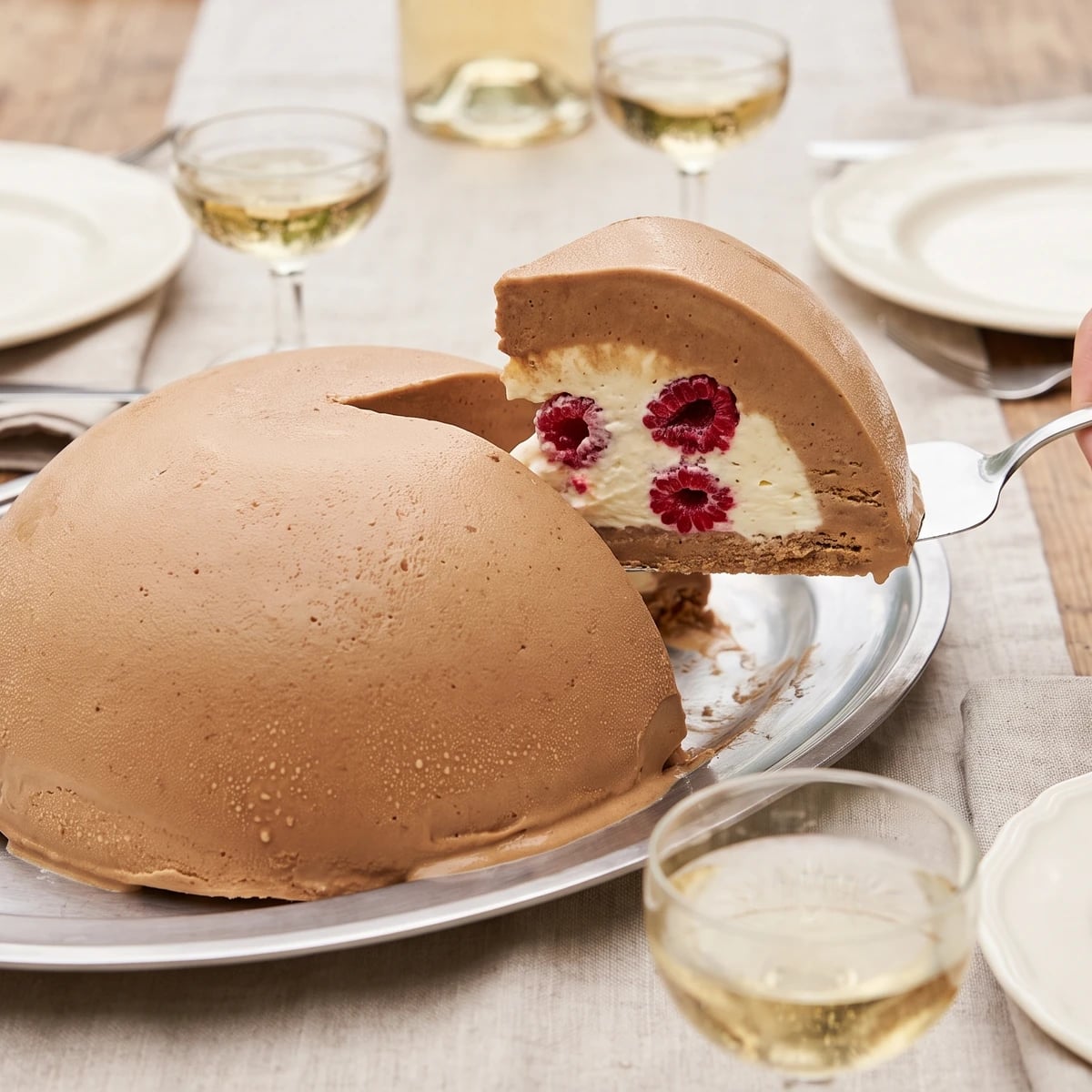
Praline ice forms the nut-brown shell, raspberry Chantilly fills the heart, and every slice holds its clean contrast: firm and nutty outside, cloud-soft within, with whole berries left bright and intact.
Bombe à la Valençay (a praline ice bombe filled with raspberry Chantilly) teaches the architecture of a frozen dessert. One ice clothes the mould in a continuous shell, a lighter filling sits inside it, and the first clean slice reveals the work. The contrast is the dish: concentrated roasted praline around ivory Chantilly, with whole raspberries held like bright little seals through the cream.
The original assumed a pâtissier churning ice, another pair of hands managing the filling, and a bombe mould buried in salted ice. Your electric ice cream maker and household freezer do the same jobs in sequence. The salted-ice tub and brigade timing are scaffolding and can go; the complete praline shell and the cold, lightly folded raspberry Chantilly are the dish and must stay. This is one cook, one stove, one evening. The freezer supplies the brigade.
When it is ready, the dome turns out smooth and nut-brown, then softens just enough at the table for the knife to pass through without crushing the filling. The step that decides everything is the fold: cream, bowl, and berries must be cold, then the spatula moves lightly enough to leave every raspberry whole.
Frozen bombes belong to the grand confectionery repertoire of Paris, where metal moulds were layered with one ice and packed with another to create a dramatic cut face at the table. The Valençay title points to the château town in Berry, a name carried into formal menus, but this praline and raspberry formula is a confectioner's composition rather than a Berry farmhouse sweet. Its kinship with savoury aspic is technical: both use chemiser, to clothe the mould, so a clean outer layer holds and reveals the centre when turned out.
Quantity
¾ cup (180 ml / 100 g)
Quantity
½ cup (120 ml / 100 g)
for the pralin
Quantity
1¼ cups (300 ml / 310 g)
Quantity
1¼ cups (300 ml / 300 g)
for the praline ice
Quantity
5 (about 6 tablespoons / 90 g)
Quantity
⅓ cup (80 ml / 65 g)
for the custard
Quantity
⅛ teaspoon (0.6 ml / 0.8 g)
Quantity
1½ cups (360 ml / 360 g)
for the Chantilly
Quantity
¼ cup (60 ml / 30 g)
Quantity
2 cups (475 ml / 250 g)
thoroughly cold and dry
Quantity
1 technique reference (No. 916)
consulted only for clothing the mould; no part is added to the dessert
| Ingredient | Quantity |
|---|---|
| blanched almonds | ¾ cup (180 ml / 100 g) |
| granulated sugarfor the pralin | ½ cup (120 ml / 100 g) |
| whole milk | 1¼ cups (300 ml / 310 g) |
| heavy creamfor the praline ice | 1¼ cups (300 ml / 300 g) |
| large egg yolks | 5 (about 6 tablespoons / 90 g) |
| granulated sugarfor the custard | ⅓ cup (80 ml / 65 g) |
| fine sea salt | ⅛ teaspoon (0.6 ml / 0.8 g) |
| cold heavy creamfor the Chantilly | 1½ cups (360 ml / 360 g) |
| confectioners' sugar | ¼ cup (60 ml / 30 g) |
| fresh raspberriesthoroughly cold and dry | 2 cups (475 ml / 250 g) |
| Another Method of Preparing Aspics de Filets de Soles (optional)consulted only for clothing the mould; no part is added to the dessert | 1 technique reference (No. 916) |
Heat the oven to 175°C (350°F). Toast the almonds for 8 to 10 minutes, until golden through and distinctly nutty in aroma. Melt the ½ cup sugar in a wide, clean saucepan over medium heat, turning the pan rather than stirring, until it becomes a deep amber caramel. If the sugar clumps, lower the heat and leave it alone; the clumps will melt as the surrounding caramel warms. Add the hot almonds, turn them through the caramel, and immediately spread the mixture on baking paper. Once completely cold, break it up and process it into very fine, slightly oily crumbs. This is pralin, and pralined means treated with this mixture.
Bring the milk and 1¼ cups cream just to the edge of a simmer. Whisk the yolks with the ⅓ cup sugar until blended and slightly pale, then pour in the hot dairy gradually while whisking. Return everything to the saucepan and cook over low heat, stirring constantly across the bottom and corners, until the custard reaches 82 to 84°C (180 to 183°F) and nappes, meaning it coats the back of a spoon. Do not let it boil. If a few curds appear, take it off the heat at once, blend until smooth, and pass it through a fine sieve. Ça se rattrape.
Blend the pralin and salt into the hot custard until the mixture is as smooth as the nuts allow. Set the bowl over an ice bath and stir until thoroughly cold, then refrigerate for at least 45 minutes. Churn in an ice cream maker until it holds the soft, dense shape of freshly made ice cream. A machine replaces the old salted-ice tub honestly: the equipment changes, but the fine freezing and constant movement remain.
Freeze a 1.75 litre metal bombe mould or deep bowl until very cold. Reserve about 1 cup of the praline ice for the final seal, then spoon the rest into the mould. With a cold spoon or small offset spatula, spread it over the bottom and sides in an even layer about 1.25 cm (½ inch) thick. This is chemiser, clothing the mould, the operation preserved through Another Method of Preparing Aspics de Filets de Soles (No. 916). If the ice slides toward the bottom, freeze the mould for 10 minutes and patch the thin places. Ça se rattrape. Freeze the finished shell for 45 minutes, until firm.
Set aside 2 tablespoons of the cold cream, then whip the remainder with the confectioners' sugar in a chilled bowl until it holds soft-to-medium peaks. This is Chantilly, sweetened whipped cream, and it must stay supple enough to fold. If it turns grainy, add the reserved cream and fold gently until it smooths. Add the cold, dry raspberries in two batches, lifting the Chantilly over them with a broad spatula. Do not stir or press. Crushed berries stain the cream pink and release enough juice to make the filling loose and weeping.
Spoon the raspberry Chantilly into the frozen shell without packing it down, leaving about 1.25 cm (½ inch) clear at the top. Soften the reserved praline ice for a few minutes in the refrigerator, just until spreadable, and draw it gently over the filling to make a complete seal. Work quickly enough that the shell remains firm. Cover the mould tightly and freeze for at least 6 hours, preferably overnight.
Chill the serving platter. Press a warm, wrung-out towel around the mould for 10 seconds, invert it over the platter, and lift carefully. If it holds fast, repeat with the towel for another 5 seconds rather than forcing it. If the surface softens before release, return the whole mould to the freezer for 20 minutes. Let the unmoulded bombe stand for 8 to 10 minutes before slicing with a hot, thoroughly dried knife, wiping the blade between cuts. À table!
1 serving (about 200g)
Culinary guides, cultural storytelling, and the editorial depth that makes cooking meaningful.
Discover Culinary Explorer
Chef Juliette
Bombe Aboukir sets a pale pistachio ice shell around pralined pâte à bombe, cool, nutty, and cleanly sliceable, with chopped pistachios held in a centre as light as frozen mousse.

Chef Juliette
A thin dark chocolate chemise gives way to golden apricot pâte à bombe, a frozen dinner-party dessert whose elegance depends on spreading the shell evenly before it firms.

Chef Juliette
Apricot ice holds a Kirsch-scented pâte à bombe and ribbons of stewed fruit, frozen into a gleaming dome whose clean layers depend on cold components and thoroughly drained apricots.

Chef Juliette
Strawberry ice forms a bright, clean shell around a satin Kirsch pâte à bombe, a frozen dessert that teaches precise layering, restrained alcohol, and the patience to let each layer set.