
Chef Juliette
Various Almond Preparations
Five almond preparations, one discipline: remove the skins cleanly, dry every kernel through, then cut, toast, or cloak it in pale caramel without letting its fragrant oils escape.
A cooking platform built around craft, culture, and the stories behind what we eat.
Created by Chef Juliette
Based on No. 2910, Bombe Tutti-Frutti, from Le Guide Culinaire (1907) by Auguste Escoffier
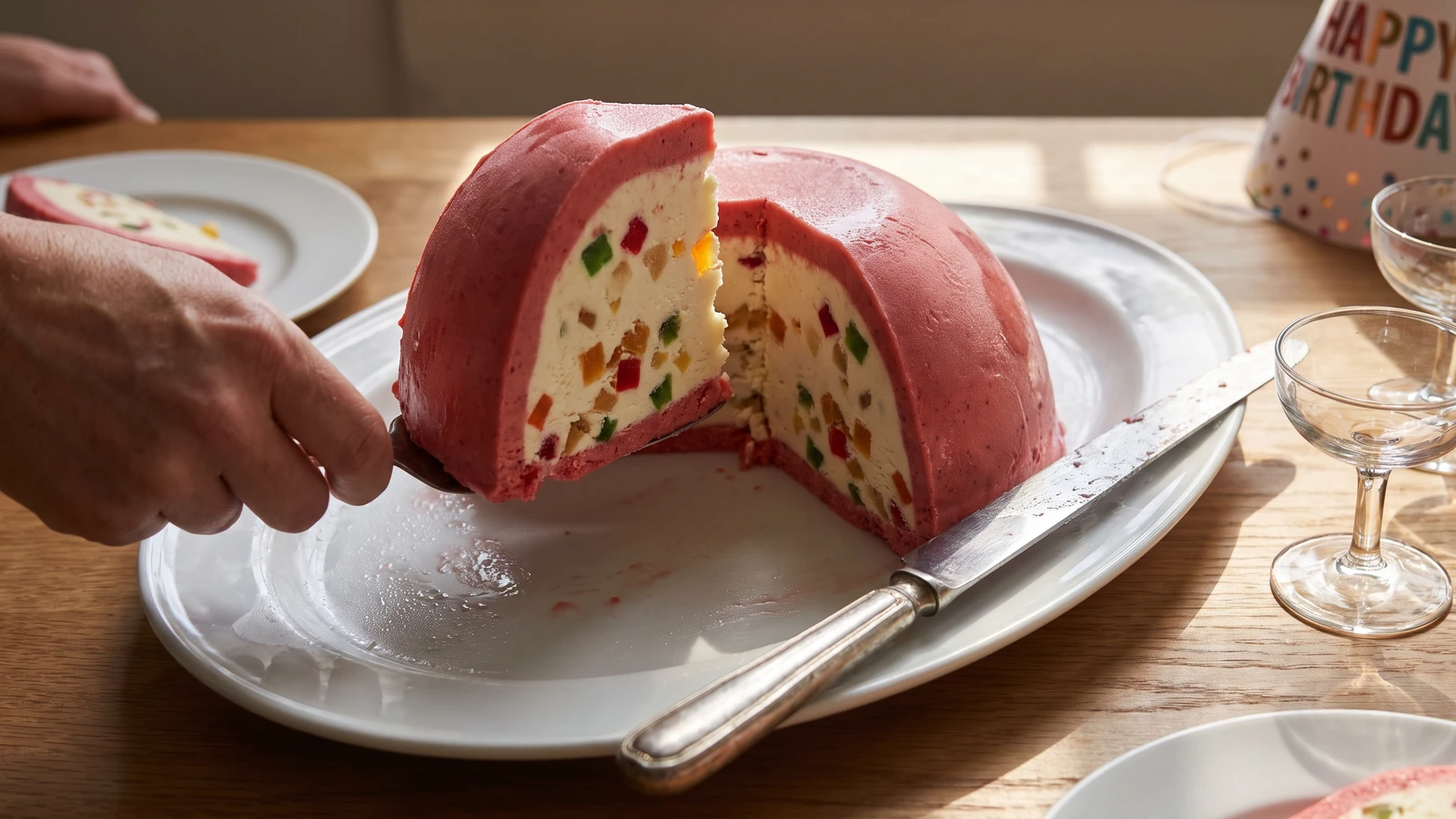
A vivid shell of strawberry ice opens onto lemon pâte à bombe flecked with jewel-like candied fruit, every slice revealing the cold precision that makes this celebration dessert magnificent.
Bombe tutti-frutti (a moulded frozen dessert of strawberry ice and lemon pâte à bombe) teaches one thing above all: temperature is structure. The strawberry shell must be firm, the hot-syrup yolk foam must be cool before it meets the cream, and the candied-fruit dice must be chilled hard or they soften the filling and sink toward the point.
The original assumed strawberry ice already waiting, a brigade-sized bombe mould kept over broken ice, and several hands to coat, fill, and freeze it. Here the quantities fill one 1.5 litre mould, a domestic freezer replaces the bed of ice, and an offset spatula does the work of the extra hands. The repeated turning used to clothe the mould is useful scaffolding; the even strawberry shell and lemon Bombe-preparation are the dish itself, and both stay.
When it is cut, the strawberry ice should hold a clean rose-red border around pale lemon cream, with small pieces of candied fruit suspended through every slice. Chill those dice before you touch the saucepan. That is the step that decides the bombe.
The bombe glacée belongs to Parisian pâtisserie and the grand French cold-dessert repertoire, its domed mould giving the preparation the shape and name of an artillery shell. Tutti-frutti denotes the assortment of candied fruits folded through the centre, not a separate French region or flavour. The source borrows its mould-clothing principle from a savoury aspic preparation because the turning motion is the same, although no fish, jelly, or aspic ingredient enters the dessert.
Quantity
4 packed cups (950 ml / 600 g)
hulled; frozen strawberries may be thawed and drained
Quantity
¾ cup (180 ml / 150 g)
for the strawberry ice
Quantity
⅓ cup (80 ml / 80 g)
for the strawberry ice
Quantity
2 tablespoons (30 ml / 30 g)
for the strawberry ice
Quantity
⅛ teaspoon (0.6 ml / 0.75 g)
Quantity
5 (about 90 g)
Quantity
¾ cup (180 ml / 150 g)
for the pâte à bombe
Quantity
¼ cup (60 ml / 60 g)
for the pâte à bombe
Quantity
1 tablespoon (15 ml / 6 g)
finely grated
Quantity
2 tablespoons (30 ml / 30 g)
for the pâte à bombe
Quantity
1½ cups (360 ml / 345 g)
Quantity
1 cup (240 ml / 180 g)
cut into 5 mm dice and blotted very dry
Quantity
1 method reference (No. 916)
used solely for the mould-clothing technique
| Ingredient | Quantity |
|---|---|
| ripe strawberrieshulled; frozen strawberries may be thawed and drained | 4 packed cups (950 ml / 600 g) |
| granulated sugarfor the strawberry ice | ¾ cup (180 ml / 150 g) |
| waterfor the strawberry ice | ⅓ cup (80 ml / 80 g) |
| fresh lemon juicefor the strawberry ice | 2 tablespoons (30 ml / 30 g) |
| fine salt | ⅛ teaspoon (0.6 ml / 0.75 g) |
| large egg yolks | 5 (about 90 g) |
| granulated sugarfor the pâte à bombe | ¾ cup (180 ml / 150 g) |
| waterfor the pâte à bombe | ¼ cup (60 ml / 60 g) |
| lemon zestfinely grated | 1 tablespoon (15 ml / 6 g) |
| fresh lemon juicefor the pâte à bombe | 2 tablespoons (30 ml / 30 g) |
| cold heavy cream | 1½ cups (360 ml / 345 g) |
| mixed candied orange peel, citron, glacé cherries, and angelicacut into 5 mm dice and blotted very dry | 1 cup (240 ml / 180 g) |
| Another Method of Preparing Aspics de Filets de Solesused solely for the mould-clothing technique | 1 method reference (No. 916) |
Spread the dry candied-fruit dice on a small tray and freeze them for at least 45 minutes. Set the clean 1.5 litre bombe mould or stainless-steel bowl beside them so it becomes thoroughly cold. The fruit may remain slightly pliable because of its sugar, but it must feel cold and firm before it meets the cream.
Combine the sugar and water for the strawberry ice in a small saucepan. Bring them just to a simmer, stirring only until the sugar dissolves, then cool completely. Blend this syrup with the strawberries, lemon juice, and salt until smooth, pass it through a fine sieve, and chill it for at least 2 hours. A cold base churns finely; a warm one freezes into coarse crystals.
Churn the strawberry mixture in an ice-cream machine until it is thick, smooth, and firm enough to mound on a spoon. Transfer it to the freezer for 15 to 25 minutes if it is flowing rather than spreading. You need the texture of soft plaster: yielding beneath the spatula, but capable of staying against the side of a cold mould.
Reserve about 1 cup (240 ml) of strawberry ice for sealing the base. Use the coating principle named in Another Method of Preparing Aspics de Filets de Soles (No. 916), turning the cold mould as you spread the remaining strawberry ice over its point and sides in an even ½-inch (1.25 cm) layer. Freeze for 45 to 60 minutes, until hard. If the ice slides downward, both mould and ice are too warm; freeze them for 10 minutes and continue. If a crack appears, press in a spoonful of soft strawberry ice. Ça se rattrape.
Put the sugar and water for the pâte à bombe in a small clean saucepan. Heat gently until the sugar dissolves, then boil without stirring until the syrup reaches 118°C (244°F). If crystals gather on the pan wall, brush them down with a little water; stirring once the syrup boils encourages the whole pan to turn grainy.
Begin whipping the egg yolks at medium speed when the syrup approaches temperature. With the mixer running, pour the hot syrup in a thin stream down the inside of the bowl, never directly onto the beaters, then whip at high speed until the pâte à bombe, the hot-syrup yolk foam, is thick, pale, and completely cool, about 7 to 10 minutes. If syrup catches on the beaters and spins into threads, stop, remove the hardened strands, and continue with the remaining syrup more slowly.
Mix the lemon zest and juice into the cooled pâte à bombe. In a separate cold bowl, whip the heavy cream to soft peaks, then fold one-third into the yolk mixture to loosen it and fold in the remainder without knocking out its volume. Add the frozen candied-fruit dice last. If the fruit begins sinking or the cream turns slack, set the bowl over ice water and fold gently for 2 or 3 minutes, just until the filling holds the dice in suspension.
Spoon the lemon filling into the frozen strawberry shell, pressing it gently into the point and against the sides so no large air pockets remain. Stop ½ inch (1.25 cm) below the rim. Spread the reserved strawberry ice over the filling to seal the base level with the mould, then cover closely and freeze for at least 6 hours, preferably overnight. If the reserved ice has hardened, leave it in the refrigerator for 5 minutes; don't heat it.
Chill the serving platter. Dip the mould in warm water for 5 to 8 seconds, dry it thoroughly, invert it onto the platter, and lift straight upward. If it refuses to release, repeat the dip for 3 seconds rather than forcing it. Return a softened bombe to the freezer for 15 minutes, then cut it with a long knife warmed in hot water and wiped dry between slices. À table!
1 serving (about 205g)
Culinary guides, cultural storytelling, and the editorial depth that makes cooking meaningful.
Discover Culinary ExplorerChef Juliette
Five almond preparations, one discipline: remove the skins cleanly, dry every kernel through, then cut, toast, or cloak it in pale caramel without letting its fragrant oils escape.

Chef Juliette
A pastry pantry lesson in one tray: filberts warmed only until their red skins release, rubbed clean, cooled, and chopped into a fragrant mise-en-place for cakes, creams, pralines, and petits fours.

Chef Juliette
The smallest pâtisserie discipline decides whether a cake leaves its mould intact: clarified butter in every corner, followed by the lightest veil of dry flour or fécule.

Chef Juliette
Four whites, one spotless bowl, and a patient change of speed: whisk gently until loosened, then briskly to glossy stiffness, with powdered sugar waiting if the foam begins to granulate.