Culinary Explorer

A cooking platform built around craft, culture, and the stories behind what we eat.
Discover Culinary Explorer
Bombe Suzanne

Bombe Suzanne

Created by Chef Juliette

Based on No. 2906, Bombe Suzanne, from Le Guide Culinaire (1907) by Auguste Escoffier

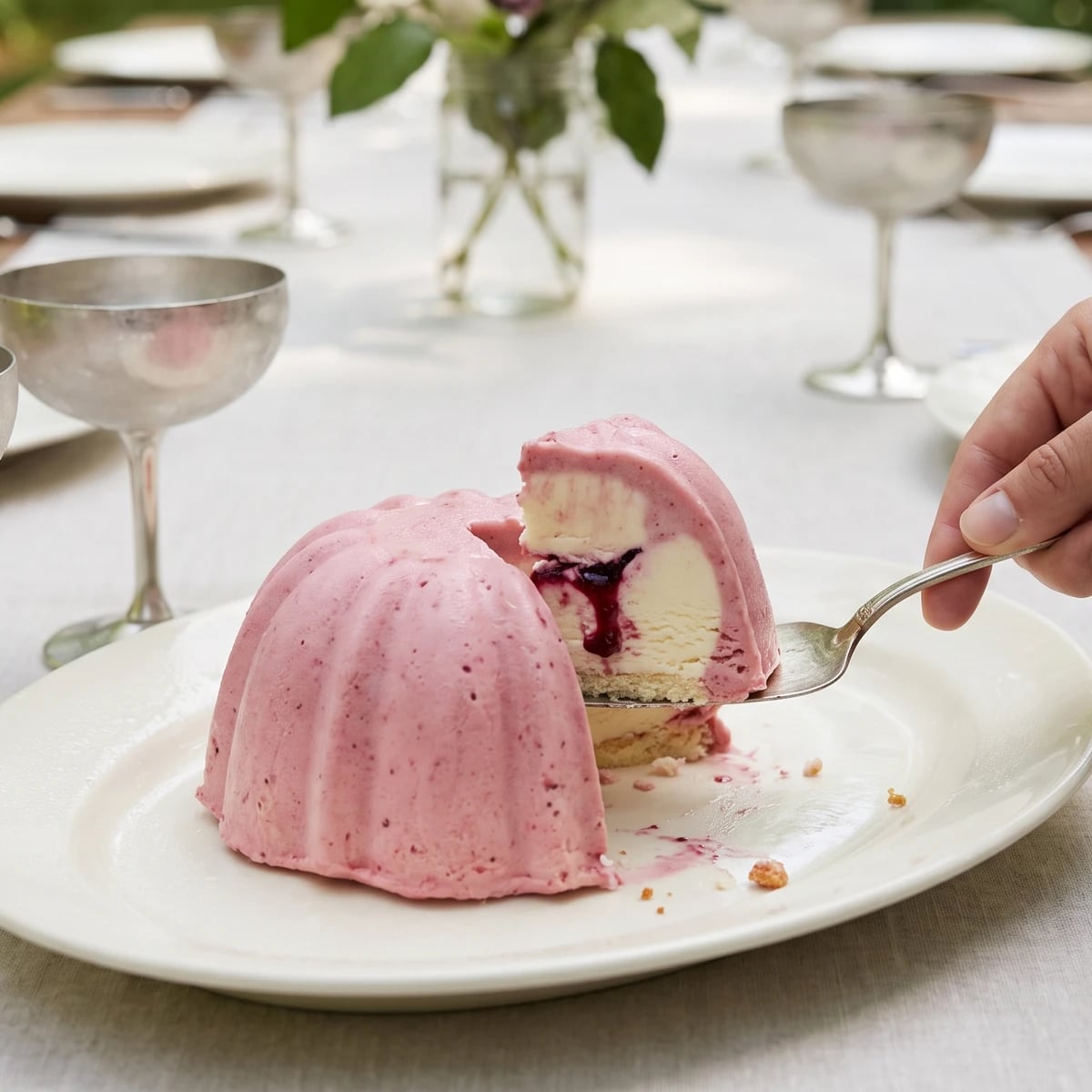
A blush-pink rum ice gives way to vanilla pâte à bombe and garnet currant veins, a moulded celebration dessert whose elegance rests on one thin, completely frozen shell.

Desserts
French
Special Occasion
Celebration
Outdoor Dining
50 min
Active Time
15 min cook7 hr total
YieldOne 5-cup (1.2 L) bombe, 8 servings

Bombe Suzanne (pink rum ice filled with vanilla cream and red-currant preserve) teaches chemisage, clothing a mould with a set layer. The shell must be thin enough to cut cleanly, thick enough to hold the centre, and completely frozen before the filling goes in. That is the one true thing to know before touching the pan.

The original recipe assumed a pastry station where pink rum ice and vanilla Bombe-preparation already waited, a proper bombe mould, and broken ice for the moulding method borrowed from aspic work. The honest home equivalents are a deep metal bowl, an ice-cream machine, and an ordinary freezer. Spreading the churned ice with a cold spoon replaces the brigade's rocking over broken ice. That choreography is scaffolding; the pale rum shell, vanilla pâte à bombe (a cooked-yolk foam folded with cream), and Bar-le-Duc jam are the dish and remain exactly where the source puts them. Only the equipment and volume change, scaled to eight portions for one cook, one stove, one long evening.

Keep the shell barely pink and the currant preserve in visible garnet veins. Most of the work is cooling and waiting, but the decisive step comes before the filling: freeze the chemisage until a fingertip leaves no mark. Then the centre stays distinct and the bombe turns out with a clean, elegant coat.

Bombe Suzanne belongs to the named bombes of the Parisian classical dessert repertory, where a fruit or spirit ice clothed a rounded mould around a richer cream centre. Its Bar-le-Duc preserve comes from Lorraine, where whole red currants are famously seeded without crushing them, traditionally with a sharpened goose quill, leaving the fruit suspended in clear ruby jelly. The cross-reference to Another Method of Preparing Aspics de Filets de Soles (No. 916) is not a savoury addition: it records how chemisage passed between the cold larder and the pastry kitchen as one shared moulding grammar.

The technique, the tradition, and the story behind every dish.

Discover Culinary Explorer

Ingredients

cold water, for the pink rum ice

Quantity

1¼ cups (300 ml / 300 g)

caster sugar, for the pink rum ice

Quantity

½ cup (120 ml / 100 g)

good rum

Quantity

2 tablespoons (30 ml / 28 g)

pink gel food colouring

Quantity

1 tiny toothpick-tip

large egg yolks

Quantity

4

caster sugar, for the pâte à bombe

Quantity

½ cup (120 ml / 100 g)

water, for the pâte à bombe

Quantity

2 tablespoons (30 ml / 30 g)

vanilla bean

Quantity

1

split and seeds scraped

heavy cream, at least 35% fat

Quantity

1¼ cups (300 ml / 300 g)

well chilled

Bar-le-Duc red-currant jam

Quantity

½ cup (120 ml / 160 g)

brought to room temperature and gently stirred

Another Method of Preparing Aspics de Filets de Soles

Quantity

1 technique reference: Another Method of Preparing Aspics de Filets de Soles (No. 916)

consulted for chemisage only; not an edible ingredient

Equipment Needed

  • 5-cup (1.2 L) metal bombe mould or deep stainless-steel bowl
  • Ice-cream machine with its bowl fully frozen
  • Stand mixer or electric hand mixer
  • Instant-read or sugar thermometer
  • Small offset spatula
  • Chilled serving platter

Instructions

  1. 1

    Chill mould and tools

    The source sends you to Another Method of Preparing Aspics de Filets de Soles (No. 916) for chemisage, the physical method of clothing a mould with a thin layer that sets before the centre is added. It is a technique reference, not a savoury ingredient. Put a 5-cup (1.2 L) metal bombe mould or deep stainless-steel bowl, an offset spatula, and the serving platter in the freezer for at least 30 minutes.

  2. 2

    Churn the rum ice

    Combine the water and sugar in a small saucepan, bring to a boil, and simmer for 2 minutes, just until perfectly clear. Cool the syrup quickly over an ice bath, then stir in the rum. Touch a toothpick to the pink colouring and dissolve that trace in a spoonful of syrup before adding it gradually to the rest. Stop at the palest blush; strong pink reads as candy. Chill thoroughly, then churn until thick and spreadable, about 20 to 25 minutes. Rum keeps an ice soft, so don't add an extra celebratory slosh. If the churned ice remains loose, spread it in a shallow tray and freeze for 20 minutes until it has the consistency of firm mortar.

  3. 3

    Clothe the mould

    Reserve about ¾ cup (180 ml) of the rum ice for the closing layer and keep it covered in the freezer. Pack the remainder over the bottom and sides of the frozen mould in an even layer about ⅜ inch (8 mm) thick, pushing it firmly against the metal with the back of a cold spoon or offset spatula. Hold the mould toward the light and patch every thin spot, then freeze for 45 minutes, until a fingertip leaves no mark. If the coating slides down the walls, scrape it back into its container and chill both mould and ice for another 15 minutes before trying again. Ça se rattrape.

  4. 4

    Whip the pâte à bombe

    Put the yolks and vanilla seeds in the mixer bowl and begin whisking at low speed. Boil the sugar and water without stirring until the syrup reaches 244°F (118°C). Increase the mixer to medium and pour the syrup in a slender stream down the inside of the bowl, keeping it away from the whisk itself. Whip at high speed until the pâte à bombe is pale, thick enough to fall in a ribbon, and completely cool, about 7 to 10 minutes. Warmth is the danger here: if the bowl still feels warm, set it over ice water and keep whisking until cool. Fold cream into a warm base and it melts, so wait.

  5. 5

    Fold in the cream

    Set aside 2 tablespoons of the liquid cream, then whip the remainder to soft peaks that bend at their tips. If it turns grainy, whisk in the reserved cream a teaspoon at a time until smooth again. Stir one-third of the whipped cream firmly into the pâte à bombe to lighten it, then fold in the rest with broad turns of the spatula, reaching to the bottom each time. Stop as soon as no white streaks remain; the air you preserve here gives the frozen centre its satin texture.

  6. 6

    Vein with currants

    Stir the room-temperature Bar-le-Duc jam gently until spoonable without crushing its currants. Drop it over the vanilla mixture in small spoonfuls and make three or four broad folds, no more. You want garnet veins running through ivory cream, not a uniformly pink filling. If the preserve sits in one heavy clump, press that clump gently against the side of the bowl and fold once more.

  7. 7

    Seal and freeze

    Spoon the filling into the frozen rum-ice shell, working it into the curve without leaving air pockets, and stop about ⅜ inch (1 cm) below the rim. Soften the reserved rum ice in the refrigerator for a few minutes if it has hardened, then spread it over the filling to close the bombe completely. Level the surface, cover tightly, and freeze for at least 5 hours, until solid through the centre. The shell, the vanilla pâte à bombe, and the Bar-le-Duc currants are the dish; this final freezing cannot be hurried.

  8. 8

    Turn out cleanly

    Wrap the mould for 5 seconds in a kitchen towel dipped in warm water and wrung nearly dry. Invert it over the frozen platter and lift gently. If the bombe refuses to release, repeat for 3 seconds rather than warming it continuously. Should the shell soften at the edge, return the unmoulded bombe to the freezer for 15 minutes. Cut with a knife dipped in hot water and wiped dry between slices, revealing the pale rum shell, vanilla centre, and red-currant veins. À table!

Chef Tips

  • Bar-le-Duc jam is the proper preserve here, prized for whole red currants held in clear jelly. If it cannot be found, use a good red-currant preserve with a bright, tart finish; seedless jelly will give the flavour but not the little bursts of fruit.
  • Colour a spoonful of rum syrup first, then use that to tint the full batch gradually. The finished shell should resemble the inside of a seashell, not confectionery. Once the colour looks obvious in the saucepan, it is already enough.
  • Keep the measured rum exact. Alcohol softens an ice, which makes the shell pleasant to cut, but too much prevents a firm release from the mould.
  • For outdoor service, transport the bombe inside its mould in an insulated cooler surrounded by frozen packs. Turn it out onto a pre-frozen platter only when everyone is ready, then keep it in deep shade.
  • Serve with black coffee or a lightly sweet sparkling wine. A very dry wine can taste sharp beside the currant preserve.

Advance Preparation

  • The completed bombe can be frozen a day ahead and kept tightly covered. Its flavour and texture remain excellent for up to 3 days.
  • The rum syrup can be cooked and chilled up to 2 days ahead, but add the rum and churn it on the day the mould is clothed.
  • Freeze the serving platter for at least 30 minutes before unmoulding. A cold platter protects the delicate base while the bombe is carried to the table.

Frequently Asked Questions

Nutrition Information

1 serving (about 130g)

Calories
310 calories
Total Fat
16 g
Saturated Fat
9 g
Trans Fat
0 g
Unsaturated Fat
5 g
Cholesterol
135 mg
Sodium
20 mg
Total Carbohydrates
39 g
Dietary Fiber
0 g
Sugars
38 g
Protein
3 g

Note: Chef personas and recipes are created with AI assistance. Cook with care: follow safe food-handling practices, check doneness with a thermometer when needed, and adapt for allergies and your kitchen.

Where cooking meets culture.

Culinary guides, cultural storytelling, and the editorial depth that makes cooking meaningful.

Discover Culinary Explorer

More from Ices and Sherbets - Various Bombes

Browse the full collection