
Chef Juliette
Various Almond Preparations
Five almond preparations, one discipline: remove the skins cleanly, dry every kernel through, then cut, toast, or cloak it in pale caramel without letting its fragrant oils escape.
A cooking platform built around craft, culture, and the stories behind what we eat.
Created by Chef Juliette
Based on No. 2899, Bombe à la Royale, from Le Guide Culinaire (1907) by Auguste Escoffier
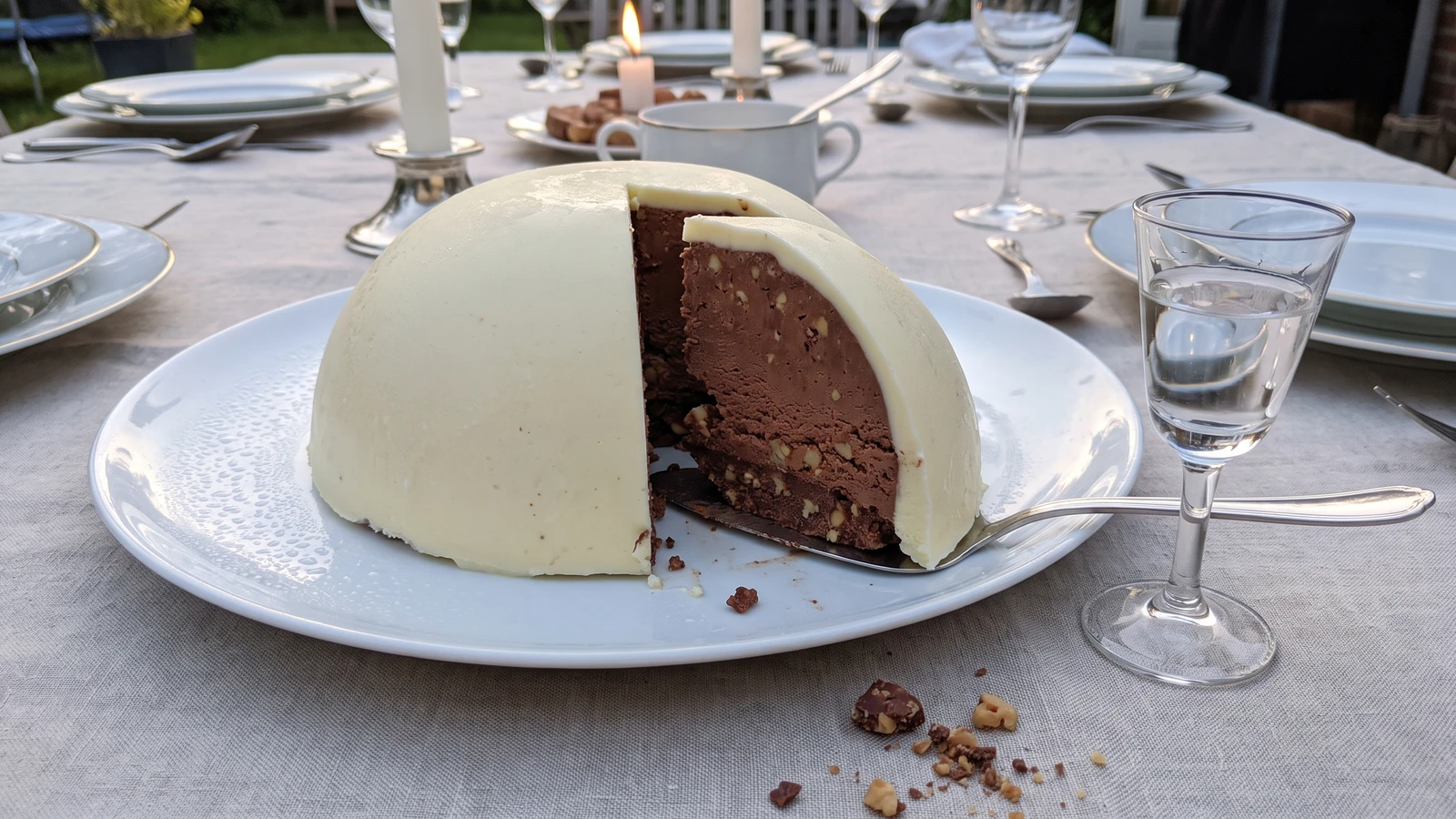
Kirsch ice forms a fine, bright shell around chocolate-praline pâte à bombe, a frozen celebration of contrast where the lightest chemise protects, rather than smothers, the creamy centre.
Bombe à la Royale (a kirsch-ice bombe with chocolate-praline centre) teaches restraint. Kirsch and chocolate want each other, but the kirsch ice must remain a fine chemise, the thin frozen lining of the mould. Make it heavy and its sugar and alcohol smother the pralined centre; keep it slender and each spoonful moves from bright cherry spirit into cool, creamy chocolate.
The source assumed a pastry kitchen with prepared ices, bombe moulds packed in salt and ice, and enough hands to turn and coat each mould while another cook made the filling. A domestic freezer, a chilled metal bowl, and an offset spatula do the same work for a six-cup bombe. The repeated packing and repacking belonged to brigade service and can go; the thin chemise and properly aerated pâte à bombe are the dish and must stay. What changed is the scale and freezing apparatus, not the flavour or its order. One cook, one stove, one evening.
The one step that decides everything comes before the filling: coat the mould no thicker than 4 mm and inspect it against the light before it freezes solid. Bare patches can be covered and heavy ones scraped back. Ça se rattrape.
The bombe belongs to the Parisian classical confectionery table, where frozen mixtures were layered inside rounded moulds and hardened in vessels packed with ice and salt. Its name comes from the domed, cannonball-like form rather than its ingredients, while titles such as royale signalled a composition rich enough for a ceremonial table, not a documented royal inventor. In this version, the unusual kirsch-ice exterior sharpens the pralined chocolate centre instead of merely decorating it.
Quantity
1 cup (240 ml / 240 g)
for the kirsch ice
Quantity
⅓ cup (80 ml / 67 g)
for the kirsch ice
Quantity
3 tablespoons (45 ml / 42 g)
Quantity
2 teaspoons (10 ml / 10 g)
Quantity
⅔ cup (160 ml / 100 g)
finely chopped
Quantity
⅓ cup (80 ml / 100 g)
Quantity
4
Quantity
½ cup (120 ml / 100 g)
for the pâte à bombe
Quantity
2 tablespoons (30 ml / 30 g)
for the pâte à bombe
Quantity
1½ cups (360 ml / 350 g)
divided, with 2 tablespoons kept unwhipped
Quantity
⅛ teaspoon (0.6 ml / 1 g)
Quantity
1 method reference (No. 916)
for clothing the mould
| Ingredient | Quantity |
|---|---|
| waterfor the kirsch ice | 1 cup (240 ml / 240 g) |
| caster sugarfor the kirsch ice | ⅓ cup (80 ml / 67 g) |
| kirsch | 3 tablespoons (45 ml / 42 g) |
| fresh lemon juice | 2 teaspoons (10 ml / 10 g) |
| dark chocolate, 64 to 70 percent cacaofinely chopped | ⅔ cup (160 ml / 100 g) |
| smooth pralined almond-hazelnut paste | ⅓ cup (80 ml / 100 g) |
| large egg yolks | 4 |
| caster sugarfor the pâte à bombe | ½ cup (120 ml / 100 g) |
| waterfor the pâte à bombe | 2 tablespoons (30 ml / 30 g) |
| cold heavy creamdivided, with 2 tablespoons kept unwhipped | 1½ cups (360 ml / 350 g) |
| fine sea salt | ⅛ teaspoon (0.6 ml / 1 g) |
| Another Method of Preparing Aspics de Filets de Solesfor clothing the mould | 1 method reference (No. 916) |
Put the water and sugar for the kirsch ice in a small saucepan. Bring to a boil, stirring only until the sugar dissolves, then simmer for 1 minute and remove from the heat. Cool completely before stirring in the kirsch and lemon juice; heat drives away the kirsch perfume, which is precisely what the shell is meant to carry. Chill the mixture thoroughly, then churn it until it resembles firm, spreadable snow. Without an ice-cream machine, freeze it in a shallow metal tray and whisk vigorously every 30 minutes until evenly slushy, about 2 hours.
Freeze a 1.5-liter metal dome mould or bowl for 20 minutes. Following the clothing principle indicated by Another Method of Preparing Aspics de Filets de Soles (No. 916), press the soft kirsch ice over the entire chilled interior with an offset spatula, turning the mould as you work. Keep the chemise between 3 and 4 mm thick, with no bare metal showing, then freeze for 30 minutes. Hold it toward the light and inspect it: patch a thin place with more ice, or scrape back a heavy ridge before it hardens completely. Ça se rattrape. Reserve enough kirsch ice to close the base later.
Set the chocolate and pralined almond-hazelnut paste in a heatproof bowl over barely simmering water, keeping the bowl above the water itself. Stir until smooth, glossy, and just warm, then remove it from the heat. Water is the enemy here. If a stray drop makes the chocolate seize, stir in 1 tablespoon of the reserved unwhipped cream and warm it gently until smooth again.
Put the yolks in the bowl of an electric mixer and begin beating at medium speed. Boil the sugar and water for the pâte à bombe without stirring until the syrup reaches 118°C (244°F). If crystals form around the pan, do not scrape them into the syrup; add a spoonful of water to a clean pan and cook it again. With the mixer running, pour the hot syrup in a thin stream down the inside of the bowl, never onto the moving whisk. Increase the speed and whip until the pâte à bombe is thick, pale, and cool enough that the bowl no longer feels warm, about 7 minutes. It should fall from the whisk in a broad ribbon.
Whip all but the reserved 2 tablespoons of cream with the salt until it holds soft folds, not stiff peaks. Stir one-third of the pâte à bombe into the warm chocolate-praline mixture to lighten it, then fold in the remainder with a broad spatula. Fold in the whipped cream in three additions, turning the bowl and cutting through the centre so the air remains inside. If the chocolate mixture tightens into little firm flecks, set the bowl over warm water for only a few seconds and fold in the remaining unwhipped cream. Stop as soon as it smooths.
Spoon the chocolate-praline pâte à bombe into the frozen chemise, pressing it gently toward the sides so no hollow pockets remain. Leave about 6 mm at the rim. Spread the reserved kirsch ice over the filling to close the base and level it with the mould. Cover tightly and freeze on a level shelf for at least 6 hours, preferably overnight. The centre needs this full rest to slice cleanly; an impatient bombe slumps at the table, and no amount of ceremony persuades it otherwise.
Chill the serving platter. Dip only the outside of the mould in tepid water for 5 seconds, dry it, and invert it onto the platter. If it does not release, wrap the mould briefly in a warm, damp towel and try again; repeated long dips melt the chemise before the centre lets go. Return the unmoulded bombe to the freezer for 15 minutes if its surface has softened. Cut with a long knife dipped in hot water and wiped dry between slices. Serve without extra sauce or decoration. The clean contrast is the finish. À table!
1 serving (about 135g)
Culinary guides, cultural storytelling, and the editorial depth that makes cooking meaningful.
Discover Culinary ExplorerChef Juliette
Five almond preparations, one discipline: remove the skins cleanly, dry every kernel through, then cut, toast, or cloak it in pale caramel without letting its fragrant oils escape.

Chef Juliette
A pastry pantry lesson in one tray: filberts warmed only until their red skins release, rubbed clean, cooled, and chopped into a fragrant mise-en-place for cakes, creams, pralines, and petits fours.

Chef Juliette
The smallest pâtisserie discipline decides whether a cake leaves its mould intact: clarified butter in every corner, followed by the lightest veil of dry flour or fécule.

Chef Juliette
Four whites, one spotless bowl, and a patient change of speed: whisk gently until loosened, then briskly to glossy stiffness, with powdered sugar waiting if the foam begins to granulate.