
Chef Juliette
Various Almond Preparations
Five almond preparations, one discipline: remove the skins cleanly, dry every kernel through, then cut, toast, or cloak it in pale caramel without letting its fragrant oils escape.
A cooking platform built around craft, culture, and the stories behind what we eat.
Created by Chef Juliette
Based on No. 2888, Bombe Saint Laud, from Le Guide Culinaire (1907) by Auguste Escoffier
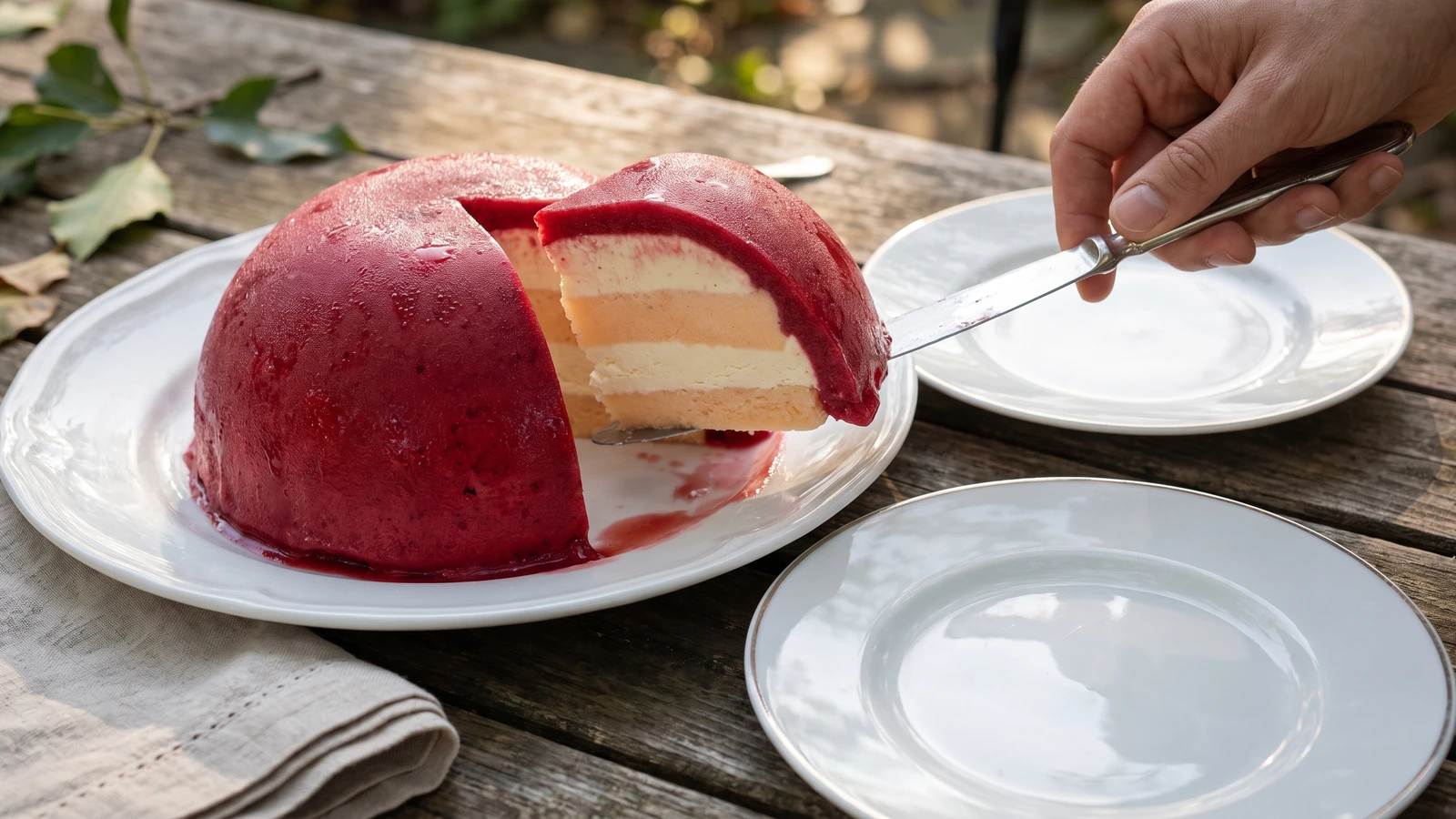
Bombe Saint Laud hides alternating melon pâte à bombe and Chantilly beneath vivid raspberry ice, a dinner-party triumph governed by one rule: concentrated fruit freezes smoothly, while watery fruit turns brittle.
Bombe Saint Laud (a raspberry-clad frozen melon bombe with Chantilly) teaches the discipline of water in frozen desserts. The one true thing to know before you touch a pan is this: melon perfume must be concentrated, because watery flesh freezes into splinters. Choose fruit that scents the room, sieve it, then let its excess juice drain until the purée sits thickly on a spoon.
The original formula assumed a pastry brigade, a metal bombe mould buried in salted ice, and separate stores of raspberry ice, melon bombe-preparation, and Chantilly ready for service. The entry gives the architecture but no quantities, so this version scales it to one 1.5-litre mould for eight. A domestic churn, a chilled metal bowl, and an ordinary freezer replace the salted ice and extra hands. Large-batch production was scaffolding, so it goes. Chemiser, to clothe the mould with raspberry ice, and alternating melon appareil à bombe with Chantilly are the dish, so they stay. One cook, one stove, one evening of work, then the freezer finishes.
Cut properly, the Bombe Saint Laud reveals a ruby shell around pale cantaloupe and ivory cream, each layer distinct but soft enough to surrender to the spoon. The step that matters most is hard-freezing the complete raspberry coat before the filling enters; if that shell remains soft, the colours smear and the bombe loses its beautiful section.
Bombe Saint Laud belongs to the Parisian grand-kitchen family of entremets glacés, composed frozen sweets served from rounded metal moulds after the savoury courses. Saint Laud is a menu title, not evidence that melon, raspberry, and Chantilly form a Normandy regional dessert; its identity lies in the classical arrangement of coloured ice around layered cream. The source's cross-reference to Another Method of Preparing Aspics de Filets de Soles (No. 916) is technical: savoury aspic and this frozen dessert use the same mould-clothing action, though no fish preparation enters the bombe.
Quantity
About 2 cups (475 ml / 490 g), using Another Method of Preparing Aspics de Filets de Soles (No. 916); yield from the next five ingredients
Quantity
3 cups (710 ml / 375 g)
fresh or frozen at their peak and thawed
Quantity
1/2 cup (120 ml / 100 g)
Quantity
3 tablespoons (45 ml / 45 g)
Quantity
2 teaspoons (10 ml / 10 g)
Quantity
1 pinch (0.3 ml / 0.4 g)
Quantity
1 medium melon (about 2 3/4 lb / 1.25 kg whole), yielding 2 1/2 cups (590 ml / 400 g) diced flesh
peeled, seeded, diced, puréed, sieved, and drained
Quantity
3 large yolks (3 tablespoons / 45 ml / 54 g)
Quantity
Scant 1/2 cup (105 ml / 90 g)
Quantity
2 tablespoons plus 1 tablespoon if needed (30 to 45 ml / 30 to 45 g)
Quantity
3/4 cup (180 ml / 180 g)
Quantity
3/4 cup (180 ml / 180 g)
Quantity
3 tablespoons (45 ml / 22 g)
Quantity
1/2 teaspoon (2.5 ml / 2.5 g)
| Ingredient | Quantity |
|---|---|
| prepared raspberry ice for clothing the mould | About 2 cups (475 ml / 490 g), using Another Method of Preparing Aspics de Filets de Soles (No. 916); yield from the next five ingredients |
| raspberriesfresh or frozen at their peak and thawed | 3 cups (710 ml / 375 g) |
| granulated sugar for the raspberry ice | 1/2 cup (120 ml / 100 g) |
| water for the raspberry ice | 3 tablespoons (45 ml / 45 g) |
| fresh lemon juice | 2 teaspoons (10 ml / 10 g) |
| fine sea salt | 1 pinch (0.3 ml / 0.4 g) |
| ripe Charentais melon or cantaloupepeeled, seeded, diced, puréed, sieved, and drained | 1 medium melon (about 2 3/4 lb / 1.25 kg whole), yielding 2 1/2 cups (590 ml / 400 g) diced flesh |
| pasteurized egg yolks | 3 large yolks (3 tablespoons / 45 ml / 54 g) |
| granulated sugar for the melon appareil à bombe | Scant 1/2 cup (105 ml / 90 g) |
| water for the sugar syrup | 2 tablespoons plus 1 tablespoon if needed (30 to 45 ml / 30 to 45 g) |
| cold heavy cream for the melon appareil à bombe | 3/4 cup (180 ml / 180 g) |
| cold heavy cream for the Chantilly | 3/4 cup (180 ml / 180 g) |
| confectioners' sugar | 3 tablespoons (45 ml / 22 g) |
| pure vanilla extract | 1/2 teaspoon (2.5 ml / 2.5 g) |
Freeze a clean 1.5-litre hemispherical metal mould or stainless-steel bowl for at least 1 hour. Chill the mixer bowl, beaters, and offset spatula as well, and prepare the ice-cream-machine canister according to its instructions. Cold equipment buys working time and keeps every layer where you put it.
Stir the 100 g granulated sugar and 45 ml water over medium heat just until the sugar dissolves, then boil for 1 minute and cool completely. Purée the raspberries and press them through a fine sieve, taking the smooth pulp and leaving every seed behind. Whisk in the cold syrup, lemon juice, and salt, then chill the mixture for at least 30 minutes. It should taste slightly sweeter and sharper than you want at the table, because freezing mutes both.
Churn the raspberry mixture until it is dense, matte, and firm enough to hold the ridges made by the paddle, usually 20 to 25 minutes. Transfer it to a shallow chilled container. If it is too loose to spread, freeze it for 15 minutes and stir every 5 minutes; if it has become hard, soften it in the refrigerator until pliable. You need raspberry ice with the consistency of thick mortar, neither flowing nor brittle.
Purée the diced melon until smooth, then pass it through a fine sieve. Set the purée in a sieve lined with damp muslin or a coffee filter and let it drain over a bowl for 20 to 30 minutes without pressing. Measure 1 cup (240 ml / 250 g) of thick purée. It should settle slowly from a spoon rather than run like juice. If it still pours freely, keep draining; that excess water is what would freeze into splinters.
Begin beating the pasteurized yolks at medium speed until pale and lightly thickened. Put the 90 g granulated sugar and 30 ml water in a small saucepan, dissolve the sugar gently, then boil without stirring to 118°C. If crystals form on the pan before the syrup reaches temperature, add the reserved tablespoon of water, cover for 30 seconds, and let the condensation dissolve them before continuing. Pour the hot syrup in a thin stream down the inside of the mixer bowl while beating, keeping it away from the moving whisk. Increase the speed and whip until the pâte à bombe is thick, pale, cool, and falls in a broad ribbon, about 7 minutes.
Whip the 180 ml cream for the melon filling to soft peaks. Fold the drained melon purée into the cool pâte à bombe, one third at a time, then lighten it with one third of the whipped cream before folding in the remainder. Keep the spatula broad and deliberate so the air stays in the mixture. If the pâte à bombe still feels warm, chill it over a bowl of cold water before adding the cream; warmth collapses the foam. Refrigerate the finished melon appareil à bombe until spoonable.
Reserve 1 tablespoon of the measured cream, then whip the remainder with the confectioners' sugar and vanilla until it holds soft, definite peaks. Chantilly must have enough body to remain a separate layer but should never look grainy. If it begins to roughen, stop and fold in the reserved liquid cream by hand; the texture will smooth again. Keep it cold.
Following the coating action in Another Method of Preparing Aspics de Filets de Soles (No. 916), chemiser, or clothe, the frozen mould with raspberry ice. Rotate the mould as you spread an even layer 8 to 10 mm thick over the bottom and sides, working from the centre toward the rim. Freeze for 20 minutes, then hold the mould toward the light and patch any thin or translucent places. If the coating slides, the ice or mould is too warm; refreeze both for 10 minutes and rebuild the patch. Reserve enough raspberry ice to close the top.
Spoon one third of the melon appareil à bombe into the hard raspberry shell and smooth it level. Freeze for 10 minutes, just until the surface resists a light fingertip, then add half the Chantilly. Repeat with another third of melon, the remaining Chantilly, and the final melon layer, firming each briefly before the next enters. Leave about 8 mm below the rim. If a pale layer begins sinking into the one beneath it, stop and freeze the mould for another 10 minutes. Ça se rattrape. Seal the filled mould with the reserved raspberry ice and smooth it flush with the rim.
Freeze the uncovered bombe for 1 hour, then wrap the mould closely once the surface is hard. Continue freezing for at least 5 hours, preferably overnight. The centre must be completely firm before unmoulding, or the weight of the filling will split the raspberry shell.
Chill the serving platter. Wrap the outside of the mould with a towel wrung out in hot water for 5 to 8 seconds, loosen the rim with a fingertip, and invert onto the platter. If the bombe does not release, repeat for 3 seconds rather than warming it continuously. Return a soft-looking bombe to the freezer for 20 minutes. Let the unmoulded dessert stand for 8 minutes, then cut it with a knife dipped in hot water and wiped dry between slices. The raspberry shell should yield cleanly around the striped melon and Chantilly centre. À table!
1 serving (about 180g)
Culinary guides, cultural storytelling, and the editorial depth that makes cooking meaningful.
Discover Culinary ExplorerChef Juliette
Five almond preparations, one discipline: remove the skins cleanly, dry every kernel through, then cut, toast, or cloak it in pale caramel without letting its fragrant oils escape.

Chef Juliette
A pastry pantry lesson in one tray: filberts warmed only until their red skins release, rubbed clean, cooled, and chopped into a fragrant mise-en-place for cakes, creams, pralines, and petits fours.

Chef Juliette
The smallest pâtisserie discipline decides whether a cake leaves its mould intact: clarified butter in every corner, followed by the lightest veil of dry flour or fécule.

Chef Juliette
Four whites, one spotless bowl, and a patient change of speed: whisk gently until loosened, then briskly to glossy stiffness, with powdered sugar waiting if the foam begins to granulate.