
Chef Juliette
Various Almond Preparations
Five almond preparations, one discipline: remove the skins cleanly, dry every kernel through, then cut, toast, or cloak it in pale caramel without letting its fragrant oils escape.
A cooking platform built around craft, culture, and the stories behind what we eat.
Created by Chef Juliette
Based on No. 2876, Bombe Médicis, from Le Guide Culinaire (1907) by Auguste Escoffier
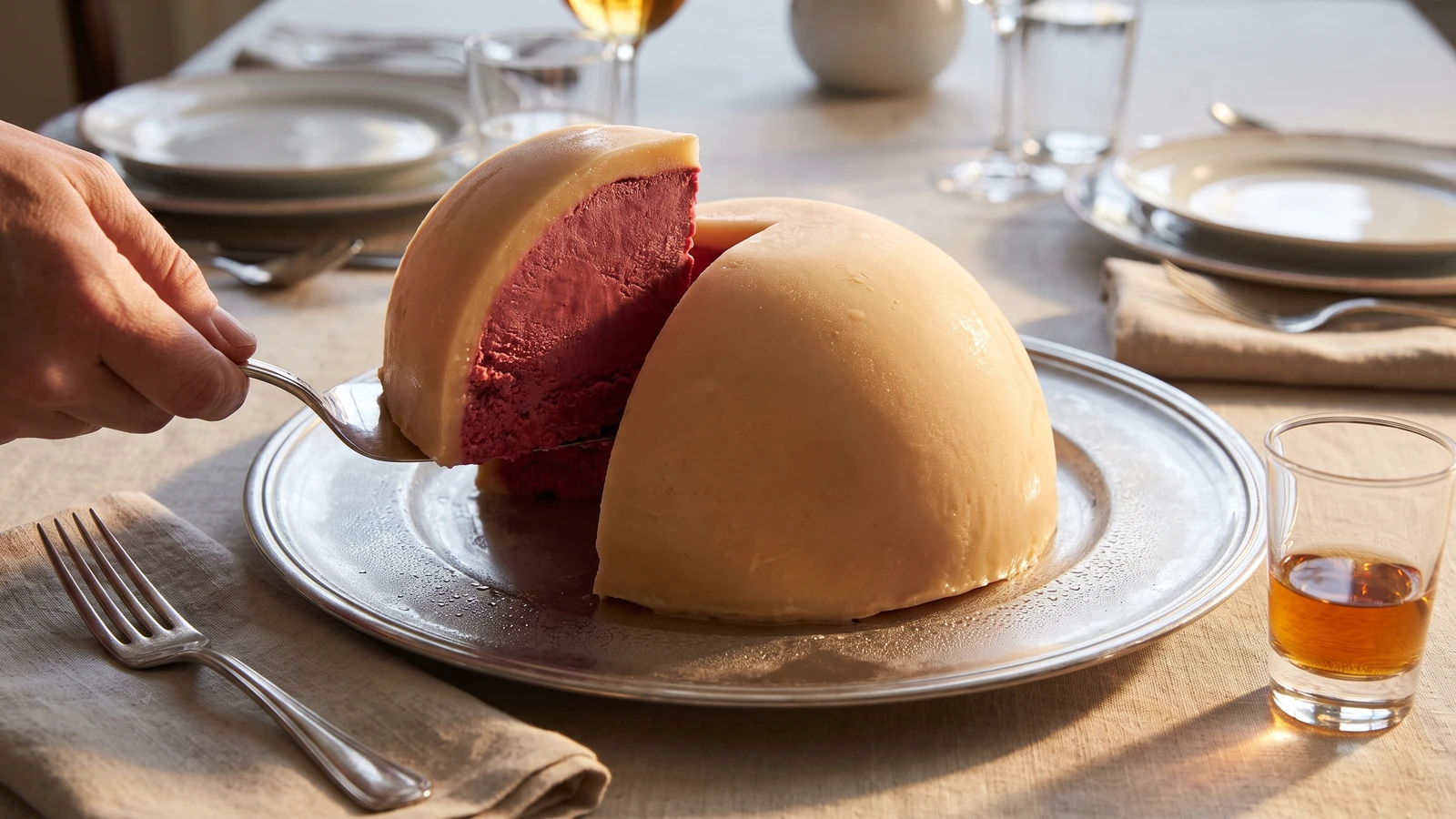
Bombe Médicis teaches frozen architecture: a pliable brandy ice shell around a rose-pink raspberry pâte à bombe, packed firmly and frozen long enough to turn out in one generous, clean-cut dome.
Bombe Médicis (a brandy-ice dome filled with creamy raspberry mousse) teaches the architecture of a bombe glacée: the outside must hold while the center remains creamy enough to cut. Its filling is a raspberry pâte à bombe, a syrup-cooked yolk mousse lightened with whipped cream. The one true thing to know before touching a pan is that alcohol lowers the freezing point. Brandy ice will always be softer than plain sorbet, so pack it cold, freeze the shell before filling it, and give the finished mould a full three hours undisturbed.
The original recipe assumed a confiseur, the pastry cook responsible for frozen sweets, with freezing pails, broken ice and salt, and a bank of metal bombe moulds. The honest home equivalents are a 1-liter metal bowl, an ice-cream maker, an electric mixer, and the coldest part of a domestic freezer. The brigade quantity becomes eight generous slices, and only the service scaffolding is cut. The dish itself remains: brandy ice clothes the mould, and raspberry pâte à bombe fills it. One cook, one stove, one evening.
The shell is the step that decides it. Press it evenly, patch every thin place while the ice is still pliable, and don't hurry the final freeze. When the dome turns out, pale amber outside and raspberry-rose within, that spare old instruction suddenly makes perfect sense.
Bombe glacée belongs to the Parisian grand-kitchen and confectionery repertoire, where contrasting frozen mixtures were packed into rounded metal moulds and turned out as dining-room centerpieces. The Médicis title reflects the canon's fondness for courtly names, but it does not prove the familiar tale that Catherine de Médicis introduced French cooks to frozen desserts. The reference to Another Method of Preparing Aspics de Filets de Soles (No. 916) is technical rather than savory: cold kitchens used the same principle of clothing a mould with an even outer layer.
Quantity
1¼ cups (300 ml / 300 g)
Quantity
¾ cup (180 ml / 150 g)
Quantity
⅓ cup (80 ml / 76 g)
Quantity
1 tablespoon (15 ml / 15 g)
Quantity
⅛ teaspoon (0.6 ml / 0.7 g)
Quantity
2½ cups (600 ml / 300 g)
thawed if frozen
Quantity
2 teaspoons (10 ml / 10 g)
Quantity
½ cup (120 ml / 100 g)
Quantity
2 tablespoons (30 ml / 30 g)
Quantity
4 (about 72 g)
Quantity
1 cup (240 ml / 240 g)
well chilled
Quantity
Technique reference only (No. 916)
| Ingredient | Quantity |
|---|---|
| water, for the brandy ice | 1¼ cups (300 ml / 300 g) |
| granulated sugar, for the brandy ice | ¾ cup (180 ml / 150 g) |
| French brandy | ⅓ cup (80 ml / 76 g) |
| fresh lemon juice, for the brandy ice | 1 tablespoon (15 ml / 15 g) |
| fine salt | ⅛ teaspoon (0.6 ml / 0.7 g) |
| fresh or frozen raspberriesthawed if frozen | 2½ cups (600 ml / 300 g) |
| fresh lemon juice, for the raspberry purée | 2 teaspoons (10 ml / 10 g) |
| granulated sugar, for the pâte à bombe | ½ cup (120 ml / 100 g) |
| water, for the pâte à bombe | 2 tablespoons (30 ml / 30 g) |
| large egg yolks | 4 (about 72 g) |
| heavy creamwell chilled | 1 cup (240 ml / 240 g) |
| Another Method of Preparing Aspics de Filets de Soles | Technique reference only (No. 916) |
Put the water and sugar for the brandy ice in a small saucepan. Warm gently, stirring only until the sugar dissolves, then boil for one minute. Take the pan from the heat and stir in the salt. Cool the syrup completely over an ice bath before adding the brandy and lemon juice; adding the brandy while the syrup is hot throws its aroma into the room instead of keeping it in the dessert. Chill the mixture until thoroughly cold, and place the clean 1-liter mould in the freezer.
Churn the cold mixture in an ice-cream maker until it resembles fine, wet snow and holds a ridge from the paddle, about 20 to 25 minutes. It will remain softer than ordinary sorbet because of the brandy. That is correct. Transfer it to the freezer for 10 minutes if it flows instead of holding against a spoon.
Chemiser, to clothe the mould, is the operation preserved through Another Method of Preparing Aspics de Filets de Soles (No. 916). Its savory ingredients have no place here, but its principle remains exact: form a continuous, even outer layer against a cold mould. Pack the brandy ice about 1 cm thick across the bottom and sides, pressing firmly with the back of a cold spoon. Reserve about ¾ cup (180 ml) for sealing the base. Hold the mould toward a light and patch every translucent or thin place. If the ice slides, freeze it for 10 minutes and continue; if a patch cracks, press fresh ice across it. Ça se rattrape. Freeze the clothed mould for 20 minutes.
Purée the raspberries with the lemon juice, then press them through a fine sieve to remove the seeds. Measure 1 cup (240 ml / about 225 g) of smooth purée and chill it. Whip the cold cream to soft peaks that curl over when the whisk is lifted, then return it to the cold. If the cream becomes grainy and stiff, fold in 1 tablespoon of unwhipped cream until it relaxes; don't keep beating.
Begin beating the yolks at medium speed until they are loosened and slightly pale. Put the sugar and water for the pâte à bombe in a clean small saucepan, heat gently until dissolved, then boil without stirring to 118°C. If crystals form before the syrup reaches temperature, add 1 teaspoon of water and return it to gentle heat until clear. Ça se rattrape. With the mixer running, pour the hot syrup in a thin stream down the inside of the bowl, avoiding the moving whisk. Beat at high speed until the pâte à bombe is thick, glossy, and no warmer than the room, about 8 minutes. A little hardened syrup on the bowl can be ignored; grainy yolks should be passed through a fine sieve while the mixture is still warm.
Fold the chilled raspberry purée into the pâte à bombe in three additions, turning from the bottom until no yellow streaks remain. Fold in one-third of the whipped cream to loosen the mixture, then add the remainder with broad, gentle turns. Stop as soon as the color is evenly raspberry-rose. If the filling looks loose, chill it for 10 minutes before filling the mould; more stirring will only knock out the air that gives the center its creamy cut.
Spoon the raspberry pâte à bombe into the clothed mould, pressing the first spoonfuls gently against the brandy-ice shell so no hollow pockets remain. Fill to about 1 cm below the rim and smooth the surface. Mash the reserved brandy ice until pliable, spread it across the filling to seal the base, and level it flush with the rim. Cover tightly and freeze in the coldest part of the freezer for a full three hours. This wait is the dish, not brigade scaffolding. The brandy ice needs every minute to hold its shape.
Chill the serving platter. Dip the mould in warm water for 5 seconds, wipe it dry, invert it onto the platter, and lift carefully. If it refuses to release, wrap the mould for a few seconds in a towel dipped in warm water; don't leave it submerged, or the soft brandy shell will melt first. If an edge slumps, return the unmoulded bombe to the freezer for 15 minutes. Cut with a knife dipped in hot water and wiped dry between slices. À table!
1 serving (about 155g)
Culinary guides, cultural storytelling, and the editorial depth that makes cooking meaningful.
Discover Culinary ExplorerChef Juliette
Five almond preparations, one discipline: remove the skins cleanly, dry every kernel through, then cut, toast, or cloak it in pale caramel without letting its fragrant oils escape.

Chef Juliette
A pastry pantry lesson in one tray: filberts warmed only until their red skins release, rubbed clean, cooled, and chopped into a fragrant mise-en-place for cakes, creams, pralines, and petits fours.

Chef Juliette
The smallest pâtisserie discipline decides whether a cake leaves its mould intact: clarified butter in every corner, followed by the lightest veil of dry flour or fécule.

Chef Juliette
Four whites, one spotless bowl, and a patient change of speed: whisk gently until loosened, then briskly to glossy stiffness, with powdered sugar waiting if the foam begins to granulate.