
Chef Juliette
Bombe Aboukir
Bombe Aboukir sets a pale pistachio ice shell around pralined pâte à bombe, cool, nutty, and cleanly sliceable, with chopped pistachios held in a centre as light as frozen mousse.
A cooking platform built around craft, culture, and the stories behind what we eat.
Created by Chef Juliette
Based on No. 2874, Bombe Mascotte, from Le Guide Culinaire (1907) by Auguste Escoffier
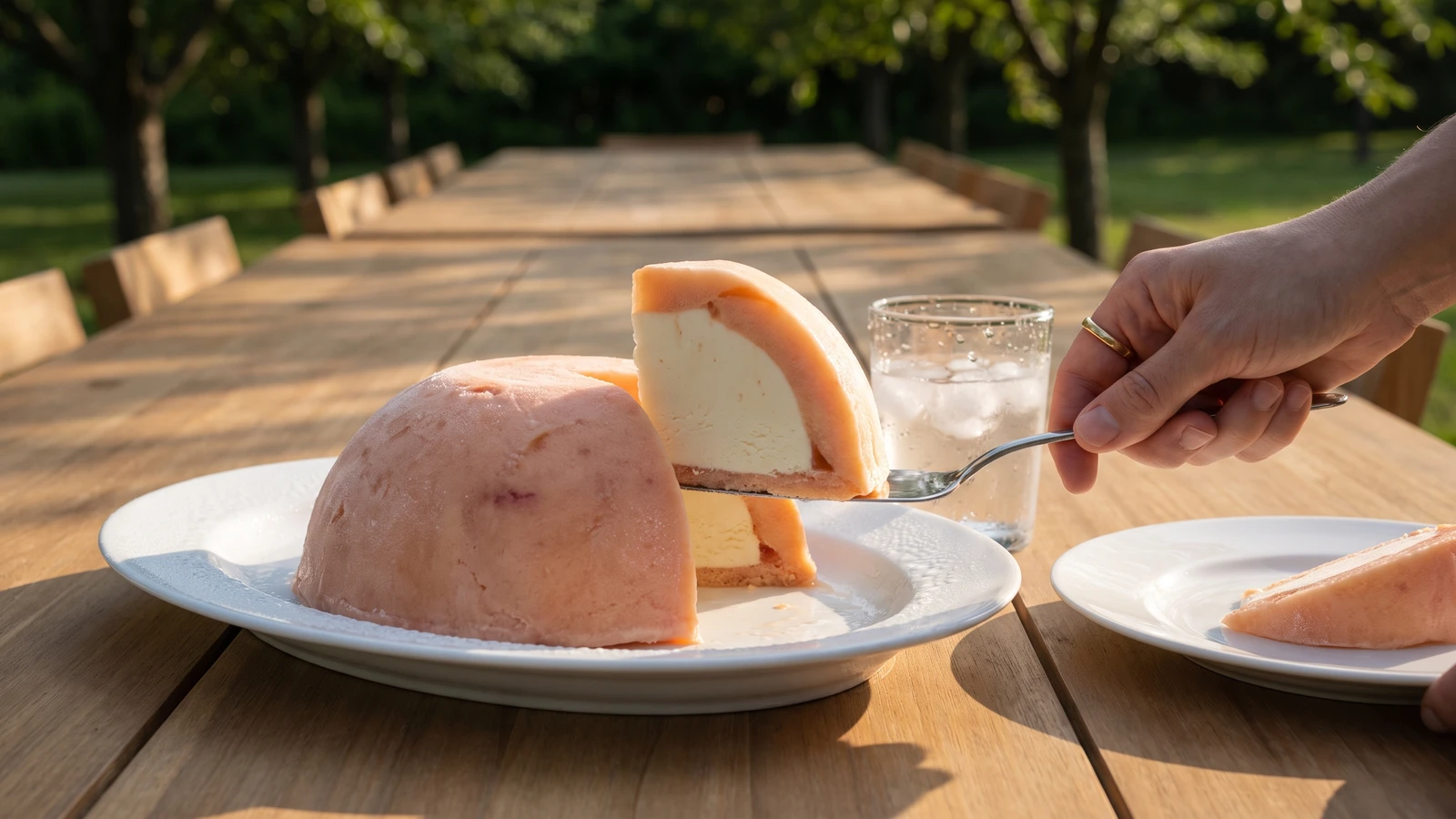
Raw-peach ice forms the fragrant shell, Kirsch pâte à bombe the satin centre. Master the freeze between layers and this grand-looking dessert becomes calm, precise work for one home freezer.
Bombe Mascotte (a moulded peach ice with a Kirsch-enriched yolk-and-cream centre) teaches that cold is structure. Each layer must be firm enough to support the next, but still supple enough to join it without a gap. Before you touch a pan, know the truth that decides its flavour: blanch the peaches only long enough to slip their skins, then sieve them raw. Cooked peach loses its scent entirely.
The source can afford one sentence because it assumes a pastry section with peach ice and Kirsch Bombe-preparation already waiting, a dedicated freezing pail packed with salted ice, and several hands to chemiser le moule, to clothe the mould. At home, a 1½-quart stainless-steel bowl, an ice-cream machine or food processor, and an ordinary freezer do the same work. The freezing pail and brigade portions are scaffolding, so they go. The raw-peach shell, the Kirsch pâte à bombe, and the firm freeze between them are the dish, so they stay. One cook, one stove, one evening, with the freezer finishing the work.
Chemiser le moule is the step that matters most. Spread the peach ice evenly, with no thin patches and no soft wall waiting to collapse under the filling. If it slumps, stop and freeze it again before continuing. Ça se rattrape.
The bombe glacée belongs to French confectionery and the formal dining rooms of Paris, where rounded moulds were packed in salted ice and layered frozen preparations could be held for service. Mascotte is a named formula rather than a regional sweet: peach ice forms its shell and Kirsch Bombe-preparation its centre. Its surprising cross-reference to Another Method of Preparing Aspics de Filets de Soles (No. 916) is not a savoury borrowing; it shows how chemiser le moule, coating a mould evenly, passed unchanged between the cold larder and the pastry kitchen.
Quantity
7 to 8 medium (about 4¼ cups sliced / 1 kg whole; yielding about 3 cups / 700 g sieved purée)
Quantity
¾ cup (180 ml / 150 g)
Quantity
½ cup (120 ml / 120 g)
Quantity
1 tablespoon (15 ml / 15 g)
Quantity
⅛ teaspoon (0.6 ml / 0.8 g)
Quantity
4 (about ¼ cup / 72 g)
Quantity
½ cup (120 ml / 100 g)
Quantity
3 tablespoons (45 ml / 45 g)
Quantity
3 tablespoons (45 ml / 43 g)
Quantity
1¼ cups (300 ml / 300 g)
Quantity
Up to 2 tablespoons (30 ml / 30 g)
Quantity
1 prepared mould-clothing application of Another Method of Preparing Aspics de Filets de Soles (No. 916)
| Ingredient | Quantity |
|---|---|
| ripe yellow peaches | 7 to 8 medium (about 4¼ cups sliced / 1 kg whole; yielding about 3 cups / 700 g sieved purée) |
| superfine sugar for the peach ice | ¾ cup (180 ml / 150 g) |
| water for the peach ice | ½ cup (120 ml / 120 g) |
| fresh lemon juice | 1 tablespoon (15 ml / 15 g) |
| fine salt | ⅛ teaspoon (0.6 ml / 0.8 g) |
| pasteurized large egg yolks | 4 (about ¼ cup / 72 g) |
| superfine sugar for the pâte à bombe | ½ cup (120 ml / 100 g) |
| water for the pâte à bombe | 3 tablespoons (45 ml / 45 g) |
| Kirsch | 3 tablespoons (45 ml / 43 g) |
| cold heavy cream | 1¼ cups (300 ml / 300 g) |
| additional cold heavy cream (optional) | Up to 2 tablespoons (30 ml / 30 g) |
| Another Method of Preparing Aspics de Filets de Soles | 1 prepared mould-clothing application of Another Method of Preparing Aspics de Filets de Soles (No. 916) |
Put the ¾ cup sugar and ½ cup water in a small saucepan. Warm gently, stirring only until the sugar dissolves, then boil for one minute. Pour the clear syrup into a bowl and set that bowl over ice until completely cold. Chill the bombe mould or stainless-steel bowl at the same time. The fruit must never meet warm syrup, which would flatten the fresh peach perfume.
Score a shallow cross in the base of each peach. Lower them into boiling water for 10 to 15 seconds, then move them directly into ice water. Slip off the skins, halve and stone the fruit, then purée it and press it through a fine-mesh sieve. Stir in the lemon juice, salt, and cold syrup. If a skin resists, use a peeler rather than boiling the peach longer. The blanching loosens the skin; it must not cook the flesh.
Chill the peach mixture until thoroughly cold, then churn it until dense and softly frozen. It should hold a ridge from the paddle but remain spreadable. Without an ice-cream machine, freeze it in a shallow metal tray until firm around the edges, process it until smooth, then return it to the freezer until it reaches the same spreadable consistency. If it freezes solid, soften it in the refrigerator and stir firmly; do not melt it back to liquid.
Reserve about 1 cup of peach ice for the base. Using the mould-coating principle cited in Another Method of Preparing Aspics de Filets de Soles (No. 916), press the remaining peach ice over the bottom and sides of the chilled mould in an even layer about ⅝ inch thick. This is chemiser le moule. Smooth the inner wall with the back of a cold spoon, inspect it against the light for thin patches, and freeze for 45 minutes. If the coating slides or exposes the metal, press it back into place and freeze again before filling.
Whisk the pasteurized yolks in a heatproof mixer bowl until thickened and pale. Put the remaining ½ cup sugar and 3 tablespoons water in a small saucepan, dissolve the sugar gently, then boil without stirring to 244°F (118°C). With the mixer running at medium speed, pour the syrup in a thin stream down the inside of the bowl, never directly onto the whisk. Increase the speed and beat until the pâte à bombe is thick, holds a ribbon, and feels cooler than your hand, about 6 minutes. If the syrup turns grainy before reaching temperature, add a spoonful of water and dissolve it again over gentle heat. Ça se rattrape.
Beat the Kirsch into the cool pâte à bombe a spoonful at a time. Whip the 1¼ cups cold cream to soft peaks, stopping while the surface remains smooth and supple. Fold one-third into the yolk base to lighten it, then fold in the rest with broad turns until no white streaks remain. If the cream becomes grainy from overwhipping, fold in the optional unwhipped cream one teaspoon at a time until it smooths. Never fold whipped cream into a warm base; chill the base over ice first or the filling will collapse.
Spoon the Kirsch filling into the frozen peach shell, pressing it gently against the wall so no air pockets remain. Leave about ⅝ inch below the rim and freeze until the surface is firm, about 45 minutes. Soften the reserved peach ice in the refrigerator just until spreadable, pack it over the filling to seal the bombe, and level it flush with the rim. Cover tightly and freeze for at least 6 hours, preferably overnight.
Chill the serving platter. Dip the mould into warm water for 5 seconds, dry it thoroughly, place the platter over it, and invert both together. If the bombe does not release, wrap the mould in a warm damp towel for 3 seconds and try again; repeat briefly rather than warming it long enough to melt the peach shell. Let the turned-out bombe stand for 5 minutes, then cut it with a knife dipped in hot water and wiped dry between slices. The pale Kirsch centre should sit cleanly inside its coral peach ring. À table!
1 serving (about 215g)
Culinary guides, cultural storytelling, and the editorial depth that makes cooking meaningful.
Discover Culinary ExplorerChef Juliette
Bombe Aboukir sets a pale pistachio ice shell around pralined pâte à bombe, cool, nutty, and cleanly sliceable, with chopped pistachios held in a centre as light as frozen mousse.

Chef Juliette
A thin dark chocolate chemise gives way to golden apricot pâte à bombe, a frozen dinner-party dessert whose elegance depends on spreading the shell evenly before it firms.

Chef Juliette
Apricot ice holds a Kirsch-scented pâte à bombe and ribbons of stewed fruit, frozen into a gleaming dome whose clean layers depend on cold components and thoroughly drained apricots.

Chef Juliette
Strawberry ice forms a bright, clean shell around a satin Kirsch pâte à bombe, a frozen dessert that teaches precise layering, restrained alcohol, and the patience to let each layer set.