
Chef Juliette
Various Almond Preparations
Five almond preparations, one discipline: remove the skins cleanly, dry every kernel through, then cut, toast, or cloak it in pale caramel without letting its fragrant oils escape.
A cooking platform built around craft, culture, and the stories behind what we eat.
Created by Chef Juliette
Based on No. 2863, Bombe Hollandaise, from Le Guide Culinaire (1907) by Auguste Escoffier
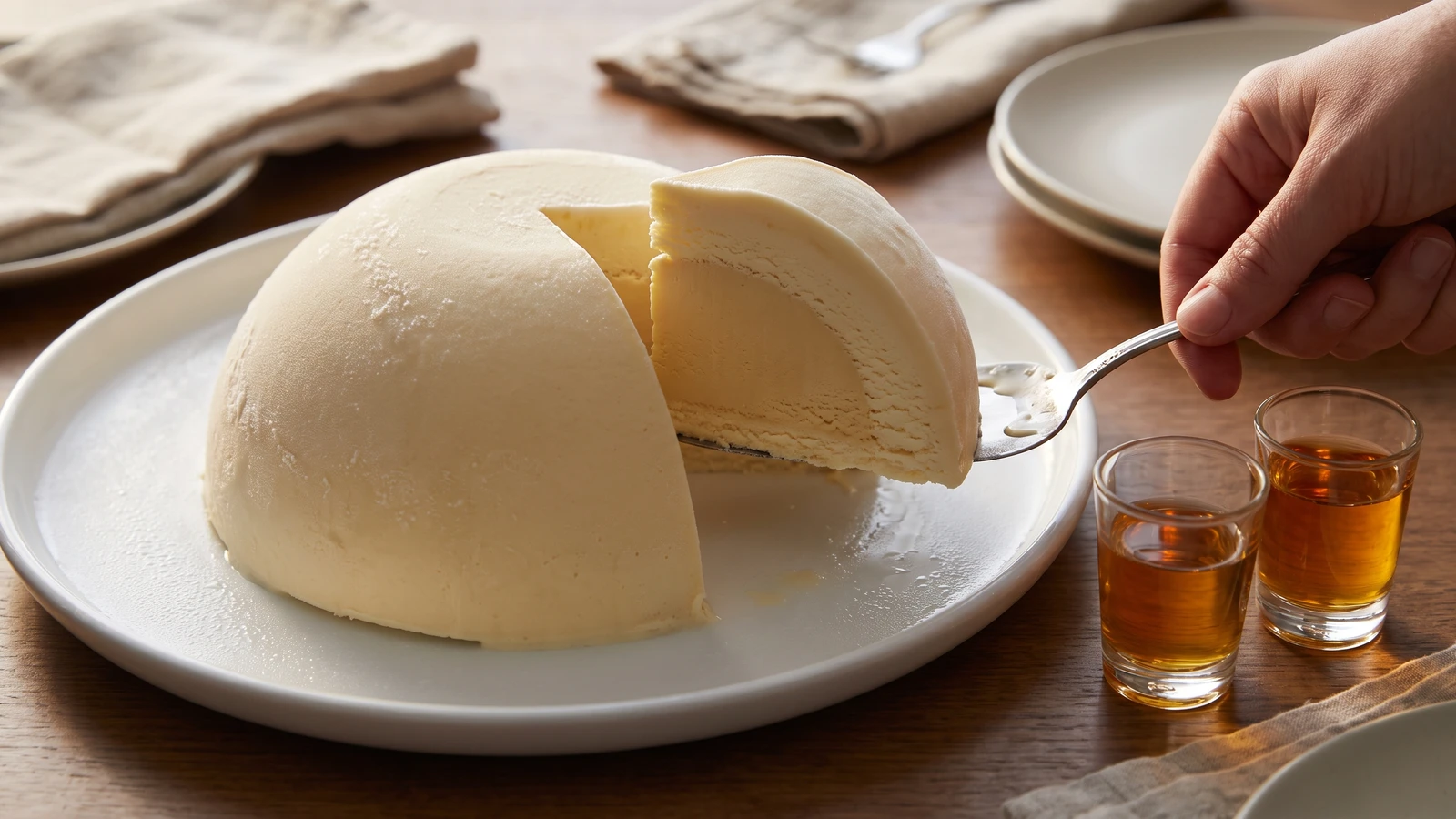
Vanilla ice cream forms the pale shell around a Curaçao pâte à bombe, rich with yolks and softly whipped cream. The lesson is temperature: add the liqueur only when the base is cold.
Bombe Hollandaise (vanilla ice cream around a Curaçao yolk-and-cream filling) teaches temperature before anything else. Its center is a pâte à bombe, a hot-syrup yolk emulsion lightened with whipped cream, but the Curaçao must enter only after that base is cold. Add it warm and its bitter-orange perfume escapes before the dessert reaches the freezer.
The original recipe assumed a glacier with vanilla ice cream and bombe preparations already waiting, plus a freezing cabinet built for rapid service. Your honest equivalent is good prepared vanilla ice cream, a hand mixer, a thermometer, and a deeply chilled metal bowl. Making a separate vanilla ice cream is brigade scaffolding, so it goes; clothing the mould and building the Curaçao pâte à bombe are the dish, so they stay. This version makes one dinner-party bombe for eight, manageable by one cook, one stove, one evening.
The finished bombe should cut into a pale vanilla shell surrounding a dense, satin-soft center with a clean orange fragrance. Cool the yolk base over ice until the bowl has lost every trace of warmth before the Curaçao goes in. That is the step that decides the dish.
Bombe glacée belongs to the grand Parisian repertoire of frozen entremets, where contrasting ice creams and parfait-like centers were packed into rounded moulds for the dessert table. In Bombe Hollandaise, the name points toward Curaçao and its Dutch Caribbean association, not toward sauce hollandaise or a Dutch household pudding. The construction remains entirely French: a vanilla shell clothing a rich pâte à bombe center.
Quantity
4 cups (950 ml / about 800 g)
softened only until spreadable
Quantity
6 (about 1/2 cup / 110 g)
Quantity
2/3 cup (160 ml / 135 g)
Quantity
1/4 cup (60 ml / 60 g)
Quantity
1 cup (240 ml / 240 g)
well chilled
Quantity
3 tablespoons (45 ml / about 43 g)
well chilled
Quantity
1 technique reference (No. 916), no food added
consulted only for the operation of clothing the mould
| Ingredient | Quantity |
|---|---|
| premium vanilla ice creamsoftened only until spreadable | 4 cups (950 ml / about 800 g) |
| large egg yolks | 6 (about 1/2 cup / 110 g) |
| granulated sugar | 2/3 cup (160 ml / 135 g) |
| water | 1/4 cup (60 ml / 60 g) |
| heavy creamwell chilled | 1 cup (240 ml / 240 g) |
| clear or amber Curaçao orange liqueurwell chilled | 3 tablespoons (45 ml / about 43 g) |
| Another Method of Preparing Aspics de Filets de Solesconsulted only for the operation of clothing the mould | 1 technique reference (No. 916), no food added |
Set a 1.5-liter metal bombe mould or round-bottomed metal bowl in the freezer for at least 30 minutes. Chill the platter for unmoulding as well. A cold mould catches the softened ice cream quickly, which gives you an even shell instead of a puddle creeping toward the bottom.
Soften about three-quarters of the vanilla ice cream until a spatula passes through it but the edges remain firm. The book names this operation through Another Method of Preparing Aspics de Filets de Soles (No. 916): clothing the mould means covering its interior with an even layer. Only that technique crosses into this dessert, no aspic or sole. Press the ice cream about 1.25 cm thick over the bottom and sides, working quickly and closing every thin patch. Freeze for 45 minutes, and return the remaining ice cream to the freezer for the final cap.
Whip the cold cream until it forms soft peaks that bend when the whisk lifts. Keep it supple, not stiff, because it must fold through the pâte à bombe without knocking out its volume. Refrigerate it while you cook the sugar.
Put the sugar and water in a small heavy saucepan. Warm gently until the sugar dissolves, then boil without stirring until the syrup reaches 118°C (244°F), the soft-ball stage. If crystals form around the edge, cover the pan for 30 seconds so condensation washes them down. If the whole syrup turns grainy, add 1 tablespoon of water, dissolve it over low heat, and begin the boil again. Ça se rattrape.
While the syrup finishes, beat the yolks in a heatproof bowl until pale and slightly thickened. Keep the mixer running at medium speed and pour the hot syrup in a thin stream down the side of the bowl, between the beaters and the bowl wall. Never pour directly onto the moving beaters, which fling sugar into hard threads. Increase the speed and beat for 6 to 8 minutes, until the pâte à bombe is voluminous, holds a broad ribbon, and has lost most of its heat.
Set the bowl over ice and continue beating until the base feels cool, not merely lukewarm, and the bowl no longer carries heat against your palm. Fold in the chilled Curaçao only now, then fold in the whipped cream in three additions, turning from the bottom until no white streaks remain. If the liqueur went into a warm base, cool it completely and fold in 1 teaspoon of fresh Curaçao to restore the perfume, no more or the center may refuse to firm.
Spoon the Curaçao pâte à bombe into the frozen vanilla shell, pressing gently so no large air pockets remain, and stop about 1.25 cm below the rim. Soften the reserved vanilla ice cream just enough to spread, then cover the filling completely and level it with the rim. Cover tightly and freeze on a level shelf for at least 8 hours, preferably overnight.
Dip the outside of the mould in warm water for 5 to 8 seconds, wipe it dry, place the chilled platter over it, and invert decisively. If the bombe holds fast, wrap the mould briefly in a warm towel rather than soaking it again. Return the unmoulded bombe to the freezer for 15 minutes if its surface has softened. Cut with a thin knife dipped in hot water and wiped dry between slices. À table!
1 serving (about 170g)
Culinary guides, cultural storytelling, and the editorial depth that makes cooking meaningful.
Discover Culinary ExplorerChef Juliette
Five almond preparations, one discipline: remove the skins cleanly, dry every kernel through, then cut, toast, or cloak it in pale caramel without letting its fragrant oils escape.

Chef Juliette
A pastry pantry lesson in one tray: filberts warmed only until their red skins release, rubbed clean, cooled, and chopped into a fragrant mise-en-place for cakes, creams, pralines, and petits fours.

Chef Juliette
The smallest pâtisserie discipline decides whether a cake leaves its mould intact: clarified butter in every corner, followed by the lightest veil of dry flour or fécule.

Chef Juliette
Four whites, one spotless bowl, and a patient change of speed: whisk gently until loosened, then briskly to glossy stiffness, with powdered sugar waiting if the foam begins to granulate.