
Chef Juliette
Various Almond Preparations
Five almond preparations, one discipline: remove the skins cleanly, dry every kernel through, then cut, toast, or cloak it in pale caramel without letting its fragrant oils escape.
A cooking platform built around craft, culture, and the stories behind what we eat.
Created by Chef Juliette
Based on No. 2860, Bombe Gismonda, from Le Guide Culinaire (1907) by Auguste Escoffier
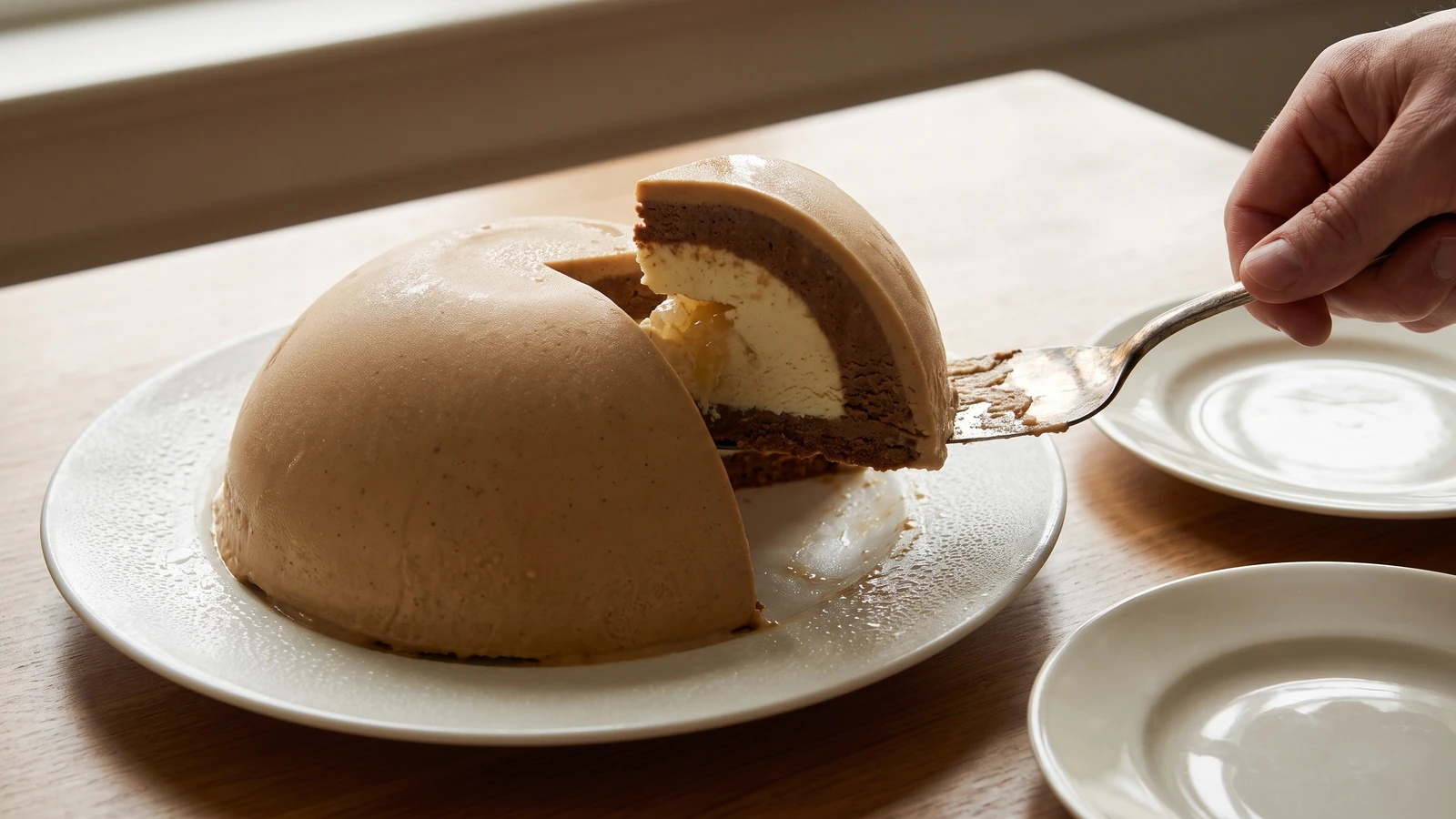
Bombe Gismonda cuts in clean rings: praline ice outside, airy anisette pâte à bombe within, and pale Bar-le-Duc currant preserve left in bright veins through the centre.
Bombe Gismonda (a praline-lined anisette frozen bombe) teaches the discipline of leaving well enough alone. White-currant jam must run through the filling in distinct veins. Stir it smooth and the flavour remains, but the dish loses the contrast that makes each slice unmistakably Gismonda.
The book assumes a pâtissier with prepared tubs of glace pralinée (praline ice), Anisette Bombe-preparation, ranked copper molds, and a freezing cabinet ready for service. This home formula fits one 1.5 litre bowl, makes each component in a manageable batch, and replaces packed ice with a small churn and an ordinary freezer. One cook, one stove, one evening of work, then the freezer keeps watch.
The decorative copper mold and the brigade's separate production schedule are scaffolding and can go. The firm pralined shell, the airy pâte à bombe (hot-syrup egg-yolk foam), the anisette, and the Bar-le-Duc preserve are the dish and must stay. Cut it cold and the shell is tawny and nutty around an ivory centre streaked with translucent currant; when the jam goes in, stop after two broad folds.
Bombe Gismonda belongs to the Parisian grand-kitchen repertoire of molded ices, a family of desserts named for stage heroines; Gismonda is the heroine, not a region. Its white-currant preserve comes from Bar-le-Duc in Lorraine, where translucent currants were traditionally deseeded by hand with a goose quill before entering the capital's pâtisserie work. The source's fish-aspic cross-reference is not an ingredient: it points only to the shared act of clothing a mold with an even outer layer.
Quantity
⅔ cup (160 ml / 75 g)
for the pralin
Quantity
⅓ cup plus 1 tablespoon (95 ml / 75 g)
for the pralin
Quantity
2 tablespoons (30 ml / 30 g)
for the pralin
Quantity
1¼ cups (300 ml / 305 g)
for the glace pralinée
Quantity
1 cup (240 ml / 240 g)
for the glace pralinée
Quantity
4
for the glace pralinée
Quantity
¼ cup (60 ml / 50 g)
for the glace pralinée
Quantity
1 small pinch
Quantity
4
for the pâte à bombe
Quantity
½ cup (120 ml / 100 g)
for the pâte à bombe
Quantity
3 tablespoons (45 ml / 45 g)
for the pâte à bombe
Quantity
3 tablespoons (45 ml / 45 g)
Quantity
1¼ cups (300 ml / 300 g)
Quantity
½ cup (120 ml / 150 g)
| Ingredient | Quantity |
|---|---|
| whole blanched almondsfor the pralin | ⅔ cup (160 ml / 75 g) |
| granulated sugarfor the pralin | ⅓ cup plus 1 tablespoon (95 ml / 75 g) |
| waterfor the pralin | 2 tablespoons (30 ml / 30 g) |
| whole milkfor the glace pralinée | 1¼ cups (300 ml / 305 g) |
| heavy creamfor the glace pralinée | 1 cup (240 ml / 240 g) |
| large egg yolksfor the glace pralinée | 4 |
| granulated sugarfor the glace pralinée | ¼ cup (60 ml / 50 g) |
| fine sea salt | 1 small pinch |
| large egg yolksfor the pâte à bombe | 4 |
| granulated sugarfor the pâte à bombe | ½ cup (120 ml / 100 g) |
| waterfor the pâte à bombe | 3 tablespoons (45 ml / 45 g) |
| clear anisette liqueur | 3 tablespoons (45 ml / 45 g) |
| cold heavy cream | 1¼ cups (300 ml / 300 g) |
| white-currant jam from Bar-le-Duc | ½ cup (120 ml / 150 g) |
Toast the almonds in a dry pan over medium heat until fragrant and pale gold, then keep them warm. Combine the first measure of sugar and water in a small heavy saucepan, dissolve the sugar over gentle heat, and cook without stirring until the caramel reaches a clear chestnut colour. Stir in the warm almonds, immediately spread the mixture on parchment or a silicone mat, and leave it until completely cold. If crystals gather around the pan edge, cover the pan for 30 seconds so condensation washes them down, then continue. Ça se rattrape. Break the cold praline into pieces and process it to a fine, slightly oily meal.
Bring the milk and first measure of cream just below a simmer. Whisk the first 4 yolks with the second measure of sugar until smooth, then temper them with a ladleful of hot dairy. Return everything to the saucepan and cook over gentle heat, stirring constantly, until the crème anglaise coats the spoon and reaches 82 to 84°C. Do not let it boil. If it turns slightly grainy, take it off the heat at once, blend briefly, and strain it over an ice bath; a fully scrambled custard must be remade. Whisk in the ground pralin and salt, cool rapidly over ice, then chill until thoroughly cold.
Churn the cold praline custard according to the machine's instructions until it holds the soft, close texture of freshly churned ice cream. It must be spreadable but not runny. Transfer about ¾ cup (180 ml) to a shallow covered container for the final cap and keep it frozen.
Chill a 1.5 litre metal bombe mold or freezer-safe stainless-steel bowl until very cold. The book points to Another Method of Preparing Aspics de Filets de Soles (No. 916) for the coating action it calls clothing the mould: press the remaining soft glace pralinée evenly over the bottom and sides in a layer about 1.25 cm thick, leaving a clean hollow at the centre. A cold bowl replaces the broken-ice bed used for jelly, while an offset spatula replaces repeated rocking. Freeze the shell for 45 to 60 minutes, until hard enough that a fingertip leaves no mark.
Place the remaining 4 yolks in the mixer bowl. Combine the third measure of sugar and water in a clean saucepan and cook to 118°C. Begin whisking the yolks at medium speed, then pour the syrup in a thin stream down the side of the bowl, never onto the moving whisk. Increase the speed and whisk until the pâte à bombe has tripled in volume, holds a thick ribbon, and feels barely warm. Drizzle in the anisette on low speed. If the foam loosens, chill it for 10 minutes before folding; the measured alcohol softens the mixture but should not collapse it.
Reserve 2 tablespoons of the cold cream, then whip the rest to soft peaks. Fold one-third into the pâte à bombe to lighten it, followed by the remainder in two additions, turning the bowl and cutting cleanly through the centre. If the cream goes slightly grainy from overwhipping, fold in the reserved liquid cream before combining it with the yolk foam. Stop as soon as no white streaks remain.
Reserve 2 tablespoons of the Bar-le-Duc jam. Stir the remainder only enough to make it spoonable, keeping the currants intact, then place it over the anisette filling in four loose dollops. Give the mixture two broad folds. Stop. The jam should remain in visible ribbons, not tint the filling evenly. If you go one fold too far, add the reserved jam in streaks and make one final pass through the bowl; that restores the veins.
Spoon the veined filling into the hard praline shell, working gently so the currant ribbons remain distinct. Press the filling into the curve without smearing the shell, tap the mold once against a folded towel to settle any large air pockets, and level the surface. Let the reserved glace pralinée soften just until spreadable, then seal the top with an even cap. Cover closely and freeze for at least 6 hours, preferably overnight.
Chill the serving plate. Dip the mold in lukewarm water for 5 seconds, dry it, and invert it onto the plate. If it clings, wrap the mold briefly in a warm damp towel rather than soaking it again. Return a softened bombe to the freezer for 20 minutes before slicing. Let it stand for 5 minutes, then cut with a knife dipped in hot water and wiped dry between slices. Each wedge should show a firm tawny shell, an airy ivory centre, and loose pale currant veins. À table!
1 serving (about 185g)
Culinary guides, cultural storytelling, and the editorial depth that makes cooking meaningful.
Discover Culinary ExplorerChef Juliette
Five almond preparations, one discipline: remove the skins cleanly, dry every kernel through, then cut, toast, or cloak it in pale caramel without letting its fragrant oils escape.

Chef Juliette
A pastry pantry lesson in one tray: filberts warmed only until their red skins release, rubbed clean, cooled, and chopped into a fragrant mise-en-place for cakes, creams, pralines, and petits fours.

Chef Juliette
The smallest pâtisserie discipline decides whether a cake leaves its mould intact: clarified butter in every corner, followed by the lightest veil of dry flour or fécule.

Chef Juliette
Four whites, one spotless bowl, and a patient change of speed: whisk gently until loosened, then briskly to glossy stiffness, with powdered sugar waiting if the foam begins to granulate.